PDF(9611 KB)

Directed Preparation of 1,3-Propanediol From Glycerol Via Chemoselective Hydrogenolysis Over Bimetallic Catalyst: Active Sites, Structure-Functional Relationship and Mechanism
Man Yang, Yuxiang Jiao, Yujing Ren
Prog Chem ›› 2024, Vol. 36 ›› Issue (2) : 256-270.
PDF(9611 KB)
PDF(9611 KB)
Directed Preparation of 1,3-Propanediol From Glycerol Via Chemoselective Hydrogenolysis Over Bimetallic Catalyst: Active Sites, Structure-Functional Relationship and Mechanism
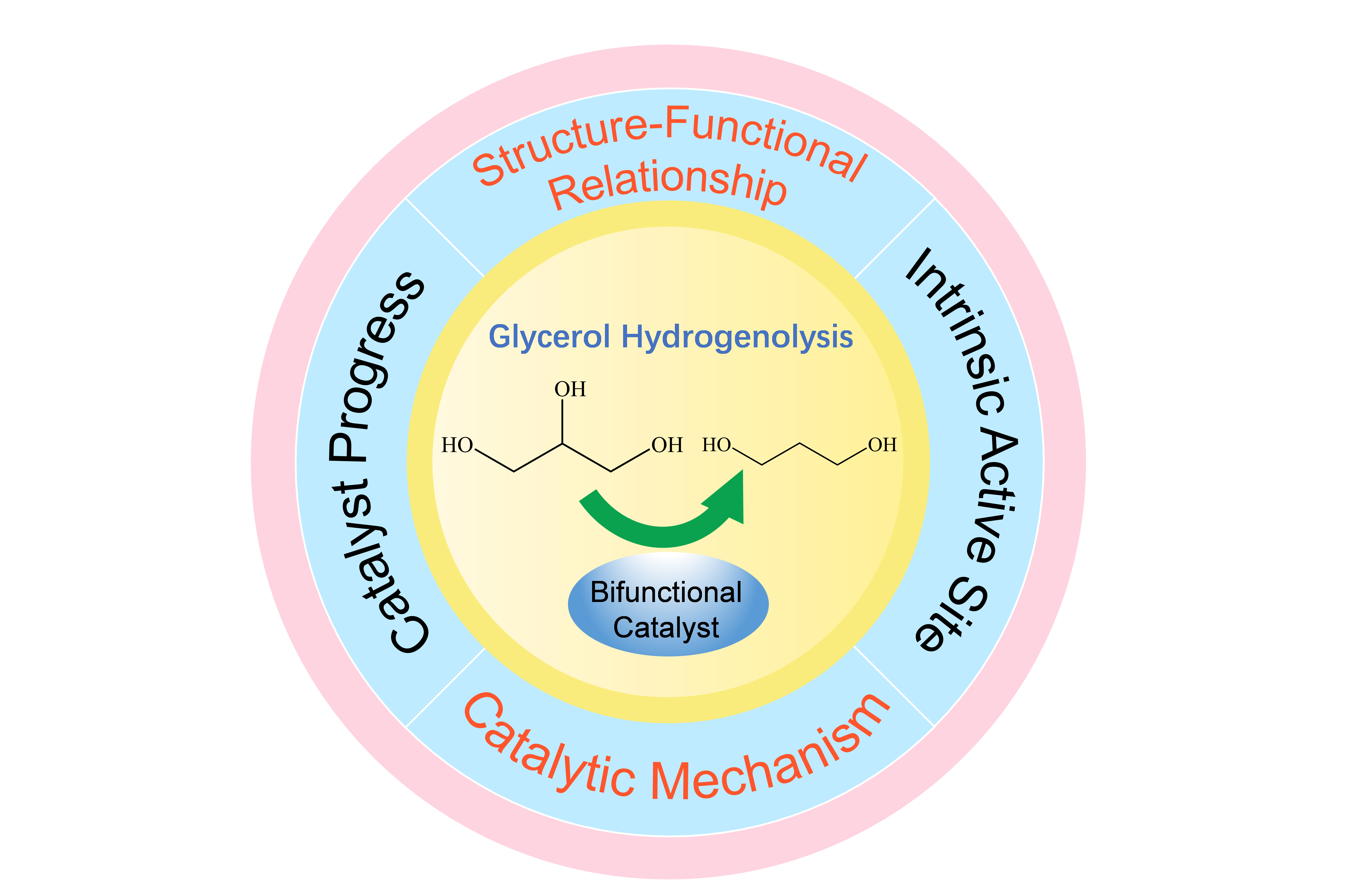
1,3-propanediol is one of the most important monomers in the polyester industry. Catalytic conversion of glycerol to 1,3-propanediol has important application value. In this article, we reviewed the research progress of bimetallic catalysts for the hydrogenolysis of glycerol to 1,3-propanediol, especially emphasizing Pt-W catalytic systems with high catalytic efficiency and great industrial application prospects. By reviewing the interaction between W species, with different microstructures and chemical environments, and Pt metal, as well as the structure-performance relationship between Pt-W dual sites and glycerol hydrogenolysis, the influence of in-situ generated Brønsted acid active species on catalytic activity, selectivity, and stability was summarized, the source of in-situ generated Brønsted acid and catalytic mechanism was discussed, and finally, the development of bimetallic catalysts for selective hydrogenolysis of glycerol to 1,3-propanediol was prospected.
Contents
1 Introduction
2 Catalyst system for selective hydrogenation of glycerol to 1,3-Propandiol
2.1 Tungsten-based catalyst
2.2 Rhenium-based catalyst
2.3 Other catalysts
3 Mechanism of selective hydrogenolysis of glycerol to 1, 3-propanediol
3.1 Dehydration-hydrogenation mechanism
3.2 Etherification-hydrogenation mechanism
3.3 Dehydrogenation-dehydration-hydrogenation mechanism
3.4 Chelation-hydrogenation mechanism
3.5 Mechanism of direct hydrogenolysis
4 Conclusion and outlook
glycerol / chemoselective hydrogenolysis / 1,3-propanediol / bimetallic catalyst / catalytic mechanism
| [1] |
|
| [2] |
(樊利民, 王菊华, 裴文. 浙江化工, 2009, 40 (6): 22.)
|
| [3] |
|
| [4] |
(李烁, 李靖. 精细与专用化学品, 2022, 30(3): 12.)
|
| [5] |
|
| [6] |
|
| [7] |
|
| [8] |
|
| [9] |
|
| [10] |
|
| [11] |
|
| [12] |
|
| [13] |
|
| [14] |
陈长林, 宋敏洁, 秦丽珍. 南京工业大学学报(自然科学版), 2011, 33(1): 1.)
|
| [15] |
|
| [16] |
(龚磊峰, 吕元, 丁云杰, 林荣和, 李经伟, 董文达, 王涛, 陈维苗. 催化学报, 2009, 30(12): 1189.)
|
| [17] |
|
| [18] |
|
| [19] |
|
| [20] |
|
| [21] |
|
| [22] |
|
| [23] |
|
| [24] |
|
| [25] |
|
| [26] |
|
| [27] |
|
| [28] |
|
| [29] |
|
| [30] |
|
| [31] |
|
| [32] |
|
| [33] |
|
| [34] |
|
| [35] |
|
| [36] |
|
| [37] |
|
| [38] |
|
| [39] |
|
| [40] |
|
| [41] |
|
| [42] |
|
| [43] |
|
| [44] |
|
| [45] |
|
| [46] |
|
| [47] |
|
| [48] |
|
| [49] |
|
| [50] |
|
| [51] |
|
| [52] |
|
| [53] |
|
| [54] |
|
| [55] |
|
| [56] |
|
| [57] |
|
| [58] |
|
| [59] |
|
| [60] |
|
| [61] |
|
| [62] |
|
| [63] |
|
| [64] |
|
| [65] |
|
| [66] |
|
| [67] |
|
| [68] |
|
| [69] |
|
| [70] |
|
| [71] |
|
| [72] |
|
| [73] |
|
| [74] |
|
| [75] |
|
| [76] |
|
| [77] |
|
| [78] |
|
| [79] |
|
| [80] |
|
| [81] |
|
| [82] |
|
| [83] |
|
| [84] |
|
/
| 〈 |
|
〉 |