 PDF(1198 KB)

The clinical analysis of 18 cases with early on-set Alzheimer's disease
XUChun-yan, QIUGuo-zhen, GUOQi-wen, WUKai-yu, CHENChun-chun, LIMing-kun, MENGXue-ya, ZHUFei-qi
Chinese Journal of Alzheimer's Disease and Related Disorders ›› 2021, Vol. 4 ›› Issue (2) : 110-115.
PDF(1198 KB)


Abbreviation (ISO4): Chinese Journal of Alzheimer's Disease and Related Disorders
Editor in chief: Jun WANG
PDF(1198 KB)
The clinical analysis of 18 cases with early on-set Alzheimer's disease
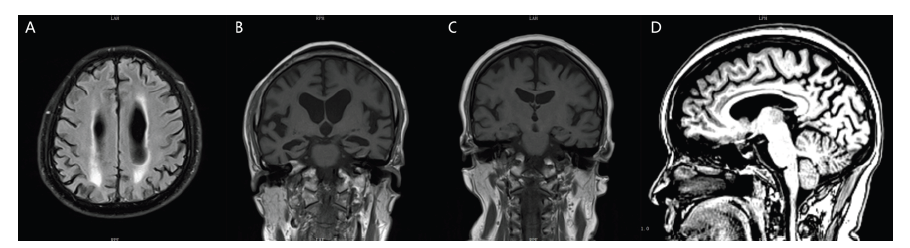
Objective: To explore the clinical characteristics of early on-set Alzheimer's disease (AD), improving the understanding of the diagnosis and treatment of the disease. Methods: This was a case-retrospective study on the data of clinical manifestations, neuropsychology, dynamic EEG and structural MRI of 18 early on-set AD patients who were proved with cerebral spinal fluid AD biomarkers. Results: The average age of 18 patients(6 males,12 females) with AD was 55.4 years old, and the average course of the disease was 5.6 years.17 patients suffered memory loss as initiate symptom, and 9 patients had family histories of dementia. The average score of MMSE was 14.3, and there existed 12 patients with moderate and severe dementia. Among 13 patients who accomplished gene whole-exon sequencing, we found 3 cases with PSEN1 mutations, 4 cases with SORL1 mutations, 1 case with ABCD7. At the same time, the carrying frequency of APOE gene ε2, ε3, ε4 in 18 patients was 1/36, 27/36 and 9/36, respectively. All 13 cases who accepted dynamic EEG testing showed abnormal EEGs with epileptiform discharge. The hippocampus atrophy of 8 patients was not significant. Conclusion: The clinical characteristics of the early on-set AD were hidden onset but developed fast. At the time of treatment, it has often been developed into severe dementia, with decline memory as initiate symptom and most patients have family history of dementia. Epilepsy discharge of EGG were detected more commonly in these patients, whose carrying rates of AD causing genes and AD risk genes were also higher than normal ones. And some cases had less hippocampus atrophy.
Early onset Alzheimer's disease / Gene Detection / Electroencephalogram / Structural MRI
| [1] |
|
| [2] |
|
| [3] |
|
| [4] |
王刚. 痴呆与认知障碍神经心理测评量表手册[M]. 北京: 科学出版社, 39.
|
| [5] |
|
| [6] |
|
| [7] |
|
| [8] |
|
| [9] |
|
| [10] |
|
| [11] |
The SORL1 protein plays a protective role against the secretion of the amyloid β peptide, a key event in the pathogeny of Alzheimer's disease. We assessed the impact of SORL1 rare variants in early-onset Alzheimer's disease (EOAD) in a case-control setting. We conducted a whole exome analysis among 484 French EOAD patients and 498 ethnically matched controls. After collapsing rare variants (minor allele frequency ≤1%), we detected an enrichment of disruptive and predicted damaging missense SORL1 variants in cases (odds radio (OR)=5.03, 95% confidence interval (CI)=(2.02-14.99), P=7.49.10(-5)). This enrichment was even stronger when restricting the analysis to the 205 cases with a positive family history (OR=8.86, 95% CI=(3.35-27.31), P=3.82.10(-7)). We conclude that predicted damaging rare SORL1 variants are a strong risk factor for EOAD and that the association signal is mainly driven by cases with positive family history.
|
| [12] |
Alzheimer's disease (AD) represents one of the most dramatic threats to healthy aging and devising effective treatments for this devastating condition remains a major challenge in biomedical research. Much has been learned about the molecular concepts that govern proteolytic processing of the amyloid precursor protein to amyloid-β peptides (Aβ), and how accelerated accumulation of neurotoxic Aβ peptides underlies neuronal cell death in rare familial but also common sporadic forms of this disease. Out of a plethora of proposed modulators of amyloidogenic processing, one protein emerged as a key factor in AD pathology, a neuronal sorting receptor termed SORLA. Independent approaches using human genetics, clinical pathology, or exploratory studies in animal models all converge on this receptor that is now considered a central player in AD-related processes by many. This review will provide a comprehensive overview of the evidence implicating SORLA-mediated protein sorting in neurodegenerative processes, and how receptor gene variants in the human population impair functional receptor expression in sporadic but possibly also in autosomal-dominant forms of AD.
|
| [13] |
|
| [14] |
|
| [15] |
|
| [16] |
|
| [17] |
|
| [18] |
|
/
| 〈 |
|
〉 |






