Home Journals Chinese Journal of Alzheimer's Disease and Related Disorders
Chinese Journal of Alzheimer's Disease and Related Disorders

Abbreviation (ISO4): Chinese Journal of Alzheimer's Disease and Related Disorders      Editor in chief: Jun WANG

About  /  Aim & scope  /  Editorial board  /  Indexed  /  Contact  / 

Astaxanthin Modulates Oxidative Stress in Primary Microglia Mediated by Lipopolysaccharide

  • GUAN Xue 1 ,
  • GUO Ling , 2, 3
Expand
  • 1 Dali University, School of Clinical Medicine, Dali, Yunnan 671000, China
  • 2 The Fourth People's Hospital of Kunming, Anning, Yunnan 650302, China
  • 3 The Seventh Affiliated Hospital of Dali University, Anning, Yunnan 650302, China

Received date: 2020-12-25

  Revised date: 2021-01-06

  Online published: 2021-03-25

Abstract

Objective:

The increased production of Inducible Nitric Oxide Synthase (iNOS), one of the pathogenesis components of Alzheimer's disease and other neurodegenerative diseases, could be detected as one of endpoints in the oxidative-stress responses caused by the activation of primary microglia. Our aim was to explore the anti-oxidative effect of Astaxanthin (AST) on the primary microglia, derived from neonatal rats of Sprague Dawley(SD), mediated by Lipopolysaccharide (LPS).

Methods:

First, primary microglia were isolated from primary mixed glia by Shake-off method, and stimulated by LPS. The primary microglia were identified through immunofluorescence while iNOS was measured by Western Blotting analysis. Secondly, this model was used to preliminarily explore the action of AST in the activated primary microglia induced by LPS.

Results:

Primary microglial cultures were confirmed using a specific CD11b antibody. iNOS was upregulated in the cells induced by LPS. The upregulation of iNOS was significantly different to that in the control (P<0.05), which suggested that the activated microglial model with oxidative stress be successfully established. Furthermore, 12.5, 25 or 50μg/ml of AST were pre-treated to the microglia for 24h before the application of LPS, which led to iNOS down-regulation at 12h, 24h or 36h, and the significant difference in the latter by comparing to that in LPS alone (P<0.05).

Conclusion:

LPS led to the oxidative stress like iNOS upregulation in rat primary microglia. AST could down-regulated the oxidative stress such as iNOS in the microglia induced by LPS. This study suggested that AST can be with an antioxidative effect on the microglial activation in Alzheimer's disease and other neurodegenerative diseases. It may potentially be a valuable drug candidate in the clinics.

Cite this article

GUAN Xue , GUO Ling . Astaxanthin Modulates Oxidative Stress in Primary Microglia Mediated by Lipopolysaccharide[J]. Chinese Journal of Alzheimer's Disease and Related Disorders, 2021 , 4(1) : 21 -27 . DOI: 10.3969/j.issn.2096-5516.2021.01.003

迄今为止,对于阿尔茨海默病(Alzheimer’s disease, AD)的研究已有115年,不乏AD发病机理及其新药研发。众所周知,针对清除β-淀粉肽(β-amyloid peptide, Aβ)在大脑皮层形成老年斑的药物临床试验相继失败[1-3];唯一可抑制Tau蛋白聚集的药物亚甲蓝[2,3],其纯化物在Ⅱ期临床试验也被终 止[3],因此,不断探索AD发病新机制,以便进行针对性的药物研发,是当前神经科学研究的重点。近二十年来,AD研究有了新的方向和突破,越来越多的研究证据表明AD患者大脑受到氧化应激反应的影响,一氧化氮合酶、一氧化氮(nitric oxide, NO)、活性氧簇(reactive oxygen species, ROS)或活性氮簇(reactive nitrogen species, RNS)等分子的上调[4,5],参与了AD、帕金森氏病(Parkinson’s disease, PD)或其他慢性病的发病机理[5,6]。其中,小胶质细胞作为中枢神经系统固有免疫细胞[7],遇外源性病原体或有害物质如LPS刺激激活时,产生氧化应激反应[8,9]或分泌大量促炎因子引起脑组织损伤[9,10],成为AD及其他神经变性疾病的发病机理之一。在针对AD的抗氧化应激反应候选化合物(candidate compounds)研究中,美国西北大学医学院化学家DM Watterson研究团队自2000年起至今致力于研究合成小分子化合物(分子量小于600),并在LPS或Aβ介导胶质细胞激活所致神经炎症或以iNOS上调为特征的氧化应激反应抑制剂研究上有新的发现和突破,获得了美国专利并发表了一系列具有影响力的论著[11,12]。近年来随着对抗氧化剂研究关注度提高,天然药物中强抗氧化剂虾青素,具有小分子(分子量596.86)特点且有可进入血脑屏障的优势[13],抗氧化作用是β-胡萝卜素10倍、维生素E的550倍[14],但是,其是否具针对激活的原代小胶质细胞下调氧化应激产物iNOS的作用未见报道。本研究针对这个空白,假设海洋生物红球藻类提取物AST可能是针对下调AD等神经变性疾病中氧化应激反应产物iNOS良好的候选药物。因此,本研究以我们前期建立的LPS介导原代小胶质细胞激活模型为基础,从时-效和量-效关系上阐述AST干预原代小胶质细胞激活后iNOS的表达。

1 材料及方法

1.1 材料

1.1.1 实验使用的动物

SPF级SD大鼠,雌雄不限,由昆明医科大学动物中心提供,实验动物饲养条件:恒温22℃,恒湿55%,喂予清洁级实验鼠饲料,光照阴暗各12h。使用8周后性成熟成年鼠交配产仔,原代混合胶质细胞培养,使用2~3d龄乳鼠。

1.1.2 主要的实验用药、试剂

本研究使用虾青素(美国Sigma,50mg/支)、脂多糖(美国Sigma,25mg/支)、α-MEM(以色列BI,500ml/瓶)、FBS(美国Gemini,500ml/瓶)、青链霉素(美国Millipore,100ml/瓶)、0.25%胰蛋白酶(美国Millipore,100ml/瓶)、PBS(美国Gibco,500ml/瓶)、POLY-D-LYSINE(美国Sigma,5mg/支)、BCA试剂盒(中国碧云天,25ml/瓶)、Anti-β-Actin antibody, Mouse monoclonal(美国Sigma,200μl/支)、Anti-iNOS抗体(英国abcam,500μl/支)、重组Anti-CD11b抗体(英国abcam,100μl/支)、辣根过氧化物酶标记山羊抗小鼠IgG(H+L)(中国碧云天,1ml/支)、辣根过氧化物酶标记山羊抗兔IgG(H+L)(中国碧云天,1ml/支)、Goat Anti-Rabbit IgG antibody(美国Gene Tex,1ml/支)等,按照说明书指导配制各相关的工作液体进行实验。

1.2 方法

1.2.1 原代小胶质细胞培养

根据前期研究中的方法[8]进行细胞培养。取新生2~3d龄SD大鼠乳鼠,麻醉,断头,把大脑皮层切 碎后加入0.25%胰酶消化25min,加入等量α-MEM(10%FBS+1%P/S)培养基终止消化,轻轻吹打成为细胞悬液,分别使用100μm和40μm细胞筛过滤共两次;离心,弃上清,加入培养基悬浮细胞并混匀,接种到T75培养瓶中,37℃、5%CO2培养箱中培养10d后,当混合胶质细胞融合,通过Shake-off法分离小胶质细胞,收集细胞悬液后离心,弃上清,用细胞培养液重悬,细胞计数,获得2.5x105cells/ml细胞悬液,以1.25x105/well接种至24-well细胞培养板,于37℃、5%CO2培养箱中静置30min,更换α-MEM (10%FBS + 1%P/S + 2.5ng/ml M-CSF)后,继续37℃、5%CO2培养箱中孵育24 h即可开展实验。

1.2.2 原代小胶质细胞鉴定

将原代小胶质细胞接种到经多聚赖氨酸包被的细胞培养爬片上,接种密度为7x10⁴cells/ml的细胞悬液100µl到爬片上,经37 ℃、5%CO2培养箱中孵育生长2~3d,进行免疫荧光染色。主要操作过程:0.01M PBS洗3次,3min/次;4%多聚甲醛室温固定20min,0.01M PBS洗3次,3min/次;1%Triton-100透膜30 min;0.01M PBS洗3次,3min/次;1%BSA室温封闭1h;一抗:CD11b抗体与小胶质细胞在室温下孵育2h,0.01M PBS洗3次,3min/次;二抗:Goat Anti-Rabbit IgG antibody与小胶质细胞在室温避光孵育1h;DAPI染细胞核室温避光孵育20min;抗荧光猝灭剂封片,室温晾干,4℃保存,荧光显微镜下观察及拍照原代小胶质细胞。

1.2.3 分组实验

(1)对照组:使用与LPS等量的PBS;在37℃、5%CO2培养箱中,孵育12h、24h或36h。
(2)LPS组:LPS 100ng/mL;在37 ℃、5%CO2培养箱中,将原代小胶质细胞与LPS孵育12h、24h或36h。
(3)用药组:LPS+AST组;据AST不同用量(12.5、25或50μg/ml)分别给予原代小胶质细胞AST预处理24h后,再加入100ng/ml的LPS;在37℃5%CO2培养箱中孵育12h、24h或36h。

1.2.4 Western Blotting Analysis

实验结束时,仔细吸去细胞上清液后,使用RIPA(碧云天)裂解液裂解细胞,提取细胞总蛋白,用BCA试剂盒检测蛋白浓度,确定上样量。制备5%和10%SDS-PAGE胶并按顺序进行电泳、转膜、1%BSA封闭1h,一抗选用iNOS抗体(1:100稀释)、β-actin抗体(1:2500稀释)4℃下孵育过夜;次日用TBST溶液洗膜3次(15min/次)后,室温下孵育与一抗对应的二抗1.5h,再用TBST溶液洗膜3次(15min/次);使用ECL显影,用Bio-Rad ChemiDoc MP成像系统获得结果。

1.3 统计学处理

按照统计学原理,实验所得数据用SPSS.20统计分析软件处理,所有数据采用均数±标准误(mean± SEM)表示。两两比较时采用t检验;组间比较用单因素方差分析(one-way ANOVA);P<0.05表示差异有显著性;图像处理采用GraphPad Prism 7和Image J软件进行处理。

2 实验结果

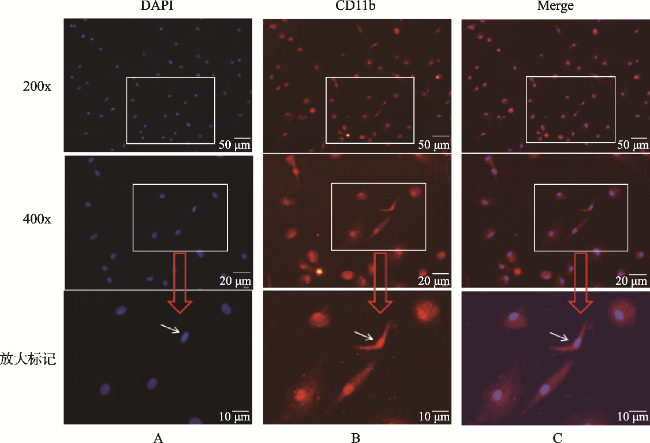
2.1 原代小胶质细胞形态学及鉴定 见图1。

2.2 建立LPS介导SD大鼠乳鼠大脑皮层原代小胶质细胞氧化应激反应的细胞模型

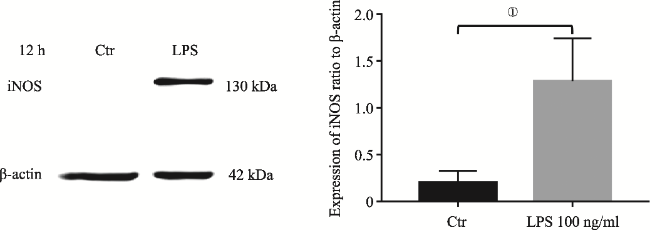
2.2.1 LPS介导原代小胶质细胞激活12h后iNOS上调

图2

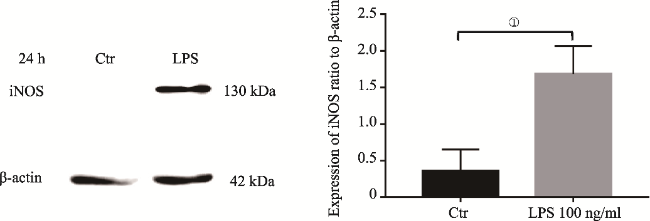
2.2.2 LPS介导原代小胶质细胞激活24h后iNOS上调

图3

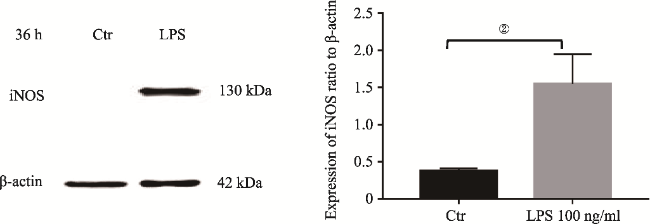
2.2.3 LPS介导原代小胶质细胞激活36h后iNOS上调

图4
图1 原代小胶质细胞免疫荧光染色的鉴定(×200、×400)

Fig.1 Identification of primary microglia cells(×200、×400)

Note: Resting primary microglia derived from the cortex of neonatal rat pups showed round, fusiform or triangular shapes with bodies in red and round nuclei in blue by immunofluorescent staining. A. DAPI showed the cell nucleus in blue. B. Using CD11b antibody for immunofluorescent staining to identify the primary microglia. CD11b antibody labeled in red could combine with the protein as the antigen in the cellular fluid of the microglia so the primary microglia showed in red. C. The whole microglia were showed in red through merging Fig.1 A and B. The purity of the primary microglia reached the range of 97.13-100% among all experiments, and the average was at 98.6% via counting five views each slide with immunofluorescent staining under microscope. The value of purity was from the formula of Merge/DAPI.

图2 LPS介导SD大鼠原代小胶质细胞12h iNOS表达

Fig.2 iNOS upregulation in primary microglia induced by LPS at 12h

Note: iNOS protein was measured by Western Blotting analysis. It showed iNOS upregulation in the primary microglia induced by LPS at 12h.The upregulation of iNOS was significantly different to that in the control (P<0.05, N=3).

图3 LPS介导SD大鼠原代小胶质细胞24h iNOS表达

Fig.3 iNOS upregulation in primary microglia induced by LPS at 24h

Note: iNOS protein was measured by Western Blotting analysis. It showed iNOS upregulation in the primary microglia induced by LPS at 24h.The upregulation of iNOS was significantly different to that in the control (P<0.05, N=3).

图4 LPS介导SD大鼠原代小胶质细胞36h iNOS表达

Fig.4 iNOS upregulation in primary microglia induced by LPS at 36h

Note: iNOS protein was measured by Western Blotting analysis. It showed iNOS upregulation in the primary microglia induced by LPS at 36h. The upregulation of iNOS was significantly different to that in the control (P<0.025, N=3).

Summary for Fig. 2~4, iNOS upregulation showed in the primary microglia induced by LPS at 12h, 24h or 36h, which suggested that the cellular model of oxidative stress responded to LPS be successfully established in this study.

2.3 在LPS介导氧化应激反应的原代小胶质细胞激活模型上,观察AST在细胞水平上对iNOS调控的药理学指标(Time course and Concentration course),见图5~7。

2.3.1 AST treatment 在LPS介导原代小胶质细胞激活12h的作用

图5

2.3.2 AST treatment 在LPS介导原代小胶质细胞激活24h的作用

图6

2.3.3 AST treatment 在LPS介导原代小胶质细胞激活36h的作用

图7
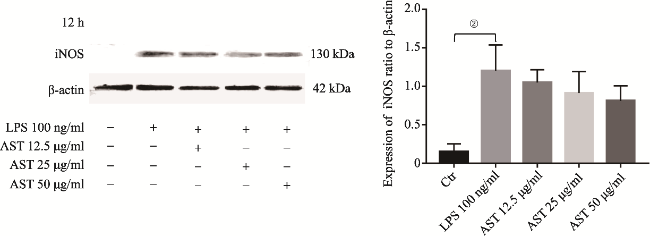
图5 AST使用12h后下调LPS介导原代小胶质细胞产生的iNOS

Fig.5 AST down-regulating the expression of iNOS in primary microglia induced by LPS at 12h

Note: 12.5, 25 or 50 μg/ml of AST were pre-treated to the microglia for 24h before the application of LPS. iNOS upregulation was showed in the cells induced by LPS alone (P<0.025, N=4), while it was showed slight down-regulation in the cells with AST co-incubation at 12h. However, the latter did not show the significant difference by comparing to that in LPS alone (P>0.05, N=4).

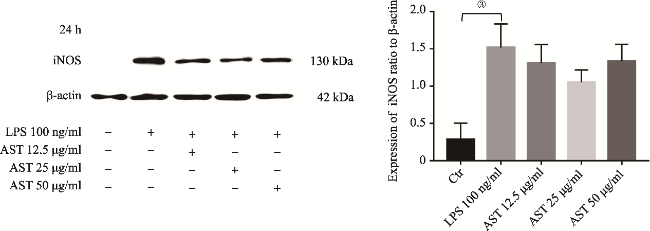
图6 AST使用24h后下调LPS介导原代小胶质细胞产生的iNOS

Fig.6 AST down-regulating the expression of iNOS in primary microglia induced by LPS at 24h

Note: 12.5, 25 or 50μg/ml of AST were pre-treated to the microglia for 24h before the application of LPS. iNOS upregulation was showed in the cells induced by LPS alone (P<0.01, N=4), while it was still showed slight down-regulation in the cells with AST co-incubation at 24h. However, the latter did not show the significant difference by comparing to that in LPS alone (P>0.05, N=4).

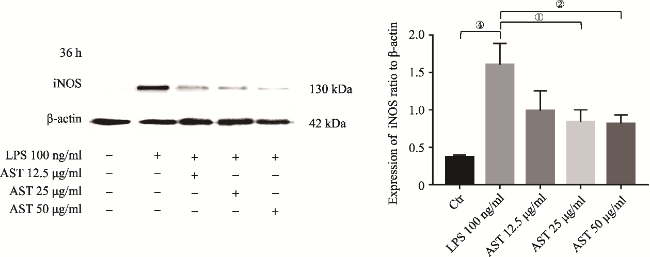
图7 AST使用36h后下调LPS介导原代小胶质细胞产生的iNOS

Fig.7 AST down-regulating the expression of iNOS in primary microglia induced by LPS at 36h

Note: 12.5, 25 or 50μg/ml of AST were pre-treated to the microglia for 24h before the application of LPS. iNOS upregulation was showed in the cells induced by LPS alone (P<0.005, N=4), while it was obviously down-regulated in the cells only by 25 or 50μg/ml of AST co-incubation at 36h. The latter two showed the significant differences by comparing to that in LPS alone (respectively P<0.05 and P<0.025, N=4).

Summary for Fig.5~7, LPS led to the oxidative stress like iNOS upregulation in rat primary microglia. AST could down-regulated iNOS in the oxidative stress response in the primary microglia sitmulated by LPS in this study. Interestingly, iNOS down-regulation was presented the congcentration-dependent or time-dependent patterns in the concentration-course or time-course expenreiments.

3 讨论

我们的前期研究结果显示,AST在LPS介导的原代神经元退行性变中可减少氧化应激产物NO、凋亡因子Caspase-3及Bax的蛋白表达[15];也已建立了LPS介导不同脑区的大脑皮层原代混合胶质细胞 或小胶质细胞氧化应激及神经炎症反应模型[11],用其成功地筛选了小分子化合物作为抗炎抗氧化候选药物[11,12,15]或开展了可能拓展依达拉奉临床应用范围的研究[8]。本研究应用这些手段首先获得原代混合胶质细胞[8,9]、再获得原代小胶质细胞[8],进而使用LPS介导原代小胶质细胞获得氧化应激反应的成功模型,其结果与对照组相比,iNOS分别在12h、24h或36h均上调(P<0.025~0.05;N=3)(见图2~4);进而以iNOS为靶标,用(12.5, 25和50μg/ml)三个不同浓度的AST预处理原代小胶质细胞24h后,使用LPS介导原代小胶质细胞产生iNOS,在AST连续共孵育12或24h中已出现浓度依赖性下调趋势,提示AST对氧化应激反应有减轻的作用趋势,但与LPS组相比,尚无差异显著性(P>0.05;N=4)(见图5~6);随着时间的推移,当共孵育36h时,12.5、25或50μg/ml的AST使原代小胶质细胞氧化应激产物iNOS明显下调,与没有AST保护的LPS组相比,后两个浓度的AST出现差异显著性(P<0.025~0.05;N=4),下调氧化应激反应产物iNOS呈现时间依赖性和浓度依赖性关系(见图7)。本研究结果,与Han Ji Hy, et al[16], Choi Seok-Keun, et al[17]报道的AST可调节小胶质细胞株BV-2细胞激活研究结果类似。提示本研究近一步证实了AST可能在神经变性疾病中针对小胶质细胞激活有抗氧化作用。
至于iNOS与NO的关系,iNOS可通过氧化还原反应催化L-精氨酸与氧分子产生NO[18],前者是酶,在前者的作用下可产生后者;后者是产物,二者在LPS诱导下产生氧化应激反应,可出现NO和iNOS一致性上调的结果,即前者产生多,则后者必然增多,反之亦然。虽然本研究由于时间限制暂未涉及NO的检测,但理论上已可推断出有二者的一致性关系。从我们的前期研究结果[8,9,15]也证明了我们的推断。因此,从本研究结果可假设,LPS同样可使原代小胶质细胞iNOS和NO同时上调,而AST可使LPS介导的iNOS或NO下调。iNOS和NO的增多与许多神经系统疾病有关,如AD的一系列氧化应激和/或炎症反应,适当调节NO对维持脑内稳态至关重要,过量的iNOS和NO会产生明显的神经毒性[15],大量的NO还可促进氧化应激进一步升级[19],而形成恶性循环,因此,临床需要及早控制iNOS的产生。
本研究的初衷是,探索或回答AST能否下调LPS介导原代小胶质细胞产生的iNOS问题。通过上述初步研究结果表明,AST可下调由LPS激活原代小胶质细胞后iNOS蛋白表达,这为后续深入研究或进一步探讨其作用机制奠定了基础,为开辟AST的临床应用提供理论和实践依据。AST是可透过血脑屏障的强抗氧化剂,能够有效的清除脑内氧化应激产物,从而达到神经保护作用,这为我们在AD等神经变性疾病的防治药物研究与开发新药中提供了新的思路和理论基础。我们初步推测,AST在临床上可能也有调节小胶质细胞过度激活的损伤和保护神经元的作用,对神经变性疾病有一定的防治作用。本研究不足之处是,由于时间等因素限制而未能同时完成NO测定,为此,我们将在今后的实验中继续完善或开展深入研究。
[1]
Cummings J, Lee G, Ritter A, et al. Alzheimer's disease drug development pipeline 2020[J]. Prev Alzheimers Dis, 2020, 7(2):66-67.

[2]
应侠, 吴振, 雷严, 等. 阿尔茨海默病的发病机制及治疗药物研究进展[J]. 中国药房, 2014, 25(33): 3152-3155.

[3]
毕丹蕾, 文朗, 熊伟, 等. 阿尔茨海默病的可能药物靶点和临床治疗研究进展[J]. 中国药理学与毒理学杂志, 2015, 29(4): 507-536.

[4]
刘军. 氧化应激在阿尔茨海默病病理发生中的作用机制与干预策略[J]. 中山大学学报(医学科学版), 2020, 41(5): 661-668.

[5]
Rekatsina M, Paladini A, Piroli A, et al. Pathophysiology and Therapeutic Perspectives of Oxidative Stress and Neurodegenerative Diseases: A Narrative Review[J]. Adv Ther, 2020, 37(1): 113-139.

[6]
Puspita L, Chung SY, Shim JW, et al. Oxidative stress and cellular pathologies in Parkinson's disease[J]. Mol Brain, 2017, 10(1): 53.

[7]
Nayak D, Roth TL, Mcgavern DB, et al. Microglia development and function[J]. Annual Review of Immunology, 2014, 32(32): 367-402.

[8]
乔廷廷, 陈忠义, 董宝莲, 等. 依达拉奉干预LPS介导原代小胶质细胞的激活实验[J]. 昆明医科大学学报, 2018, 39(4): 5-10.

[9]
陈忠义, 乔廷廷, 董宝莲, 等. LPS介导三种啮齿动物原代胶质细胞炎症氧化反应的研究[J]. 昆明医科大学学报, 2018, 39(6): 7-13.

[10]
Qin L, Wu X, Block ML, et al. Systemic LPS causes chronic neuroinflammation and progressive neurodegeneration[J]. Glia, 2010, 55(5): 453-462.

[11]
Guo L, Sawkar A, Zasadzki M, et al. Similar activation of glial cultures from different rat brain regions by neuroinflammatory stimuli and downregulation of the activation by a new class of small molecule ligands[J]. Neurobiology of Aging, 2001, 22(6): 975-981.

[12]
Watterson DM, Mirzoeva S, Guo L, et al. Ligand modulation of glial activation: cell permeable, small molecule inhibitors of serine-threonine protein kinases can block induction of interleukin 1 beta and nitric oxide synthase II[J]. Neurochem Int, 2001, 39(5-6): 459-468.

[13]
董宝莲, 郭玲. 虾青素的研究进展[J]. 中国临床药理, 2019, 35(8): 102-105.

[14]
江利华, 柳慧芳, 郝光飞, 等. 虾青素抗氧化能力研究进展[J]. 食品工业科技, 2019, 40(10): 350-354.

[15]
董宝莲, 乔廷廷, 陈忠义, 等. 建立Aβ1-42介导新生鼠原代神经元退行性变细胞模型及虾青素作用研究[J]. 阿尔茨海默病及相关病杂志, 2019, 2(2): 368-374.

[16]
Hye HJ, Sun LY, Hyung IJ, et al. Astaxanthin Ameliorates Lipopolysaccharide-Induced Neuroinflammation, Oxidative Stress and Memory Dysfunction through Inactivation of the Signal Transducer and Activator of Transcription 3 Pathway[J]. Marine drugs, 2019, 17(2): 123.

[17]
Keun CS, Sam PY, Kug CD, et al. Effects of astaxanthin on the production of NO and the expression of COX-2 and iNOS in LPS-stimulated BV2 microglial cells[J]. J Microbiology Biotechnol, 2008, 18(12): 1990-1996.

[18]
廖润玲, 杨斌. 一氧化氮及诱导型一氧化氮合酶的研究进展[J]. 时珍国医国药, 2007, (4): 980-981.

[19]
Seimetz M, Parajuli N, Pichl A, et al. Inducible NOS inhibition reverses tobacco-smoke-Induced emphysema and pulmonary hypertension in mice[J]. Cell, 2011, 147(2): 293-305.

Outlines

/