Abbreviation (ISO4): Chinese Journal of Alzheimer's Disease and Related Disorders
Editor in chief: Jun WANG
Chinese Journal of Alzheimer's Disease and Related Disorders >
Effect of cerebral microbleeds on cognitive impairment in Alzheimer's disease
Received date: 2020-09-01
Revised date: 2020-09-30
Online published: 2020-12-25
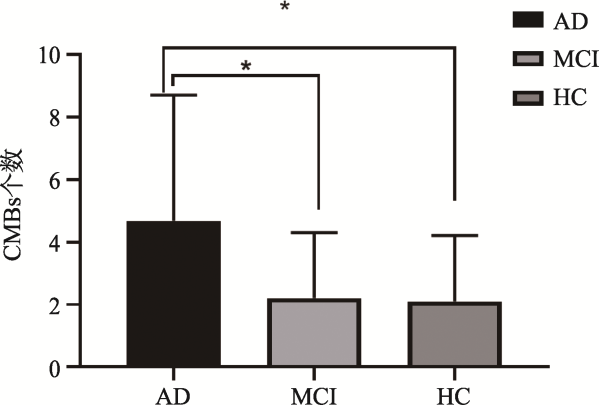
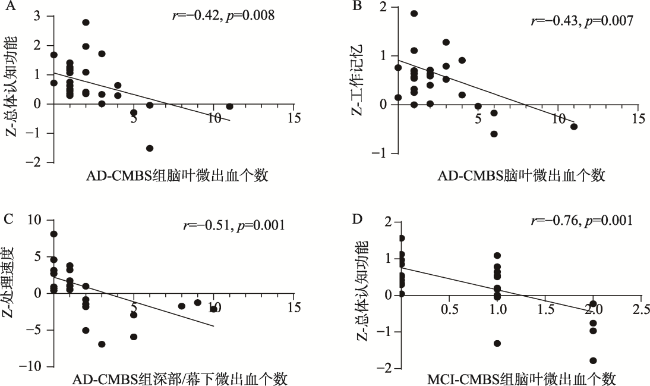
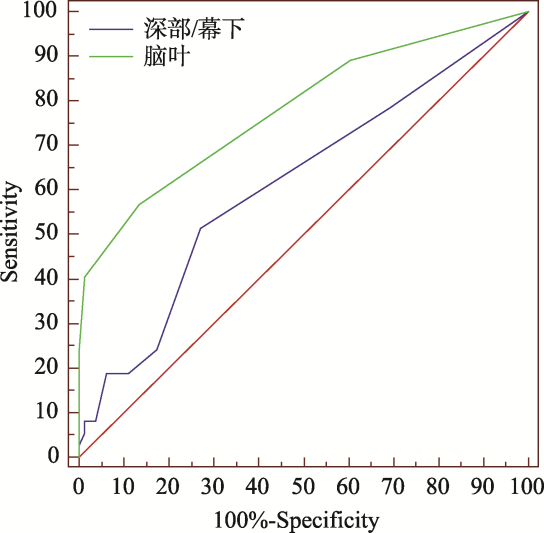
Objective: To investigate the characteristics of cerebral microbleeds in patients with Alzheimer's disease (AD) and its effect on cognitive impairment. Methods: Total 37 patients with AD-CMBs, 42 patients with mild cognitive impairment (MCI) and cerebral microbleeds (MCI-CMBs), 39 patients with normal cognitive function (NC) and cerebral microbleeds (MCI-CMBs) were recruited in this study. All subjects were underwent neuropsychological assessment and brain magnetic resonance imaging scan. The clinical characteristics, the number and location of cerebral microbleeds were compared among three groups, and the correlation between the location of microbleeds and different cognitive domains was analyzed, and the predictive value of different locations of cerebral microbleeds on AD patients was also analyzed. Results: The number of cerebral microbleeds in AD group was significantly higher than that in other two groups (P=0.001). The proportion of lobular microbleeds in AD CMBS group was significantly higher than that in other two groups (P=0.005). In addition, in AD-CMBS group, the number of lobular microbleeds was correlated with the overall cognitive function and working memory (r=-0.42, P=0.008; r=-0.43, P=0.001); the number of deep / infratentorial microbleeds in AD-CMBS group was related with the speed of information processing (r=-0.51, P=0.001) and the number of cerebral lobular microbleeds in MCI-CMBS group was correlated with overall cognitive function (r=-0.51, P=0.001). Finally, compared with deep / infratentorial microbleeds, the number of lobular microbleeds has a better predictive value for AD.Conclusion: The number of cerebral microbleeds in AD patients is significantly increased, especially the number of lobular microbleeds, which is related to the overall cognitive ability. And the lobular microbleeds might be a good marker for the recognition of AD.
SHAO Pengfei , XU Hengheng , QIN Ruomeng , MA Junyi , SHENG Xiaoning , HUANG Lili , ZHAO Hui . Effect of cerebral microbleeds on cognitive impairment in Alzheimer's disease[J]. Chinese Journal of Alzheimer's Disease and Related Disorders, 2020 , 3(4) : 277 -283 . DOI: 10.3969/j.issn.2096-5516.2020.04.004
表1 三组受试者的人口统计学和临床特征一览表 |
| 项目 | AD-CMBs组(n=37) | MCI-CMBs组(n=42) | NC-CMBs组(n=39) | P值 |
|---|---|---|---|---|
| 年龄(岁) | 61.36±8.30 | 59.12±9.41 | 56.96±7.56 | 0.045b |
| 性别(男,%) | 23(62.16) | 25(59.52) | 23(58.97) | 0.95 |
| 教育年限(年) | 9(6,9) | 6(6,9) | 9(6,9) | 0.923 |
| 高血压(例,%) | 22(59.46) | 12(28.57) | 11(28.20) | 0.006a.b |
| 糖尿病(例,%) | 12(32.43) | 10(23.80) | 5(12.82) | 0.124 |
| 吸烟者(例,%) | 19(51.35) | 12(28.57) | 15(38.46) | 0.117 |
| 饮酒者(例,%) | 11(29.73) | 16(38.10) | 10(25.64) | 0.467 |
| 腔梗病灶(个) | 2(1,2) | 1(1,2) | 1(1,2) | 0.232 |
| 脑白质高信号(Fazekas) | 1(0,1) | 1(1,1) | 1(1,2) | 0.07 |
| CMBs个数 | 4(1,7) | 1(1,3) | 1(1,2) | 0.001a.b |
Note: a: AD-CMBs group compared with MCI-CMBS group, P< 0.05; b: AD-CMBs group compared with NC-CMBS group, P< 0.05 |
表2 三组研究对象的总体认知功能及各个认知域得分 |
| 项目 | AD-CMBs组(n=37) | MCI-CMBs组(n=42) | NC-CMBs组(n=39) | P值 |
|---|---|---|---|---|
| Z-总体认知功能 | 0.70±0.75 | 0.30±0.71 | 0.30±0.71 | 0.003a.b |
| Z-处理速度 | 0.72±3.33 | -0.66±4.03 | -0.66±4.03 | 0.034b |
| Z-执行功能 | 1.08±11.75 | -0.12±10.07 | -0.10±10.07 | 0.799 |
| Z-工作记忆 | 0.63±0.58 | 0.32±0.70 | 0.32±0.70 | 0.004b |
| Z-语言功能 | -0.11±0.83 | 0.04±0.81 | 0.04±0.81 | 0.548 |
| Z-视空间功能 | 0.09±0.94 | -0.16±0.81 | -0.16±0.81 | 0.849 |
Note: a: AD-CMBs group compared with MCI-CMBS group, P< 0.05; b:AD-CMBs group compared with NC-CMBS group, P< 0.05; Z: The results of standardized scores of each cognitive domain. |
表3 三组受试者各认知量表原始分数 |
| 项目 | AD-CMBs组 | MCI-CMBs组 | NC-CMBs组 |
|---|---|---|---|
| MMSE | 19.00(18.00, 22.00) | 25.00(24.00, 25.00) | 26.00(26.00, 27.00) |
| MoCA | 15.00(13.00, 17.00) | 25.00(24.00, 25.00) | 26.00(26.00, 27.00) |
| TMTA | 77.50(61.25, 84.00) | 72.00(58.50, 82.00) | 49.75(43.00, 54.00) |
| SCWTB | 27.50(26.75, 31.00) | 26.00(25.75, 29.00) | 21.00(20.25, 23.75) |
| TMTba | 34.00(22.00, 39.00) | 31.00(24.00, 38.00) | 31.00(25.00, 36.00) |
| SCWTcb | 9.00(7.50, 10.00) | 9.00(7.00, 11.25) | 10.00(8.00, 10.50) |
| AVLT-LTDR | 3.00(2.00, 3.00) | 3.00(2.00, 3.00) | 6.00(5.00, 8.00) |
| VR-DR | 4.00(3.00, 4.00) | 4.00(3.00, 500) | 7.00(4.00, 10.00) |
| BNT | 49.00(44.00, 54.00) | 47.00(44.00, 53.00) | 49.00(45.00, 53.50) |
| CVF | 7.50(7.38, 9.50) | 8.25(8.00, 9.00) | 8.75(8.25, 9.00) |
| VRC | 7.00(6.75, 8.00) | 6.50(6.00, 7.25) | 7.00(7.00, 7.50) |
| CTD | 2.00(2.00, 3.00) | 2.00(2.00, 3.00) | 3.00(2.00, 3.00) |
Note: MMSE (Mini-mental State Examination); MoCA (Montreal Cognitive Assessment); TMTA(Trail making Test); SCWTB(Stroop Color Word Test); TMTba (Time difference between TMTA and TMTB); SCWTcb (Time difference between SCWTC and SCWTB); AVLT-LTDR (Auditory Verbal Learning Test-long time delay recall); VR-DR (Visual Reproduction-delay recall); BNT (Boston Naming Test); CVF (Category Verbal fluency); VRC (VR-copy); CDT (clock drawing test). |
表4 三组受试者的脑微出血分布位置 |
| 位置 | AD-CMBs组(n=37) | MCI-CMBs组(n=42) | NC-CMBs组(n=39) | P值 |
|---|---|---|---|---|
| 脑叶 | 90 | 32 | 29 | 0.005a.b |
| 深部/幕下 | 83 | 61 | 53 |
Note: a: AD-CMBs group compared with MCI-CMBS group, P< 0.05; b: AD-CMBs group compared with NC-CMBS group, P< 0.05 |
表5 三组受试者的脑微出血病灶与各认知域的相关性 |
| AD伴CMBS | MCI伴CMBS | 对照组 | ||||||||||
|---|---|---|---|---|---|---|---|---|---|---|---|---|
| 脑叶 | 深部/幕下 | 脑叶 | 深部/幕下 | 脑叶 | 深部/幕下 | |||||||
| r | p | r | p | r | p | r | p | r | p | r | p | |
| Z-总体认知功能 | -0.42 | 0.008① | 0.11 | 0.527 | -0.76 | 0.001① | -0.45 | 0.41 | 0.2 | 0.21 | 0.11 | 0.485 |
| Z-处理速度 | -0.19 | 0.237 | -0.51 | 0.001① | 0.19 | 0.212 | 0.01 | 0.984 | 0.17 | 0.28 | -0.12 | 0.451 |
| Z-执行功能 | -0.24 | 0.146 | -0.14 | 0.419 | 0.26 | 0.09 | -0.02 | 0.984 | 0.06 | 0.74 | -0.02 | 0.896 |
| Z-工作记忆 | -0.43 | 0.007① | -0.11 | 0.533 | -0.17 | 0.256 | -0.02 | 0.874 | 0.07 | 0.683 | -0.09 | 0.547 |
| Z-语言功能 | 0.06 | 0.721 | -0.09 | 0.599 | 0.07 | 0.626 | 0.04 | 0.77 | 0.01 | 0.964 | -0.26 | 0.101 |
| Z-视空间功能 | -0.03 | 0.843 | 0.04 | 0.808 | -0.07 | 0.651 | -0.08 | 0.579 | -0.23 | 0.152 | -0.01 | 0.981 |
Note: ①: P< 0.05; Z: The results of standardized scores of each cognitive domain. |
| [1] |
|
| [2] |
|
| [3] |
|
| [4] |
|
| [5] |
|
| [6] |
|
| [7] |
|
| [8] |
|
| [9] |
|
| [10] |
中国高血压防治指南修订委员会. 中国高血压防治指南 (2018 年修订版)[J]. 心脑血管病防治, 2019, 19(1): 1-44.
|
| [11] |
中华医学会糖尿病学分会. 中国2型糖尿病防治指南 (2017年版)[J]. 中华糖尿病杂志, 2018, 10(1): 4-67.
|
| [12] |
|
| [13] |
|
| [14] |
|
| [15] |
|
| [16] |
|
| [17] |
|
| [18] |
|
| [19] |
|
| [20] |
|
| [21] |
吴依娜, 庄惠翔, 李钒, 等. 阿尔茨海默病的脑微出血特征研究[J]. 上海交通大学学报(医学版), 2018, 8(38): 918-922.
|
| [22] |
|
| [23] |
|
/
| 〈 |
|
〉 |