PDF(4756 KB)
 PDF(4756 KB)
PDF(4756 KB)
PDF(4756 KB)
钙钛矿基近红外光电探测器
Perovskite-Based Near-Infrared Photodetectors
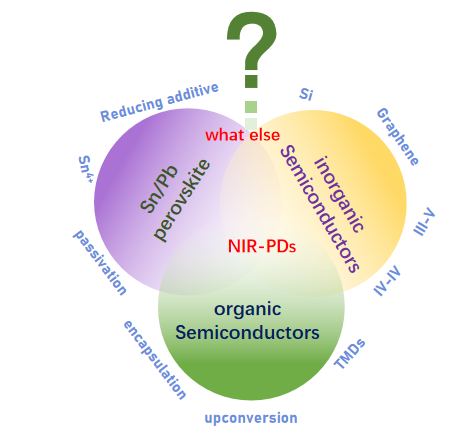
近年来,具有ABX3晶体结构的金属卤化物钙钛矿材料因其可调带隙、高吸收系数、长载流子传输距离等光电学特性而在光电探测领域表现出良好应用前景,尤其是基于纯Sn或者Sn/Pb混合阳离子制备的杂化钙钛矿在760~1050 nm范围的近红外光电响应性能非常优异,展现出高灵敏度、低暗电流和高探测率等多方面优势。为进一步拓宽钙钛矿的近红外以及红外响应波长范围,研究人员探索了将有机材料、晶体硅/锗、Ⅲ-Ⅴ族化合物、Ⅳ-Ⅵ族化合物、上转换荧光材料等作为互补光吸收层与钙钛矿结合制备异质结来构筑出宽谱响应的近红外光电探测器。基于以上研究,本文总结了当前拓宽钙钛矿光电探测器的光谱范围的有效途径。同时,对钙钛矿材料的近红外光电探测器的未来发展前景作出了展望。
In recent years, organo-metal halide perovskites materials with ABX3 crystal structure have shown promising application prospects in the field of photoelectric detection due to their optical and electrical properties such as adjustable bandgap engineering, high absorption coefficient and long carrier transmission distance. Especially, the hybrid perovskite prepared by pure Sn or Sn/Pb mixed cations have excellent near-infrared photoelectroresponse in the range of 760~1050 nm, showing many advantages such as high sensitivity, low dark current and high detection rate. To further broaden the near-infrared and infrared response wavelength range of perovskite, the researchers explored combining organic materials, crystalline silicon/germanium, Ⅲ-Ⅴ compounds, Ⅳ-Ⅵ compounds, upconversion fluorescent materials as complementary light absorption layers with perovskite to prepare heterostructures to construct wide-spectrum response near-infrared photodetectors. Based on the above research, this paper summarizes the current effective ways to broaden the spectrum range of perovskite photodetectors. At the same time, the future development prospect of perovskite material near infrared photodetector is prospected.
Contents
1 Introduction
2 Basic indicators of photodetectors
2.1 Device structure and working principle of photodetectors
2.2 Performance parameters of photodetectors
2.3 Strategy of broadening the spectrum response range of perovskites
3 Pb perovskite for near-infrared photodetectors
3.1 Polycrystalline perovskite materials
3.2 Single crystal perovskite materials
4 Narrow band gap Sn and Sn/Pb Mixed Perovskite- Based near-infrared photodetectors
4.1 Sn-based perovskite near-infrared photodetectors
4.2 Sn/Pb mixed perovskite near-infrared photodetectors
5 Perovskite/inorganic heterojunction near-infrared photodetectors
5.1 Silicon and other classic semiconductors
5.2 Graphene
5.3 Transition metal dichalcogenides
5.4 Ⅲ-Ⅴ compounds semiconductors
5.5 Ⅳ-Ⅳ compounds semiconductors
6 Perovskite/organic heterojunction near-infrared photodetectors
7 Perovskite/upconversion material near-infrared photodetectors
8 Application of near-infrared photodetectors
9 Conclusion and outlook
optical device / perovskite / near-infrared photodetectors / narrow-bandgap materials
| [1] |
|
| [2] |
|
| [3] |
|
| [4] |
|
| [5] |
|
| [6] |
|
| [7] |
|
| [8] |
|
| [9] |
|
| [10] |
|
| [11] |
National Renewable Energy Laboratory, (2023). https://www.nrel.gov/pv/interactive-cell-efficiency.html.
|
| [12] |
|
| [13] |
|
| [14] |
|
| [15] |
|
| [16] |
|
| [17] |
|
| [18] |
|
| [19] |
|
| [20] |
|
| [21] |
|
| [22] |
|
| [23] |
|
| [24] |
|
| [25] |
|
| [26] |
|
| [27] |
|
| [28] |
|
| [29] |
|
| [30] |
|
| [31] |
|
| [32] |
|
| [33] |
|
| [34] |
|
| [35] |
|
| [36] |
|
| [37] |
|
| [38] |
|
| [39] |
|
| [40] |
|
| [41] |
|
| [42] |
|
| [43] |
|
| [44] |
|
| [45] |
|
| [46] |
|
| [47] |
|
| [48] |
|
| [49] |
|
| [50] |
|
| [51] |
|
| [52] |
|
| [53] |
|
| [54] |
|
| [55] |
|
| [56] |
|
| [57] |
|
| [58] |
|
| [59] |
|
| [60] |
|
| [61] |
|
| [62] |
|
| [63] |
|
| [64] |
|
| [65] |
|
| [66] |
|
| [67] |
|
| [68] |
|
| [69] |
|
| [70] |
|
| [71] |
|
| [72] |
|
| [73] |
|
| [74] |
|
| [75] |
|
| [76] |
|
| [77] |
|
| [78] |
|
| [79] |
|
| [80] |
|
| [81] |
|
| [82] |
|
| [83] |
|
| [84] |
|
| [85] |
|
| [86] |
|
| [87] |
|
| [88] |
|
| [89] |
|
| [90] |
|
| [91] |
|
| [92] |
|
| [93] |
|
| [94] |
|
| [95] |
|
| [96] |
|
| [97] |
|
| [98] |
|
| [99] |
|
/
| 〈 |
|
〉 |