催化材料的空间限域效应及其低温脱硝应用

张巍, 伍乔, 付业昊, 梁垚城, 阮敏, 尹艳山, 成珊

化学进展 ›› 2024, Vol. 36 ›› Issue (6) : 928-938.

PDF(12539 KB)
PDF(12539 KB)
化学进展 ›› 2024, Vol. 36 ›› Issue (6) : 928-938. DOI: 10.7536/PC231005
综述

催化材料的空间限域效应及其低温脱硝应用

作者信息 +

The Space Confinement Effect of Catalytic Materials and Its Application in Low Temperature Denitration

Author information +
文章历史 +

摘要

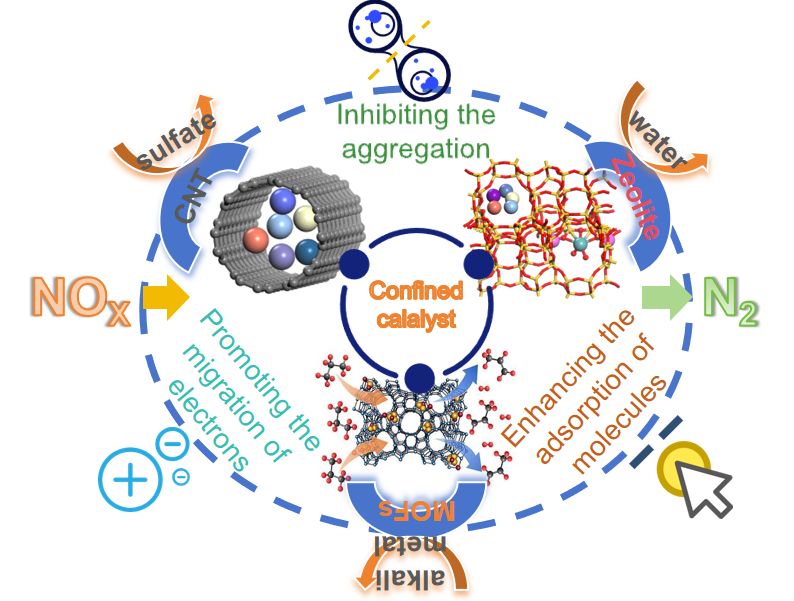
The spatial confinement effect of porous materials can change the surface electron distribution and electron transport performance, realize the local reaction in the micro-nano pore domain, effectively prevent the external environment from affecting the active substances in the confined space, and inhibit the agglomeration of active centers, which is an effective way to enhance the denitrification performance of catalysts. In this paper, we focus on the changes of surface energy, periodic boundary conditions and electronic energy levels of different catalytic materials, and discuss the formation mechanism of spatial confinement effect; The effects of confinement on the dispersion of active species, redox ability and molecular adsorption strength in the reaction process, as well as the control strategies of size effect, encapsulation effect and molecular sieve effect in the confinement effect were described; The enhancement effects of the confined catalyst on NH3 adsorption, reaction selectivity, anti-toxicity and denitrification activity in the denitrification process were summarized.Finally, the development prospect of the confined denitrification catalyst was prospected.

Abstract

The spatial confinement effect of porous materials can change the surface electron distribution and electron transport performance,realize the local reaction in the micro-nano pore domain,effectively prevent the external environment from affecting the active substances in the confined space,and inhibit the agglomeration of the active center,which is an effective way to strengthen the denitrification performance of the catalyst.This paper focuses on the changes in surface energy,periodic boundary conditions and electronic energy levels of different catalytic materials,and discusses the formation mechanism of the spatial confinement effect.The effects of confinement effect on the dispersion of active species,redox ability and molecular adsorption strength in the reaction process and the regulation strategies of size effect,encapsulation effect and molecular sieve effect in confinement effect were described.The strengthening effects of confined catalysts on NH3adsorption performance,reaction selectivity,anti-toxicity and denitrification activity in the denitrification process were summarized.Finally,the development prospect of confined denitrification catalysts was prospected.

Contents

1 introduction

2 The influence of space confinement effect on catalytic reaction

2.1 Inhibiting the aggregation of active species

2.2 Promoting the migration of interface electrons

2.3 Enhancing the adsorption of reaction molecules

3 Spatial confinement effect regulation strategy

3.1 Control of confinement size effect

3.2 Control of confinement encapsulation effect

3.3 Control of confined molecular sieve effect

4 The application of spatial confinement effect in low-temperature denitrification

4.1 Strengthen the adsorption performance of NH3

4.2 Enhance the selectivity of the denitration reaction

4.3 Enhance the anti-toxicity of the catalyst

5 Conclusion and outlook
关键词

多孔材料 / 限域效应 / 催化机制 / 调控策略 / 低温脱硝

Key words

porous materials / confinement effect / catalytic mechanism / regulation strategy / low-temperature denitration

引用本文

导出引用
张巍 , 伍乔 , 付业昊 , . 催化材料的空间限域效应及其低温脱硝应用[J]. 化学进展. 2024, 36(6): 928-938 https://doi.org/10.7536/PC231005
, , , et al. The Space Confinement Effect of Catalytic Materials and Its Application in Low Temperature Denitration[J]. Progress in Chemistry. 2024, 36(6): 928-938 https://doi.org/10.7536/PC231005
中图分类号: O.643   

参考文献

[1]
Grommet A B, Feller M, Klajn R. Nat. Nanotechnol., 2020, 15(4): 256.
[2]
Zhou Z Q, Yu F, Ma J. Environ. Chem. Lett., 2022, 20(1): 563.
[3]
Boles M A, Ling D S, Hyeon T, Talapin D V. Nat. Mater., 2016, 15(2): 141.
[4]
He L B, Zhang L, Tang L P, Sun J, Zhang Q B, Sun L T. Mater. Today Nano, 2018, 1: 8.
[5]
Wang L G, Liu H, Zhuang J H, Wang D S. Small Sci., 2022, 2(11): 2200036.
[6]
Ou C H, Wang D W. Adv. Civ. Eng., 2021(3): 1.
[7]
Wu X Q, Han R, Liu Q L, Su Y, Lu S C, Yang L Z, Song C F, Ji N, Ma D G, Lu X B. Catal. Sci. Technol., 2021, 11(16): 5374.
[8]
Annamalai J, Murugan P, Ganapathy D, Nallaswamy D, Atchudan R, Arya S, Khosla A, Barathi S, Sundramoorthy A K. Chemosphere, 2022, 298: 134184.
[9]
Xiao J P, Pan X L, Guo S J, Ren P J, Bao X H. J. Am. Chem. Soc., 2015, 137(1): 477.
[10]
Novoselov K S, Mishchenko A, Carvalho A, Castro Neto A H. Science, 2016, 353(6298): aac9439.
[11]
Sastre G, Corma A. J. Mol. Catal. A Chem., 2009, 305(1/2): 3.
[12]
Jiang Z Z, Zhou W D, Hu C, Luo X F, Zeng W, Gong X G, Yang Y, Yu T, Lei W, Yuan C L. Adv. Mater., 2023, 35: 2300505.
[13]
Yan C, Wang T. Chem. Soc. Rev., 2017, 46(5): 1483.
[14]
Miners S A, Rance G A, Khlobystov A N. Chem. Soc. Rev., 2016, 45(17): 4727.
[15]
Deng D H, Novoselov K S, Fu Q, Zheng N F, Tian Z Q, Bao X H. Nat. Nanotechnol., 2016, 11(3): 218.
[16]
Li H B, Xiao J P, Fu Q, Bao X H. PNAS, 2017, 114(23): 5930.
[17]
Huang X S, Dong F, Zhang G D, Tang Z C. J. Catal., 2023, 420: 134.
[18]
Wu S M, Yang X Y, Janiak C. Angew. Chem. Int. Ed., 2019, 58(36): 12340.
[19]
Huo J J, Lu L, Shen Z Y, Liu Y, Guo J J, Liu Q B, Wang Y, Liu H, Wu M H, Wang G X. J. Mater. Chem. A, 2020, 8(32): 16271.
[20]
A B, C S, Y Z, Xia J, T G. Appl. Surf. Sci., 2020, 541:148460.
[21]
Cao L M, Zhang J, Zhang X F, He C T. Chem. Sci., 2022, 13(6): 1569.
[22]
Yang M, Ling Q, Yang H X, Li C S, Zhang A M. Catal. Commun., 2014, 46: 238.
[23]
Su J N, Zhuang L Z, Zhang S S, Liu Q J, Zhang L Z, Hu G Z. Chin. Chemical Lett., 2021, 32(10): 2947.
[24]
Zhang Z P, Li R M, Wang M J, Li Y S, Tong Y M, Yang P P, Zhu Y J. Appl. Catal. B Environ., 2021, 282: 119542.
[25]
Mu Y B, Huang X S, Tang Z C, Wang Q C. Chem. Eng. J., 2023, 454: 140181.
[26]
Chen X B, Wang P L, Fang P, Wang H Q, Cen C P, Zeng W H, Wu Z B. Environ. Sci.: Nano, 2017, 4(2): 437.
[27]
Yao G S, Wu L P, Lv T, Li J, Huang Y Q, Dong K J, Li X J. Open Chem., 2018, 16(1): 1.
[28]
Gao R J, Wang J, Huang Z F, Zhang R R, Wang W, Pan L, Zhang J F, Zhu W K, Zhang X W, Shi C X, Lim J, Zou J J. Nat. Energy, 2021, 6(6): 614.
[29]
Zhan W T, Wang Y J, Chen J M, Chen Z J, Li Y W. Appl. Catal. B Environ., 2022, 313: 121469.
[30]
Nørskov J K, Rossmeisl J, Logadottir A, Lindqvist L, Kitchin J R, Bligaard T, Jónsson H. J. Phys. Chem. B, 2004, 108(46): 17886.
[31]
Zhou Y N, Chen W, Cui P, Zeng J, Lin Z N, Kaxiras E, Zhang Z Y. Nano Lett., 2016, 16(10): 6058.
[32]
Hawash Z, Ono L K, Raga S R, Lee M V, Qi Y B. Chem. Mater., 2022, 34(8): 3882.
[33]
Dong T, Liu W M, Ma M D, Peng H G, Yang S Y, Tao J X, He C, Wang L, Wu P, An T C. Chem. Eng. J., 2020, 393: 124717.
[34]
Xu M Y, Lai C, Liu X G, Li B S, Zhang M M, Xu F H, Liu S Y, Li L, Qin L, Yi H, Fu Y K. J. Mater. Chem. A, 2021, 9(43): 24148.
[35]
Baig N, Kammakakam I, Falath W. Mater. Adv., 2021, 2(6): 1821.
[36]
Zhang Y Q, Yang J, Ge R Y, Zhang J J, Cairney J M, Li Y, Zhu M Y, Li S A, Li W X. Coord. Chem. Rev., 2022, 461: 214493.
[37]
Wang H W, Gu X K, Zheng S X, Pan H B, Zhu J F, Chen S, Cao L N, Li W X, Lu J L. Sci. Adv., 2019, 5(1): eaat6413.
[38]
Zhang L, Zhang L, Dong X, Zhang S, Zhao Y, Cen Q H, Zhang K M. Microporous Mesoporous Mater., 2021, 311: 110667.
[39]
Zaarour M, Dong B, Naydenova I, Retoux R, Mintova S. Microporous Mesoporous Mater., 2014, 189: 11.
[40]
Ekpe, Ikenna. Int. Res. J. Environmental Sci., 2017, 6(10): 45.
[41]
Cao F C, Ouyang Y P, Huang Z K, Gong Y T, Hu Y B, He Z. Int. J. Mod. Phys. B, 2022, 36(9n11): 2240033.
[42]
Jangi I, Vaezi M J. J. Aust. Ceram. Soc., 2023: 1.
[43]
Derbe T, Temesgen S, Bitew M. Adv. Mater. Sci. Eng., 2021, 2021: 6637898.
[44]
Liang J, Mi Y Y, Song G, Peng H G, Li Y L, Yan R, Liu W M, Wang Z, Wu P, Liu F D. J. Hazard. Mater., 2020, 398: 122986.
[45]
Łuczak J, Kroczewska M, Baluk M, Sowik J, Mazierski P, Zaleska-Medynska A. Adv. Colloid Interface Sci., 2023, 314: 102864.
[46]
Yang X Y, Yuan S, Zou L F, Drake H, Zhang Y M, Qin J S, Alsalme A, Zhou H C. Angew. Chem. Int. Ed., 2018, 57(15): 3927.
[47]
Xu J, Liu J, Li Z, Wang X B, Xu Y F, Chen S S, Wang Z. New J. Chem., 2019, 43(10): 4092.
[48]
Dai E N, Wang X K, Wang Y T, Liu Z N, Sun D F. Angew. Chem. Int. Ed, 2020, 59: 22372.
[49]
Shen K, Zhang M D, Zheng H G. CrystEngComm, 2015, 17(5): 981.
[50]
Wang F L, Guo H L, Chai Y M, Li Y P, Liu C G. Microporous Mesoporous Mater., 2013, 173: 181.
[51]
Huang Q, Yang Y, Qian J J. Coord. Chem. Rev., 2023, 484: 215101.
[52]
Wang Z K, Guo X, Dou W, Wang K B, Mao F F, Wu H, Sun C H. J. Solid State Chem., 2020, 289: 121452.
[53]
Sun Y X, Sun W Y. Chin. Chemical Lett., 2014, 25(6): 823.
[54]
Damma D, Pappas D K, Boningari T, Smirniotis P G. Appl. Catal. B Environ., 2021, 287: 119939.
[55]
López Zavala M Á, Lozano Morales S A, Ávila-Santos M. Heliyon, 2017, 3(11): e00456.
[56]
Abbas W A, Abdullah I H, Ali B A, Ahmed N, Mohamed A M, Rezk M Y, Ismail N, Mohamed M A, Allam N K. Nanoscale Adv., 2019, 1(8): 2801.
[57]
Chen X B, Cen C P, Tang Z X, Zeng W H, Chen D S, Fang P, Chen Z H. J. Nanomaterials, 2013, 2013(3): 1.
[58]
Cai Q Y, Paulose M, Grimes C A, Varghese O K. J. Mater. Res., 2005, 20(1): 230.
[59]
Chávez-Mejía A C, Zaragoza-Sánchez P I, Magaña-López R, Barrera-Díaz C E, Jiménez-Cisneros B E. J. Mater. Sci. Mater. Electron., 2020, 31(18): 15907.
[60]
Galstyan V, Comini E, Faglia G, Sberveglieri G. Sensors, 2013, 13(11): 14813.
[61]
Zhang L, Han Y. Nanotechnology, 2010, 21(5): 055602.
[62]
He G Y, Zhang J H, Hu Y, Bai Z G, Wei C H. Appl. Catal. B Environ., 2019, 250: 301.
[63]
Gupta N, Gupta S M, Sharma S K. Carbon Lett., 2019, 29(5): 419.
[64]
Rahman G, Najaf Z, Mehmood A, Bilal S, Shah A, Mian S, Ali G. C-J. Carbon Res., 2019, 5(1): 3.
[65]
Sari A H, Khazali A, Parhizgar S S. Int. Nano Lett., 2018, 8(1): 19.
[66]
Sinnott S B, Andrews R. Crit. Rev. Solid State Mater. Sci., 2001, 26(3): 145.
[67]
Scott C D, Arepalli S, Nikolaev P, Smalley R E. Appl. Phys. A, 2001, 72(5): 573.
[68]
José-Yacamán M, Miki-Yoshida M, Rendón L, Santiesteban J G. Appl. Phys. Lett., 1993, 62(6): 657.
[69]
Ding R G, Lu G Q, Yan Z F, Wilson M A. J. Nanosci. Nanotechnol., 2001, 1(1): 7.
[70]
Koziol K, Boskovic B O, Yahya N. Advanced Structured Materials. Berlin, Heidelberg: Springer Berlin Heidelberg, 2010: 23.
[71]
Gergeroglu H, Ebeoglugil M F. Carbon Lett., 2022, 32(7): 1729.
[72]
Li M, Li Z W, Lin Q, Cao J X, Liu F, Kawi S. Chem. Eng. J., 2022, 431: 133970.
[73]
Zaarour M, Cazemier J, Ruiz-Martínez J. Catal. Sci. Technol., 2020, 10(24): 8140.
[74]
Ning X, Deng D Z, Fu H Y, Qu X L, Xu Z Y, Zheng S R. Chem. Commun., 2020, 56(51): 6985.
[75]
Wen M, Dong F, Tang Z C, Zhang J Y. Microporous Mesoporous Mater., 2021, 322: 111156.
[76]
Wen M, Dong F, Tang Z C, Zhang J Y. Mol. Catal., 2022, 519: 112149.
[77]
Brachvogel R C, Hampel F, von Delius M. Nat. Commun., 2015, 6: 7129.
[78]
Sheng Z Y, Ma D R, Yu D Q, Xiao X, Huang B J, Yang L, Wang S. Chin. J. Catal., 2018, 39(4): 821.
[79]
Qiao T, Liu Z G, Liu C H, Meng W, Sun H, Lu Y. Appl. Catal. A Gen., 2021, 617: 118128.
[80]
Boutros M, Gálvez M E, Onfroy T, Da Costa P. Microporous Mesoporous Mater., 2014, 183: 1.
[81]
Ye Z P, Zhao L, Nikiforov A, Giraudon J M, Chen Y, Wang J D, Tu X. Adv. Colloid Interface Sci., 2022, 308: 102755.
[82]
Wang H L, Luo S T, Li X H, Liu W, Wu X D, Weng D, Liu S. Catal. Today, 2019, 332: 189.
[83]
Feng A H, Yu Y, Mi L, Cao Y Z, Yu Y, Song L X. Microporous Mesoporous Mater., 2019, 290: 109646.
[84]
Zhang K, Ostraat M L. Catal. Today, 2016, 264: 3.
[85]
Kwok K M, Ong S W D, Chen L W, Zeng H C. ACS Appl. Mater. Interfaces, 2019, 11(16): 14774.
[86]
Sun Y X, Quan K J, Chen J, Li H, Li X, Li Z G, Qiu H D. Chin. Chemical Lett., 2023, 34(9): 108166.
[87]
Fan C, Quan K J, Chen J, Qiu H D. J. Chromatogr. A, 2022, 1661: 462690.
[88]
Tuan D D, Kwon E, Phattarapattamawong S, Thanh B X, Khiem T C, Lisak G, Wang H T, Lin K Y A. J. Environ. Chem. Eng., 2022, 10(2): 106989.
[89]
Pannopard P, Khongpracha P, Warakulwit C, Namuangruk S, Probst M, Limtrakul J. ChemPhysChem, 2012, 13(2): 583.
[90]
Xu G Y, Guo X L, Cheng X X, Yu J, Fang B Z. Nanoscale, 2021, 13(15): 7052.
[91]
Jiang Z P, Wang Q L, Cai Y Z. Catal. Surv. Asia, 2022, 26(3): 161.
[92]
Li Y F, Hou Y Q, Zhang Y Z, Yang Y T, Huang Z G. J. Colloid Interface Sci., 2022, 608: 2224.
[93]
Guo K, Ji J W, Osuga R, Zhu Y X, Sun J F, Tang C J, Kondo J N, Dong L. Appl. Catal. B Environ., 2021, 287: 119982.
[94]
Matsuki Y, Iwamoto M, Mita K, Shigemi K, Matsunaga S, Oiki S. J. Am. Chem. Soc., 2016, 138(12): 4168.
[95]
Zhou X J, Zhu B Z, Sun Y L, Chen J Y, Geng X, Xu M G. Appl. Surf. Sci., 2023, 607: 154981.
[96]
Chen H Y, Wei Z H, Kollar M, Gao F, Wang Y L, Szanyi J, Peden C H F. J. Catal., 2015, 329: 490.
[97]
Song I, Lee H, Jeon S W, Kim D H. ACS Catal., 2020, 10(20): 12017.
[98]
Chen W, Pan X L, Bao X H. J. Am. Chem. Soc., 2007, 129(23): 7421.
[99]
Kapteijn F, Singoredjo L, Andreini A, Moulijn J A. Appl. Catal. B, 1994, 3(2): 173.
[100]
Zhao T, Huang X S, Cui R J, Zhang G D, Tang Z C. Nanoscale, 2023, 15(30): 12540.
[101]
Xu W Q, He H, Yu Y B. J. Phys. Chem. C, 2009, 113(11): 4426.
[102]
Yan R, Lin S X, Li Y L, Liu W M, Mi Y Y, Tang C J, Wang L, Wu P, Peng H G. J. Hazard. Mater., 2020, 396: 122592.
[103]
Shi Y R, Yi H H, Gao F Y, Zhao S Z, Xie Z L, Tang X L. Sep. Purif. Technol., 2021, 265: 118517.
[104]
Xu Z Q, Impeng S, Jia X Y, Wang F L, Shen Y J, Wang P L, Zhang D S. Environ. Sci.: Nano, 2022, 9(6): 2121.
[105]
Huang X S, Fang N J, Wu S L, Dong F, Chu Y H, Tang Z C. Appl. Catal. B Environ., 2024, 343: 123518.
[106]
Su Y X, Fan B X, Wang L S, Liu Y F, Huang B C, Fu M L, Chen L M, Ye D Q. Catal. Today, 2013, 201: 115.
[107]
Li M Q, Huang X S, Zhang G D, Tang Z C, Hu D C. Sep. Purif. Technol., 2023, 324: 124555.

基金

国家自然科学基金(52006016)
湖南省自然科学基金(2023JJ30047)
湖南省自然科学基金(2021JJ40573)
湖南省自然科学基金(2020JJ4098)
湖南省教育厅科学研究项目重点项目(21A0216)
湖南省教育厅优秀青年项目(202B041)
湖南省教育厅优秀青年项目(22B0291)
长沙市自然科学基金(kq2014104)
长沙理工大学青年教师成长计划项目(2019QJCZ044)

PDF(12539 KB)

Accesses

Citation

Detail

段落导航
相关文章

/


