Journal of Inorganic Materials >
Oxide Neuron Devices and Their Applications in Artificial Neural Networks
Received date: 2023-09-05
Revised date: 2023-11-28
Online published: 2024-04-25
Supported by
National Natural Science Foundation of China(U20A20209)
Strategic Priority Research Program of Chinese Academy of Sciences(XDB32050204)
China National Postdoctoral Program for Innovative Talents(BX2021326)
China Postdoctoral Science Foundation(2021M703310)
Zhejiang Provincial Natural Science Foundation(LQ22F040003)
Ningbo Natural Science Foundation(2021J139)
Ningbo Natural Science Foundation(2023J356)
State Key Laboratory for Environment-Friendly Energy Materials(20kfhg09)
Nowadays, artificial intelligence (AI) is playing an increasingly important role in human society. Running AI algorithms represented by deep learning places great demands on computational power of hardware. However, with Moore's Law approaching physical limitations, the traditional Von Neumann computing architecture cannot meet the urgent demand for promoting hardware computational power. The brain-inspired neuromorphic computing (NC) employing an integrated processing-memory architecture is expected to provide an important hardware basis for developing novel AI technologies with low energy consumption and high computational power. Under this conception, artificial neurons and synapses, as the core components of NC systems, have become a research hotspot. This paper aims to provide a comprehensive review on the development of oxide neuron devices. Firstly, several mathematical models of neurons are described. Then, recent progress of Hodgkin-Huxley neurons, leaky integrate-and-fire neurons and oscillatory neurons based on oxide electronic devices is introduced in detail. The effects of device structures and working mechanisms on neuronal performance are systematically analyzed. Next, the hardware implementation of spiking neural networks and oscillatory neural networks based on oxide artificial neurons is demonstrated. Finally, the challenges of oxide neuron devices, arrays and networks, as well as prospect for their applications are pointed out.
Zongxiao LI , Lingxiang HU , Jingrui WANG , Fei ZHUGE . Oxide Neuron Devices and Their Applications in Artificial Neural Networks[J]. Journal of Inorganic Materials, 2024 , 39(4) : 345 -358 . DOI: 10.15541/jim20230405
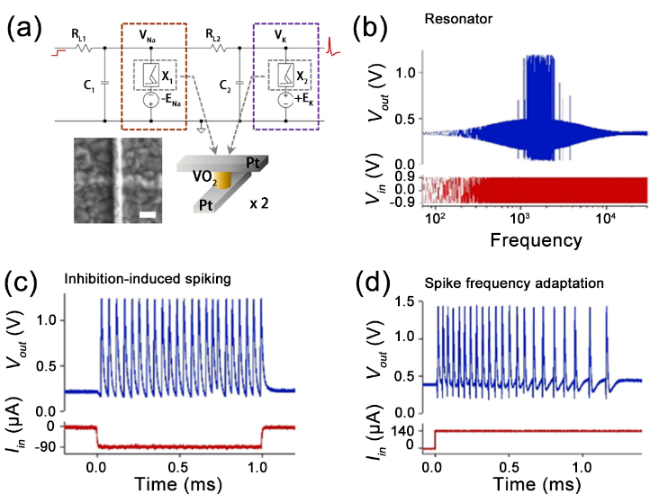
图2 基于VO2忆阻器的HH神经元[32]Fig. 2 Hodgkin-Huxley (HH) neuron based on VO2 memristors[32] (a) HH neuron circuit based on VO2-based memristors; (b) Output resonator spiking of VO2-based HH neuron; (c) Output inhibition-induced spiking of VO2-based HH neuron; (d) Spike frequency adaptation property of HH neuron |
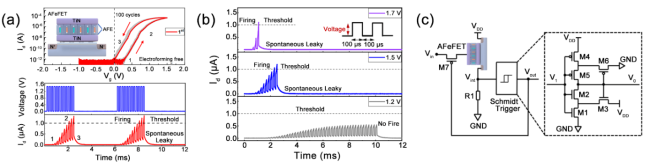
图3 基于反铁电场效应晶体管的LIF神经元[43]Fig. 3 Leaky integrate-and-fire (LIF) neuron based on antiferroelectric field effect transistor[43] (a) Volatile typical transfer curves of an antiferroelectric field effect transistor (AFeFET) (up) and continuous firing events of an AFeFET neuron under voltage pulses (down); (b) Dynamic of leaky and integration process of an AFeFET neuron under gate pulse with different amplitudes; (c) Artificial neuron circuit diagram based on AFeFET |
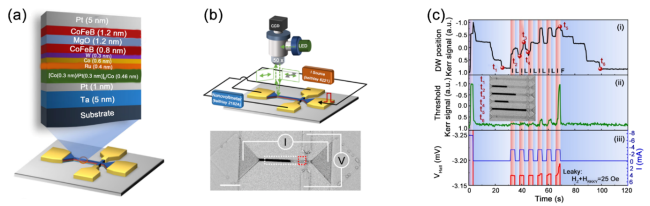
图4 基于反铁磁材料的LIF神经元[51]Fig. 4 LIF neuron based on an antiferromagnetic spintronic device[51] (a) Schematic of an antiferromagnetic spintronic device; (b) Schematic of a polar magneto-optic Kerr effect microscope setup for in-situ magneto-electrical transport probing (up) and its measured domain wall position of hall bar under current stimuli (down); (c) Domain wall position signal (up), neural threshold signal (middle) and output voltage spike dynamics (down) of the antiferromagnetic spintronic device under current stimuli with inset presenting dynamics of domain wall motion |
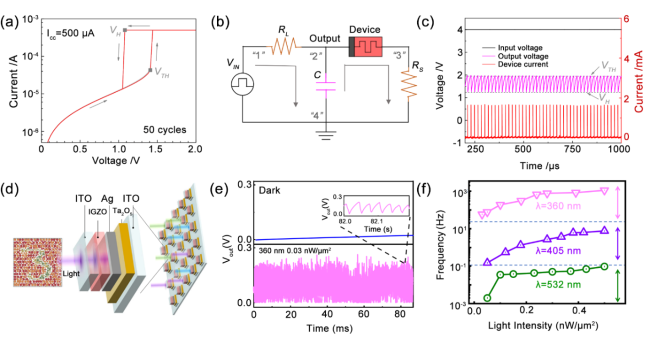
图5 氧化物忆阻器基LIF神经元研究Fig. 5 Researches of LIF neurons based on oxide memristors (a) Typical I-V curve of a NbOx-based TS memristor[63]; (b) Schematic diagram of artificial spiking neuron circuit based on NbOx-based memristor[63]; (c) Oscillation and output spiking characteristics of memristive neuron under constant voltage stimuli[63]; (d) Schematic illustration of an optoelectronic neuron with ITO/IGZO/Ag/Ta2O5/ITO structure[73]; (e) Comparison of fire dynamics of the optoelectronic neuron under dark and ultraviolet light[73]; (f) Fire frequency of the optoelectronic neuron as a function of light intensity at different wavelengths[73] |
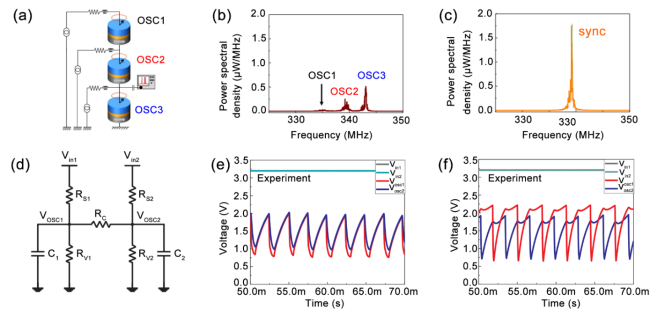
图6 振荡神经元耦合电路及其振荡波同步输出图Fig. 6 Coupling circuits of oscillation neurons and the output mutual waves (a) Circuit schematic of three spin-torque nano-oscillators connected electrically[108]; (b) Unsynchronized oscillatory wave of the three coupled oscillators[108]; (c) Synchronized oscillatory wave of the three coupled oscillators[108]; (d) Coupled circuit consisting of two VO2-based oscillators[96]; (e) In-phase voltage oscillatory waves of VO2-based coupled circuit[96]; (f) Out-of-phase voltage oscillatory waves of VO2-based coupled circuit[96] |
表1 氧化物基HH、LIF和振荡神经元性能对比Table 1 Performance comparison of HH, LIF and oscillation neurons based on oxides |
| Type | Device structure | Physics | Auxiliary circuit | Operation stimulus | Highest output frequency | Energy consumption per spike | Advanced function | Ref. |
|---|---|---|---|---|---|---|---|---|
| HH | Pt/VO2/Pt | Mott | 2S2R2C* 2S1R3C* 2S2R3C* | Current/ Voltage | <60 kHz | 5.6 fJ | 23 types of biological neuronal behaviors | [32] |
| W/WO3/PEDOT:PSS/Pt | Proton migration | CMOS | 2 V | — | — | Local graded potential, all or nothing | [34] | |
| LIF | Si:HfO2-based FeFET | Polarization switching | 6T* | 2.4 V | — | — | Integration of excitatory and inhibitory inputs | [42] |
| Hf0.5Zr0.5O2-based FeFET | Polarization switching | 5T1C* | 1.8 V | — | — | Spike frequency adaptation | [44] | |
| Hf0.2Zr0.8O2-based FeFET | Polarization switching | 6T1R* | 1.8 V | — | 37 fJ | Adjustable output frequency | [43] | |
| MTJ | Spin | 1T* | — | 17 MHz | 486 fJ | Adjustable output frequency | [51] | |
| Pt/Ag/TiN/HfAlOx/Pt | Filament | 2R1C* | 1.5 V | — | 16 fJ | Adjustable output frequency | [111] | |
| Ag/SiO2/SiO2.03/Pt | Filament | 2R1C* | 0.1 V | — | 2 fJ | Adjustable output frequency | [79] | |
| Au/VO2/Au | Mott | 2R1C* | 5 V | 1 MHz | 2.9 nJ | Adjustable output frequency | [112] | |
| Si/NbO2/TiN | Mott | 1R* | 2 V | 900 kHz | 38 pJ | Self-protection | [110] | |
| Oscillation | Pt/TaOx/Ta/Pt | Filament | 1R1C* | 4-6V | 250 MHz | 300 μW | Adjustable output frequency | [105] |
| Ag/HfOx/Pt | Filament | 1R* | 0.6 V | ~80 kHz | 1.8 µW | Adjustable output frequency | [113] | |
| Pt/NbOx/Pt | Mott | 1R1C* | 4 V | 33 MHz | — | Adjustable output frequency | [94] | |
| VO2 | Mott | 1R1C* | 2.5 V | 1 MHz | 735 mW | Coupling | [114] |
* S: Source; R: Resistor; C: Capacitor; T: Transistor |
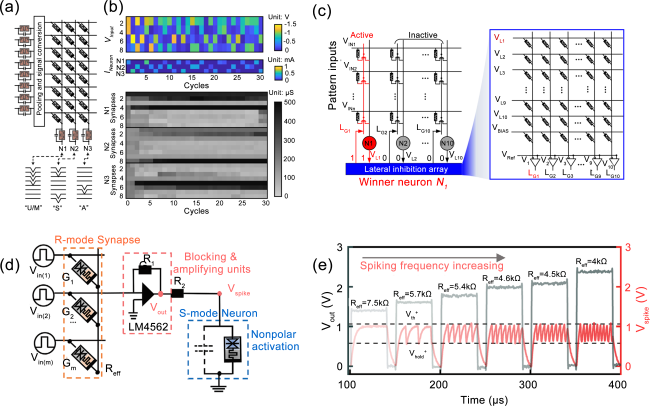
图7 基于氧化物神经元硬件的SNN研究Fig. 7 Researches on hardware implementations of spiking neural network (SNN) based on oxide neurons (a) Schematic of an SNN with 8×3 array network for unsupervised learning[116]; (b) Evolution of input voltages, neuron currents and synaptic weights in the unsupervised learning process[116]; (c) Neuromorphic circuit based on hybrid memristor/CMOS neurons[119]; (d) Circuit diagram of the V/VOx/HWOx/Pt-based SNN hardware system[120]; (e) Output spike frequency (Vout) as a function of resistance of R-mode device[120] |
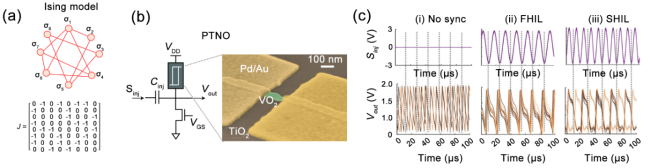
图8 基于VO2振荡神经网络的伊辛解算器[121]Fig. 8 VO2 oscillator-based oscillatory neural network (ONN) for Ising Hamiltonian solver[121] (a) Eight-node Ising model; (b) Schematic of a phase-transition nano-oscillator consisting of a VO2-based memristor in series with a transistor (left) and the scanning electron microscopy image of the VO2-based memristor (right); (c) Measured oscillatory waveforms in no-synchronization state, first-harmonic injection-locking and second-harmonic injection-locking |
| [1] |
|
| [2] |
|
| [3] |
|
| [4] |
|
| [5] |
|
| [6] |
|
| [7] |
|
| [8] |
|
| [9] |
|
| [10] |
|
| [11] |
|
| [12] |
|
| [13] |
|
| [14] |
|
| [15] |
|
| [16] |
|
| [17] |
|
| [18] |
|
| [19] |
|
| [20] |
|
| [21] |
|
| [22] |
|
| [23] |
|
| [24] |
|
| [25] |
|
| [26] |
|
| [27] |
|
| [28] |
|
| [29] |
|
| [30] |
|
| [31] |
|
| [32] |
|
| [33] |
|
| [34] |
|
| [35] |
|
| [36] |
|
| [37] |
|
| [38] |
|
| [39] |
|
| [40] |
|
| [41] |
|
| [42] |
|
| [43] |
|
| [44] |
|
| [45] |
|
| [46] |
|
| [47] |
|
| [48] |
|
| [49] |
|
| [50] |
|
| [51] |
|
| [52] |
|
| [53] |
|
| [54] |
|
| [55] |
|
| [56] |
|
| [57] |
|
| [58] |
|
| [59] |
|
| [60] |
|
| [61] |
|
| [62] |
|
| [63] |
|
| [64] |
|
| [65] |
|
| [66] |
|
| [67] |
|
| [68] |
|
| [69] |
|
| [70] |
|
| [71] |
|
| [72] |
|
| [73] |
|
| [74] |
|
| [75] |
|
| [76] |
|
| [77] |
|
| [78] |
|
| [79] |
|
| [80] |
|
| [81] |
|
| [82] |
|
| [83] |
|
| [84] |
|
| [85] |
|
| [86] |
|
| [87] |
|
| [88] |
|
| [89] |
|
| [90] |
|
| [91] |
|
| [92] |
|
| [93] |
|
| [94] |
|
| [95] |
|
| [96] |
|
| [97] |
|
| [98] |
|
| [99] |
|
| [100] |
|
| [101] |
|
| [102] |
|
| [103] |
|
| [104] |
|
| [105] |
|
| [106] |
|
| [107] |
|
| [108] |
|
| [109] |
|
| [110] |
|
| [111] |
|
| [112] |
|
| [113] |
|
| [114] |
|
| [115] |
|
| [116] |
|
| [117] |
|
| [118] |
|
| [119] |
|
| [120] |
|
| [121] |
|
| [122] |
|
| [123] |
|
| [124] |
|
| [125] |
|
| [126] |
|
| [127] |
|
| [128] |
|
| [129] |
|
| [130] |
|
/
| 〈 |
|
〉 |