Southern Power System Technology >
2023 , Vol. 17 >Issue 3: 65 - 74
DOI: https://doi.org/10.13648/j.cnki.issn1674-0629.2023.03.008
Online Assessment Method for Static Voltage Stability of New Power System Based on RReliefF-BP Network
Received date: 2022-03-02
Online published: 2022-09-10
Supported by
the National Natural Science Foundation of China(52107068)
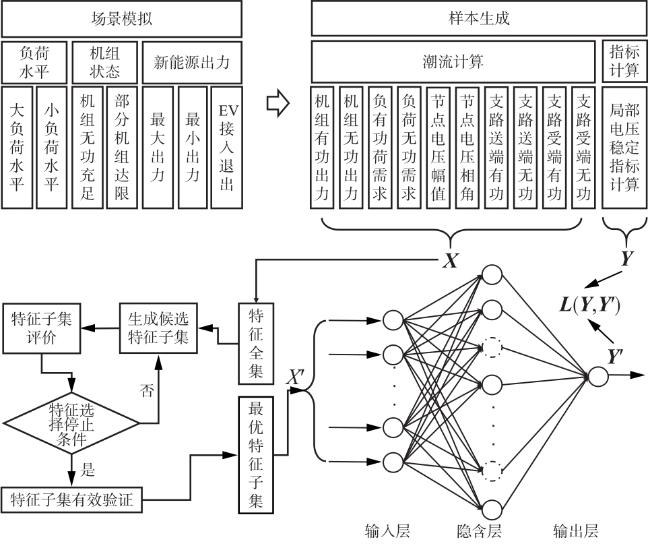
As the construction of new power system gradually takes shape, the trend of source-load separation is becoming more and more obvious and its randomness is increasing, making the problem of voltage stability increasingly prominent. Under the new circumstances, the grid urgently needs a voltage stability assessment method with high accuracy, fast response speed and good extensibility. The static voltage stability assessment problem is defined as regression problem and artificial neural network is constructed to assess the problem online. Firstly, the training sample set is obtained by scenario simulation, power flow calculation and local voltage stability index calculation. Then the RReliefF method is used to sort the features and eliminate the attributes with low weight to improve the training efficiency. Then the mapping relationship between key features and voltage stability is obtained by artificial neural network training. Finally, taking the modified IEEE39-node system as an example, six groups of experiments are set and a simple linear weighting method is introduced to calculate a comprehensive evaluation index about the speed and accuracy of the model to verify that the proposed method has ideal modeling speed and high accuracy, and can meet the requirements of voltage stability assessment of power system under the new situation.
Pei ZHANG , Zhujun ZHU , Zhao LIU , Xiaofei LIU . Online Assessment Method for Static Voltage Stability of New Power System Based on RReliefF-BP Network[J]. Southern Power System Technology, 2023 , 17(3) : 65 -74 . DOI: 10.13648/j.cnki.issn1674-0629.2023.03.008
表1 RReliefF算法原理Tab.1 Principle of RReliefF algorithm |
| 初始化: 、 、 、 =0 对于i=1,2,3…,m 从训练数据集S中随机选择一个样本 从S中找到k个该样本的最近邻样本 对于j=1,2,3…,k 根据 对每个特征属性A 根据 根据 结束 结束 对特征属性A 根据 结束 输出:特征子集并排序 |
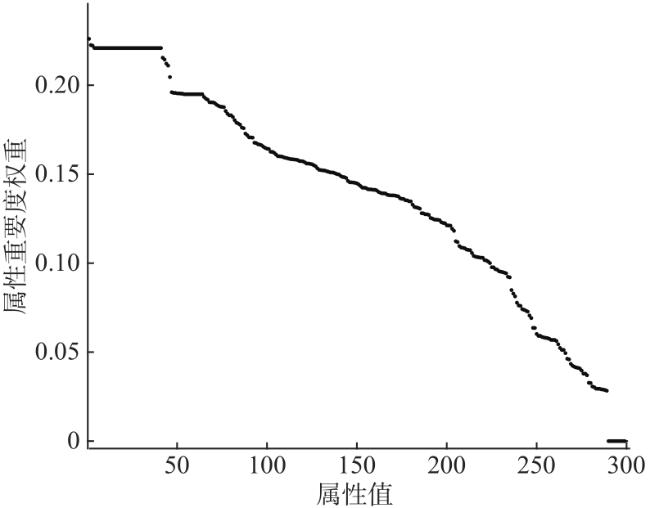
表2 RReliefF算法筛选结果(截取)Tab.2 Results of the RReliefF algorithm(Interception) |
| 权值排名前五属性 | 权值排名后五属性 | ||
|---|---|---|---|
| 属性 | 权重 | 属性 | 权重 |
| bus36_Vm | 0.226 1 | bus34_Vm | 0 |
| bus37_Va | 0.222 6 | bus38_Vm | 0 |
| branch8_Qs | 0.222 2 | bus37_Vm | 0 |
| branch24_Qs | 0.220 9 | bus31_Vm | 0 |
| bus6_Vm | 0.220 9 | bus31_Va | 0 |
表3 不同方法性能效果对照-1Tab.3 Comparison of the performance of different methods-1 |
| 序号 | 方法对照 | 训练时间/s | M SE |
|---|---|---|---|
| ① | bp-dropout | 331.23 | 5.563 6×10⁻⁷ |
| ② | bp-dropout-rreliefF | 232.50 | 6.195 4×10⁻⁷ |
| ③ | bp | 321.03 | 2.639 6×10⁻⁶ |
| ④ | bp-random-select-1 | 225.69 | 6.379 7×10⁻⁵ |
| ⑤ | bp-random-select-2 | 230.07 | 3.064 0×10-3 |
| ⑥ | Cart-decision-tree | 409.42 | 8.407 0×10-5 |
| ⑦ | SVR | 761.65 | 1.846 1×10⁻⁶ |
表4 不同方法性能效果对照-2Tab.4 Comparison of the performance of different methods-2 |
| 序号 | 方法对照 | 训练时间/s | M SE | M APE |
|---|---|---|---|---|
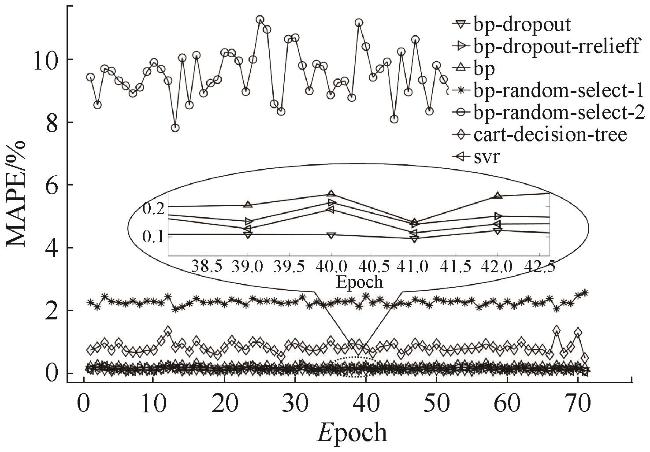
| ① | bp-dropout | 331.23 | 5.563 6×10⁻⁷ | 0.001 1 |
| ② | bp-dropout-rreliefF | 232.50 | 6.195 4×10⁻⁷ | 0.001 7 |
| ③ | bp | 321.03 | 2.639 6×10⁻⁶ | 0.002 1 |
| ④ | bp-random-select-1 | 225.69 | 6.379 7×10⁻⁵ | 0.022 6 |
| ⑤ | bp-random-select-2 | 230.07 | 3.064 0×10-3 | 0.095 7 |
| ⑥ | cart-decision-tree | 409.42 | 8.407 0×10-5 | 0.008 3 |
| ⑦ | svr | 761.65 | 1.846 1×10⁻⁶ | 0.001 3 |
表5 简单线性加权法步骤Tab.5 Procedures of simple linear weighting method |
| ①确定各指标的权重因子 ,且 ; ②处理指标矩阵 ,得 ,处理后的指标均为正向指标,q为方案数量; ③计算各方法方案的线性加权指标值 ; ④以线性加权指标值 为依据,选择加权指标值最大的方案,即, 。 |
表6 不同方法性能指标对照Tab.6 Comparison of performance indices for different methods |
| 序号 | 方法对照 | 指标1 | 指标2 | 指标3 | 综合指标 |
|---|---|---|---|---|---|
| ① | bp-dropout | 0.125 5 | 0.412 6 | 0.132 7 | 0.213 8 |
| ② | bp-dropout-rreliefF | 0.178 7 | 0.370 0 | 0.132 7 | 0.222 3 |
| ③ | bp | 0.129 4 | 0.086 9 | 0.132 6 | 0.117 6 |
| ④ | bp-random-select-1 | 0.184 1 | 0.003 6 | 0.129 9 | 0.113 7 |
| ⑤ | bp-random-select-2 | 0.180 6 | 0.000 1 | 0.120 2 | 0.108 3 |
| ⑥ | Cart-decision-tree | 0.101 5 | 0.002 7 | 0.131 8 | 0.080 9 |
| ⑦ | SVR | 0.054 6 | 0.124 0 | 0.132 7 | 0.098 8 |
| [1] |
|
| [2] |
|
| [3] |
|
| [4] |
王颖, 文福拴, 赵波, 等. 高密度分布式光伏接入下电压越限问题的分析与对策 [J]. 中国电机工程学报, 2016, 36(5): 1200 - 1206.
|
| [5] |
|
| [6] |
|
| [7] |
|
| [8] |
高延涛. 大规模风电并网对电压稳定的影响研究 [D].青岛:青岛大学,2018
|
| [9] |
马赛, 田宝炸, 邱建, 等. STATCOM提升单LCC-HVDC馈人系统静态电压稳定裕度的机理分析 [J].南方电网技术,2020,14(11):49 - 56.
|
| [10] |
李晖,盖振宇,蔡东阳,等.计及直流系统影响的交直流受端电网静态电压稳定分析 [J].南方电网技术,2021,15(5):12 - 19.
|
| [11] |
娄文静,王蕾,焦提操,等.基于电网拓扑优化的电压稳定预防控制方法[J].南方电网技术,2022,16(1): 75 - 82.
|
| [12] |
刘艳萍,李欣,曾顺奇,等.面向区间状态估计的配电系统PMU优化配置[J].南方电网技术,2021,15(7):67 - 75.
|
| [13] |
徐全,袁智勇,雷金勇,等.基于5G的高精度同步相量测量及测试方法[J].南方电网技术,2021,15(7):76 - 80.
|
| [14] |
王强,陈浩,刘炼.基于自然梯度提升的静态电压稳定裕度预测及其影响因素分析[J].电力系统及其自动化学报, 2022,34(9): 130 - 137.
|
| [15] |
徐成司,王子翰,董树锋, 等.基于潮流雅可比行列式的静态电压稳定分析[J].中国电机工程学报,2022,42(6):2096 - 2109.
|
| [16] |
丁长新,张沛,孟祥飞,等.基于分类回归树算法的在线静态电压稳定裕度评估 [J].电力系统及其自动化学报,2020,32(1):93 - 100.
|
| [17] |
张晓英,史冬雪,张琎,等.基于CPSO-BP神经网络的风电并网暂态电压稳定评估 [J].智慧电力, 2021,49(10): 38 - 44.
ZHANG Xiaoying, SHI Dongxue, ZHANG Jin, et al, Transient voltage stability assessment of power system integrated with wind power based on CPSO-BP neural network [J]. Smart Power, 2021,49(10):38 - 44.
|
| [18] |
来文青,龚庆武,高春辉,等.基于特征量和卷积神经网络的暂态电压稳定评估[J].武汉大学学报(工学版),2019,52(9):815 - 823, 835.
|
| [19] |
梁修锐,刘道伟,杨红英,等.数据驱动的电力系统静态电压稳定态势评估[J].电力建设,2020, 41(1):126 - 132.
|
| [20] |
姜涛,李国庆,贾宏杰,等. 电压稳定在线监控的简化L指标及其灵敏度分析方法[J].电力系统自动化, 2012, 36(21):13 - 18.
|
| [21] |
吴亚宁, 罗毅, 周生存, 等. 计及源-荷功率波动性的静态电压稳定故障快速筛选和排序方法[J]. 中国电力, 2022, 55(11): 29 - 40.
|
| [22] |
丁思凡,王锋,魏巍. 一种基于标签相关度的Relief特征选择算法[J]. 计算机科学,2021,48(4):91 - 96.
|
| [23] |
梁鸿,魏倩,孙运雷. 基于改进的RReliefF算法的超参数重要性分析[J]. 计算机与数字工程,2020,48(8):1840 - 1845, 2045.
LIANG Hong, WEI Qian, SUN Yunlei, An efficient hyperparameters importance analysis based on improved RRelief F algorithm [J]. Computer & Digital Engineering, 2020, 48(8):1840 - 1845, 2045.
|
| [24] |
李植鹏,侯惠勇,蒋嗣凡,等. 基于人工神经网络的线损计算及窃电分析[J]. 南方电网技术, 2019, 13(2):7 - 12, 50.
LI Zhipeng HOU Huiyong JIANG Sifan.Line loss calculation and electricity theft analysis based on artificial neural network [J]. Southern Power System Technology, 2019,13(2):7 - 12,50
|
| [25] |
陈文进,朱峰,张童彦, 等. 基于AFSA-BP神经网络的光伏功率预测方法 [J]. 浙江电力, 2022,41(4):7 - 13.
|
| [26] |
邢晓敏,何铁新,郑雪瑞,等.基于ANN-dropout的配电网可靠性预测方法[J].南方电网技术,2019, 13(2):66 - 73.
|
| [27] |
岳超源. 决策理论与方法[M]. 北京:科学出版社, 2003.
|
/
| 〈 |
|
〉 |