Home Journals Electric Power
Electric Power

Abbreviation (ISO4): Electric Power      Chairperson: Changyu OUYANG

About  /  Aim & scope  /  Editorial board  /  Indexed  /  Contact  / 
Original article

Optimal port selection method for grounding grid corrosion diagnosis based on weighted coverage and multi-weight collaborative optimization

  • Yafei HUANG ,
  • Jiawu ZUO ,
  • Zihao WANG ,
  • Xin YANG ,
  • Tian TAN ,
  • Fei JIANG
Expand
  • State Key Laboratory of Disaster Prevention&Reduction for Power Grid(Changsha University of Science and Technology), Changsha 410114, China

Received date: 2026-02-02

  Revised date: 2026-07-21

  Online published: 2026-09-03

Abstract

Port selection plays a critical role in the corrosion diagnosis of grounding grids.However,the lack of scientific guidance for port selection has restricted the application of network-based corrosion diagnosis methods.To address this issue,this paper proposes an iterative optimization method for port selection based on weighted coverage and multi-weight collaborative optimization.The method firstly establishes a port scoring model using the sensitivity matrix to quantify port values from three aspects:information complementarity, information richness and numerical stability.An iterative optimization strategy is then adopted,which greedily selects ports while predicting the resistance of grounding grid branches,thereby enabling recursive correction of the sensitivity matrix and gradually screening out port combinations with high-quality information.Finally,simulation experiments conducted on a simulated grounding grid with 53 branches show that,compared with the unweighted greedy selection with the same 14 selected ports,the weighted greedy selection method reduces the mean absolute percentage error from 34.83%to 5.7%.It is verified that the proposed method can effectively optimize the measuring port selection and improve the accuracy of grounding grid corrosion diagnosis.

The research conclusions can provide theoretical guidance for port selection in corrosion diagnosis of large grounding grids. This work is supported by National Natural Science Foundation of China(Nos. 52507163 and 52507023),Natural Science Foundation of Hunan Province(No.2026JJ60193),Natural Science Foundation of Changsha(No.kq2502124). Keywords:grounding grid;port iterative optimization;branch-port sensitivity;multi-weight collaborative optimization

Cite this article

Yafei HUANG , Jiawu ZUO , Zihao WANG , Xin YANG , Tian TAN , Fei JIANG . Optimal port selection method for grounding grid corrosion diagnosis based on weighted coverage and multi-weight collaborative optimization[J]. Electric Power, 2026 , 59(8) : 39 -48 . DOI: 10.11930/j.issn.1004-9649.202602007

0 引言

接地网作为发变电站的重要组成部分,对于电力系统的稳定运行起到关键作用 [1] 。国内接地网常采用镀锌扁钢,抗腐蚀能力较差,严重降低了接地网使用性能,导致站内设备和人员安全受到威胁 [2-3] 。接地网庞大,埋设深度较深,开挖检测难度大,因此,寻求一种不停电、不大面积开挖下对腐蚀区域实现精准诊断的方法,对于接地网安全运行具有重要工程意义 [4]
国内外学者针对接地网腐蚀的诊断方法主要有电磁场检测方法和电网络诊断方法 [5-6] 。电磁场检测方法通过接地引下线向接地网注入交流激励源,依据地表磁场分布特征反推出接地网区域中的支路电阻情况 [7-8] 。该方法需要具有较高精度的磁场检测装置,同时对测量反演方法具有较高要求 [9] 。电网络诊断方法将接地网等效为纯电阻网络,根据节点支路拓扑结构建立腐蚀诊断模型,通过接地引下线连接的可及节点向接地网注入直流激励,测量端口电压或电阻从而构建方程组求解问题 [10] 。由于方程组高维、欠定、非线性,往往采用优化算法方式求解 [11-13] ,该求解过程的精度与数值稳定性取决于由测量端口构建的方程组所提供的支路信息是否充分、互补(即所选端口的灵敏度向量应互不相同,以减少信息重叠),以及数值上是否稳定 [14]
针对测量端口如何选择的问题,许多学者对此提出了解决措施。文献[15-16]基于试验经验或现场操作经验,从现场测量效率出发进行端口优选(如分块、跨距限制、几何分布规律等),但尚未建立理论化的端口信息量化模型。文献[17-18]通过蒙特卡罗模拟分析支路可测性,并以此筛选端口方案,但需要人工简化本征网络,相对复杂。文献[19]通过灵敏度分析量化支路影响,虽构建端口信息量化模型,并从几何分布规律角度选择端口,但未系统考虑端口信息互补性等因素。文献[20]在测量方案评价时,通过计算灵敏度矩阵行向量间的距离来评估端口测试方案的独立性,该方法虽关注信息互补性,但未系统考虑数值稳定性与支路覆盖均衡性等关键因素。文献[21]通过支路端口灵敏度量化分析,并利用凝聚层次聚类优化端口优选,提升了端口组合的代表性与信息互补性,但灵敏度模型的准确性依赖于支路电阻微小变化的假设,且聚类阈值依赖经验设定。
为解决测量端口优选中信息量化模型不完善的问题,本文综合考虑端口信息互补性、数值稳定性与支路覆盖均衡性,提出一种基于加权覆盖率与多权重协同优化的端口迭代优选方法。该方法基于灵敏度矩阵构建端口多权重综合评价模型,并通过迭代优选端口组合。每轮迭代依据预测的支路电阻更新灵敏度矩阵并计算端口得分,择优扩充端口后重新诊断并修正支路电阻预测值,进而再次更新灵敏度矩阵。经多次循环,最终筛选出信息质量最优的端口集合。

1 接地网腐蚀诊断原理与端口灵敏度

1.1 电网络法的接地网腐蚀诊断原理

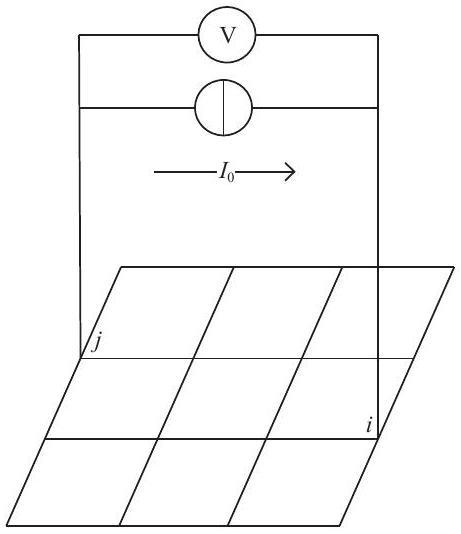
变电所接地网是由接地金属(镀锌扁钢、镀锡铜绞线)经水平和坚直连接而成的网状结构。接地网通常埋设于地下 1.3 m 处,通过引上线与电力设备相连,对设备起到保护作用。接地网电阻远低于土壤电阻,因此从接地网引下线注入直流激励时可忽略土壤散流,认为接地网是由各支路电阻组成的纯电阻网络 [22] ,如图1所示。
图1 接地网端口测量模型

Fig. 1 Grounding grid port measurement model

根据电网络理论,向结构参数已知的接地网端口注入电流激励 I0 可得任意2端口间电阻。
首先,节点导纳矩阵计算式为
$\begin{array}{c}{\mathit{Y}}_{\mathit{n}}=\mathit{A}{\mathit{Y}}_{\mathit{b}}{\mathit{A}}^{\mathrm{T}}\end{array}$
式中: Yn 为节点导纳矩阵;n 为接地网节点数;A 为关联矩阵; Yb 为支路导纳矩阵;b 为支路数。
Yn 可得节点电压矩阵为
$\begin{array}{c}{\mathit{U}}_{\mathit{n}}={\mathit{Y}}_{\mathit{n}}^{-1}{\mathit{I}}_{\mathit{n}}\end{array}$
式中: Un 为节点电压矩阵; In 为节点电流向量。
因此可计算各端口电阻 Rij
$\begin{array}{c}{\mathit{R}}_{\mathit{i}\mathit{j}}=\frac{{\mathit{U}}_{\mathit{i}\mathit{j}}}{{\mathit{I}}_{0}}\end{array}$
式中:Rij 为腐蚀前端口电阻;下标 ij 为节点 ij 形成的端口 ij;Uij 为腐蚀前端口 ij 的电压。
式(1)~(3)可表示为
$\begin{array}{c}{\mathit{R}}_{\mathit{i}\mathit{j}}=\mathit{f}\left({\mathit{R}}_{1},{\mathit{R}}_{2},\cdots,{\mathit{R}}_{\mathit{b}}\right)\end{array}$
式中: ${\mathit{R}}_{1},{\mathit{R}}_{2},\cdots,{\mathit{R}}_{\mathit{b}}$ 为腐蚀前各支路电阻值。
当计算的端口电阻与测量的实际端口电阻相同,则说明网络参数预测正确,表示为
$F_{(i)}=\min\big(R_{ij}'(i)-f_{(i)}(R_{1}',R_{2}',\dots,R_{k}',\dots,R_{b}')\big),\quad(i=1,2,\dots,m)$
式中:F(i) 为端口 i 的目标函数; ${\mathit{R}}_{\mathit{i}\mathit{j}}^{\mathit{\text{'}}}\left(\mathit{i}\right)$ 为腐蚀后第i 个测量端口电阻; ${\mathit{f}}_{\left(\mathit{i}\right)}\left({\mathit{R}}_{1}^{\mathit{\text{'}}},{\mathit{R}}_{2}^{\mathit{\text{'}}},\cdots,{\mathit{R}}_{\mathit{b}}^{\mathit{\text{'}}}\right)$ 为腐蚀后第i 个计算端口电阻值; ${\mathit{R}}_{\mathit{k}}^{\mathit{\text{'}}}(\mathit{k}=1,\cdots,\mathit{b})$ 为腐蚀后预测的第 k 个支路电阻;m 为端口数量。
因此总目标函数 Fm
$F_m=\sum _{i=1}^{m}{F_{i}}$
式(6)使用优化算法将非线性欠定方程组问题转化为目标函数最小值问题 [23] 。设支路电阻放大倍数 $\mathit{x}={\mathit{R}}_{\mathit{k}}^{\mathit{\text{'}}}/{\mathit{R}}_{\mathit{k}}(\mathit{x}>1)$ 为优化算法求解量。
测量端口质量越高,构建的方程组越完备,则腐蚀预测越准确。但接地网网格间距平均为15 m ,可及节点间隔较远,不便进行端口大量测量 [24] 。因此在有限测量条件下,端口的选择决定了诊断的精度,需要通过优选端口在有限测量中提取更多信息。

1.2 端口灵敏度

注入恒流激励,支路电阻与节点电压关系为
$\begin{array}{c}\underset{\mathrm{\Delta }{\mathit{R}}_{\mathit{k}}\to 0}{\mathrm{l}\mathrm{i}\mathrm{m}} \frac{\mathrm{\Delta }{\mathit{U}}_{\mathit{n}}}{\mathrm{\Delta }{\mathit{R}}_{\mathit{k}}}=\frac{\partial {\mathit{U}}_{\mathit{n}}}{\partial {\mathit{R}}_{\mathit{k}}}=\frac{\partial {\mathit{Y}}_{\mathit{n}}^{-1}}{\partial {\mathit{R}}_{\mathit{k}}}{\mathit{I}}_{\mathit{n}}\end{array}$
式(7)可变化为
$\begin{array}{c}\frac{\partial {\mathit{U}}_{\mathit{n}}}{\partial {\mathit{R}}_{\mathit{k}}}=-{\mathit{Y}}_{\mathit{n}}^{-1}\mathit{A}\frac{\partial {\mathit{Y}}_{\mathit{b}}}{\partial {\mathit{R}}_{\mathit{k}}}{\mathit{A}}^{\mathrm{T}}{\mathit{Y}}_{\mathit{n}}^{-1}{\mathit{I}}_{\mathit{n}}\end{array}$
式(8)定义了 UnRk 的灵敏度向量 dUn/dRk ,表示在给定恒流激励下,各节点电压随支路电阻变化的响应程度。将 dUn/dRk 中任意2个节点 ij 的灵敏度值相减得到
$\begin{array}{c}{\mathit{S}}_{\mathit{i}\mathit{j}\mathit{k}}=\frac{\partial {\mathit{U}}_{\mathit{i}\mathit{j}}}{\partial {\mathit{R}}_{\mathit{k}}}=\frac{\partial {\mathit{U}}_{\mathit{n}\left(\mathit{i}\right)}}{\partial {\mathit{R}}_{\mathit{k}}}-\frac{\partial {\mathit{U}}_{\mathit{n}\left(\mathit{j}\right)}}{\partial {\mathit{R}}_{\mathit{k}}}\end{array}$
式中:Sijk 为端口电压 Uij 对支路电阻 Rk 的灵敏度值。
由于激励电流幅值恒定,端口电压变化率与端口电阻变化率一致,因此该灵敏度即为支路电阻对端口电阻的灵敏度。端口灵敏度受接地网结构、支路位置与端口距离等因素影响,同一支路对不同端口的灵敏度差异显著 [21]

2 接地网腐蚀诊断端口优选方法

2.1 覆盖率定义

端口灵敏度越高,代表该支路电阻变化对端口电阻的影响越显著,端口蕴含的支路状态信息越丰富。优选端口时,应追求对各支路均有较高灵敏度,以实现接地网状态信息的全面覆盖。
由式(9)可知,每个测量端口对任意支路都有1个灵敏度值,可建立端口-支路灵敏度矩阵S ,即
$\begin{array}{c}\mathit{S}=\left[\begin{array}{cccc}{\mathit{S}}_{11}& {\mathit{S}}_{12}& \cdots & {\mathit{S}}_{1\mathit{b}}\\ {\mathit{S}}_{21}& {\mathit{S}}_{22}& \cdots & {\mathit{S}}_{2\mathit{b}}\\ ⋮& ⋮& \ddots & ⋮\\ {\mathit{S}}_{\mathit{m}1}& {\mathit{S}}_{\mathit{m}2}& \cdots & {\mathit{S}}_{\mathit{m}\mathit{b}}\end{array}\right]\end{array}$
式中:Spk 为第 p 个端口对第 k 条支路电阻变化的灵敏度值。
定义支路 k 的覆盖率 Ck 为所有已选端口对该支路灵敏度绝对值之和,用以量化端口组合对该支路信息的覆盖程度,计算式为
$\begin{array}{c}{\mathit{C}}_{\mathit{k}}=\sum _{\mathit{p}\in {\mathrm{\Omega }}_{\text{sel}\text{ }}}  \left|{\mathit{S}}_{\mathit{p}\mathit{k}}\right|\end{array}$
式中:Ωsel  为已选端口集合。
覆盖率 Ck 越大,表明该支路信息越丰富 [20] 。端口优选旨在通过有限端口尽可能覆盖更多支路,理论上 Ck 足够高时,端口组合可反映接地网完整状态。然而仅依赖覆盖率易导致信息冗余与支路覆盖不均,为此需要引入多权重机制,从信息互补性、数值稳定性及覆盖均衡性 3 个方面协同优化端口优选 [25]

2.2 加权覆盖率评价模型

2.2.1 端口权重设计

为减少端口信息冗余,须设计权重以量化端口间的信息互补性,同时确保测量方程组具有良好数值稳定性 [26-27] 。端口 i 权重 Wi
$\begin{array}{c}{\mathit{W}}_{\mathit{i}}={\mathit{W}}_{\text{ortho}\text{ },\mathit{i}}{\mathit{W}}_{\text{cond}\text{ },\mathit{i}}\end{array}$
式中:Wortho ,i 为端口 i 信息互补性权重;Wcond ,i 为端口 i 数值稳定性权重。
1)正交性权重 Wortho ,i 用于确保端口信息互补,能够量化候选端口 i 与已选端口集之间的信息差异度。该权重基于灵敏度空间中的向量夹角计算,夹角越大表明信息互补性越强 [28] ,即
$\begin{array}{c}{\mathit{W}}_{\text{ortho}\text{ },\mathit{i}}=\frac{2}{\mathit{\pi }}\underset{\mathit{j}\in \mathrm{\Omega }\text{ }\text{sel}\text{ }}{\mathrm{m}\mathrm{i}\mathrm{n}} \left({\mathit{\theta }}_{\mathit{i},\mathit{j}}\right)\end{array}$
$\begin{array}{c}{\mathit{\theta }}_{\mathit{i},\mathit{j}}=\mathit{a}\mathit{r}\mathit{c}\mathit{c}\mathit{o}\mathit{s}\left(\left|\frac{{\mathit{S}}_{\mathit{i}}{\mathit{S}}_{\mathit{j}}}{‖{\mathit{S}}_{\mathit{i}}‖‖{\mathit{S}}_{\mathit{j}}‖}\right|\right)\end{array}$
式中:θi,j 为候选端口 i 与已选端口 j 的灵敏度向量 SiSj 之间的夹角。
正交性权重 Wortho ,i 通过计算候选端口与已选端口灵敏度向量间的最小夹角,评估其信息相似度,夹角越小,信息重叠度越高,权重越低。权重优先选取信息差异最大的端口。
2)条件数权重 Wcond ,i 用于确保端口数值稳定。接地网腐蚀诊断为参数反演问题,其数值稳定性取决于灵敏度矩阵的条件数 [29-30] 。引入 Wcond ,i 评估候选端口对后续算法预测的稳定性,即
$\begin{array}{c}{\mathit{W}}_{\text{cond}\text{ },\mathit{i}}=\frac{1}{1+\mathrm{l}\mathrm{o}\mathrm{g}\left[\mathit{\kappa }\left({\mathit{S}}_{\text{new}\text{ }}^{\mathrm{T}}{\mathit{S}}_{\text{new}\text{ }}\right)\right]}\end{array}$
式中: Snew  为加入候选端口后的灵敏度矩阵;κ(⋅)为矩阵条件数运算符号。
接地网腐蚀诊断须求解反问题方程组 (STSR=STΔU ,其依赖于 Gram 矩阵的条件数,条件数过大将导致误差在求解过程中被放大。条件数权重Wcond ,i 从数值稳定性角度评估端口价值,预先考察候选端口对条件数 $\mathit{\kappa }\left({\mathit{S}}_{\text{new}\text{ }}^{\mathrm{T}}{\mathit{S}}_{\text{new}\text{ }}\right)$ 的影响。同时引入log 函数,抑制条件数的影响程度,使其能够排除极端病态端口。
3)完整端口权重。综上,端口权重 Wi
$\begin{array}{c}{\mathit{W}}_{\mathit{i}}=\frac{1}{1+\mathrm{l}\mathrm{o}\mathrm{g}\left[\mathit{\kappa }\left({\mathit{S}}_{\text{new}\text{ }}^{\mathrm{T}}{\mathit{S}}_{\text{new}\text{ }}\right)\right]}\frac{2}{\mathit{\pi }}\underset{\mathit{j}\in \mathrm{\Omega }\mathrm{s}\mathrm{e}\mathrm{l}}{\mathrm{m}\mathrm{i}\mathrm{n}} \left({\mathit{\theta }}_{\mathit{i},\mathit{j}}\right)\end{array}$
条件数权重 Wcond ,i 用于避免选择极端病态端口;正交性权重 Wortho ,i 用于避免选择与已选端口信息高度相似的候选端口。

2.2.2 支路权重设计

为解决支路覆盖率分布不均衡导致的诊断盲区问题,引入支路权重 αk ,对覆盖率落后的支路k 提供补偿,即
$\begin{array}{c}{\mathit{\alpha }}_{\mathit{k}}=\frac{1+\mathit{\beta }\mathrm{t}\mathrm{a}\mathrm{n}\mathrm{h}\left(\frac{{\mathit{\mu }}_{\mathrm{C}}-{\mathit{C}}_{\mathit{k}}}{{\mathit{\sigma }}_{\mathrm{C}}}\right)}{{\mathit{C}}_{\mathit{k}}+\mathit{\epsilon }}\end{array}$
式中:μC 为所有支路的平均覆盖率;σC 为覆盖率的标准差;β 为分布敏感系数;ε 为防止分母为零的极小常数,本文取 1×10⁻⁶
αk 通过 μCCk 进行调节:当 μC>Ck 时,αk增大,提升低覆盖率支路权重;当 μC<Ck 时, αk 减小,降低高覆盖率支路权重。并通过分母 (Ck+ε)直接实现 Ck 越低、 αk 越大的效果。
分布敏感系数 β 根据端口优选阶段(由 μC 判断)与整体覆盖率均衡程度( 1-E )调整惩罚强度,即
$\begin{array}{c}\mathit{\beta }=2(1-\mathit{E})\left[1-\frac{1}{1+{\mathrm{e}}^{-15\left({\mathit{\mu }}_{\mathrm{C}}-0.128\right)}}\right]\end{array}$
式中:E 为覆盖率分布的归一化信息熵,用于量化整体均衡程度 [31]
β 通过 2 个因子的乘积以同时考虑覆盖率分布的均衡程度和端口优选阶段,各参数经网格搜索法确定。当支路覆盖率均衡时,(1-E) 趋于 0, β值减小,减小调节作用;当分布不均衡时,(1-E)趋于 1, β 值增大,增强调节作用。后半部分sigmoid 函数依据平均覆盖率 μC 调整 β 的调节作用,在覆盖初期( μC<0.128 )增强干预,在覆盖后期随 μC 增大适当减弱干预,避免过度惩罚。 E 的计算式为
$\begin{array}{c}\mathit{E}=\frac{-\sum _{\mathit{i}=1}^{\mathit{b}}  \left[{\mathit{p}}_{\mathit{i}}\mathrm{l}\mathrm{o}\mathrm{g}\left({\mathit{p}}_{\mathit{i}}+{10}^{-10}\right)\right]}{\mathrm{l}\mathrm{o}\mathrm{g}\left(\mathit{b}\right)}\end{array}$
$\begin{array}{c}{\mathit{p}}_{\mathit{i}}=\frac{{\mathit{C}}_{\mathit{i}}}{\sum _{\mathit{j}=1}^{\mathit{b}}  {\mathit{C}}_{\mathit{j}}}\end{array}$
式中:pi 为支路 i 概率质量。
综上,支路权重 αk 在端口优选初期关注绝对灵敏度值 $\left|{\mathit{S}}_{\mathit{i}\mathit{k}}\right|$ ;中期随着端口增加,覆盖率出现不均,αk 开始关注低覆盖率支路;后期覆盖率趋于均匀,αk 调节作用减弱,更关注其余指标。

2.2.3 端口得分函数

候选端口 i 得分 vscore ,i
$\begin{array}{c}{\mathit{v}}_{\text{score}\text{ },\mathit{i}}={\mathit{W}}_{\mathit{i}}\sum _{\mathit{k}=1}^{\mathit{b}}  \left(\left|{\mathit{S}}_{\mathit{i}\mathit{k}}\right|{\mathit{\alpha }}_{\mathit{k}}\right)\end{array}$
得分函数通过端口权重 Wi 评估数值稳定性与信息互补性,由支路权重 αk 动态补偿低覆盖支路,从而在单次选择中兼顾信息全面性与均衡性,构成端口优选的基础模型 [32]

2.3 端口迭代优选

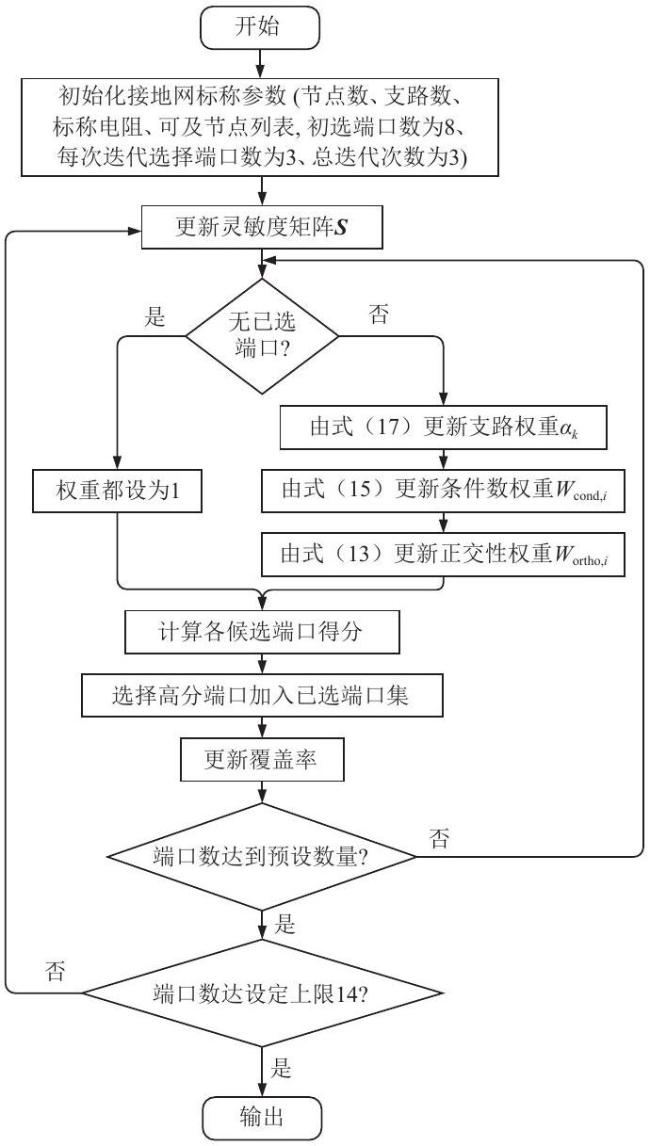
端口优选与腐蚀诊断皆依赖于灵敏度矩阵 S的准确性。然而 S 基于支路电阻仅发生微小变化的假设,而实际支路电阻变化会使 S 偏离真实结果,进而影响端口优选与诊断精度 [33-35] 。因此引入端口迭代优选与 S 更新机制,每轮诊断依据当前支路电阻估计值更新 S ,并重新计算权重、新增端口。该方法不仅使 S 逐步逼近实际网络,同时优化端口组合提升腐蚀诊断精度。整体流程如图2所示,详细步骤如下。
1)初始化。根据接地网施工图输入节点数
图2 端口优选算法流程

Fig. 2 Port optimization algorithm flowchart

n 、支路数 b 、支路标称电阻 Rk 、可及节点列表,设置初选端口数为8、每次迭代选择端口数为3、总迭代次数为 3 。由当前支路电阻值计算端口-支路灵敏度矩阵 S
2)端口优选。
(1)若还未选取端口,则令各权重为 1 ;否则由式(17)(15)(13)更新各权重值,后由式(21)计算各候选端口的综合得分。
(2)选取得分最高的端口加入已选端口集合,更新各支路覆盖率。
(3)若本次迭代已选端口数未达预设数量(初次迭代为 8,后续迭代为 3),则返回步骤(1);否则使用当前已选端口进行腐蚀诊断,得到支路电阻估计值。
3)更新灵敏度矩阵。基于新估计的支路电阻由式(8)(9)重新计算灵敏度矩阵 S
4)终止迭代判断。若已选端口总数达到 14则输出支路电阻诊断结果;否则返回步骤2)继续迭代。

3 算例分析

3.1 模拟接地网模型

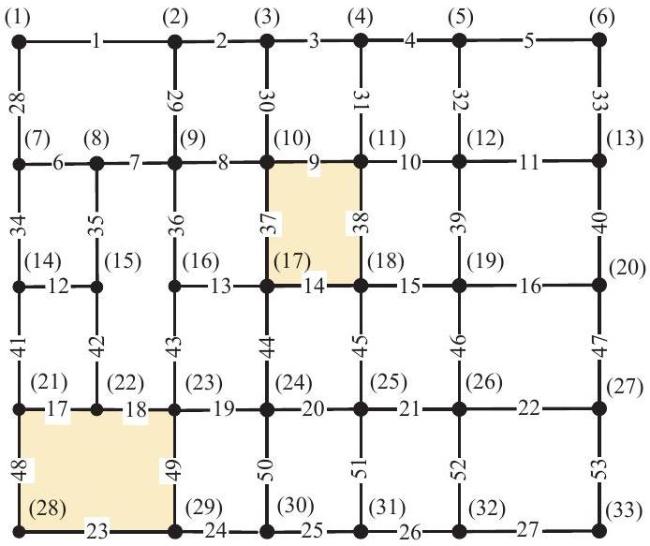
宁夏银川某变电站接地网部分网络拓扑结构如图3所示,该接地网有33个节点和53条支路,其中节点1、2、4、6、7、8、9、11、13、14、 15 、 16 、 18 、 20 、 21 、 22 、 23 、 25 、 27 、 31 为可及节点,设节点 33 为参考节点。各支路电阻的标称值如表1所示。
图3 接地网拓扑结构

Fig. 3 Grounding grid topology

表 1 支路电阻标称值

Table 1 Nominal branch resistance values

支路编号 Rk/mΩ 支路编号 Rk/mΩ 支路编号 Rk/mΩ
1 15.86 19 9.37 37 12.43
2 9.37 20 9.37 38 12.43
3 9.37 21 9.37 39 12.43
4 9.37 22 14.24 40 12.43
5 14.24 23 15.86 41 12.43
6 7.96 24 9.37 42 12.43
7 7.96 25 9.37 43 12.43
8 9.37 26 9.37 44 12.43
9 9.37 27 14.24 45 12.43
10 9.37 28 12.43 46 12.43
11 14.24 29 12.43 47 12.43
12 7.96 30 12.43 48 12.43
13 9.37 31 12.43 49 12.43
14 9.37 32 12.43 50 12.43
15 9.37 33 12.43 51 12.43
16 14.24 34 12.43 52 12.43
17 7.96 35 12.43 53 12.43
18 7.96 36 12.43
考虑实际接地网具有区域性腐蚀的特点,假设支路9、14、37、38发生较严重腐蚀,其支路电阻放大倍数 x 为2.5;支路17、18、23、48、49发生较轻腐蚀,其支路电阻放大倍数 x 为 1.5 ;其余各支路阻值不变。腐蚀区域在图3中用阴影区表示。

3.2 端口优选过程与结果分析

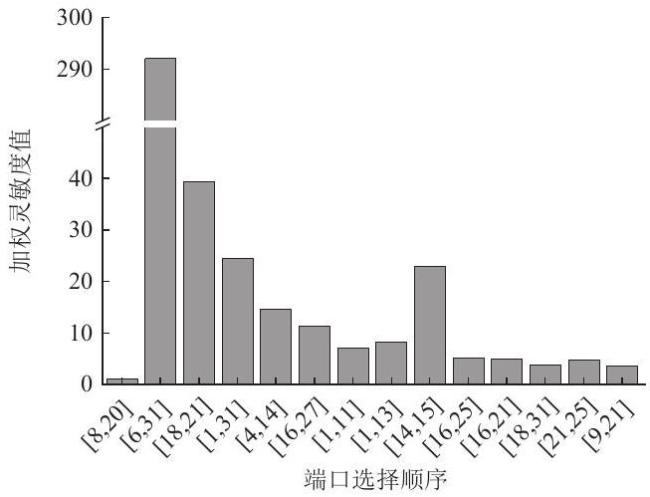
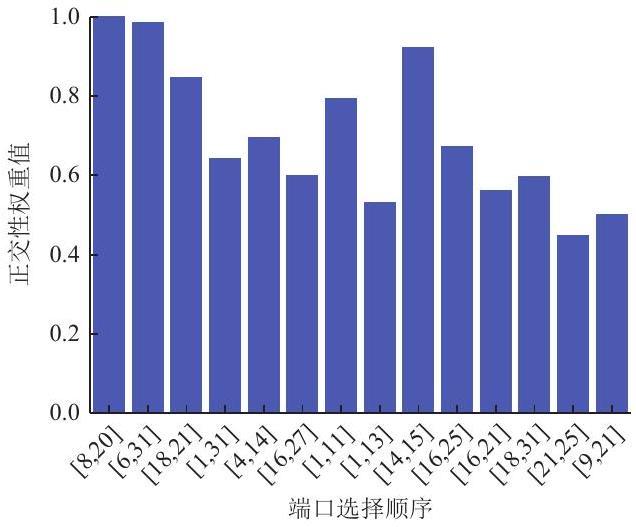
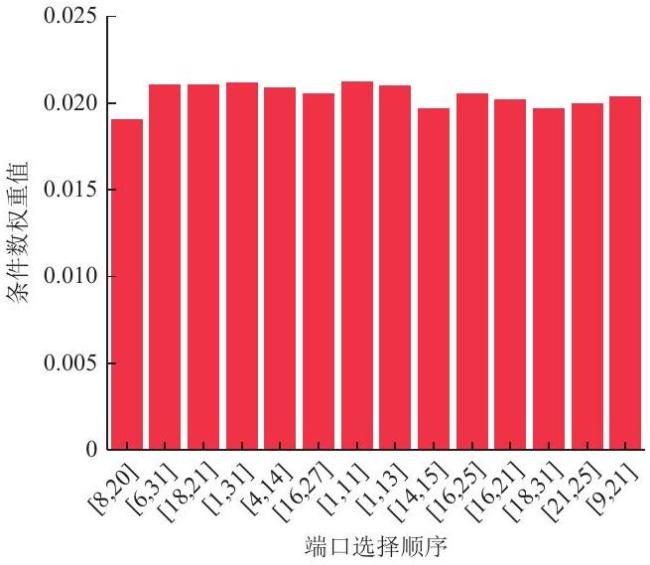
首次从190个候选端口中,依据式(21)计算端口得分,择优选取8组端口;随后基于当前支路电阻估计值更新灵敏度矩阵,重新计算得分并增选 3 组端口,依次迭代,直至端口总数达到14组。最后选择的14组端口各权重值、排名与得分情况如表2所示,其中加权灵敏度为 $\left|{\mathit{S}}_{\mathit{i}\mathit{k}}\right|{\mathit{\alpha }}_{\mathit{k}}$ 对应支路权重。14 组端口的 3 个权重值如图4~6所示。
图4可知:1)加权灵敏度值整体呈下降趋势,这是由于高灵敏度端口被优先选择后,各支路覆盖率 Ck 增加,导致权重 αk 衰减;2)中期端口 [14,15] 处出现明显上升,源于覆盖率分布不均时调节系数 β 增强,使低覆盖率支路的 αk 值提升;3)后期平均覆盖率 μC 增高,β 的抑制增强,αk 调节作用减小,加权灵敏度值趋于平稳。
表2 各端口权重值、得分及其百分位排名结果

Table 2 Weight value,score,and corresponding per- centile ranking results of each port

迭代次数 被选端口 端口得分 加权灵敏度值 条件数权重值 加权灵 正交性
正交性
条件数
敏度百分位排名/% 权重百分位排 权重百分位排
名/% 名/% 名/%
1 [8,20] 0.0189 0.993 1.000 0.019 98.95 0.00 31.05
1 [6,31] 6.0544 292.090 0.986 0.021 97.88 97.35 99.47
1 [18,21] 0.7040 39.397 0.848 0.021 90.96 86.70 91.49
1 [1,31] 0.3327 24.463 0.642 0.021 98.93 53.48 91.98
1 [4,14] 0.2131 14.656 0.696 0.021 88.17 85.48 68.82
1 [16,27] 0.1387 11.258 0.600 0.021 85.41 78.38 40.00
1 [1,11] 0.1197 7.114 0.793 0.021 40.22 95.11 94.57
1 [1,13] 0.0924 8.304 0.530 0.021 83.06 76.50 78.69
2 [14,15] 0.4151 22.928 0.921 0.020 99.45 99.45 19.23
2 [16,25] 0.0722 5.212 0.674 0.021 46.96 92.82 87.85
2 [16,21] 0.0567 5.005 0.562 0.020 58.33 85.00 55.56
3 [18,31] 0.0445 3.786 0.598 0.020 30.73 87.71 59.22
3 [21,25] 0.0427 4.767 0.449 0.020 67.42 76.40 84.83
3 [9,21] 0.0374 3.649 0.502 0.020 43.50 81.92 99.44
图4 各端口加权灵敏度值分布

Fig. 4 Weighted sensitivity value distribution of each port

上述3点反映出 αk 的设计机制:初期侧重高灵敏度支路,中期强化对低覆盖支路的补偿,后期则减弱调节以平衡其他指标。
图 5 可知:1)正交性权重值整体呈下降趋势,这是因为随着已选端口集合 Ωsel  增大,新选端口难以与 Ωsel 保持较大夹角,导致权重降低;2)权重值下降中存在多个凸起,源于每次选择端口后,Ωsel  更新,新选端口被重新评估,同时表明该端口有 Ωsel  未能充分表达的信息。上述2点反映出正交性权重通过动态评估端口间的信息互补性,减少信息冗余。
图5 各端口正交性权重值分布

Fig. 5 Orthogonality weight distribution of each port

图6 各端口条件数权重值分布

Fig. 6 Condition number weight distribution of each port

图6可知,条件数权重值稳定在0.019~0.021 ,整体变化幅度很小。表明端口优选集中在支路覆盖率最大化和信息互补性优化上。
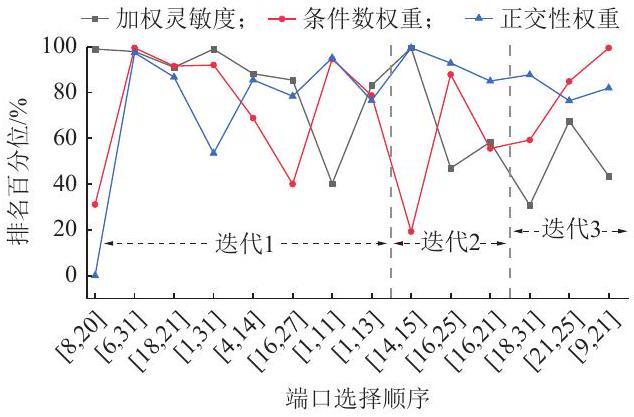
通过 3 次迭代完成端口优选,其结果及权重排名百分位如图7所示。
图7 3种权重百分位排名随端口优选顺序的演化

Fig. 7 Evolution of three weight percentile rankings with port selection sequence

图7可知:1)正交性权重排名始终保持在高位(平均排名84.33%),表明算法始终重视端口间信息互补性;加权灵敏度前中期排名高,后期降落,符合其在不同端口优选阶段的调节作用;条件数权重在后期起主导作用,在即将完成时避免引入数值不稳定端口;2)各权重排名动态变化,主导权重随阶段变化,表明算法能避免对单一准则的依赖,优选出信息全面、互补且稳定的最优组合。

3.3 消融实验与对比分析

各实验结果对比如表3所示。以无权重贪婪选择为基准,即不采用权重下每次选取最高分数端口,后续依次加入条件数权重、正交性权重、支路均衡权重及 3 者组合。
表3中,基尼系数 G 越低表示覆盖率约均匀,其计算式为
$\begin{array}{c}\mathit{G}=\frac{\mathit{b}+1-\frac{2}{{\mathit{C}}_{\text{sum}\text{ }}}\sum _{\mathit{i}=1}^{\mathit{b}}  {\mathit{C}}_{\mathit{i}}}{\mathit{b}}\end{array}$
式中:Csum  为总覆盖率。
表3 消融实验结果

Table 3 Ablation experiment results

实验组别 MAPE/% 覆盖率基尼系数 计算时间/s
贪婪选择(基准) 34.83 0.6633 27.7585
贪婪选择 + 条件数权重 26.49 0.6716 36.7552
贪婪选择+正交性权重 18.08 0.6712 28.5899
贪婪选择+支路均衡权重 15.57 0.5674 32.3481
贪婪选择 +3 种权重结合 5.70 0.5115 28.9802
结果表明,单独引入条件数权重、正交性权重、支路均衡权重分别使平均绝对百分比误差(mean absolute percentage error,MAPE)降低8.34、16.75、19.26 个百分点,且支路均衡权重显著改善覆盖均衡性(基尼系数下降0.096)。3种权重结合时,MAPE降低29.13个百分点,基尼系数降低0.1518,验证了多权重协同优化的必要性与优越性。

4 结论

针对现有接地网腐蚀诊断方法的端口优选缺乏科学指导,导致电网络法使用受限的问题,本文提出了一种基于加权覆盖率与多权重协同优化的端口优选方法,并以包含53条支路的模拟变电站接地网为例进行了仿真验证。主要结论如下。
1)支路均衡权重能够依据当前覆盖率分布的均值与信息熵动态调整其补偿强度,在端口优选初期侧重高灵敏度支路,中期强化对低覆盖率支路的补偿,后期减小调节效果注重其他权重,从而实现对全网支路信息的均衡有效覆盖。
2)构建了基于迭代更新与多权重协同的动态优选框架。该框架通过诊断、反馈、递推、修正灵敏度矩阵,并在迭代过程中使正交性权重、条件数权重与支路均衡权重动态协同,系统兼顾端口信息互补性、诊断方程数值稳定性与支路均衡覆盖,从而从候选端口中筛选出信息全面、互补且稳定的最优组合。
3)在 53 条支路的接地网模型中,经该方法优选14组端口,使 MAPE 从34.83%降低至5.7%,同时信息覆盖均衡性改善(基尼系数从0.6633优化至0.5115),验证了其在提升诊断精度与信息全面性方面的有效性。
本文所提方法中端口数量依靠经验设定,缺乏与网络结构的理论关联。后续将构建不同拓扑规模的接地网样本库,通过仿真确定诊断精度的拐点端口数并作为输入,再引入图神经网络学习网络结构与端口数量的映射,实现端口数量的自适应配置。
[1]
王永红, 焦重庆, 肖冰, 等. 变电站接地网上两点间电位差的特性[J]. 中国电力, 2021, 54(1):150-158.

WANG Yonghong, JIAO Chongqing, XIAO Bing, et al. The potential difference characteristics between two points on grounding grid of substation[J]. Electric Power, 2021, 54(1):150-158.

[2]
宋智伟, 黄新波, 纪超, 等. 基于 PCSA-YOLOv7 Former 的输电线路连接金具及其锈蚀检测方法[J]. 中国电力, 2024, 57(6): 141-152.

SONG Zhiwei, HUANG Xinbo, JI Chao, et al. Transmission line connection fittings and corrosion detection method based on PCSA-YOLOv7 Former[J]. Electric Power, 2024, 57(6):141-152.

[3]
ZHANG Y X, ZHANG L H, LIU H, et al. Synergistic effects of CI-/ SO42-and sulfate-reducing bacteria on the grounding grid corrosion:performance,metabolites and mechanisms[J]. Journal of Environmental Management, 2026, 400: 128807.

[4]
YANG J C, ZAYED T, ARIMIYAW D, et al. Structural failure in urban sewer pipelines:a comprehensive review from analysis to intervention techniques[J]. Tunnelling and Underground Space Technology, 2026, 167: 107027.

[5]
XUE J, GAO F, LI Z, et al. Corrosion and fracture localization in grounding grids and state evaluation based on analysis of the evolution of magnetic field distributions[J]. Applied Sciences, 2025, 15(22): 12079.

[6]
ZHAO J, MENG X, REN X, et al. Review on soil corrosion and protection of grounding grids[J]. Materials, 2024, 17(2): 507.

[7]
SONG H L, XIONG Y X, ZHAO Q P. Topological image reconstruction of regular grounding network based on Hough transform[J]. IEEE Sensors Journal, 2024, 24(17):27587-27596.

[8]
刘任, 曾宇, 胡安龙, 等. 电工装备硅钢磁心静态磁滞改进模拟方法[J]. 中国电力, 2025, 58(7):137-146.

LIU Ren, ZENG Yu, HU Anlong, et al. Modified static hysteresis simulation method for electrical equipment with silicon steel core[J]. Electric Power, 2025, 58(7):137-146.

[9]
HUO M Z, DENG Y M, DUAN H B. Cauchy-Gaussian pigeon-inspired optimisation for electromagnetic inverse problem[J]. International Journal of Bio-Inspired Computation, 2021, 17(3): 182.

[10]
HUANG L S, XIAO X H, HUANG M X, et al. Research on grounding grid corrosion diagnosis based on genetic K-means algorithm[J]. Energy Science&Engineering, 2025, 13(6): 3074-3087.

[11]
陈祥文, 刘阳, 赵青春, 等. 基于拖尾电流识别的断路器失灵保护判据与延时优化[J]. 中国电力, 2025, 58(6):198-205.

CHEN Xiangwen, LIU Yang, ZHAO Qingchun, et al. Criterion and delay optimization of circuit breaker failure protection based on tail current recognition[J]. Electric Power, 2025, 58(6):198-205.

[12]
田鑫, 靳晓凌, 韩新阳, 等. 基于机器学习算法的新型电力系统中电网投资成效评价及投资推演[J]. 中国电力, 2025, 58(7):197-206.

TIAN Xin, JIN Xiaoling, HAN Xinyang, et al. Evaluation of grid investment effectiveness and investment simulation for new-type power systems based on machine learning algorithm[J]. Electric Power, 2025, 58(7):197-206.

[13]
CHEN J H, QI J Y, AO Y Y, et al. A solution method for non-linear underdetermined equation systems in grounding grid corrosion diagnosis based on an enhanced hippopotamus optimization algorithm[J]. Biomimetics, 2025, 10(7): 467.

[14]
王雪, 刘林, 刘文迪, 等. 基于纵横交叉算法的新型电力系统惯量延迟优化控制策略[J]. 中国电力, 2024, 57(7):12-20.

WANG Xue, LIU Lin, LIU Wendi, et al. A novel inertia delay optimization control strategy for new power systems based on crisscross optimization[J]. Electric Power, 2024, 57(7):12-20.

[15]
詹花茂, 郭明鑫, 刘春江, 等. 基于正则化最小二乘法的接地网腐蚀状态评估方法[J]. 腐蚀与防护, 2022, 43(6):79-85, 113.

ZHAN Huamao, GUO Mingxin, LIU Chunjiang, et al. Corrosion state assessment method of grounding grid based on regularized least square method[J]. Corrosion&Protection, 2022, 43(6):79-85, 113.

[16]
刘渝根, 王硕, 田金虎, 等. 接地网腐蚀诊断优化测量方法[J]. 重庆大学学报, 2008, 31(11):1303-1306.

LIU Yugen, WANG Shuo, TIAN Jinhu, et al. A corrosion diagnosis method for optimized measurement of grounding grids[J]. Journal of Chongqing University, 2008, 31(11):1303-1306.

[17]
刘健, 李腾, 倪云峰, 等. 接地网故障诊断测试方案的自动生成方法[J]. 高电压技术, 2009, 35(7):1578-1582.

LIU Jian, LI Teng, NI Yunfeng, et al. Automatically generated method of test schemes for grounding grids corrosion diagnosis[J]. High Voltage Engineering, 2009, 35(7):1578-1582.

[18]
刘健, 王建新, 卢伟, 等. 基于蒙特卡罗模拟的接地网支路可测性分析的改进方法[J]. 电测与仪表, 2009, 46(12):9-13, 24.

LIU Jian, WANG Jianxin, LU Wei, et al. An improved approach of Monte-Carlo simulation based testability evaluation of grounding grids corrosion diagnosis[J]. Electrical Measurement& Instrumentation, 2009, 46(12):9-13, 24.

[19]
刘渝根, 孟宪, 田金虎, 等. 接地网故障诊断中测量节点对选取方法分析[J]. 重庆大学学报(自然科学版), 2010, 33(1):73-77.

LIU Yugen, MENG Xian, TIAN Jinhu, et al. Analysis on the method of selecting nodes on the erosion diagnosis of grounding grid[J]. Journal of Chongqing University(Natural Science Edition), 2010, 33(1):73-77.

[20]
刘健, 王建新, 王森. 一种改进的接地网故障诊断算法及测试方案评价[J]. 中国电机工程学报, 2005, 25(3):71-77.

LIU Jian, WANG Jianxin, WANG Sen. An lmproved algorithm of corrosion diagnosis for grounding grids&lts evaluation[J]. Proceedings of the CSEE, 2005, 25(3):71-77.

[21]
谢炀, 杨鑫, 黄亚飞, 等. 基于凝聚层次聚类的接地网定向支路减维腐蚀诊断优化方法[J]. 高电压技术, 2024, 50(4):1723-1730.

XIE Yang, YANG Xin, HUANG Yafei, et al. Optimization method for dimension-reduction corrosion diagnosis of directional branch of grounding grid based on condensation hierarchical clustering[J]. HighVoltage Engineering, 2024, 50(4):1723-1730.

[22]
张迅, 曾鹏, 黄道春, 等. 接地体与土壤接触电阻的测试评估方法及应用[J]. 高电压技术, 2021, 47(2):687-694.

ZHANG Xun, ZENG Peng, HUANG Daochun, et al. Measurement and assessment method of contact resistance between grounding conductor and soil and its application[J]. High Voltage Engineering, 2021, 47(2):687-694.

[23]
HANU M, WEISSMANN S. On the ensemble Kalman inversion under inequality constraints[J]. Inverse Problems, 2024, 40(9): 095009.

[24]
AMARAL A B, PAULINO J O S, CAETANO C E F, et al. Substation grounding grid resistance measurement using auxiliary circuits vertically disposed on the ground[J]. Electric Power Systems Research, 2024, 233: 110497.

[25]
ALI HATEFI M. New aggregation multiple attribute methods based on indifference threshold and yearning threshold concepts[J]. Informatica, 2025:337-367.

[26]
裴梓翔, 舒恺, 周勋甜, 等. 基于信息融合的配网线路雷害风险评估[J]. 中国电力, 2024, 57(7):125-131.

PEI Zixiang, SHU Kai, ZHOU Xuntian, et al. Lightning risk assessment of distribution network line based on information fusion[J]. Electric Power, 2024, 57(7):125-131.

[27]
张惠山. 基于有效数据辨识及多维信息融合的高压 CVT 故障诊断方法[J]. 中国电力, 2025, 58(5):158-165.

ZHANG Huishan. High-voltage CVT fault diagnosis based on effective data recognition and multi-dimensional information fusion[J]. Electric Power, 2025, 58(5):158-165.

[28]
SURYA A, VIMALA J. Similarity measure for complex non-linear Diophantine fuzzy hypersoft set and its application in pattern recognition[J]. Information Sciences, 2025, 690: 121591.

[29]
BOLOTOV I. CLSP:linear algebra foundations of a modular two-step convex optimization-based estimator for ill-posed problems[J]. Mathematics, 2025, 13(21): 3476.

[30]
MEIER M K, NAKATSUKASA Y, TOWNSEND A, et al. Are sketch-and-precondition least squares solvers numerically stable?[J]. SIAM Journal on Matrix Analysis and Applications, 2024, 45(2): 905-929.

[31]
SHANNON C E. A mathematical theory of communication[J]. The Bell System Technical Journal, 1948, 27(4):623-656.

[32]
王海明, 王剑锋, 王仲源, 等. 融合切比雪夫距离和修正余弦相似度算法的保护二次回路测量误差识别方法[J]. 中国电力, 2025, 58(12):165-177.

WANG Haiming, WANG Jianfeng, WANG Zhongyuan, et al. Measurement error identification of protection secondary circuit by fusing Chebyshev distance and modified cosine similarity algorithms[J]. Electric Power, 2025, 58(12):165-177.

[33]
刘渝根, 许晓艳, 杨蕊菁, 等. 基于 Tikhonov 正则化原理的接地网腐蚀诊断方法[J]. 高电压技术, 2017, 43(8):2709-2717.

LIU Yugen, XU Xiaoyan, YANG Ruijing, et al. Corrosion diagnosis method for grounding grid based on Tikhonov regularized principle[J]. High Voltage Engineering, 2017, 43(8):2709-2717.

[34]
张绅, 刘崇新, 冯陈佳, 等. 一种应用于接地网故障诊断的混合算法[J]. 中国电机工程学报, 2019, 39(21):6419-6428.

ZHANG Shen, LIU Chongxin, FENG Chenjia, et al. A hybrid algorithm for fault diagnosis of grounding grids[J]. Proceedings of the CSEE, 2019, 39(21):6419-6428.

[35]
彭珑, 郭洁, 李晓峰. 微量处理法在变电站接地网腐蚀诊断中的应用[J]. 高电压技术, 2007, 33(7):199-202.

PENG Long, GUO Jie, LI Xiaofeng. Application of micro disposal technology in diagnosing the corrosion of grounding grid[J]. High Voltage Engineering, 2007, 33(7):199-202.

Options
Outlines

/