Mechanism-data fusion driven modeling for integrated energy systems under incomplete information
Received date: 2026-02-27
Revised date: 2026-07-15
Online published: 2026-09-04
Supported by
Science and Technology Project of SGCC(520201250010-075-ZN))
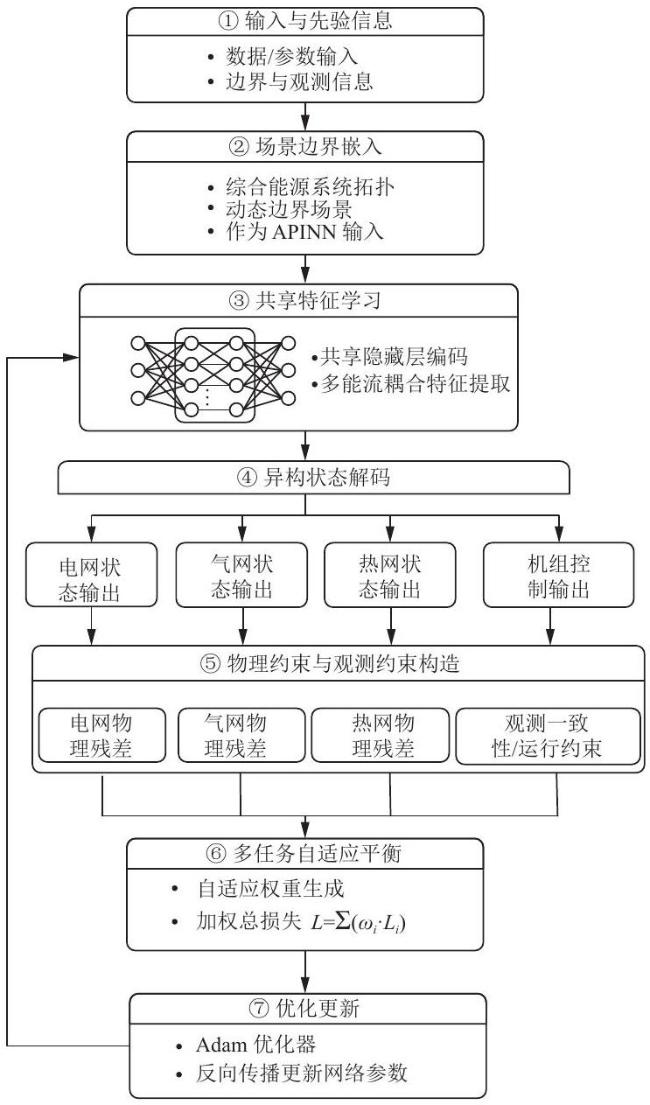
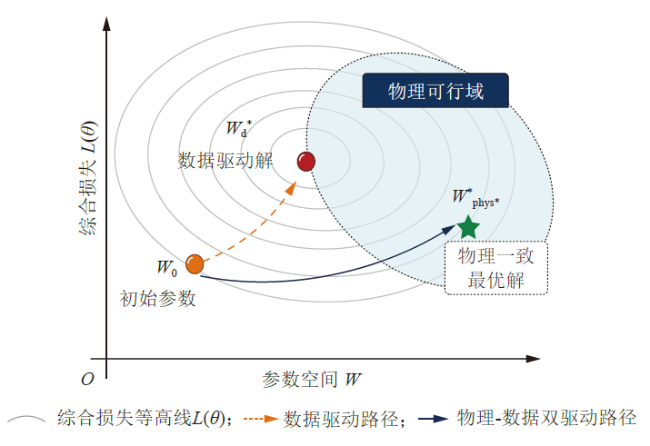
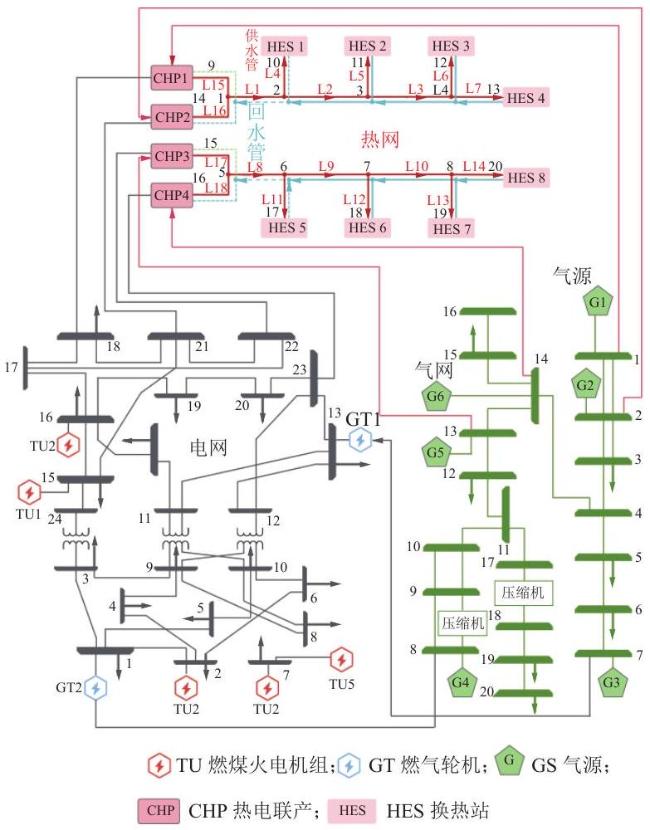
To address the incomplete information problems commonly existing in the actual operation of integrated energy systems(IES),such as sparse observation and missing measurement data,this paper proposes an adaptive physics- informed neural network(APINN)-driven mechanism-data fusion modeling method.Firstly,a unified mechanism-data fusion network framework is constructed,which embeds multi- energy flow physical mechanisms,including power flow of power grids,fluid dynamics of natural gas pipelines,and thermodynamics of heating pipelines,into the training objective in the form of residuals,and establishes observation consistency constraints with a small number of anchor measurements to alleviate convergence difficulties caused by non-unique solution space and trivial solutions in pure physics-informed training.Secondly,a loss amplitude-aware adaptive weight adjustment mechanism is designed to dynamically optimize gradient weights of multi-physics field learning tasks, effectively resolving model optimization imbalance caused by dimensional mismatch across multiple physics fields.Finally, numerical validation on an electricity-gas-heat coupled IES consisting of an IEEE 24-bus power system,a 20-node natural gas system and a 16-node heating system shows that the proposed method achieves stable global state reconstruction with favorable physical consistency and anti-disturbance robustness.
Yifan YANG , Zhaoyan LIU , Fangyuan SI , Yanna XI , Yin XU , Xiao LI , Xiaojun WANG . Mechanism-data fusion driven modeling for integrated energy systems under incomplete information[J]. Electric Power, 2026 , 59(8) : 237 -252 . DOI: 10.11930/j.issn.1004-9649.202602046
表 1 差异化激活函数与硬约束映射策略Table 1 Heterogeneous activation and hard constraint mapping strategy |
| 物理变量 | 原始输出 | 激活函数 | 映射公式 |
|---|---|---|---|
| 节点电压 Ui | | Sigmoid | |
| 机组有功 Pg,u | | Sigmoid | |
| 节点压力 pi | | Softplus | |
| 相角 θi | | Tanh | |
| 回水温度 | | Softplus | |
| 爬坡约束 | - | - | 不采用输出层映射 |
表2 电-气-热分层次的尺度归一化处理策略Table 2 Hierarchical scale normalization strategy for electricity-gas-heat systems |
| 处理环节 | 处理对象 | 处理方式 |
|---|---|---|
| 网络输人 | 时间坐标 | 区间归一化 |
| 网络输出 | 电网、气网、热网状态变量 | 结合激活函数与映射恢复至真实物理范围 |
| 残差构造 | 电网、气网、热网机理残差 | 由恢复后的物理变量直接计算,不改变机理方程原始量纲 |
表 3 综合能源系统节点分类Table 3 Node classification of integrated energy systems |
| 子系统 | 节点类型 | 程序编号(0-based) | 训练阶段是否观测 |
|---|---|---|---|
| 电网 | 观测节点 | 0、1、2、3、15、17、20、21 | 是 |
| 验证节点 不完全信息节点 | 5、6、12、14、22 | 否 | |
| 其余节点 | 否 | ||
| 气网 | 观测节点 | 0、1、2、3、7、9、12、14 | 是 |
| 验证节点 | 4、11、13、16、19 | 否 | |
| 不完全信息节点 | 其余节点 | 否 | |
| 热网 | 观测节点 | 0、1、2、12、13、14、15 | 是 |
| 验证节点 | 3、8、9、10、11 | 否 | |
| 不完全信息节点 | 其余节点 | 否 |
表4 估计精度对比Table 4 Comparison of estimation accuracy |
| 指标 | C1 | C2 | C3 |
|---|---|---|---|
| 观测电压(p.u.) | 0.0012 | 0.0018 | 0.0014 |
| 观测相角/rad | 0.0030 | 0.0045 | 0.0025 |
| 观测气源压力/kPa | 3.5 | 6.2 | 3.1 |
| 观测热源供水/ ∘C | 1.100 | 1.650 | 0.980 |
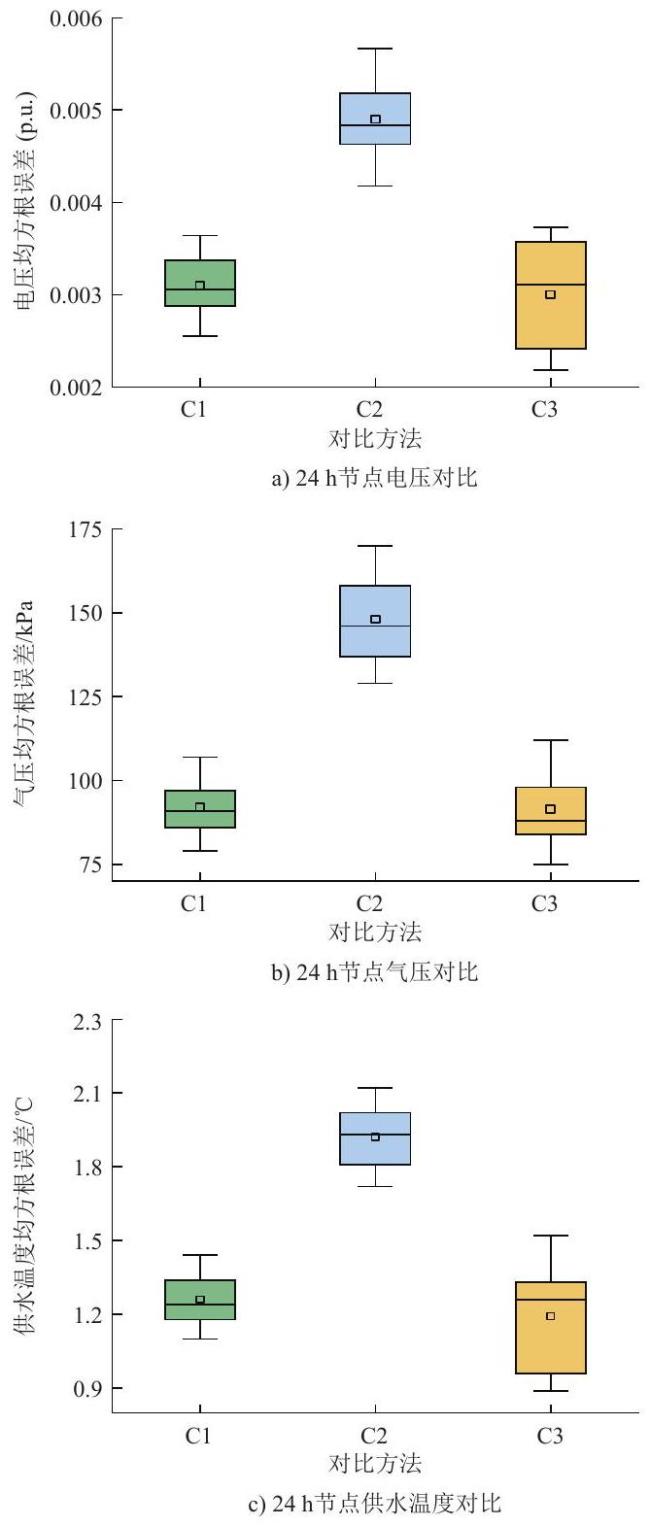
| 验证节点电压(p.u.) | 0.0031 | 0.0049 | 0.0029 |
| 验证节点气压/kPa | 9.2 | 14.8 | 8.7 |
| 验证节点温度/ ∘C | 1.26 | 1.92 | 1.34 |
表5 物理一致性对比Table 5 Comparison of physical consistency |
| 指标 | C1 | C2 | C3 |
|---|---|---|---|
| 电网潮流平衡残差 | 2.2×10⁻² | 2.8×10⁻² | 2.5×10⁻² |
| 气网质量守恒残差 | 3.1×10⁻² | 7.4×10⁻² | 3.3×10⁻² |
| 气网动量残差 | 2.7×10⁻² | 5.9×10⁻² | 2.6×10⁻² |
| 热网能量平衡残差 | 2.6×10⁻² | 9.2×10⁻² | 1.7×10⁻² |
| 物理残差总计 | 2.9×10⁻² | 7.1×10⁻² | 2.1×10⁻² |
表 6 安全性对比Table 6 Comparison of operational safety |
| 约束与指标 | C1 | C2 | C3 |
|---|---|---|---|
| 电压越界最大值(p.u.) | 0.012 | 0.031 | 0.013 |
| 电压越界比例/% | 2.8 | 6.8 | 2.2 |
| 气压越界最大值/kPa | 11.0 | 23.5 | 10.2 |
| 气压越界比例/% | 3.7 | 9.5 | 2.1 |
| 回水温度越界最大值/ ∘C | 5.8 | 12.6 | 5.4 |
| 回水温度越界比例/% | 3.2 | 8.1 | 3.7 |
| [1] |
王小君, 盛康玲, 司方远, 等. 极高渗透率分布式光储场景下主配协同系统优化调控: 基于复杂系统理论的研究框架[J/OL]. 中国电机工程学报: 1- 19[2026-06-25].
|
| [2] |
赵琛, 叶金池, 和萍, 等. 考虑源荷多重不确定性的园区综合能源系统优化策略[J]. 电力系统保护与控制, 2025, 53(4):148-164.
|
| [3] |
董帅, 王成福, 徐士杰, 等. 计及网络动态特性的电-气-热综合能源系统日前优化调度[J]. 电力系统自动化, 2018,42(13): 12-19. DONG Shuai,WANG Chengfu,XU Shijie,et al. Day-ahead optimal scheduling of electricity-gas-heat integrated energy system considering dynamic characteristics of networks[J]. Automation of Electric Power Systems,2018, 42(13):12-19.
|
| [4] |
|
| [5] |
臧海祥, 耿明旲, 黄蔓云, 等. 电-热气混联综合能源系统状态估计研究综述与展望[J]. 电力系统自动化, 2022,46(7): 187-199. ZANG Haixiang,GENG Minghao,HUANG Manyun,et al. Review and prospect of state estimation for electricity-heat-gas integrated energy system[J]. Automation of Electric Power Systems,2022, 46(7):187-199.
|
| [6] |
王明军, 穆云飞, 孟宪君, 等. 考虑热能输运动态特性的电-热综合能源系统优化调度方法[J]. 电网技术, 2020,44(1): 132-142. WANG Mingjun,MU Yunfei,MENG Xianjun,et al. Optimal scheduling method for integrated electro-thermal energy system considering heat transmission dynamic characteristics[J]. Power System Technology,2020, 44(1):132-142.
|
| [7] |
|
| [8] |
|
| [9] |
|
| [10] |
杨帅, 陈磊, 徐飞, 等. 基于能量流的电热综合能源系统弃风消纳优化调度模型[J]. 电网技术, 2018,42(2): 417-426. YANG Shuai,CHEN Lei,XU Fei,et al. Optimal dispatch model of wind power accommodation in integrated electrical-thermal power system based on power flow model[J]. Power System Technology, 2018, 42(2):417-426.
|
| [11] |
韩一宁, 崔明建, 罗光浩, 等. 基于自适应联邦学习的输配网动-静态综合状态估计方法研究[J]. 中国电机工程学报, 2026, 46(3):957-969.
|
| [12] |
兰浦哲, 韩冬, 徐潇源, 等. 基于长短期记忆的电-气耦合综合能源系统贝叶斯状态估计[J]. 电力系统自动化, 2021, 45(20):18-28.
|
| [13] |
窦嘉铭, 王小君, 司方远, 等. 基于深度强化学习的区域综合能源系统主动调节灵活性规则提取及可解释优化调度[J]. 电力系统保护与控制, 2025, 53(23):139-151.
|
| [14] |
孙庆凯, 王小君, 张义志, 等. 基于 LSTM 和多任务学习的综合能源系统多元负荷预测[J]. 电力系统自动化, 2021, 45(5):63-70.
|
| [15] |
|
| [16] |
|
| [17] |
|
| [18] |
|
| [19] |
|
| [20] |
|
| [21] |
|
| [22] |
赵连伟, 罗四维, 赵艳敞, 等. 高维数据流形的低维嵌入及嵌入维数研究[J]. 软件学报, 2005(8):1423-1430.
|
| [23] |
邱建荣, 罗汉. 改进的局部线性嵌入算法及其应用[J]. 计算机工程与应用, 2020, 56(3):176-179.
|
| [24] |
高晨元, 田建艳, 姬政雄, 等. 基于门控循环单元残差连接网络与多任务学习的园区综合能源系统多元负荷预测[J]. 电网技术, 2025, 49(5):1771-1780.
|
| [25] |
秦烁, 赵健, 徐剑, 等. 基于多任务学习和单任务学习组合模型的综合能源系统多元负荷预测[J]. 电网技术, 2024, 48(4):1510-1522.
|
| [26] |
刘佳委, 王丹, 李宜哲, 等. 基于熵态机理的综合能源信息物理系统虚假数据注入攻击物理防御与负荷削减策略研究[J/OL]. 电网技术: 1- 25[2026-06-25].https://doi.org/10.13335/j.1000-3673.pst.2025.1237.
|
| [27] |
沈赋, 刘思蕊, 徐潇源, 等. 基于多尺度特征提取的 IES 多元负荷短期联合预测[J]. 高电压技术, 2024, 50(7):2918-2930.
|
| [28] |
|
| [29] |
刘金波, 郭庆来, 张靖, 等. 机理数据融合驱动的图神经网络状态估计方法[J]. 电力系统自动化, 2026, 50(5):173-183.
|
| [30] |
贾睿, 杨国华, 郑豪丰, 等. 基于自适应权重的 CNN-LSTM&GRU 组合风电功率预测方法[J]. 中国电力, 2022, 55(5):47-56, 110.
|
| [31] |
范宏, 徐涛, 贾庆山. 数据-模型混合驱动的数据中心综合能源系统优化调度综述[J]. 南方电网技术, 2025, 19(3):175-188.
|
| [32] |
李忠达, 侯慧, 王振国, 等. 机理数据融合的架空线路冻雨落区覆冰厚度概率预测[J/OL]. 中国电力: 1- 14[2026-06-25].
|
| [33] |
翁宗龙, 李滨, 肖佳文, 等. 基于数据-物理模型融合驱动的原始-对偶自监督学习最优潮流求解方法[J]. 电力自动化设备, 2025, 45(4):202-208.
|
| [34] |
|
| [35] |
李再鹏, 陈湘萍, 叶华洋, 等. 动态碳流追踪驱动的综合能源系统优化调度模型[J]. 南方电网技术, 2025, 19(9):25-36, 71.
|
/
| 〈 |
|
〉 |