Home Journals Electric Power
Electric Power

Abbreviation (ISO4): Electric Power      Chairperson: Changyu OUYANG

About  /  Aim & scope  /  Editorial board  /  Indexed  /  Contact  / 
Original article

Bidding strategy and clearing mechanism of virtual power plants considering dynamic variation of regulation capacity under multi-market environment

  • Xiuyu YANG , 1 ,
  • Zhiwen LI , 1 ,
  • Hao ZHANG 2 ,
  • Chang LIU 3 ,
  • Jingshan MO 1
Expand
  • 1 Key Laboratory of Modern Power System Simulation and Control&Renewable Energy Technology, Ministry of Education(Northeast Electric Power University), Jilin 132012, China
  • 2 State Grid Jilin Electric Power Co., Ltd.Changchun Power Supply Company, Changchun 130021, China
  • 3 State Grid Jilin Electric Power Co., Ltd.Jilin Power Supply Company, Jilin 132001, China

Received date: 2025-12-30

  Revised date: 2026-02-02

  Online published: 2026-09-04

Supported by

National Natural Science Foundation of China(52307084)

Abstract

The virtual power plant(VPP)can participate in electricity markets to provide power and frequency regulation auxiliary services for the system by aggregating resources such as distributed generation,adjustable load and energy storage.Its core objective is to maximize the benefits by optimizing the allocation of internal resources across the two markets.To address the insufficient market competitiveness of VPPs caused by the lack of specific and accurate volume bidding methods, this paper proposes a VPP bidding strategy considering the dynamic variation of regulation capacity under a multi-market environment,as well as a joint clearing mechanism of energy-frequency regulation markets incorporating VPPs.Firstly,the adjustable capacity boundary of the VPP is characterized according to the scheduling characteristics of internal resources. A segmented joint bidding strategy based on adjustable capacity partition interval is then proposed to enable full scheduling of internal resources for market participation.Secondly,in view of the overlap between the two markets,a joint clearing mechanism of energy-frequency regulation markets with VPP integrated is constructed to improve the allocation efficiency of flexible resources.Finally,case studies are carried out to verify the proposed bidding strategy and clearing mechanism.The results show that compared with the single-segment bidding strategy based on a fixed power range,the total power purchase cost of the system and VPP is reduced by 0.75%and 53.93%, respectively.It is verified that the proposed bidding strategy and clearing mechanism can maximize the social benefits while improving the VPP's own benefits.

Cite this article

Xiuyu YANG , Zhiwen LI , Hao ZHANG , Chang LIU , Jingshan MO . Bidding strategy and clearing mechanism of virtual power plants considering dynamic variation of regulation capacity under multi-market environment[J]. Electric Power, 2026 , 59(8) : 151 -162 . DOI: 10.11930/j.issn.1004-9649.202512076

0 引言

在实现"双碳"目标的进程中,电力行业正积极推进以风电和光伏为代表的新能源规模化发展,但其出力的波动性、间歇性和不确定性增加了电力系统的灵活性需求,给电网安全稳定运行带来新挑战  [1-7] 。虚拟电厂(virtual power plant,VPP)可以通过调控、通信等技术聚合海量、分散的分布式电源、储能、柔性负荷等灵活性资源,并进行电力市场交易  [8-13] ,为电力系统运行提供灵活性调节能力,减少源荷双侧时序错配对系统稳定运行带来的威胁。然而,在 VPP 参与电力市场的过程中,受到市场中多主体投标行为不确定性的影响,当前投标策略缺乏对 VPP 动态特性的刻画,致使其无法充分调度内部调节能力参与多市场实现收益最大化。因此,有必要深入研究 VPP 面临多市场时的投标策略和出清机制,以实现精准报量、合理出清,为建设适应多元化市场主体参与的新型电力市场提供科学依据。
针对 VPP 参与电力市场投标策略,现有研究主要沿着单一市场与多市场下的投标策略两个维度展开。在单一市场下投标策略方面,文献[14]根据 VPP 内部聚合资源的运行特性,在满足系统电力平衡的前提下,提出了根据可调容量区间划分的 VPP 灵活投标策略;文献[15]将电动汽车作为柔性负荷资源,构建了充电站在日前和实时电力市场中的投标策略,提出了一种日前报价与实时报量相结合的两阶段电力市场交易机制。在多市场下投标策略方面,文献[16]提出了一种 VPP 参与多品种交易的优化调控模型,采用场景规划法和条件风险价值处理风电、负荷、电价及调频信号的不确定性;文献[17]基于非合作博弈理论,构建多VPP鲁棒决策框架,优化其日前市场的竞价方案。然而,VPP 聚合资源的调节能力在时序上是动态变化的,应根据其调节能力灵活确定投标电量范围,否则将导致无法准确刻画 VPP 的真实可行域,从而难以充分调动内部资源参与市场,降低市场竞争力。
同时,VPP 投标策略的优化困境与市场出清机制的设计紧密相关。在市场出清机制方面,文献[18]基于现有经济调度模型及其结算规则,提出了区域联合出清时的红利概念,保证没有市场主体利益受损且能获得额外红利,结果表明该规则可以激励各市场主体积极参与区域电力市场。在含储能参与的电力市场出清机制方面,文献[19]构建了以源、荷、储为市场主体的主辅联合出清模型,并分析了联合市场的耦合机理;文献[20]从包含储能的电能量与备用市场出清模型出发进行理论推导,进一步建立了同时涵盖电能量、备用及调频市场的联合市场出清模型;文献[21]分析了独立储能准入市场的关键问题并给出解决方案,进而构建了包含独立储能的电力市场出清模型。然而,上述研究在构建市场出清模型时,均将源、荷、储视为独立的市场主体,未能将聚合了多种分布式资源的 VPP 纳入考量  [22] ,这导致现有模型难以充分挖掘和利用由 VPP 内部优化调度所带来的、远超单个资源的灵活性潜力。
综上所述,当前研究存在两个方面局限:1)报量时未考虑 VPP 调节能力的时变性,难以构建精准响应此特性的投标策略;2)出清时将源、荷、储视为独立主体,未能充分挖掘 VPP 聚合协同的整体灵活性,这些不足导致 VPP 市场竞争力与资源调用效率受到制约。鉴于此,本文面向电能量和调频市场,提出了基于可调节能力划分区间的 VPP 联合投标策略,并进一步构建了包含 VPP 的市场联合出清机制。首先,根据内部聚合资源种类对 VPP 进行分类,刻画出相应运行功率边界,再基于 VPP 自平衡需求提出了分段式联合投标策略;其次,考虑到不同市场具有重叠性,实施以 VPP 和火电机组等为市场主体的现货电能量-调频辅助服务市场联合出清;最后,对所提投标策略和出清机制进行算例分析,验证所提投标策略与出清机制的可行性和有效性。

1 VPP 分类与外特性分析

1.1 VPP 的分类与运行模型

VPP 内在资源禀赋、技术特性存在显著差
异,为了精准刻画外特性,有必要对其进行科学分类  [23] 。根据内部聚合资源类型,VPP 可分为以分布式储能、电动汽车等为主的储能型 VPP、以可中断负荷为主的可控负荷型 VPP、以分布式光伏、风电为主的可再生能源型 VPP 和混合型 VPP。
VPP 的运行特性通常可用功率不等式约束描述,这些约束体现在功率、爬坡或电量中的一个或多个方面  [24] 。储能型 VPP 既可作为电源向电网注入功率,也可作为负荷吸收功率,对外呈现出一个具有毫秒级快速响应能力的"双向调节电厂"的外特性。由于其需要存储电量,所以充放电功率和电量之间存在时序耦合关系,其运行模型可用功率约束和电量约束表示,即
$\begin{array}{c}{\mathit{P}}_{\mathrm{e}\mathrm{s}\mathrm{v}}^{\mathrm{m}\mathrm{i}\mathrm{n}}\left(\mathit{t}\right)⩽{\mathit{P}}_{\mathrm{e}\mathrm{s}\mathrm{v}}^{\mathrm{c}\mathrm{h}}\left(\mathit{t}\right)-{\mathit{P}}_{\mathrm{e}\mathrm{s}\mathrm{v}}^{\mathrm{d}\mathrm{i}\mathrm{s}}\left(\mathit{t}\right)⩽{\mathit{P}}_{\mathrm{e}\mathrm{s}\mathrm{v}}^{\mathrm{m}\mathrm{a}\mathrm{x}}\left(\mathit{t}\right)\end{array}$
$\begin{array}{c}{\mathit{P}}_{\mathrm{e}\mathrm{s}\mathrm{v}}^{\mathrm{c}\mathrm{h}}\left(\mathit{t}\right){\mathit{P}}_{\mathrm{e}\mathrm{s}\mathrm{v}}^{\mathrm{d}\mathrm{i}\mathrm{s}}\left(\mathit{t}\right)=0\end{array}$
$\begin{array}{c}{\mathit{E}}_{\mathrm{e}\mathrm{s}\mathrm{v}}^{\mathrm{m}\mathrm{i}\mathrm{n}}\left(\mathit{t}\right)⩽{\mathit{E}}_{\mathrm{e}\mathrm{s}\mathrm{v}}\left(0\right)+{\mathit{\eta }}_{\mathrm{e}\mathrm{s}\mathrm{v}}{\mathit{P}}_{\mathrm{e}\mathrm{s}\mathrm{v}}^{\mathrm{c}\mathrm{h}}\left(\mathit{t}\right)\mathit{\Delta }\mathit{t}-{\mathit{P}}_{\mathrm{e}\mathrm{s}\mathrm{v}}^{\mathrm{d}\mathrm{i}\mathrm{s}}\left(\mathit{t}\right)\mathit{\Delta }\mathit{t}/{\mathit{\eta }}_{\mathrm{e}\mathrm{s}\mathrm{v}}⩽{\mathit{E}}_{\mathrm{e}\mathrm{s}\mathrm{v}}^{\mathrm{m}\mathrm{a}\mathrm{x}}\left(\mathit{t}\right)\#\left(\right(\left)\right)\\ {\mathit{\eta }}_{\mathrm{e}\mathrm{s}\mathrm{v}}\sum _{\mathit{t}=1}^{\mathit{T}}  {\mathit{P}}_{\mathrm{e}\mathrm{s}\mathrm{v}}^{\mathrm{c}\mathrm{h}}\left(\mathit{t}\right)\mathit{\Delta }\mathit{t}-\sum _{\mathit{t}=1}^{\mathit{T}}  {\mathit{P}}_{\mathrm{e}\mathrm{s}\mathrm{v}}^{\mathrm{d}\mathrm{i}\mathrm{s}}\left(\mathit{t}\right)\mathit{\Delta }\mathit{t}/{\mathit{\eta }}_{\mathrm{e}\mathrm{s}\mathrm{v}}={\mathit{E}}_{\mathrm{e}\mathrm{s}\mathrm{v}}\left(\mathit{T}\right)-{\mathit{E}}_{\mathrm{e}\mathrm{s}\mathrm{v}}\left(0\right)\end{array}$
式中: ${\mathit{P}}_{\text{esv }}^{\text{ch }}\left(\mathit{t}\right)\mathrm{、}{\mathit{P}}_{\text{esv }}^{\text{dis }}\left(\mathit{t}\right)$ 分别为储能型 VPP 在时段 t的充电和放电功率; ${\mathit{P}}_{\text{esv }}^{\text{max }}\left(\mathit{t}\right)\mathrm{、}{\mathit{P}}_{\text{esv }}^{\text{min }}\left(\mathit{t}\right)$ 分别为储能型VPP 在时段 t 输入功率的上限和下限;Eesv (t) 为储能型 VPP 在时段 t 的荷电状态;ηesv  为储能型 VPP的充放电效率;Δt 为调度步长; ${\mathit{E}}_{\mathrm{e}\mathrm{s}\mathrm{v}}^{\mathrm{m}\mathrm{a}\mathrm{x}}\left(\mathit{t}\right)\mathrm{、}{\mathit{E}}_{\mathrm{e}\mathrm{s}\mathrm{v}}^{\mathrm{m}\mathrm{i}\mathrm{n}}\left(\mathit{t}\right)$分别为储能型 VPP 在时段 t 电量的上下限;T 为调度周期。
可控负荷型 VPP 在负荷高峰时可以通过削减负荷(如调整空调设定温度、暂停非关键生产流程)等效于向电网提供正向功率支撑  [25] ,扮演虚拟"发电机"角色,功率单向流动且不存储能量,其运行模型可用功率约束和爬坡约束表示,即
$\begin{array}{c}{\mathit{P}}_{\text{conl }}^{\mathrm{m}\mathrm{i}\mathrm{n}}\left(\mathit{t}\right)⩽{\mathit{P}}_{\text{conl }}\left(\mathit{t}\right)⩽{\mathit{P}}_{\text{conl }}^{\mathrm{m}\mathrm{a}\mathrm{x}}\left(\mathit{t}\right)\end{array}$
$\begin{array}{c}{\mathit{R}}_{\text{conl }}^{\mathrm{m}\mathrm{i}\mathrm{n}}\left(\mathit{t}\right)⩽{\mathit{P}}_{\text{conl }}\left(\mathit{t}\right)-{\mathit{P}}_{\text{conl }}(\mathit{t}-1)⩽{\mathit{R}}_{\text{conl }}^{\mathrm{m}\mathrm{a}\mathrm{x}}\left(\mathit{t}\right)\end{array}$
式中:Pconl (t) 为可控负荷型 VPP 在时段 t 的输出功率; ${\mathit{P}}_{\text{conl }}^{\text{max }}\left(\mathit{t}\right)\mathrm{、}{\mathit{P}}_{\text{conl }}^{\text{min }}\left(\mathit{t}\right),\text{ }{\mathit{R}}_{\text{conl }}^{\text{max }}\left(\mathit{t}\right)\mathrm{、}{\mathit{R}}_{\text{conl }}^{\text{min }}\left(\mathit{t}\right)$ 分别为可控负荷型 VPP 在时段 t 输出功率上下限和爬坡容量上下限。
可再生能源型 VPP 输出功率受政策、天气等因素影响较大,灵活调控程度低,运行模型为其内部资源的日前预测出力,即
$\begin{array}{c}{\mathit{P}}_{\text{unc }}\left(\mathit{t}\right)={\mathit{P}}_{\text{unc }}^{\text{pred }}\left(\mathit{t}\right)\end{array}$
式中:Punc(t) 为可再生能源型 VPP 在时段 t 的调度功率; ${\mathit{P}}_{\text{unc }}^{\text{pred }}\left(\mathit{t}\right)$ 为可再生能源型 VPP 内部聚合资源在时段 t 的出力预测值。
混合型 VPP 有效融合了单一类型 VPP 的优势,在一定程度上克服了可再生能源的波动性、储能的能量约束以及可控负荷的持续时间限制,从而展现出更强大的可调节能力与可靠性,对外呈现出兼具发电、用电与跨时段能量转移的统一外特性。混合型 VPP 的运行模型可用功率约束、爬坡约束和电量约束统一表示,即
$\begin{array}{c}{\mathit{P}}_{\mathrm{v}\mathrm{p}\mathrm{p}}^{\mathrm{m}\mathrm{i}\mathrm{n}}\left(\mathit{t}\right)⩽{\mathit{P}}_{\mathrm{v}\mathrm{p}\mathrm{p}}^{\mathrm{c}\mathrm{h}}\left(\mathit{t}\right)-{\mathit{P}}_{\mathrm{v}\mathrm{p}\mathrm{p}}^{\mathrm{d}\mathrm{i}\mathrm{s}}\left(\mathit{t}\right)⩽{\mathit{P}}_{\mathrm{v}\mathrm{p}\mathrm{p}}^{\mathrm{m}\mathrm{a}\mathrm{x}}\left(\mathit{t}\right)\end{array}$
$\begin{array}{c}{\mathit{R}}_{\mathrm{v}\mathrm{p}\mathrm{p}}^{\mathrm{m}\mathrm{i}\mathrm{n}}\left(\mathit{t}\right)⩽\left[{\mathit{P}}_{\mathrm{v}\mathrm{p}\mathrm{p}}^{\mathrm{c}\mathrm{h}}\left(\mathit{t}\right)-{\mathit{P}}_{\mathrm{v}\mathrm{p}\mathrm{p}}^{\mathrm{d}\mathrm{i}\mathrm{s}}\left(\mathit{t}\right)\right]-\left[{\mathit{P}}_{\mathrm{v}\mathrm{p}\mathrm{p}}^{\mathrm{c}\mathrm{h}}(\mathit{t}-1)-\right.\end{array}$
$\begin{array}{c}\left.{\mathit{P}}_{\mathrm{v}\mathrm{p}\mathrm{p}}^{\mathrm{d}\mathrm{i}\mathrm{s}}(\mathit{t}-1)\right]⩽{\mathit{R}}_{\mathrm{v}\mathrm{p}\mathrm{p}}^{\mathrm{m}\mathrm{a}\mathrm{x}}\left(\mathit{t}\right)\end{array}$
$\begin{array}{c}{\mathit{E}}_{\mathrm{v}\mathrm{p}\mathrm{p}}^{\mathrm{m}\mathrm{i}\mathrm{n}}\left(\mathit{t}\right)⩽\sum _{\mathit{\tau }=1}^{\mathit{t}}  \left({\mathit{\eta }}_{\mathrm{a}}{\mathit{P}}_{\mathrm{v}\mathrm{p}\mathrm{p}}^{\mathrm{c}\mathrm{h}}\left(\mathit{t}\right)-{\mathit{P}}_{\mathrm{v}\mathrm{p}\mathrm{p}}^{\mathrm{d}\mathrm{i}\mathrm{s}}\left(\mathit{t}\right)/{\mathit{\eta }}_{\mathrm{a}}\right)\mathit{\Delta }\mathit{t}⩽{\mathit{E}}_{\mathrm{v}\mathrm{p}\mathrm{p}}^{\mathrm{m}\mathrm{a}\mathrm{x}}\left(\mathit{t}\right)\end{array}$
式中: ${\mathit{P}}_{\mathrm{v}\mathrm{p}\mathrm{p}}^{\mathrm{c}\mathrm{h}}\left(\mathit{t}\right)\mathrm{、}{\mathit{P}}_{\mathrm{v}\mathrm{p}\mathrm{p}}^{\mathrm{d}\mathrm{i}\mathrm{s}}\left(\mathit{t}\right)$ 分别为混合型 VPP 在时段 t 的充、放电功率; ${\mathit{P}}_{\text{vpp }}^{\text{max }}\left(\mathit{t}\right)\mathrm{、}{\mathit{P}}_{\text{vpp }}^{\text{min }}\left(\mathit{t}\right),\text{ }{\mathit{R}}_{\text{vpp }}^{\text{max }}\left(\mathit{t}\right)\mathrm{、}{\mathit{R}}_{\text{vpp }}^{\text{min }}\left(\mathit{t}\right)$ ${\mathit{E}}_{\text{vpp }}^{\text{max }}\left(\mathit{t}\right)\mathrm{、}{\mathit{E}}_{\text{vpp }}^{\text{min }}\left(\mathit{t}\right)$ 分别为混合型 VPP 在时段 t 聚合功率上下限、爬坡速率上下限和电量上下限;ηa 为混合型 VPP 等效充放电效率。

1.2 VPP 市场参与能力差异性分析

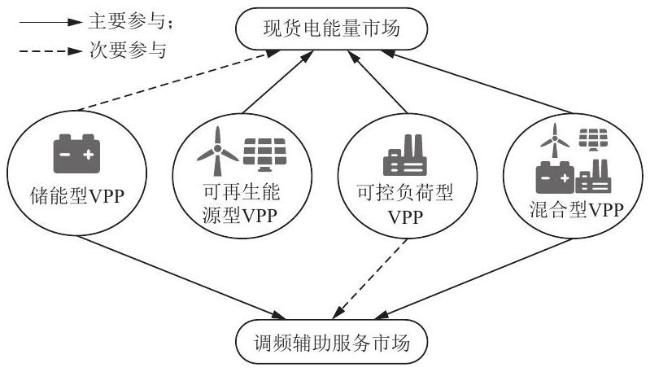
不同类型 VPP 在电能量市场与调频市场中的参与能力存在明显差异,这主要取决于其资源构成及技术特性。
储能型 VPP 凭借快速响应特性能够高效地参与系统频率调节,并提供相较于传统机组更高质量的服务,同时还具有能量时移特性,能够实现削峰填谷和平滑可再生能源出力。但由于容量限制,储能型 VPP 无法提供大规模、长时间的电能量供应,在当前市场机制下,其主要权责是提供调频辅助服务以获取相应收益。
可控负荷型和可再生能源型 VPP 由于体量较大,在电能量市场中具备较强的电能量供应能力,但其出力受自然条件等因素影响,波动性与不确定性显著,不能稳定提供调频辅助服务,导致其在调频市场中的调节能力受限。
混合型 VPP 则通过多类型资源的协同优化,在电能量市场与调频市场中均展现出较强的竞争力,能够同时提供相对稳定的电能量供应与调频辅助服务。
因此,VPP 在参与电能量市场与调频市场时,需要基于其资源特性,制定差异化的运行方案,以实现经济效益与系统贡献的最大化,各类型 VPP 在两种市场中的参与能力如图1所示。
图1 不同类型 VPP 的市场参与能力

Fig. 1 Market participation ability of different types of VPPs

2 VPP 分段式联合投标策略

2.1 VPP 调节能力动态特性与功率边界

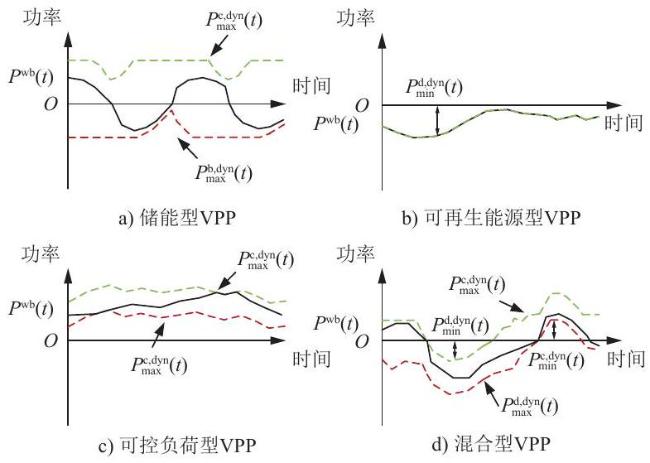
VPP 调节能力是其内部各类分布式资源调节能力的聚合,具有时变性  [26] 。储能型 VPP 的调节能力与其实时荷电状态(state of charge,SOC)和最大充放电功率相关,充电功率中标后,SOC上升,吸收功率的能力会下降;放电功率中标后,SOC 下降,输出功率的能力会下降。可再生能源型 VPP 调节能力主要依靠弃风弃光手段实现,调节容量相对有限。可控负荷型 VPP 的调节潜力与用户的用电行为密切相关,通常在负荷高峰时段,调节容量较大;在负荷低谷时段,调节容量较小。混合型 VPP 的调节能力受到多种资源叠加的影响,总体来说,吸收功率的能力包含储能充电能力和刚性负荷,输出功率的能力包含储能放电能力、可中断负荷以及风电输出功率。
1.1节所提运行模型中的功率边界可用于确定VPP 的报量范围,根据此边界可得到2组功率区间:日内动态最大充电功率 ${\mathit{P}}_{\mathrm{m}\mathrm{a}\mathrm{x}}^{\mathrm{c},\mathrm{d}\mathrm{y}\mathrm{n}}\left(\mathit{t}\right)$ 与放电功率 ${\mathit{P}}_{\text{max }}^{\mathrm{d},\text{ dyn }}\left(\mathit{t}\right)$ ,对应 VPP 在日内运行中充、放电功率的动态上限;日内动态最小充电功率 ${\mathit{P}}_{\text{min }}^{\mathrm{c},\text{ dyn }}\left(\mathit{t}\right)$ 和放电功率 ${\mathit{P}}_{\mathrm{m}\mathrm{i}\mathrm{n}}^{\mathrm{d},\mathrm{d}\mathrm{y}\mathrm{n}}\left(\mathit{t}\right)$ ,对应在一些时段为维持内部功率平衡,VPP需要与系统交换的最小充、放电功率。不同类型 VPP 聚合后的功率边界范围如图2所示,图中黑色实线为 VPP 在时段 t 的中标功率 Pwb(t) 。
图2 不同类型 VPP 聚合功率边界

Fig. 2 Aggregation power boundary of different types of VPP

需要说明的是,本文所提投标策略依赖于对VPP 可调节能力边界的准确计算,该边界是基于VPP 内部资源的具体运行模型进行聚合优化后得出的结果,是 VPP 作为一个整体参与市场的技术可行域。在后续的市场出清模型中,将以此边界作为 VPP 投标与出清的约束条件,从而在保证内部资源可行性的前提下,实现市场层面的高效出清。

2.2 VPP 分段式联合报量方法

VPP 参加的电能量交易和调频辅助服务交易二者相互关联,需要根据自身调节能力在不同市场中协调报量。此外,由于其调节能力随着内部聚合资源出力的变化而动态变化,本文提出一种计及 VPP 调节容量动态特性的分段区间容量申报方法,具体如下。
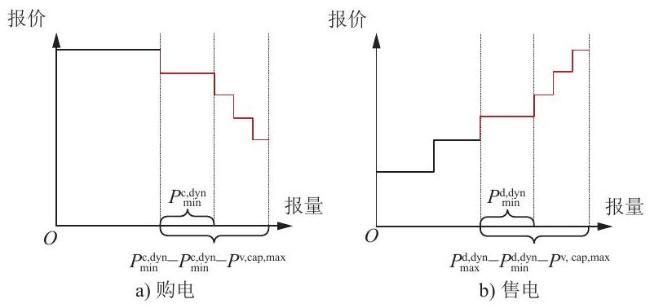
1)当 VPP 能够通过调用内部资源来满足自身功率平衡需求时,先利用日内动态最大充电功率 ${\mathit{P}}_{\text{max }}^{\mathrm{c},\text{ dyn }}\left(\mathit{t}\right)$ 和放电功率 ${\mathit{P}}_{\text{max }}^{\mathrm{d},\text{ dyn }}\left(\mathit{t}\right)$ 中的一部分申报调频容量,再将其扣除调频申报容量后的区间平均分配作为购、售电报量范围;
2)当 VPP 需要与外界系统交换功率实现自平衡时,先将日内动态最小充电功率 ${\mathit{P}}_{\text{min }}^{\mathrm{c},\mathrm{d}\mathrm{y}\mathrm{n}}\left(\mathit{t}\right)$ 和放电功率 ${\mathit{P}}_{\text{min }}^{\mathrm{d},\text{ dyn }}\left(\mathit{t}\right)$ 作为最高购电和最低售电报价段的申报容量范围,随后,在功率调度边界内扣除分配的调频容量,把剩余可调节容量平均分配至其余各申报分段以确定对应的容量区间。VPP 在电能量市场的购、售电报量 ${\mathit{P}}_{{\mathit{q}}_{\mathrm{A}}}^{\mathrm{c},\text{ max }}\left(\mathit{t}\right)\mathrm{、}{\mathit{P}}_{{\mathit{k}}_{\mathrm{A}}}^{\mathrm{d},\text{ max }}\left(\mathit{t}\right)$ 分别为
$\begin{array}{c}{\mathit{P}}_{1}^{\mathrm{c},\text{ max }}\left(\mathit{t}\right)={\mathit{P}}_{\mathrm{m}\mathrm{i}\mathrm{n}}^{\mathrm{c},\text{ dyn }}\left(\mathit{t}\right)\end{array}$
$\begin{array}{c}{\mathit{P}}_{1}^{\mathrm{d},\text{ max }}\left(\mathit{t}\right)={\mathit{P}}_{\mathrm{m}\mathrm{i}\mathrm{n}}^{\mathrm{d},\text{ dyn }}\left(\mathit{t}\right)\end{array}$
$\begin{array}{c}{\mathit{P}}_{{\mathit{q}}_{\mathrm{A}}}^{\mathrm{c},\mathrm{m}\mathrm{a}\mathrm{x}}\left(\mathit{t}\right)=\frac{{\mathit{P}}_{\mathrm{m}\mathrm{a}\mathrm{x}}^{\mathrm{c},\mathrm{d}\mathrm{y}\mathrm{n}}\left(\mathit{t}\right)-{\mathit{P}}_{\mathrm{m}\mathrm{i}\mathrm{n}}^{\mathrm{c},\mathrm{d}\mathrm{y}\mathrm{n}}\left(\mathit{t}\right)-{\mathit{P}}^{\mathrm{v},\mathrm{c}\mathrm{a}\mathrm{p},\mathrm{m}\mathrm{a}\mathrm{x}}\left(\mathit{t}\right)}{{\mathit{q}}_{\mathrm{A}}-1},{\mathit{q}}_{\mathrm{A}}\in {\mathit{Q}}_{\mathrm{A}}\end{array}$
$\begin{array}{c}{\mathit{P}}_{{\mathit{k}}_{\mathrm{A}}}^{\mathrm{d},\mathrm{m}\mathrm{a}\mathrm{x}}\left(\mathit{t}\right)=\frac{{\mathit{P}}_{\mathrm{m}\mathrm{a}\mathrm{x}}^{\mathrm{d},\mathrm{d}\mathrm{y}\mathrm{n}}\left(\mathit{t}\right)-{\mathit{P}}_{\mathrm{m}\mathrm{i}\mathrm{n}}^{\mathrm{d},\mathrm{d}\mathrm{y}\mathrm{n}}\left(\mathit{t}\right)-{\mathit{P}}^{\mathrm{v},\mathrm{c}\mathrm{a}\mathrm{p},\mathrm{m}\mathrm{a}\mathrm{x}}\left(\mathit{t}\right)}{{\mathit{k}}_{\mathrm{A}}-1},{\mathit{k}}_{\mathrm{A}}\in {\mathit{K}}_{\mathrm{A}}\end{array}$
式中: ${\mathit{P}}_{1}^{\mathrm{c},\text{ max }}\left(\mathit{t}\right)\mathrm{、}{\mathit{P}}_{1}^{\mathrm{d},\text{ max }}\left(\mathit{t}\right)$ 分别为 VPP 在电能量市场中时段 t 的首段购电和售电申报功率上限;qAkA 分别为 VPP 购电和售电投标报价段;QAKA 分别为 VPP 投标购电和售电报价分段集合; ${\mathit{P}}_{{\mathit{q}}_{\mathrm{A}}}^{\mathrm{c},\text{ max }}\left(\mathit{t}\right)\mathrm{、}{\mathit{P}}_{{\mathit{k}}_{\mathrm{A}}}^{\mathrm{d},\text{ max }}\left(\mathit{t}\right)$ 分别为 VPP 在电能量市场中时段 t 的第 qA 段购电和第 kA 段售电申报功率上限;Pv,cap , max (t) 为 VPP 在调频市场中时段 t 的调频投标容量上限。
同时, ${\mathit{P}}_{{\mathit{q}}_{\mathrm{A}}}^{\mathrm{c},\text{ max }}\left(\mathit{t}\right)\mathrm{、}{\mathit{P}}_{{\mathit{k}}_{\mathrm{A}}}^{\mathrm{d},\text{ max }}\left(\mathit{t}\right)$Pv, cap , max (t) 需要满足申报约束,即
$\begin{array}{c}{\mathit{P}}^{\mathrm{v},\text{ cap, }\mathrm{m}\mathrm{a}\mathrm{x}}\left(\mathit{t}\right)+\sum _{{\mathit{q}}_{\mathrm{A}}\in {\mathit{Q}}_{\mathrm{A}}}  {\mathit{P}}_{{\mathit{q}}_{\mathrm{A}}}^{\mathrm{c},\text{ max }}\left(\mathit{t}\right)⩽{\mathit{P}}_{\mathrm{m}\mathrm{a}\mathrm{x}}^{\mathrm{c},\text{ dyn }}\left(\mathit{t}\right)-{\mathit{P}}_{\mathrm{m}\mathrm{i}\mathrm{n}}^{\mathrm{c},\text{ dyn }}\left(\mathit{t}\right)\end{array}$
$\begin{array}{c}{\mathit{P}}^{\mathrm{v},\text{ cap },\mathrm{m}\mathrm{a}\mathrm{x}}\left(\mathit{t}\right)+\sum _{{\mathit{k}}_{\mathrm{A}}\in {\mathit{K}}_{\mathrm{A}}}  {\mathit{P}}_{{\mathit{k}}_{\mathrm{A}}}^{\mathrm{d},\text{ max}}\left(\mathit{t}\right)⩽{\mathit{P}}_{\mathrm{m}\mathrm{a}\mathrm{x}}^{\mathrm{d},\text{ dyn }}\left(\mathit{t}\right)-{\mathit{P}}_{\mathrm{m}\mathrm{i}\mathrm{n}}^{\mathrm{d},\text{ dyn }}\left(\mathit{t}\right)\end{array}$
VPP 分段式联合报量策略示意如图3所示。从原理上看,分段式申报的优势在于实现了对 VPP内部非线性、时变边际机会成本的精细化表征。传统一档报价隐含了成本恒定的假设,而分段策略允许 VPP 为不同容量的调节能力申报不同价格,以构建一条非递减的供给曲线,进而能够更真实地反映调用不同深度资源的递增成本。因此,该方法通过精确刻画成本增加了报价灵活性,帮助 VPP 在市场中实现收益最大化。
图3 分段式联合报量策略

Fig. 3 Segmented joint bidding quantity strategy

3 电能量与调频市场出清机制

3.1 市场出清方式

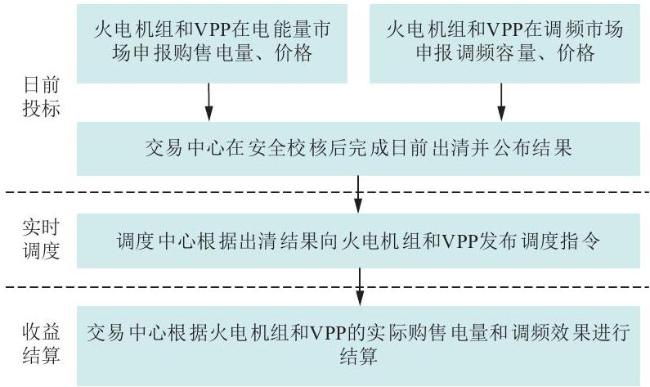
火电机组和 VPP 参与联合市场的交易流程如图4所示,可以看出,二者既可以提供电能量服务,又可以提供调频服务,但同一时段相应容量仅能参与其一市场。多电力市场出清的关键在于确定各时段发电主体在两个市场间的容量最优分配以实现社会总福利最大化  [27-28] ,如果两个市场独立、顺序出清,则很难准确反映资源同时提供两种服务的机会成本,进而无法实现社会总福利最大化;相比之下,若采用联合出清机制则可以同时考虑电能量和调频容量的需求与约束,并同时形成统一的电能量市场价格和调频容量价格,实现降本增效  [29] 。因此,本文采用联合优化出清机制,并通过边际出清方式确定出清价格。此外,调频辅助服务市场中各参与主体的补偿费用按照"两部制"结算  [30] ,即调频容量补偿和调频里程补偿。
图4 火电机组和 VPP 参与联合市场交易流程

Fig. 4 Joint market transaction process for thermal power units and VPPs

3.2 目标函数

目标函数为最大化社会总福利,即最小化用户电能量和调频辅助服务购买总成本 f[31-33] ,即
$\begin{array}{rrr}\mathit{ }\mathrm{m}\mathrm{i}\mathrm{n}\mathit{f}=\sum _{\mathit{j}\in {\mathit{W}}_{\mathrm{G}}}  \sum _{\mathit{t}=1}^{\mathit{T}}  \sum _{{\mathit{k}}_{\mathrm{G}}\in {\mathit{K}}_{\mathrm{G}}}  {\mathit{\gamma }}_{\mathit{j},{\mathit{k}}_{\mathrm{G}}}^{\mathrm{G}}{\mathit{P}}_{\mathit{j},{\mathit{k}}_{\mathrm{G}}}^{\mathrm{G}}\left(\mathit{t}\right)\mathrm{\Delta }\mathit{t}+\\\mathrm{ }\sum _{\mathit{t}=1}^{\mathit{T}}  \left(\sum _{{\mathit{k}}_{\mathrm{A}}\in {\mathit{K}}_{\mathrm{A}}}  {\mathit{\gamma }}_{{\mathit{k}}_{\mathrm{A}}}^{\mathrm{d}\mathrm{i}\mathrm{s}}\left(\mathit{t}\right){\mathit{P}}_{\mathrm{v}\mathrm{p}\mathrm{p},{\mathit{k}}_{\mathrm{A}}}^{\mathrm{d}\mathrm{i}\mathrm{s}}\left(\mathit{t}\right)-\sum _{{\mathit{q}}_{\mathrm{A}}\in {\mathit{Q}}_{\mathrm{A}}}  {\mathit{\gamma }}_{{\mathit{q}}_{\mathrm{A}}}^{\mathrm{c}\mathrm{h}}\left(\mathit{t}\right){\mathit{P}}_{\mathrm{v}\mathrm{p}\mathrm{p},{\mathit{q}}_{\mathrm{A}}}^{\mathrm{c}\mathrm{h}}\left(\mathit{t}\right)\right)\mathrm{\Delta }\mathit{t}+\\ \mathrm{ }\sum _{\mathit{j}\in {\mathit{W}}_{\mathrm{G}}}  \sum _{\mathit{t}=1}^{\mathit{T}}  \left({\mathit{\lambda }}_{\mathit{j}}^{\mathrm{G},\mathrm{c}\mathrm{a}\mathrm{p}}\left(\mathit{t}\right)+{\mathit{\lambda }}_{\mathit{j}}^{\mathrm{G},\mathrm{m}\mathrm{i}\mathrm{l}}\left(\mathit{t}\right){\mathit{S}}_{\mathit{j}}^{\mathrm{G},\mathrm{m}\mathrm{c}}\right){\mathit{P}}_{\mathit{j}}^{\mathrm{G},\mathrm{c}\mathrm{a}\mathrm{p}}\left(\mathit{t}\right)+\mathrm{ }\sum _{\mathit{t}=1}^{\mathit{T}}  \left({\mathit{\lambda }}^{\mathrm{v},\mathrm{c}\mathrm{a}\mathrm{p}}\left(\mathit{t}\right)+{\mathit{\lambda }}^{\mathrm{v},\mathrm{m}\mathrm{i}\mathrm{l}}\left(\mathit{t}\right){\mathit{S}}^{\mathrm{v},\mathrm{m}\mathrm{c}}\right){\mathit{P}}^{\mathrm{v},\mathrm{c}\mathrm{a}\mathrm{p}}\left(\mathit{t}\right)&\end{array}$
式中:WG 为电力系统的火电机组集合;kG 为火电机组售电投标报价段;KG 为火电机组的报价段集合; ${\mathit{\gamma }}_{\mathit{j},{\mathit{k}}_{\mathrm{G}}}^{\mathrm{G}}$ 为火电机组 j 在第 kG 个售电报价段的投标价格; ${\mathit{P}}_{\mathit{j},{\mathit{k}}_{\mathrm{G}}}^{\mathrm{G}}\left(\mathit{t}\right)$ 为火电机组 j 在时段 tkG 个售电报价段的售电中标功率; ${\mathit{\gamma }}_{{\mathit{k}}_{\mathit{A}}}^{\text{dis }}\left(\mathit{t}\right)$ 为 VPP 在时段 tkA 个售电报价段的售电投标价格; ${\mathit{P}}_{\mathrm{v}\mathrm{p}\mathrm{p},{\mathit{k}}_{\mathrm{A}}}^{\mathrm{d}\mathrm{i}\mathrm{s}}\left(\mathit{t}\right)$ 为 VPP在时段 tkA 个售电报价段的售电中标功率; ${\mathit{\gamma }}_{{\mathit{q}}_{\mathrm{A}}}^{\mathrm{c}\mathrm{h}}\left(\mathit{t}\right)$为 VPP 在时段 tqA 个报价段的购电投标价格; ${\mathit{P}}_{\mathrm{v}\mathrm{p}\mathrm{p},{\mathit{q}}_{\mathrm{A}}}^{\mathrm{c}\mathrm{h}}\left(\mathit{t}\right)$ 为 VPP 在时段 tqA 个购电报价段的购电中标功率; ${\mathit{\lambda }}^{\mathrm{G},\text{ cap }}\left(\mathit{t}\right)\mathrm{、}{\mathit{\lambda }}^{\mathrm{G},\text{ mil }}\left(\mathit{t}\right),{\mathit{\lambda }}^{\mathrm{v},\text{ cap }}\left(\mathit{t}\right)\mathrm{、}{\mathit{\lambda }}^{\mathrm{v},\text{ mil }}\left(\mathit{t}\right)$ 分别为火电机组和 VPP 的容量报价和里程报价; ${\mathit{S}}_{\mathit{j}}^{\mathrm{G},\mathrm{m}\mathrm{c}}\mathrm{、}{\mathit{S}}^{\mathrm{v},\mathrm{m}\mathrm{c}}$ 分别为火电机组 j 和 VPP 的历史调频里程-容量比; ${\mathit{P}}_{\mathit{j}}^{\mathrm{G},\text{ cap }}\left(\mathit{t}\right)\mathrm{、}{\mathit{P}}^{\mathrm{v},\text{ cap }}\left(\mathit{t}\right)$ 分别为火电机组j 和 VPP 在时段 t 的调频中标容量。

3.3 约束条件

1) 系统功率平衡约束为
$\begin{array}{cc}& \sum _{\mathit{j}\in {\mathit{W}}_{\mathrm{G}}}  \sum _{{\mathit{k}}_{\mathrm{G}}\in {\mathit{K}}_{\mathrm{G}}}  {\mathit{P}}_{\mathit{j},{\mathit{k}}_{\mathrm{G}}}^{\mathrm{G}}\left(\mathit{t}\right)+\sum _{{\mathit{k}}_{\mathrm{A}}\in {\mathit{K}}_{\mathrm{A}}}  {\mathit{P}}_{\mathrm{v}\mathrm{p}\mathrm{p},{\mathit{k}}_{\mathrm{A}}}^{\mathrm{d}\mathrm{i}\mathrm{s}}\left(\mathrm{t}\right)-\sum _{{\mathit{q}}_{\mathrm{A}}\in {\mathit{Q}}_{\mathrm{A}}}  {\mathit{P}}_{\mathrm{v}\mathrm{p}\mathrm{p},{\mathit{q}}_{\mathrm{A}}}^{\mathrm{c}\mathrm{h}}\left(\mathit{t}\right)={\mathit{P}}^{\text{netload }}\left(\mathit{t}\right)&\end{array}$
式中:Pnetload (t) 为时段 t 的系统净负荷,即系统负荷与可再生能源出力的差值。
2)报价约束。报价约束是为了防范电能量市场出清价格剧烈波动的风险,而对 VPP 的购、售电报价设定的上下限,以及限制购、售电投标区间的投标递减、递增趋势,即
$\begin{array}{c}{\mathit{\gamma }}_{\mathrm{m}\mathrm{i}\mathrm{n}}^{\mathrm{c}\mathrm{h}}⩽{\mathit{\gamma }}_{{\mathit{q}}_{\mathrm{A}}}^{\mathrm{c}\mathrm{h}}\left(\mathit{t}\right)⩽{\mathit{\gamma }}_{\mathrm{m}\mathrm{a}\mathrm{x}}^{\mathrm{c}\mathrm{h}}\end{array}$
$\begin{array}{c}{\mathit{\gamma }}_{{\mathit{q}}_{\mathrm{A}}}^{\mathrm{c}\mathrm{h}}\left(\mathit{t}\right)⩽{\mathit{\gamma }}_{{\mathit{q}}_{\mathrm{A}}-1}^{\mathrm{c}\mathrm{h}}\left(\mathit{t}\right)-\mathit{\Delta }\mathit{\gamma },\mathit{ }{\mathit{q}}_{\mathrm{A}}⩾2\end{array}$
$\begin{array}{c}{\mathit{\gamma }}_{\mathrm{m}\mathrm{i}\mathrm{n}}^{\mathrm{d}\mathrm{i}\mathrm{s}}⩽{\mathit{\gamma }}_{{\mathit{k}}_{\mathrm{A}}}^{\mathrm{d}\mathrm{i}\mathrm{s}}\left(\mathit{t}\right)⩽{\mathit{\gamma }}_{\mathrm{m}\mathrm{a}\mathrm{x}}^{\mathrm{d}\mathrm{i}\mathrm{s}}\end{array}$
$\begin{array}{c}{\mathit{\gamma }}_{{\mathit{k}}_{\mathrm{A}}}^{\mathrm{d}\mathrm{i}\mathrm{s}}\left(\mathit{t}\right)⩾{\mathit{\gamma }}_{{\mathit{k}}_{\mathrm{A}}-1}^{\mathrm{d}\mathrm{i}\mathrm{s}}\left(\mathit{t}\right)+\mathit{\Delta }\mathit{\gamma },\mathit{ }{\mathit{k}}_{\mathrm{A}}⩾2\end{array}$
式中: ${\mathit{\gamma }}_{\text{max }}^{\mathrm{c}\mathrm{h}}\mathrm{、}{\mathit{\gamma }}_{\text{min }}^{\mathrm{c}\mathrm{h}},{\mathit{\gamma }}_{\text{max }}^{\text{dis }}\mathrm{、}{\mathit{\gamma }}_{\text{min }}^{\text{dis }}$ 分别为 VPP 购、售电报价的上下限;Δγ 为相邻段最小报价步长。
3)发电资源运行约束。
(1)火电机组爬坡、出力上下限约束为
$\begin{array}{c}\begin{array}{r}\left|\sum _{{\mathit{k}}_{\mathrm{G}}\in {\mathit{K}}_{\mathrm{G}}}  {\mathit{P}}_{\mathit{j},{\mathit{k}}_{\mathrm{G}}}^{\mathrm{G}}\left(\mathit{t}\right)-\sum _{{\mathit{k}}_{\mathrm{G}}\in {\mathit{K}}_{\mathrm{G}}}  {\mathit{P}}_{\mathit{j},{\mathit{k}}_{\mathrm{G}}}^{\mathrm{G}}(\mathit{t}-1)\right|⩽{\mathit{R}}_{\mathit{j}}^{\mathrm{G}}$
${\mathit{P}}_{\mathit{j}}^{\mathrm{G},\mathrm{m}\mathrm{i}\mathrm{n}}⩽\sum _{{\mathit{k}}_{\mathrm{G}}\in {\mathit{K}}_{\mathrm{G}}}  {\mathit{P}}_{\mathit{j},{\mathit{k}}_{\mathrm{G}}}^{\mathrm{G}}\left(\mathit{t}\right)⩽{\mathit{P}}_{\mathit{j}}^{\mathrm{G},\text{ max }}\end{array}\end{array}$
式中: ${\mathit{R}}_{\mathit{j}}^{\mathrm{G}}$ 为火电机组 j 的上下爬坡速率上限; ${\mathit{P}}_{\mathit{j}}^{\mathrm{G},\text{ max }}$ ${\mathit{P}}_{\mathit{j}}^{\mathrm{G},\mathrm{m}\mathrm{i}\mathrm{n}}$ 分别为火电机组 j 的出力上下限。
(2)VPP 功率平衡约束为
$\begin{array}{cc}& \sum _{{\mathit{k}}_{\mathrm{A}}\in {\mathit{K}}_{\mathrm{A}}}  {\mathit{P}}_{\mathrm{v}\mathrm{p}\mathrm{p},{\mathit{k}}_{\mathrm{A}}}^{\mathrm{d}\mathrm{i}\mathrm{s}}\left(\mathit{t}\right)-\sum _{{\mathit{q}}_{\mathrm{A}}\in {\mathit{Q}}_{\mathrm{A}}}  {\mathit{P}}_{\mathrm{v}\mathrm{p}\mathrm{p},{\mathit{q}}_{\mathrm{A}}}^{\mathrm{c}\mathrm{h}}\left(\mathit{t}\right)={\mathit{P}}^{\mathrm{W}\mathrm{S}}\left(\mathit{t}\right)-\\ {\mathit{P}}^{\mathrm{D}\mathrm{R}}\left(\mathit{t}\right)+{\mathit{P}}_{\mathrm{e}\mathrm{s},\mathrm{n}}^{\mathrm{d}\mathrm{i}\mathrm{s}}\left(\mathit{t}\right)-{\mathit{P}}_{\mathrm{e}\mathrm{s},\mathrm{n}}^{\mathrm{c}\mathrm{h}}\left(\mathit{t}\right)-{\mathit{P}}^{\mathrm{R}\mathrm{L}}\left(\mathit{t}\right)& \text{(25)}\end{array}$
式中:PWS(t)、PRL(t) 分别为 VPP 在时段 t 风光出力和刚性负荷需求的预测值;PDR(t) 为 VPP 在时段 t 柔性负荷响应后的负荷需求; ${\mathit{P}}_{\mathrm{e}\mathrm{s},\mathrm{n}}^{\mathrm{c}\mathrm{h}}\left(\mathit{t}\right)\mathrm{、}{\mathit{P}}_{\mathrm{e}\mathrm{s},\mathrm{n}}^{\mathrm{d}\mathrm{i}\mathrm{s}}\left(\mathit{t}\right)$分别为 VPP 在时段 t 储能的充电功率和放电功率。
(3)VPP 内部储能运行约束为
$\begin{array}{c}0⩽{\mathit{P}}_{\mathrm{e}\mathrm{s}}^{\mathrm{d}\mathrm{i}\mathrm{s}}\left(\mathit{t}\right)⩽{\mathit{P}}_{\mathrm{e}\mathrm{s}}^{\mathrm{d}\mathrm{i}\mathrm{s},\text{ max }}\left(\mathit{t}\right){\mathit{\alpha }}_{\mathrm{e}\mathrm{s}}\left(\mathit{t}\right)\end{array}$
$\begin{array}{c}0⩽{\mathit{P}}_{\mathrm{e}\mathrm{s}}^{\mathrm{c}\mathrm{h}}\left(\mathit{t}\right)⩽{\mathit{P}}_{\mathrm{e}\mathrm{s}}^{\mathrm{c}\mathrm{h},\text{ max }}\left(\mathit{t}\right)\left(1-{\mathit{\alpha }}_{\mathrm{e}\mathrm{s}}\left(\mathit{t}\right)\right)\end{array}$
$\begin{array}{c}{\mathit{E}}_{\mathrm{e}\mathrm{s}}\left(\mathit{t}\right)={\mathit{E}}_{\mathrm{e}\mathrm{s}}(\mathit{t}-1)+{\mathit{P}}_{\mathrm{e}\mathrm{s}}^{\mathrm{c}\mathrm{h}}\left(\mathit{t}\right){\mathit{\eta }}_{\mathrm{e}\mathrm{s}}-{\mathit{P}}_{\mathrm{e}\mathrm{s}}^{\mathrm{d}\mathrm{i}\mathrm{s}}\left(\mathit{t}\right)/{\mathit{\eta }}_{\mathrm{e}\mathrm{s}}\end{array}$
$\begin{array}{c}{\mathit{E}}_{\mathrm{e}\mathrm{s}}\left(0\right)={\mathit{E}}_{\mathrm{e}\mathrm{s}}\left(\mathit{T}\right)\end{array}$
式中: ${\mathit{P}}_{\mathrm{e}\mathrm{s}}^{\mathrm{c}\mathrm{h},\text{ max }}\left(\mathit{t}\right)\mathrm{、}{\mathit{P}}_{\mathrm{e}\mathrm{s}}^{\mathrm{d}\mathrm{i}\mathrm{s},\text{ max }}\left(\mathit{t}\right)$ 分别为储能在时段 t 的最大充电功率和放电功率; ${\mathit{P}}_{\mathrm{e}\mathrm{s}}^{\mathrm{c}\mathrm{h}}\left(\mathit{t}\right)\mathrm{、}{\mathit{P}}_{\mathrm{e}\mathrm{s}}^{\mathrm{d}\mathrm{i}\mathrm{s}}\left(\mathit{t}\right)$ 分别为储能在时段 t 的充电功率和放电功率;αes(t) 为 $0-$1 变量,表示储能在时段 t 的充放电状态,充电为0 ,放电为 1;Ees(t) 为储能在时段 t 的荷电状态;ηes 为储能的充放电效率。
(4)VPP 内部可中断负荷约束为
$\begin{array}{c}\sum _{\mathit{i}\in {\mathit{N}}_{\mathrm{D}\mathrm{R}}}  {\mathit{P}}_{\mathit{i}}^{\mathrm{D}\mathrm{R}}\left(\mathit{t}\right)={\mathit{\kappa }}_{1}{\mathit{P}}_{\text{load }}\left(\mathit{t}\right)\end{array}$
$\begin{array}{c}\sum _{\mathit{i}\in {\mathit{N}}_{\mathrm{D}\mathrm{R}}}  {\mathit{P}}_{\mathit{i}}^{\mathrm{D}}\left(\mathit{t}\right)⩽{\mathit{\kappa }}_{2}\sum _{\mathit{i}\in {\mathit{N}}_{\mathrm{D}\mathrm{R}}}  {\mathit{P}}_{\mathit{i}}^{\mathrm{D}\mathrm{R}}\left(\mathit{t}\right)\end{array}$
式中: ${\mathit{P}}_{\mathit{i}}^{\mathrm{D}\mathrm{R}}\left(\mathit{t}\right)\mathrm{、}{\mathit{P}}_{\mathit{i}}^{\mathrm{D}}\left(\mathit{t}\right)$ 分别为可中断负荷 i 在时段 t 的负荷占比和中断功率;Pload (t) 为VPP在时段 t 的负荷;κ1κ2 分别为VPP 中柔性负荷的比例和最大可中断负荷的比例;NDR 为可中断负荷集合。
4)中标功率约束为
$\begin{array}{c}0⩽{\mathit{P}}_{\mathit{j},{\mathit{k}}_{\mathrm{G}}}^{\mathrm{G}}\left(\mathit{t}\right)⩽{\mathit{P}}_{\mathit{j},{\mathit{k}}_{\mathrm{G}}}^{\mathrm{G},\mathrm{m}\mathrm{a}\mathrm{x}}\end{array}$
$\begin{array}{c}0⩽{\mathit{P}}_{\mathrm{v}\mathrm{p}\mathrm{p},{\mathit{k}}_{\mathrm{A}}}^{\mathrm{d}\mathrm{i}\mathrm{s}}\left(\mathit{t}\right)⩽{\mathit{P}}_{{\mathit{k}}_{\mathrm{A}}}^{\mathrm{d},\text{ max }}\left(\mathit{t}\right)\end{array}$
$\begin{array}{c}0⩽{\mathit{P}}_{\mathrm{v}\mathrm{p}\mathrm{p},{\mathit{q}}_{\mathrm{A}}}^{\mathrm{c}\mathrm{h}}\left(\mathit{t}\right)⩽{\mathit{P}}_{{\mathit{q}}_{\mathrm{A}}}^{\mathrm{c},\text{ max }}\left(\mathit{t}\right)\end{array}$
式中: ${\mathit{P}}_{\mathit{j},\mathit{k}}^{\mathrm{G},\mathrm{m}\mathrm{a}\mathrm{x}}$ 为第 j 个火电机组的出力上限。

5 )调频容量、里程供需平衡约束为

$\begin{array}{c}0⩽{\mathit{P}}_{\mathit{j}}^{\text{G,cap }}\left(\mathit{t}\right)⩽{\mathit{P}}_{\mathit{j}}^{\text{G,cap,max }}\left(\mathit{t}\right)\end{array}$
$\begin{array}{c}0⩽{\mathit{P}}^{\text{v,cap }}\left(\mathit{t}\right)⩽{\mathit{P}}^{\text{v,cap,max }}\left(\mathit{t}\right)\end{array}$
$\begin{array}{c}\sum _{\mathit{j}\in {\mathit{W}}_{\mathrm{G}}}  {\mathit{P}}_{\mathit{j}}^{\mathrm{G},\text{ cap }}\left(\mathit{t}\right)+{\mathit{P}}^{\mathrm{v},\text{ cap }}\left(\mathit{t}\right)⩾{\mathit{P}}_{\mathit{t}}^{\text{capD }}\end{array}$
$\begin{array}{c}\sum _{\mathit{j}\in {\mathit{W}}_{\mathrm{G}}}  {\mathit{P}}_{\mathit{j}}^{\mathrm{G},\mathrm{c}\mathrm{a}\mathrm{p}}\left(\mathit{t}\right){\mathit{S}}_{\mathit{j}}^{\mathrm{G},\mathrm{m}\mathrm{c}}+{\mathit{P}}^{\mathrm{v},\text{ cap }}\left(\mathit{t}\right){\mathit{S}}^{\mathrm{v},\mathrm{m}\mathrm{c}}⩾{\mathit{P}}_{\mathit{t}}^{\mathrm{m}\mathrm{i}\mathrm{l}\mathrm{D}}\end{array}$
式中: ${\mathit{P}}_{\mathit{j}}^{\mathrm{G},\text{ cap },\text{ max }}\left(\mathit{t}\right)$ 为火电机组 j 在时段 t 的调频投标容量上限;PcapD (t)、PmilD (t) 分别为系统在时段t 的调频容量需求和里程需求。
6)电能量-调频容量耦合约束。电能量-调频容量耦合约束是在联合出清时,常规火电机组和VPP 需要将电能量市场中标功率扣除该时段调频中标容量,火电机组在出清时也需如此,即
$\begin{array}{c}{\mathit{P}}_{\mathit{j}}^{\mathrm{G},\mathrm{m}\mathrm{i}\mathrm{n}}+{\mathit{P}}_{\mathit{j}}^{\mathrm{G},\mathrm{c}\mathrm{a}\mathrm{p}}\left(\mathit{t}\right)⩽\sum _{{\mathit{k}}_{\mathrm{G}}\in {\mathit{K}}_{\mathrm{G}}}  {\mathit{P}}_{\mathit{j},{\mathit{k}}_{\mathrm{G}}}^{\mathrm{G}}\left(\mathit{t}\right)⩽{\mathit{P}}_{\mathit{j}}^{\mathrm{G},\mathrm{m}\mathrm{a}\mathrm{x}}-{\mathit{P}}_{\mathit{j}}^{\mathrm{G},\mathrm{c}\mathrm{a}\mathrm{p}}\left(\mathit{t}\right)\end{array}$
$\begin{array}{c}0⩽\sum _{{\mathit{k}}_{\mathrm{A}}\in {\mathit{K}}_{\mathrm{A}}}  {\mathit{P}}_{\mathrm{v}\mathrm{p}\mathrm{p},{\mathit{k}}_{\mathrm{A}}}^{\mathrm{d}\mathrm{i}\mathrm{s}}\left(\mathit{t}\right)⩽\sum _{{\mathit{k}}_{\mathrm{A}}\in {\mathit{K}}_{\mathrm{A}}}  {\mathit{P}}_{{\mathit{k}}_{\mathrm{A}}}^{\mathrm{d},\text{ max }}\left(\mathit{t}\right)-{\mathit{P}}^{\mathrm{v},\text{ cap }}\left(\mathit{t}\right)\end{array}$
$\begin{array}{c}0⩽\sum _{{\mathit{q}}_{\mathrm{A}}\in {\mathit{Q}}_{\mathrm{A}}}  {\mathit{P}}_{\mathrm{v}\mathrm{p}\mathrm{p},{\mathit{q}}_{\mathrm{A}}}^{\mathrm{c}\mathrm{h}}\left(\mathit{t}\right)⩽\sum _{{\mathit{q}}_{\mathrm{A}}\in {\mathit{Q}}_{\mathrm{A}}}  {\mathit{P}}_{{\mathit{q}}_{\mathrm{A}}}^{\mathrm{c},\text{ max }}\left(\mathit{t}\right)-{\mathit{P}}^{\mathrm{v},\text{ cap }}\left(\mathit{t}\right)\end{array}$

4 算例分析

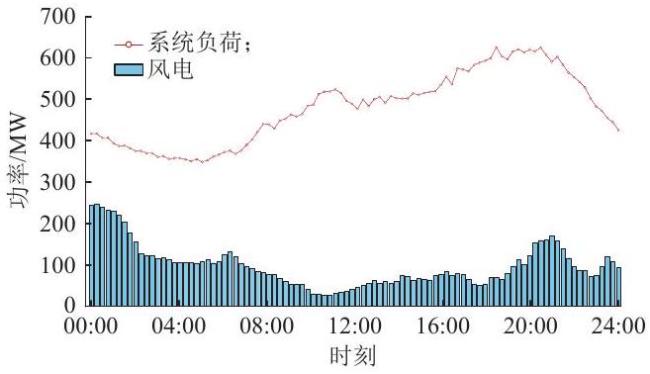
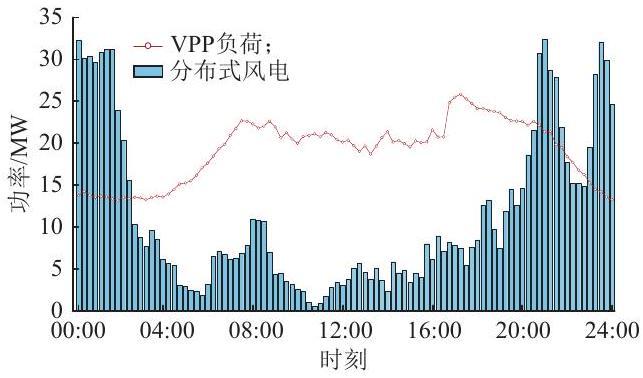
本文构建的电能量-调频市场联合出清模型是一个混合整数线性规划模型,该模型在 Matlab R2023a 环境下采用 Yalmip 工具箱建模,并调用商业优化求解器 Gurobi 10.0.0 进行求解。算例市场主体包含1个混合型 VPP、6 台火电机组和电力用户,系统和 VPP 某典型日负荷、风电功率分别如图5图6所示。VPP和火电机组均采用6段式报价,电能量报价范围分别为 100∼750 元/(MW • h)和 200~750 元/(MW • h),Δγ 取 100 元/(MW • h),每 15 min 出清一次。VPP 聚合的可中断负荷占总负荷的 10% ,最大可削减比例为 50% 。此外,VPP 接入的储能现货电能量市场中,为了促进可再生能源消纳,现有机制将其视为边界电量条件  [34] ,所以市场需求设置为系统净负荷;调频辅助服务市场中,系统调频容量需求为负荷的1%,并乘以系统历史调频里程-容量比(取10  [35] )作为系统调频里程需求。
图5 系统日负荷、风电功率

Fig. 5 System daily load and wind power

图6 VPP 日负荷、风电功率

Fig. 6 VPP daily load and wind power

表1 VPP 内部聚合的储能参数

Table 1 Internal aggregated energy storage parameters of VPP

额定功率/ MW 额定容量/ (MW⋅h) 最大荷电状态 最小荷电状态 充放电效率
20 60 0.9 0.1 0.9
表2 各火电机组参数

Table 2 Parameters of various thermal power units

编号 最大出力/MW 最小出力/MW 爬坡速率/(MW⋅h-1)
1 150 15 35
2 135 20 25
3 95 20 30
4 110 20 35
5 115 15 25
6 115 20 25
表3 调频申报参数

Table 3 Frequency regulation bidding parameters

机组类型 总数量 里程报价/ (元 ⋅(MW) -1 容量报价/ (元 ⋅( MW⋅h)-1 历史里程-容量比
火电机组 6 18 12 7
储能装置 1 12 14 12

4.1 VPP 市场调度结果与行为分析

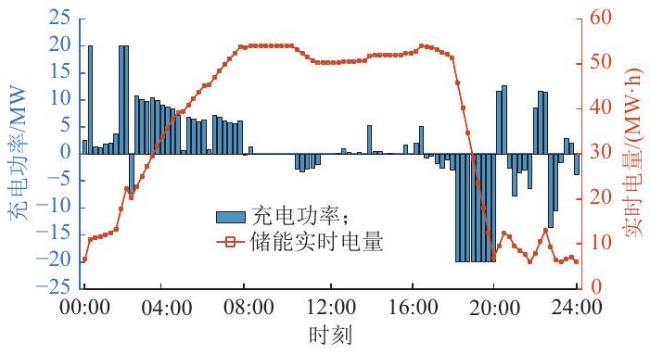
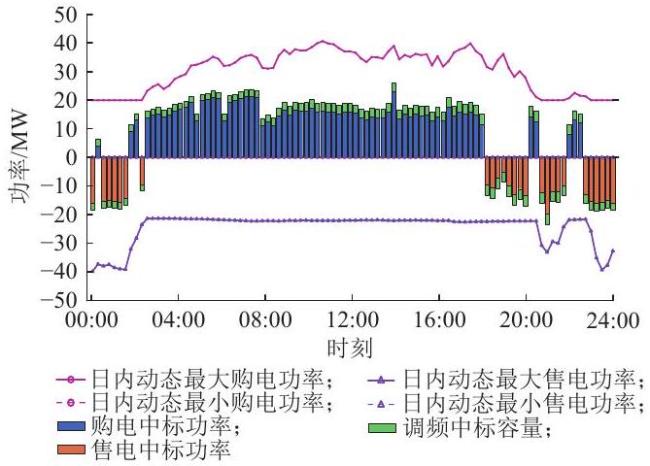
图7图8分别展示了典型日下,所提分段式联合投标策略的内部储能充放电功率时序曲线以及 VPP 调度结果。整体而言,该策略通过主动管理储能充放电行为,实现了电能量套利与调频辅助服务收益的动态最大化。如图7中的储能 SOC曲线所示,其运行区间基本覆盖了从完全放空到充满的整个范围,这并非被动的深度充放,而是策略为捕捉最有利市场机会的主动选择:在前半日电价低谷时段充电蓄能,在后半日电价高峰时段全力放电,从而将储能的能量时序转移能力转换为最大化的市场收益。
图7 储能充、放电功率曲线(放电功率为负数)

Fig. 7 Energy storage charge/discharge power curves (discharge power is negative)

图8 VPP 中标情况

Fig. 8 VPP winning bids

图8可以看出,VPP 购电行为发生在00:15—00:30、 01 : 45 -02:15、 02:30-18:00、20:00-20:30、21:45—22:30,其余时段进行售电。在内部净负荷小于零(净发电)时,VPP 可以通过储能充电或向系统售电来满足内部功率平衡,如在00:30—00:45,VPP 净负荷为—16.6 MW,售电功率15.19 MW,储能充电功率为1.41 MW;在内部净负荷大于零时,VPP 可以通过储能放电或向系统购电以及调度可削减负荷来满足内部功率平衡,如在10:00—10:15,VPP净负荷为18.47 MW,削减负荷中断功率为 1.04 MW,购电功率为 17.43 MW。总体上看,VPP 中标功率和调节能力变化趋势基本一致,说明所提投标策略能够实时响应 VPP 调节能力的波动,并调整、优化作为边际机组时的申报容量区间,从而提高调节能力利用率以及促进资源优化配置。

4.2 社会效益分析

为验证本文所提分段式联合投标策略的有效性,并分析其对市场购电成本的影响,设置 VPP分别采用如下两种方法:方法1:分段式联合投标策略;方法 2:基于固定功率范围的单段申报策略(即 VPP 在每个时段仅以其最大可调功率范围作为一个整体的电量段,并申报单一价格参与电能量市场投标)。对两种投标方法下的市场调度场景进行对比。
各方法下的市场购电成本如表4所示。可见VPP 利用方法 1 进行投标时,系统和 VPP 在两个市场中的总购电成本相较于方法2分别降低了3.51万元( 0.75% )和 3.24 万元( 53.93% )。考虑到 VPP在电能量市场中的发电占比仅约为1%,系统购电成本差异性已较为显著。
表4 Market electricity purchase cost

Table 4

投标策略 电能量市场购电成本 调频市场系统购电成本
系统 VPP 系统 VPP
方法1 456.39 9.11 8.92 -6.34
方法2 459.90 12.15 8.92 -6.14
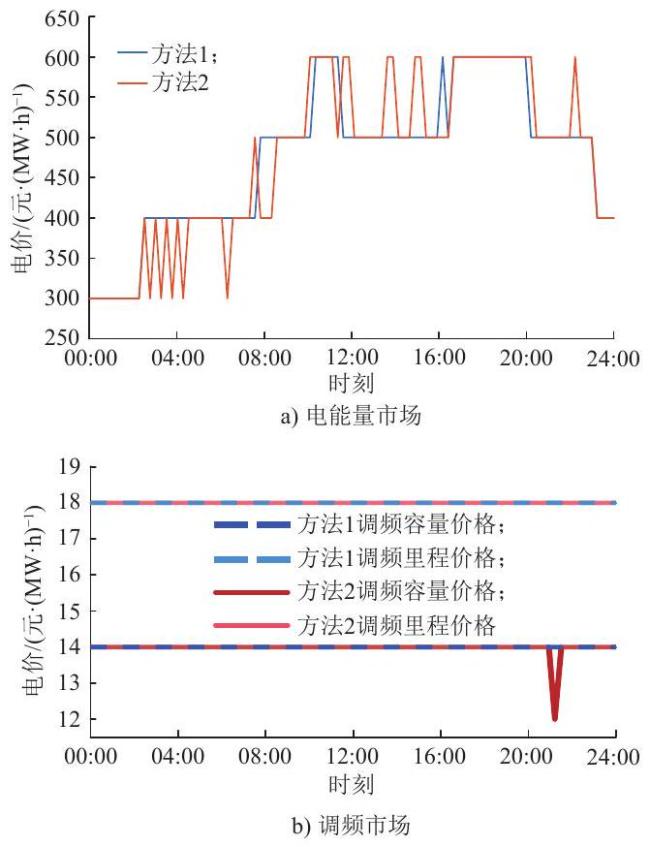
电能量市场和调频市场中两种方法下的出清价格分别如图9a)和图9b)所示。在电能量市场的高电价段( 500∼600 元/(MW⋅h) )中,方法1下的电价整体上要比方法 2 的低,这是导致系统购电成本出现差异的原因。调频市场中,尽管方法1下的系统购电成本与方法2相比略有上升,但VPP 的调频收益显著增加,提高了 VPP 参与市场的意愿度。

4.3 VPP 收益分析

4.3.1 VPP 在不同市场参与方式下的收益情况

表 5 列出了 VPP 在只参与电能量市场和同时参与调频市场两种情况下的整体收益,表中所示的各种收益均按照相应市场出清价格进行结算。可见,在电能量市场中 VPP 为了匹配内部负荷而产生的成本,在两种参与市场方式下相差不大,但 VPP 在调频市场中会获得可观的收益,所以VPP 主动参与调频辅助服务能够获取更高的经济效益。因此,调频市场对 VPP 的发展具有很强的激励作用,同时也体现出所提联合出清机制能挖掘其额外价值。
图9 市场出清价格

Fig. 9 Market clearing price

表5 VPP 在不同市场参与方式下的收益情况 单位:万元

Table 5 Revenue of VPPs under different market parti-cipation modes

市场参与方式 电能量收益 调频容量收益 调频里程收益 总收益
只参与电能量市场 -9.12 -9.12
同时参与电能量和调频市场 -9.11 0.39 5.96 -2.77

4.3.2 不同类型VPP 在不同市场中的收益情况

为验证1.2节所分析的不同类型 VPP 的市场参与能力,对比其在不同市场中的收益,将前文算例中的混合型 VPP 定义为 VPP1,再分别取其内部的储能、分布式风电和柔性负荷作为储能型VPP(VPP2)、可再生能源型 VPP(VPP3)和可控负荷型 VPP(VPP4)内部成员,然后利用本文所提报量方法各自参与电能量-调频联合市场,市场出清后各 VPP 收益情况如表 6 所示。此外,VPP4中的可中断负荷的补偿设置为 300 元/(MW•h)。
表6 不同类型VPP在不同市场中的收益情况

Table 6 Revenue of different types of VPPs in different markets 单位:万元

VPP编号 电能量收益 调频容量收益 调频里程收益 总收益
VPP2 -0.20 0.39 5.96 6.15
VPP3 11.75 11.75
VPP4 -0.42 0 0 -0.42
可以看出,由于储能型的 VPP2 能出色地提供调频辅助服务,所以其在电能量市场进行策略性购电存储能量,以参与调频市场获得相应收益;而可再生能源型的 VPP3 和可控负荷型的 VPP4 更擅长参与现货电能量市场获益,并且由于可再生能源出力具有较强的波动性和不确定性以至于不能稳定地提供调频辅助服务,故通常不建议其参与调频市场。

5 结论

本文研究了 VPP 参与电能量和调频联合市场的投标策略与出清机制,并分析了不同类型 VPP的市场参与能力,得出以下结论。
1)VPP 在同时参与电能量和调频市场时,分段式联合报量方法可使其充分调度内部资源参与到两个市场中,满足自身功率平衡的同时利用多余的调节能力提供电能量和调频辅助服务。与基于固定功率范围的单段申报方法相比,该方法下的系统和 VPP 总购电成本分别降低0.75%和53.93%。
2)本文所提联合出清机制考虑了 VPP 聚合协同的整体灵活性以及电能量和调频市场之间的重叠性,实现了 VPP 在同时参与两个市场时的策略性竞价。此外,精细化分段投标与多市场联合出清可有效激励分布式资源参与市场,并提升系统资源配置效率,这为当前全国统一电力市场建设中整合海量灵活性资源提供了一条可行的技术路径。
3)不同类型 VPP 在市场中表现出的竞争力差异为市场规则设计带来了一些启示:市场运营机构应设计差异化的准入、激励机制,让储能型 VPP侧重调频辅助服务,让可再生能源型和可控负荷型 VPP 聚焦电能量市场,从而最大化全社会资源配置效率,促进各类分布式资源健康发展。
后续需要进一步将输电网络约束、风光出力和市场价格不确定性对出清结果的影响纳入研究,从而更加贴近实际应用。
[1]
苏烨, 石剑涛, 张江丰, 等. 考虑调频的储能规划与竞价策略综述[J]. 电力自动化设备, 2021, 41(9):191-198.

SU Ye, SHI Jiantao, ZHANG Jiangfeng, et al. Review on planning and bidding strategy of energy storage considering frequency regulation[J]. Electric Power Automation Equipment, 2021, 41(9): 191-198.

[2]
康重庆, 陈启鑫, 苏剑, 等. 新型电力系统规模化灵活资源虚拟电厂科学问题与研究框架[J]. 电力系统自动化, 2022, 46(18):3-14.

KANG Chongqing, CHEN Qixin, SU Jian, et al. Scientific problems and research framework of virtual power plant with enormous flexible distributed energy resources in new power system[J]. Automation of Electric Power Systems, 2022, 46(18):3-14.

[3]
陈伟, 马金辉, 章莉, 等. 一种面向分布式新能源终端的安全性评估技术[J]. 电力信息与通信技术, 2024, 22(1):55-60.

CHEN Wei, MA Jinhui, ZHANG Li, et al. A security evaluation technique for distributed new energy terminals[J]. Electric Power Information and Communication Technology, 2024, 22(1):55-60.

[4]
彭道刚, 税纪钧, 王丹豪, 等. "双碳"背景下虚拟电厂研究综述[J]. 发电技术, 2023, 44(5):602-615.

PENG Daogang, SHUI Jijun, WANG Danhao, et al. Review of virtual power plant under the background of"dual carbon"[J]. Power Generation Technology, 2023, 44(5):602-615.

[5]
宋卓然, 张燕妮, 王阳, 等. 电力市场环境下分布式能源系统的多元运行模式与灵活性影响分析[J]. 中国电力, 2025, 58(11):111-121.

SONG Zhuoran, ZHANG Yanni, WANG Yang, et al. Impacts of diverse operational modes and flexibility of distributed energy systems within electricity market[J]. Electric Power, 2025, 58(11): 111-121.

[6]
吴问足, 王旭辉, 卢苑, 等. 基于分形理论的电力现货市场出清电价预测方法[J]. 中国电力, 2025, 58(9):183-193.

WU Wenzu, WANG Xuhui, LU Yuan, et al. A forecast method for electricity spot market clearing prices based on fractal theory[J]. Electric Power, 2025, 58(9):183-193.

[7]
黄宇翔, 陈白告勇, 许星原, 等. 电力系统市场化平衡机制的国际经验与启示[J]. 电力系统自动化, 2026, 50(9):13-26.

HUANG Yuxiang, CHEN Haoyong, XU Xingyuan, et al. International experiences and insights from market-based balancing mechanisms for power systems[J]. Automation of Electric Power Systems, 2026, 50(9):13-26.

[8]
杨丰任, 王鸿, 王致杰. 基于碳排放生产优先级的综合能源虚拟电厂优化运行策略[J]. 电力科学与技术学报, 2024, 39(5):192-202.

YANG Fengren, WANG Hong, WANG Zhijie. Optimal operation strategy of integrated energy virtual power plant based on production priority of carbon emission[J]. Journal of Electric Power Science and Technology, 2024, 39(5):192-202.

[9]
任帅, 肖楚鹏, 梁新龙, 等. 计及虚拟电厂内需求侧灵活性资源的实时电价和 V2G 协调优化调度策略[J]. 电力信息与通信技术, 2024, 22(8):27-36.

REN Shuai, XIAO Chupeng, LIANG Xinlong, et al. The real-time electricity price and v 2 g coordinated optimal scheduling strategy considering demand-side flexibility resources in VPP[J]. Electric Power Information and Communication Technology, 2024, 22(8): 27-36.

[10]
张宁, 朱昊, 杨凌霄, 等. 考虑可再生能源消纳的多能互补虚拟电厂优化调度策略[J]. 发电技术, 2023, 44(5):625-633.

ZHANG Ning, ZHU Hao, YANG Lingxiao, et al. Optimal scheduling strategy of multi-energy complementary virtual power plant considering renewable energy consumption[J]. Power Generation Technology, 2023, 44(5):625-633.

[11]
葛成扬, 林顺富, 谭津, 等. 含多个产消者的虚拟电厂日前协调优化运行策略[J]. 电网技术, 2025, 49(6):2521-2532.

GE Chengyang, LIN Shunfu, TAN Jin, et al. A day-ahead optimal coordination strategy for a VPP with multiple prosumers[J]. Power System Technology, 2025, 49(6):2521-2532.

[12]
刘金朋, 胡国松, 彭锦淳, 等. 多能互补的虚拟电厂低碳-经济-鲁棒优化调度[J]. 中国电机工程学报, 2024, 44(24):9718-9731.

LIU Jinpeng, HU Guosong, PENG Jinchun, et al. Low-carbon economic-robust optimization scheduling of multi-energy complementary virtual power plants[J]. Proceedings of the CSEE, 2024, 44(24):9718-9731.

[13]
田雨亮, 覃智君, 黄镇. 考虑绿证分类的耦合市场下虚拟电厂日前运行策略[J]. 电力建设, 2025, 46(1):14-26.

TIAN Yuliang, QIN Zhijun, HUANG Zhen. Day-ahead operational strategy for virtual power plant considering green certificate classification in coupled market[J]. Electric Power Construction, 2025, 46(1):14-26.

[14]
彭超逸, 徐苏越, 顾慧杰, 等. 基于主从博亦的虚拟电厂参与多元竞争市场投标策略研究[J]. 电力系统保护与控制, 2024, 52(7):125-137.

PENG Chaoyi, XU Suyue, GU Huijie, et al. Bidding strategy for a virtual power plant participating in a multiple competitive market based on the Stackelberg game[J]. Power System Protection and Control, 2024, 52(7):125-137.

[15]
詹祥澎, 杨军, 韩思宁, 等. 考虑电动汽车可调度潜力的充电站两阶段市场投标策略[J]. 电力系统自动化, 2021, 45(10):86-96.

ZHAN Xiangpeng, YANG Jun, HAN Sining, et al. Two-stage market bidding strategy of charging station considering schedulable potential capacity of electric vehicle[J]. Automation of Electric Power Systems, 2021, 45(10):86-96.

[16]
杨康, 杨苹, 曾宪锴, 等. 电力现货市场环境下虚拟电厂的优化调控策略[J]. 电气自动化, 2023, 45(5):11-15, 19.

YANG Kang, YANG Ping, ZENG Xiankai, et al. Optimized regulation strategy of virtual power plant in the electricity spot market environment[J]. Electrical Automation, 2023, 45(5):11-15, 19.

[17]
宋嘉启, 杨永标, 徐青山, 等. 多虚拟电厂参与日前电力市场的鲁棒竞标博弈方法[J]. 电力自动化设备, 2023, 43(5):77-85.

SONG Jiaqi, YANG Yongbiao, XU Qingshan, et al. Robust bidding game approach for multiple virtual power plants participating in day-ahead electricity market[J]. Electric Power Automation Equipment, 2023, 43(5):77-85.

[18]
方圣哲, 陈思捷, 秦瑜遥, 等. 面向区域电力市场的联合出清红利再分配机制和共识算法[J/OL]. 上海交通大学学报[2025-01-08].https://doi.org/10.16183/j.cnki.jsjtu.2024.364.

FANG Shengzhe, CHEN Sijie, QIN Yuyao, et al. Dividend redistribution mechanism and consensus algorithm for joint clearing in regional power markets[J/OL]. Journal of Shanghai Jiao Tong University[2025-01-08].https://doi.org/10.16183/j.cnki.jsjtu.2024.364.

[19]
刘玥, 张忠, 尹振斌, 等. 电能量与辅助服务市场联合出清的电价耦合机理分析[J]. 电力系统自动化, 2024, 48(23):76-86.

LIU Yue, ZHANG Zhong, YIN Zhenbin, et al. Analysis on coupling mechanism of joint clearing electricity prices in electric power energy and ancillary service markets[J]. Automation of Electric Power Systems, 2024, 48(23):76-86.

[20]
黄翰锟, 王秀丽, 张恒源, 等. 独立储能参与的电能量和全过程调频市场联合出清模型[J]. 西安交通大学学报, 2025, 59(1):17-27.

HUANG Hankun, WANG Xiuli, ZHANG Hengyuan, et al. Joint clearing model for electric energy and full process frequency regulation market with independent energy storage participation[J]. Journal of Xi'an Jiaotong University, 2025, 59(1):17-27.

[21]
肖云鹏, 张兰, 张轩, 等. 包含独立储能的现货电能量与调频辅助服务市场出清协调机制[J]. 中国电机工程学报, 2020, 40(S1): 167-180.

XIAO Yunpeng, ZHANG Lan, ZHANG Xuan, et al. The coordinated market clearing mechanism for spot electric energy and regulating ancillary service incorporating independent energy storage resources[J]. Proceedings of the CSEE, 2020, 40(S1):167-180.

[22]
陈启鑫, 房曦晨, 郭鸿业, 等. 电力现货市场建设进展与关键问题[J]. 电力系统自动化, 2021, 45(6):3-15.

CHEN Qixin, FANG Xichen, GUO Hongye, et al. Progress and key issues for construction of electricity spot market[J]. Automation of Electric Power Systems, 2021, 45(6):3-15.

[23]
仪忠凯, 侯朗博, 徐英, 等. 市场环境下灵活性资源虚拟电厂聚合调控关键技术综述[J]. 中国电力, 2024, 57(12):82-96.

YI Zhongkai, HOU Langbo, XU Ying, et al. Aggregation and operation key technology of virtual power plant with flexible resources in electricity market environment:review[J]. Electric Power, 2024, 57(12):82-96.

[24]
ZHAO H T, WANG B, WANG X Y, et al. Active dynamic aggregation model for distributed integrated energy system as virtual power plant[J]. Journal of Modern Power Systems and Clean Energy, 2020, 8(5):831-840.

[25]
黄蔚亮, 苏志鹏, 梁欣怡, 等. 考虑可调市场和外部需求响应的虚拟电厂优化运行策略[J]. 中国电力, 2023, 56(12):156-163.

HUANG Weiliang, SU Zhipeng, LIANG Xinyi, et al. Optimal operation strategy for virtual power plant considering regulation market and external demand response[J]. Electric Power, 2023, 56(12):156-163.

[26]
杨欣怡, 陈涛, 高赐威, 等. 虚拟电厂调节能力评估与典型运行模式用户画像方法[J]. 电网技术, 2026, 50(5):1801-1813.

YANG Xinyi, CHEN Tao, GAO Ciwei, et al. Regulation capability assessment and user profiling methods for typical operational modes of virtual power plant[J]. Power System Technology, 2026, 50(5): 1801-1813.

[27]
黄宇翔, 黄蔚亮, 牛振勇, 等. 虚拟电厂市场机制与盈利模式及欧洲运行实例分析[J]. 电力系统自动化, 2025, 49(9):17-30.

HUANG Yuxiang, HUANG Weiliang, NIU Zhenyong, et al. Market mechanisms and profit modes of virtual power plants and analysis of their operation cases in Europe[J]. Automation of Electric Power Systems, 2025, 49(9):17-30.

[28]
孙大雁, 史新红, 冯树海, 等. 全国统一电力市场环境下的电力辅助服务市场体系设计[J]. 电力系统自动化, 2024, 48(4):13-24.

SUN Dayan, SHI Xinhong, FENG Shuhai, et al. Design of auxiliary service market system under national unified electricity market[J]. Automation of Electric Power Systems, 2024, 48(4):13-24.

[29]
王景亮, 许拮, 陈晓东, 等. 计及能量-备用联合出清的区域电力市场增益分配机制[J]. 中国电力, 2025, 58(10):216-224.

WANG Jingliang, XU Zhe, CHEN Xiaodong, et al. Gain allocation mechanism for regional electricity markets considering energy-reserve joint clearing[J]. Electric Power, 2025, 58(10):216-224.

[30]
沈赋, 付玉, 徐潇源, 等. 计及退化成本的储能参与能量及调频市场双层优化运行策略[J]. 高电压技术, 2026, 52(3):1201-1210.

SHEN Fu, FU Yu, XU Xiaoyuan, et al. A bi-level optimal operation strategy for energy storage participating in energy and frequency regulation markets considering with degradation costs[J]. High Voltage Engineering, 2026, 52(3):1201-1210.

[31]
王帝, 艾芊, 余涛, 等. 虚拟电厂可信交易的技术难点与解决方案[J]. 电力系统自动化, 2025, 49(19):8-25.

WANG Di, AI Qian, YU Tao, et al. Technical challenges and solutions for trusted trading of virtual power plant[J]. Automation of Electric Power Systems, 2025, 49(19):8-25.

[32]
王俊, 徐箭, 王晶晶, 等. 基于条件风险价值的虚拟电厂参与能量及备用市场的双层随机优化[J]. 电网技术, 2024, 48( 6):2502-2510. WANG Jun,XU Jian,WANG Jingjing,et al.Bi-level stochastic optimization for a virtual power plant participating in energy and reserve market based on conditional value at risk[J]. Power SystemTechnology,2024, 48(6):2502-2510.

[33]
陈艳波, 肖钦泽, 张智, 等. 电力现货市场出清结果影响因素量化表征及市场力评价方法[J]. 电网技术, 2025, 49(5):2035-2045.

CHEN Yanbo, XIAO Qinze, ZHANG Zhi, et al. Quantitative methods for influencing the results of electricity spot market and methods for evaluating market power[J]. Power System Technology, 2025, 49(5):2035-2045.

[34]
刘金朋, 吴天俣, 彭锦淳, 等. 电力现货市场中多主体报价场景与优化策略研究展望[J]. 电网技术, 2025, 49(12):4997-5008.

LIU Jinpeng, WU Tianyu, PENG Jinchun, et al. Research prospects on the optimization of multi-agent bidding strategies in electricity spot markets[J]. Power System Technology, 2025, 49(12): 4997-5008.

[35]
NYISO.Order on compliance filing(Docket No. ER121653-002)[R]. Washington DC: FERC, 2013.

Options
Outlines

/