Home Journals Electric Power
Electric Power

Abbreviation (ISO4): Electric Power      Chairperson: Changyu OUYANG

About  /  Aim & scope  /  Editorial board  /  Indexed  /  Contact  / 
Original article

Optimal planning method for electric vehicle charging stations with multi-stakeholder interest equilibrium

  • Haoda LEI , 1 ,
  • Ziyu XU , 1 ,
  • Yutian LIU , 1 ,
  • Chunyi WANG 2 ,
  • Yilu YANG 3
Expand
  • 1 School of Electrical Engineering, Shandong University, Jinan 250061, China
  • 2 State Grid Shandong Electric Power Company, Jinan 250001, China
  • 3 State Grid Jining Power Supply Company, Jining 272100, China

Received date: 2026-02-05

  Revised date: 2026-07-28

  Online published: 2026-09-03

Supported by

Science Foundation of China(U22B2099)

Abstract

The rapid proliferation of electric vehicles(EVs)and distributed photovoltaic(PV)poses significant challenges to the safe and stable operation of distribution networks.Ordered charging and vehicle-to-grid(V2G)offer effective means to alleviate the operational pressure of distribution networks. Therefore,this paper proposes an optimal planning method for electric vehicle charging stations(EVCSs)that balances the interests of multiple stakeholders.First,considering ordered charging and V2G,the flexible charging/discharging power is determined based on dynamic pricing signals and user response behavior.Second,a multi-stakeholder equilibrium optimization model is established to coordinate the benefits of multiple stakeholders,including distribution system operators, photovoltaic power producers,EV aggregators,and EV users, and is solved by NSGA-III algorithm to obtain the optimal planned charging and discharging power.Finally,to accommodate various charging and discharging requirements across different EV types,an EV charging network composed of centralized charging station(CCS)and distributed charging station(DCS)is constructed,and optimal power allocation between CCS and DCS is achieved.Distribution network security verification as well as distribution facility upgrading are carried out to meet the operational safety requirements. Simulation results of a power grid in a city of Shandong Province validate the effectiveness of the proposed method. This work is supported by Joint Funds of National Natural

Cite this article

Haoda LEI , Ziyu XU , Yutian LIU , Chunyi WANG , Yilu YANG . Optimal planning method for electric vehicle charging stations with multi-stakeholder interest equilibrium[J]. Electric Power, 2026 , 59(8) : 205 -214 . DOI: 10.11930/j.issn.1004-9649.202602005

0 引言

电动汽车(electric vehicle,EV)和分布式光伏(photovoltaic,PV)被视为缓解环境污染、降低对化石燃料依赖的有效手段  [1-2] 。随着 EV 数量的迅速增长,充电需求也与日俱增  [3-7] 。为满足不同类型 EV 用户的需求,电动汽车充电站(electric vehicle charging station,EVCS)被划分为集中式充电站(centralized charging station,CCS)和分布式充电站(distributed charging station,DCS) [8] 。EV 用户的充电行为受主观意愿影响,充电负荷具有显著的随机性与波动性。市场机制可以引导EV 用户的充电行为,从而减少充电负荷的随机性  [9-11] 。车网互动(vehicle-to-grid,V2G)技术的应用可以促进 PV 的消纳  [12] ,提升电网运行的稳定性  [13-14] ,甚至加快电力系统的恢复过程  [15-17] 。因此,基于市场机制和 V2G 的 CCS 和 DCS 协同规划具有重要的实践意义。
在价格型需求响应框架下,可通过动态电价信号引导负荷时移与削峰填谷,从而提升配电网灵活性与新能源消纳能力  [18] 。针对 EV 充电负荷的强时空随机性,已有研究表明基于分时电价(time-of-use,TOU)的有序充电可有效抑制负荷峰值并改善负荷曲线  [19] 。进一步地,面向更复杂的供需与网架约束,文献[20]提出动态 TOU 引导的 EV 需求侧响应机制,以增强调控效率并兼顾用户侧收益。文献[21]从分区域网络差异出发构建区域动态电价机制以引导 EV 充电优化。此外,动态电价的调控效果高度依赖用户响应模型的准确性。文献[22]结合 EV 移动特性设计了最优分时充电定价策略。文献[23]将合作博亦与动态 TOU结合以实现有序充放电协调。文献[24]提出一种计及电池放电损耗的充放电优化调度策略,根据电池损耗模型计算电池放电损耗并计人用户用电成本。文献[25]考虑 EV 用户对时间和价格的异质化心理权重,准确刻画用户实际充电行为决策。文献[26]针对智能小区场景设计充电动态电价策略,利用需求响应对电动汽车和光储系统进行综合管理。上述研究从不同角度构建了动态电价机制和用户意愿函数,为 EVCS 的合理规划提供了有力支撑,但尚未考虑不同类型 EV 用户意愿的差异性。
为应对日益增长的 EV 充放电需求,确定 EVCS的最优规划成为研究热点  [27] ,已有研究从不同角度提出了多种规划框架。例如,文献[28]提出了一种适用于不同类型插电式 EV 充电设施的综合规划框架。文献[29]提出了一种新型插电式混合动力电动汽车充电站规划方案,旨在最大化配电网运营商的收益。考虑投资约束,文献[30]在有限的预算下,实现了在交通网中对 EVCS 的最优规划。文献[31]则提出了一种基于 EV 时空负荷预测的集中式换电站规划方法。随着可再生能源渗透率的提高,已有研究将可再生能源也纳入 EVCS的规划范畴。文献[32]使用双层规划方法,对含可再生能源的 EVCS 规划进行了优化。为避免弃光和不必要的配电网扩充,文献[4]实现了考虑光-网-车三方交易的 EVCS 最优规划。EVCS 的规划还需要考虑多方主体的利益均衡。在最小化充电站、EV用户和电网社会成本的前提下,文献[33]确定了 EVCS 的最优容量和位置。文献[34]建立了电动汽车聚合商需求响应成本电价模型,获得了可平衡双方利益的需求响应电价。但是,上述研究尚未同时考虑配电网运营(distributed system operator,DSO)、光伏发电运营(photo-voltaic generation operator,PVGO)、EV聚合(EV aggregator,EVA)和 EV 用户等主体的利益均衡。
为解决上述问题,本文提出一种均衡多主体利益的 EVCS 最优规划方法。通过结合动态电价机制和 Sigmoid 函数,可以更及时、精准地刻画不同 EV 用户参与需求响应的意愿。通过构建多主体利益均衡优化模型并利用 NSGA-III进行求解,可以得到 EVCS 的最优规划功率。考虑不同类型电动汽车的充放电需求,构建由 CCS 和 DCS 组成的 EV 充电网络,并实现最优规划功率在 CCS 和DCS 间的分配,最后进行配电网安全校验以满足安全运行需求。山东省某市实际电网的 EVCS 规划方案验证了该方法的有效性。

1 动态电价与用户响应

为激励 EV 用户参与有序充电,可利用基于净负荷的模糊逻辑理论划分分时电价。为激励EV 用户参与 V2G,可基于 TOU 和负荷动态确定放电电价。基于 Sigmoid 函数,考虑参与需求响应的前提条件,可以精准描述 EV 用户的响应行为,得到柔性充/放电功率。

1.1 基于模糊逻辑的 TOU 划分

1.1.1 净负荷计算

考虑分布式 PV 和 EV 充放电过程的影响,净负荷 Pload ,t 的计算式为
$\begin{array}{c}{\mathit{P}}_{\text{load },\mathit{t}}={\mathit{P}}_{\text{base },\mathit{t}}+{\mathit{P}}_{\text{char },\mathit{t}}^{\text{total }}-{\mathit{P}}_{\text{disc },\mathit{t}}^{\text{total }}-{\mathit{P}}_{\mathrm{P}\mathrm{V},\mathit{t}}\end{array}$
式中:t 为时段(以 15 min 为 1 个时段);Pbase ,t为时段 t 基础负荷; ${\mathit{P}}_{\text{char },\mathit{t}}^{\text{total }}$ ${\mathit{P}}_{\text{disc },\mathit{t}}^{\text{total }}$ 分别为 t 时段总充电、放电功率;PPV,tt 时段光伏出力。

1.1.2 基于梯形隶属度函数的峰谷时段划分

采用偏大型和偏小型梯形分布函数  [35] 表征隶属度,即
$\begin{array}{c}{\mathit{\varphi }}_{\mathrm{L}}\mathit{ }=\frac{{\mathit{P}}_{\text{load },\mathit{t}}-{\mathit{P}}_{\text{load }}^{\mathrm{m}\mathrm{a}\mathrm{x}}}{{\mathit{P}}_{\text{load }}^{\mathrm{m}\mathrm{a}\mathrm{x}}-{\mathit{P}}_{\text{load }}^{\mathrm{m}\mathrm{i}\mathrm{n}}}\end{array}$
$\begin{array}{c}{\mathit{\varphi }}_{\mathrm{S}}\mathit{ }=\frac{{\mathit{P}}_{\text{load }}^{\mathrm{m}\mathrm{a}\mathrm{x}}-{\mathit{P}}_{\text{load },\mathit{t}}}{{\mathit{P}}_{\text{load }}^{\mathrm{m}\mathrm{a}\mathrm{x}}-{\mathit{P}}_{\text{load }}^{\mathrm{m}\mathrm{i}\mathrm{n}}}\end{array}$
式中: ${\mathit{\varphi }}_{\mathrm{L}}$ 为偏大型梯形分布函数; ${\mathit{\varphi }}_{\mathrm{S}}$ 为偏小型梯形分布函数; ${\mathit{P}}_{\text{load }}^{\text{max }}$ 为最大负荷; ${\mathit{P}}_{\text{load }}^{\text{min }}$ 为最小负荷。
通过定义隶属度阈值,可以将负荷分为尖峰、高峰、平、低谷和深谷5个时段,分时电价与负荷时段一一对应,即
$\begin{array}{c}{\mathit{C}}_{\mathrm{T}\mathrm{O}\mathrm{U},\mathit{t}}=\left\{\begin{array}{l}{\mathit{C}}_{\mathrm{T}\mathrm{O}\mathrm{U},\mathrm{s}\mathrm{p}},\mathit{t}\in {\mathit{T}}_{\mathrm{s}\mathrm{p}},{\mathit{\varphi }}_{\mathrm{L}}⩾{\mathit{\epsilon }}_{1}\\ {\mathit{C}}_{\mathrm{T}\mathrm{O}\mathrm{U},\mathrm{p}},\mathit{t}\in {\mathit{T}}_{\mathrm{p}},{\mathit{\epsilon }}_{2}⩽{\mathit{\varphi }}_{\mathrm{L}}<{\mathit{\epsilon }}_{1}\\ {\mathit{C}}_{\mathrm{T}\mathrm{O}\mathrm{U},\mathrm{f}},\mathit{t}\in {\mathit{T}}_{\mathrm{f}},{\mathit{\varphi }}_{\mathrm{L}}⩽{\mathit{\epsilon }}_{2},{\mathit{\varphi }}_{\mathrm{S}}⩽{\mathit{\epsilon }}_{2}\\ {\mathit{C}}_{\mathrm{T}\mathrm{O}\mathrm{U},\mathrm{v}},\mathit{t}\in {\mathit{T}}_{\mathrm{v}},{\mathit{\epsilon }}_{2}⩽{\mathit{\varphi }}_{\mathrm{S}}<{\mathit{\epsilon }}_{1}\\ {\mathit{C}}_{\mathrm{T}\mathrm{O}\mathrm{U},\mathrm{d}\mathrm{v}},\mathit{t}\in {\mathit{T}}_{\mathrm{d}\mathrm{v}},{\mathit{\varphi }}_{\mathrm{S}}⩾{\mathit{\epsilon }}_{1}\end{array}\right.\end{array}$
式中:CTOU,t 为时段 t 分时电价;CTOU,spCTOU,pCTOU,fCTOU,vCTOU,dv 分别为尖峰、高峰、平、低谷、深谷分时电价;TspTpTfTvTdv 分别为尖峰、高峰、平、低谷、深谷时段集合;ε1ε2 为隶属度阈值,且 ε1>ε2

1.2 电动汽车参与需求响应的放电电价

放电电价由分时电价和负荷动态来确定  [36] ,即
$\begin{array}{c}{\mathit{C}}_{\mathrm{d}\mathrm{i}\mathrm{s}\mathrm{c},\mathit{t}}={\mathit{C}}_{\mathrm{T}\mathrm{O}\mathrm{U},\mathit{t}}\mathit{K}\frac{{\mathit{P}}_{\mathrm{l}\mathrm{o}\mathrm{a}\mathrm{d},\mathit{t}}-{\mathit{P}}_{\mathrm{l}\mathrm{o}\mathrm{a}\mathrm{d},\mathrm{a}\mathrm{v}\mathrm{r}}}{{\mathit{P}}_{\mathrm{l}\mathrm{o}\mathrm{a}\mathrm{d},\mathrm{a}\mathrm{v}\mathrm{r}}}\end{array}$
式中:Cdisc ,t 为时段 t 放电电价;K 为削峰需求价格调整系数;Pload,avr  为日平均负荷。

1.3 基于用户意愿的需求响应分析

1.3.1 Sigmoid 函数的构建

EV 用户参与 V2G 的意愿和放电电价呈现死区—线性区—饱和区的 S 形曲线关系,可以用 Sigmoid函数进行刻画。
不同类型 EV 的用户对于放电电价的敏感程度不同,因此 V2G 最大参与意愿 μp 、死区阈值μd 和饱和区阈值 μs 都不同  [37] 。Sigmoid 函数定义为
$\begin{array}{c}{\mathit{\lambda }}_{\text{disc },\mathit{h},\mathit{t}}=\frac{{\mathit{\mu }}_{\mathrm{p},\mathit{h}}}{1+\mathrm{e}\mathrm{x}\mathrm{p}\left(-\left({\mathit{C}}_{\text{disc },\mathit{t}}-{\mathit{a}}_{\mathit{h}}\right)/{\mathit{b}}_{\mathit{h}}\right)}\end{array}$
式中: ${\mathit{\lambda }}_{\text{disc },\mathit{h},\mathit{t}}\in \left[\mathrm{0,1}\right]$ ,为第 h 类 EV 在时段 t 参与V2G 的意愿;μp,h 为第 h 类 EV 的 V2G 最大参与意愿;ah 为死区阈值和饱和区阈值的平均值;点( ah ,0.5μp,h) 为曲线的对称中心,曲线在该点具有最大增速;bh 为 Sigmoid 曲线的倾斜程度,其值越小,曲线的倾斜程度越大,越快达到饱和,通过放电电价为饱和区阈值时参与意愿达到 0.95μp,h 来确定。
h 类 EV 在时段 t 参与有序充电的意愿 λchar ,h,t可以表示为
$\begin{array}{c}{\mathit{\lambda }}_{\text{char },\mathit{h},\mathit{t}}=1-{\mathit{\lambda }}_{\text{disc },\mathit{h},\mathit{t}}\end{array}$

1.3.2 电动汽车参与需求响应的前提条件

若 EV 在接人充电桩时开始放电,一定时间后再开始充电,且离开充电桩时仍能保证出行所需的 SOC,则该 EV 满足参与 V2G 的前提条件为
$\begin{array}{c}{\mathit{t}}_{\text{leave }}-{\mathit{t}}_{\text{arrive }}⩾{\mathit{E}}_{\mathrm{s}}\frac{{\mathit{Q}}_{\text{arrive }}-{\mathit{Q}}_{\text{change }}}{{\mathit{P}}_{\text{disc }}{\mathit{\eta }}_{\text{disc }}}+{\mathit{E}}_{\mathrm{s}}\frac{{\mathit{Q}}_{\text{expected }}-{\mathit{Q}}_{\text{change }}}{{\mathit{P}}_{\text{char }}{\mathit{\eta }}_{\text{char }}}\end{array}$
式中:tarrive tleave  分别为 EV 接入、离开充电桩的时间;Es 为 EV 的电池容量;Qexpected Qarrive  分别为 EV 出行的期望 SOC、接人充电桩时的 SOC;Pchar Pdisc  分别为 EV 的充电、放电功率;ηchar ηdisc  分别为 EV 的充电、放电效率;Qchange  为 EV从放电状态转换到充电状态时的 SOC。
EV 满足参与有序充电的前提条件为其在接入充电桩时的 SOC 低于上限,即
$\begin{array}{c}{\mathit{Q}}_{\text{arrive }}⩽{\mathit{Q}}^{\mathrm{m}\mathrm{a}\mathrm{x}}\end{array}$
式中:Qmax  为 EV 电池 SOC 的上限。

1.3.3 电动汽车参与需求响应的概率分布特征

电动汽车大多在午间和夜晚进行充电,在傍晚负荷高峰期进行放电,其接入充电桩的时间呈现明显的"多峰"特征,因此采用混合高斯分布进行刻画,即
$\begin{array}{c}{\mathit{t}}_{\text{arrive }}\sim \sum _{\mathit{i}=1}^{\mathit{k}}  {\mathit{\omega }}_{\mathit{i}}\text{ }\mathit{N}\left({\mathit{\mu }}_{\mathit{i}},{\mathit{\sigma }}_{\mathit{i}}^{2}\right)\end{array}$
式中:k 为高斯分布的个数;ωi 为第 i 个高斯分布的权重,所有权重的和为 $1;\text{ }{\mathit{\mu }}_{\mathit{i}}\mathrm{、}{\mathit{\sigma }}_{\mathit{i}}^{2}$ 分别为第 i 个高斯分布的均值、方差。
电动汽车的 SOC 介于 0~1之间,因而非常适合采用 Beta 分布描述电动汽车接入充电桩时和出行期望的 SOC,即
$\begin{array}{c}{\mathit{Q}}_{\text{arrive }}\sim \mathit{B}\mathit{e}\mathit{t}\mathit{a}\left({\mathit{\alpha }}_{1},{\mathit{\beta }}_{1}\right)\end{array}$
$\begin{array}{c}{\mathit{Q}}_{\text{expected }}\sim \mathit{B}\mathit{e}\mathit{t}\mathit{a}\left({\mathit{\alpha }}_{2},{\mathit{\beta }}_{2}\right)\end{array}$
式中:α1β1 为描述电动汽车接人充电桩时 SOC的 Beta 分布形状参数;α2β2 为描述电动汽车出行期望 SOC 的 Beta 分布形状参数。
电动汽车的停留时长( tleave -tarrive  )服从对数正态分布,用于模拟车辆在充电站停留的时间,即
$\begin{array}{c}\left({\mathit{t}}_{\text{leave }}-{\mathit{t}}_{\text{arrive }}\right)\sim \mathit{L}\mathit{N}(\mathit{\mu },\mathit{\sigma })\end{array}$
式中:μσ 分别为对数正态分布的均值、标准差。1.3.4 柔性充放电功率计算
所有满足参与 V 2 G 条件的 EV 在时段 t 总体的柔性放电功率 P disc,t
$\begin{array}{c}{\mathit{P}}_{\text{disc },\mathit{t}}^{\text{flex }}={\mathit{P}}_{\text{disc },\mathit{t}}^{\text{history }}+\sum _{\mathit{h}=1}^{\mathit{m}}  {\mathit{\lambda }}_{\text{disc },\mathit{h},\mathit{t}}{\mathit{N}}_{\mathit{h},\mathit{t}}{\mathit{P}}_{\text{disc },\mathit{h}}^{\mathrm{m}\mathrm{a}\mathrm{x}}\end{array}$
式中: ${\mathit{P}}_{\text{disc },\mathit{t}}^{\text{history }}$ 为历史时段已经参与到 V2G 中且在时段 t 仍为驶离的 EV 总放电功率;m 为 EV 的总类数;Nh,t 为时段 t 满足参与 V2G 前提条件的第 h 类EV 总数; ${\mathit{P}}_{\text{disc,}\mathit{h}}^{\text{max }}$ 为第 h 类 EV 的最大放电功率。
类似地,所有满足参与有序充电条件的 EV 在t 时段总体的柔性充电功率 ${\mathit{P}}_{\text{char },\mathit{t}}^{\text{flex }}$ 定义为
$\begin{array}{c}{\mathit{P}}_{\text{char },\mathit{t}}^{\text{flex }}={\mathit{P}}_{\text{char },\mathit{t}}^{\text{history }}+\sum _{\mathit{h}=1}^{\mathit{m}}  {\mathit{\lambda }}_{\text{char },\mathit{h},\mathit{t}}{\mathit{N}}_{\mathit{h},\mathit{t}}{\mathit{P}}_{\text{char },\mathit{h}}^{\mathrm{m}\mathrm{a}\mathrm{x}}\end{array}$
式中: ${\mathit{P}}_{\text{char },\mathit{h}}^{\text{max }}$ 为第 h 类 EV 的最大充电功率。

2 多主体利益均衡优化

以 EV 总体的充/放电功率为决策变量,在柔性充/放电功率范围内,利用 NSGA-III对表征多主体利益的目标函数进行优化求解,得到用于后续EVCS 规划的最优充/放电功率。

2.1 目标函数

考虑 DSO、PVGO、EVA、EV 用户等,进行多主体利益的均衡优化。
配电网运营更关注配电网的安全高效运行,偏重最小化负荷波动。最小化负荷方差的目标函数 f1
$\begin{array}{c}\mathit{m}\mathit{i}\mathit{n}{\mathit{f}}_{1}=\frac{1}{\mathit{T}}\sum _{\mathit{t}=1}^{\mathit{T}}  {\left({\mathit{P}}_{\text{load },\mathit{t}}-{\mathit{P}}_{\text{load,avr }}\right)}^{2}\end{array}$
PVGO 和 EVA 进行合作,期望从现货市场及EV 用户的交易中获益最大  [12] 。由于多主体的利益本质上存在矛盾,引入针对 PVGO 和 EVA 的辅助服务收益,以避免其利益单方受损。最大化 PVGO和 EVA 平均收益的目标函数 f2
式中:Cmarket,t 为时段 t 现货市场电价;Csubsidy  为PVGO 和 EVA 的辅助服务收益。
EV 用户则期望充放电成本最低  [9] ,最小化 EV用户平均充放电成本的目标函数 f3
$\max f_2=\frac{1}{T}\sum_{t=1}^{T}\Big[\Big(P_{\text{PV},t}-P_{\text{char},t}^{\text{total}}+P_{\text{disc},t}^{\text{total}}\Big)C_{\text{market},t}+P_{\text{char},t}^{\text{total}}C_{\text{TOU},t}-P_{\text{disc},t}^{\text{total}}\big(C_{\text{disc},t}-C_{\text{subsidy}}\big)\Big]$
式中:$C_(market, t)$ 为时段 $t$ 现货市场电价;$C_{subsidy}$为PVGO 和 EVA 的辅助服务收益。
EV 用户则期望充放电成本最低[9] ,最小化 EV用户平均充放电成本的目标函数 $f_3$ 为
$\min f_3=\frac{1}{T}\sum_{t=1}^{T}\Big[P_{\text{char},t}^{\text{total}}C_{\text{TOU},t}-P_{\text{disc},t}^{\text{total}}C_{\text{disc},t}\Big]$

2.2 约束条件

考虑配电网运行的潮流约束  [12] 和 EV 的充/放电功率约束作为多主体利益均衡优化的约束条件。
EV 的充/放电功率需要限制在柔性充/放电功率范围内,即
$\begin{array}{c}0⩽{\mathit{P}}_{\text{char },\mathit{t}}^{\text{total }}⩽{\mathit{P}}_{\text{char },\mathit{t}}^{\text{flex }}\end{array}$
$\begin{array}{c}0⩽{\mathit{P}}_{\text{disc },\mathit{t}}^{\text{total }}⩽{\mathit{P}}_{\text{disc },\mathit{t}}^{\text{flex }}\end{array}$

2.3 优化求解

将总充电功率 ${\mathit{P}}_{\text{char },\mathit{t}}^{\text{total }}$ 和总放电功率 ${\mathit{P}}_{\text{disc },\mathit{t}}^{\text{total }}$ 作为决策变量,利用 NSGA-III  [38] 对多目标优化模型进行求解,得到用于 EVCS 规划的最优充/放电功率。
3个目标函数不能同时达到最优值。由于EVCS 的规划需要考虑长期的利益均衡,选择能够尽可能满足更多主体利益的解用于后续规划。

3 电动汽车充电站规划

根据第2章获得的多主体利益均衡的最优解,考虑不同类型 EV 的充放电需求,构建由 CCS 和DCS 组成的 EV 充电网络,并在每个充电站内配置不同规格的普通充电桩和 V2G 充电桩  [28] ,实现规划功率在 CCS 和 DCS 之间的合理分配,最终进行配电网安全校验,以满足安全运行需求。

3.1 集中式充电站规划

CCS 主要规划在交通枢纽,用于满足有快速充电需求的 EV 用户。保证 CCS 的充放电容量不小于多主体利益均衡优化模型得到的最优功率的一定比例,即
$\begin{array}{c}\left\{\begin{array}{l}{\mathit{q}}_{\text{cen }}{\mathit{P}}_{\text{char },\text{ opt }}⩽\sum _{\mathit{j}=1}^{\mathit{l}}  {\mathit{N}}_{\text{normal,cen }}{\mathit{n}}_{\text{cen },\mathit{j}}{\mathit{P}}_{\text{normal,cen },\mathit{j}}\\ {\mathit{q}}_{\text{cen }}{\mathit{P}}_{\text{disc,opt }}⩽\sum _{\mathit{j}=1}^{\mathit{l}}  {\mathit{N}}_{\mathrm{V}2\mathrm{G},\text{ cen }}{\mathit{v}}_{\text{cen },\mathit{j}}{\mathit{P}}_{\mathrm{V}2\mathrm{G},\text{ cen },\mathit{j}}\end{array}\right.\end{array}$
式中:qcen  为最优充放电功率分配给 CCS 的比例; Pchar,opt Pdisc,opt  分别为多主体利益均衡优化得到的最优充电、放电功率的最大值;Nnormal,cen  ${\mathit{N}}_{\text{V2G,cen 分别为集中式普通充电桩、 }\mathrm{V}2\mathrm{G}\text{ 充电桩的 }}$数量;ncen ,jvcen ,j 分别为第 j 类集中式普通充电桩、 V2G 充电桩的比例;l=3 ,为普通充电桩和V2G 充电桩的类数; ${\mathit{P}}_{\text{normal,cen },\mathit{j}}\mathrm{、}{\mathit{P}}_{\text{V2G,cen },\mathit{j}}$ 分别为第 j 类集中式普通充电桩、V2G 充电桩的额定充电、充/放电功率。

3.2 分布式充电站规划

DCS 主要规划在居民社区内。依据各节点的人口占比,将规划的功率分配给每个 DCS,即
$\begin{array}{c}\left\{\begin{array}{l}{\mathit{q}}_{\text{dist },\mathit{i}}={\mathit{N}}_{\text{house },\mathit{i}}/\sum _{\mathit{i}=1}^{\mathit{z}}  {\mathit{N}}_{\text{house },\mathit{i}}\\ {\mathit{q}}_{\text{dist },\mathit{i}}{\mathit{P}}_{\text{char },\text{ opt }}⩽\sum _{\mathit{j}=1}^{\mathit{l}}  {\mathit{N}}_{\text{normal },\text{ dist },\mathit{i}}{\mathit{n}}_{\text{dist },\mathit{j}}{\mathit{P}}_{\text{normal, dist },\mathit{j}}\\ {\mathit{q}}_{\text{dist },\mathit{i}}{\mathit{P}}_{\text{disc,opt }}⩽\sum _{\mathit{j}=1}^{\mathit{l}}  {\mathit{N}}_{\mathrm{V}2\mathrm{G},\text{ dist },\mathit{i}}{\mathit{v}}_{\text{dist },\mathit{j}}{\mathit{P}}_{\mathrm{V}2\mathrm{G},\text{ dist },\mathit{j}}\end{array}\right.\end{array}$
式中:qdist ,i 为最优充放电功率分配给节点 i 的 DCS的比例;Nhouse ,i 为节点 i 的人口数量;z 为用于规划 DCS 的节点总数;ndist ,jvdist ,j 分别为第 j 类分布式普通充电桩、V2G 充电桩的比例;Nnormal, dist ,iNV2G, dist ,i 分别为节点 i 分布式普通充电桩、V2G 充电桩的数量; ${\mathit{P}}_{\text{normal, dist },\mathit{j}}\mathrm{、}{\mathit{P}}_{\text{V2G },\text{ dist },\mathit{j}}$ 分别为第 j 类分布式普通充电桩、V2G 充电桩额定充电、充/放电功率。

3.3 集中式与分布式充电站功率分配

不同 EV 用户的充放电行为具有差异,因此CCS 和 DCSs 的规划功率占比可表示为
$\begin{array}{c}{\mathit{q}}_{\text{cen }}=\frac{{\mathit{c}}_{1}{\mathit{N}}_{\text{household }}+{\mathit{c}}_{2}{\mathit{N}}_{\text{official }}+{\mathit{c}}_{3}{\mathit{N}}_{\text{taxi }}}{{\mathit{N}}_{\text{household }}+{\mathit{N}}_{\text{official }}+{\mathit{N}}_{\text{taxi }}}\end{array}$
$\begin{array}{c}\sum _{\mathit{i}=1}^{\mathit{z}}  {\mathit{q}}_{\text{dist },\mathit{i}}=1-{\mathit{q}}_{\text{cen }}\end{array}$
式中: ${\mathit{N}}_{\text{household }}\mathrm{、}{\mathit{N}}_{\text{official }}\mathrm{、}{\mathit{N}}_{\text{taxi }}$ 分别为家用车、公务车、出租车的数量;c1c2c3 为相应的权重系数。
家用车主要选择居民社区内的 DCS 进行充电;公务车主要在办公地点的 DCS 进行充电;出租车需要保证充足的 SOC 用于载客,故主要在CCS 进行充电。为满足不同 EV 的充放电需求,权重系数 c1c2c3 应满足
$\begin{array}{c}{\mathit{c}}_{1}\approx {\mathit{c}}_{2}<{\mathit{c}}_{3}\end{array}$

3.4 配电网安全校验

将各节点的 EVCS 容量和不考虑 EV 时的负荷峰值加和,得到该节点用于配电网安全校验的等效负荷。当该等效负荷对应的等效视在功率超过该节点变压器容量限制时,需要对变压器进行增容。按照等效负荷进行潮流计算,得到各节点电压和各段线路电流。当线路电流超过额定载流量或节点电压偏差超过 ±5% 时,需要对该段线路进行扩容,以满足配电网的安全运行需求。

4 算例分析

以山东省某市实际电网为例,验证所提方法的有效性。仿真工具采用 Python 3.13,相关测试环境为12th Gen Intel(R)Core(TM)i5-12500处理器( 3.00 GHz)和16 GB RAM 的 PC。
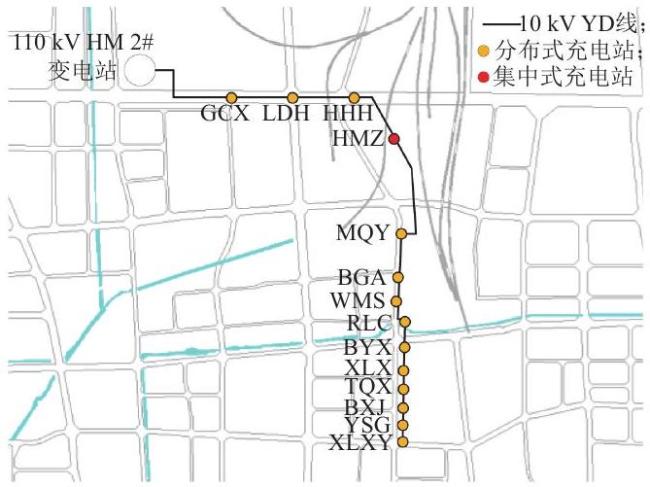
充电站主供配电线路的拓扑结构如图1所示。10 kV YD 线是目标线路,HMZ 是 CCS 节点,GCX、LDH、HHH、MQY、BGA、WMS、RLC、BYX、XLX、TQX、BXJ、YSG 和 XLXY 是 DCS节点。
图1 充电站供电线路结构

Fig. 1 EV charging station power supply topology of distribution network

4.1 动态电价与用户响应

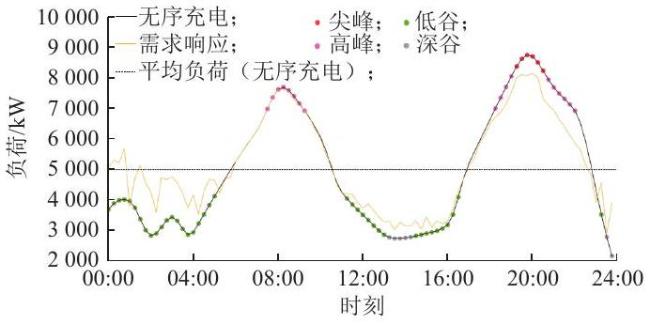
选取2023年目标线路典型日负荷曲线,考虑负荷年增长率 3.0%∼6.7% ,获得2030年的负荷预测用于 EVCS 规划。净负荷曲线和峰谷时段划分如图2中黑色实线所示。
图2 目标线路净负荷曲线与时段划分

Fig. 2 Target line net load curve and time period division

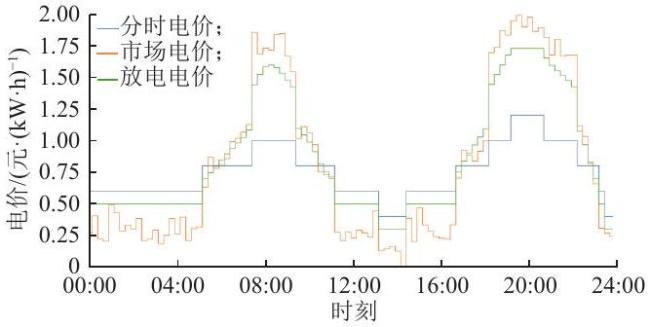
分时电价如表1所示。考虑现有市场电价且削峰需求价格调整系数 K=1.1 ,得到的分时电价、市场电价和放电电价如图3所示。
表1 分时电价表

Table 1 TOU price

单位:元 ⋅(kW⋅h)-1
时段 尖峰 高峰 低谷 深谷
电价 1.2 1.0 0.8 0.6 0.4
图3 分时电价、市场电价与放电电价

Fig. 3 TOU,market and discharging price

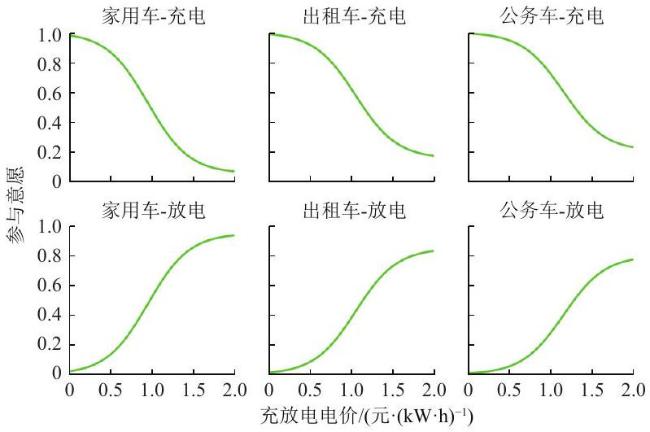
不同类型 EV 参与需求响应的意愿如图4所示。家用车对于电价最为敏感;出租车需要保持足够的 SOC 用于载客服务,故对电价的敏感程度次之;公务车仅用于行政目的出行,故电价敏感度最低。

4.2 多主体利益均衡优化

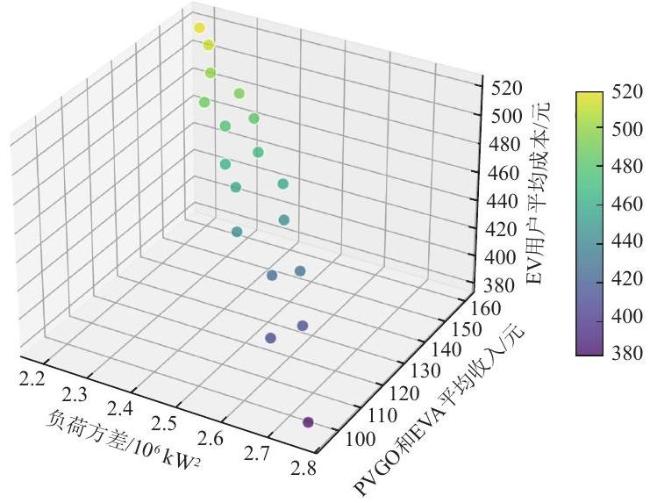
多主体利益均衡优化模型经过 100 次 NSGA-III 迭代后的帕累托前沿如图5所示,部分分析数据如表2所示。结果1的负荷方差最小,结果2的 PVGO 和 EVA 平均收益最高,结果 3 的 EV 用户成本最低,结果4是帕累托前沿的平均解。
图4 不同类型 EV 的需求响应参与意愿

Fig. 4 Demand response participation willingness of different EV types

图5 NSGA-III 帕累托前沿(100次迭代)

Fig. 5 NSGA-III Pareto front(100 iterations)

表2 帕累托前沿分析 Table 2 Analysis of the Pareto front
结果 负荷方差/kW  2 PVGO和EVA平均收入/元 EV用户平均成本/元
优化前 2213921 147.12 666.96
1 2189908 (-1.08%) 159.62 (+8.50%) 517.70 (-22.38%)
2 2189908 (-1.08%) 159.62 (+8.50%) 517.70 (-22.38%)
3 2762526 (+24.78%) 95.07 (-35.38%) 382.71 (-42.62%)
4 2413648 (+9.02%) 132.63 (-9.85%) 458.13 (-31.31%)
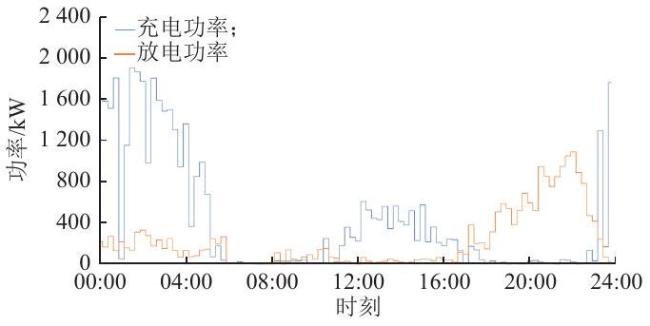
由此可见,结果1和结果2能够同时满足负荷方差最小且 PVGO 和 EVA 平均收益最高,还能够有效降低 EV 用户平均成本,故选择结果1和结果2作为用于后续规划的解。对应的最优规划充放电功率如图 6 所示。在高峰和尖峰时刻,放电功率升高以实现削峰。相应地,在低谷和深谷时刻,充电功率升高以便于填谷。削峰填谷后的负荷曲线如图2中黄色实线所示。
图6 最优规划充放电功率

Fig. 6 Optimal planned charging/discharging power

4.3 电动汽车充电站规划

目标线路中不同类型的 EV 数量分别为 ${\mathit{N}}_{\text{household }}=932,{\mathit{N}}_{\text{official }}=87,{\mathit{N}}_{\text{taxi }}=29$ 。取 c1=c2= 0.35,c3=0.75 ,通过计算得到最优规划功率分配给 CCS 和 DCS 的比例分别为33.4%和66.6%。
集中式普通充电桩的规格包括 7 kW、60 kW和120 kW,V2G 充电桩的规格包括7kW、20kW和60kW;出于安全需求,分布式普通充电桩和 V2G 充电桩的规格均被限制为7 kW、15 kW和 20 kW。最终得到满足多类 EV 充放电需求的规划结果分别如表3表4所示。
表 3 CCS 规划结果

Table 3 Planning result of CCS

参数 集中式V2G充电桩
功率/kW 7 60 120 7 20 60
单价/万元 0.168 2.57 5 0.3 1.68 5
数量/个 优化前 0 8 2 1 13 2
优化后 0 7 2 1 12 2
总容量/kW 优化前 720 387
优化后 660 367
总成本/万元 优化前 62.70
优化后
相较于优化前的结果,采用多主体利益均衡优化后的解用于 EVCS 规划,CCS 的总容量由1107 kW 下降到 1027 kW ,减少了 7.23% ,投资成本由 62.70 万元下降到 58.45 万元,减少了 6.78% ;DCS 的总容量由2181 kW下降到2058 kW,减少了 5.64% ,投资成本由 85.056 万元下降到 80.536 万元,降低了 5.31% ;EVCS 的总容量由3288 kW下降到3085kW,减少了6.17%,总投资成本由147.756 万元下降到 138.986 万元,减少了 5.94% 。
表 4 DCSs 规划结果

Table 4 Planning result of DCSs

参数 分布式普通充电桩 分布式V2G充电桩
功率/kW 7 15 20 7 15 20
单价/万元 0.168 0.45 0.58 0.3 1.4 1.68
节点 普通充电桩总容量/kW V2G充电桩总容量/kW 成本/万元
优化前 优化后 优化前 优化后 优化前 优化后
GCX 133 125 75 72 8.622 8.080
LDH 132 120 72 70 8.248 7.930
HHH 177 162 97 95 11.558 11.088
MQY 42 42 28 21 2.208 1.908
BGA 402 372 225 213 25.828 24.348
WMS 107 102 62 62 6.418 6.228
RLC 92 85 55 50 5.668 5.220
BYX 42 42 28 28 2.208 2.208
XLX 42 42 28 28 2.208 2.208
TQX 103 97 62 55 6.342 5.798
BXJ 42 42 28 28 2.208 2.208
YSG 21 21 14 14 1.104 1.104
XLXY 44 42 28 28 2.436 2.208
总成本/万元 优化前优化后 85.056
80.536 (-5.31%)
这证明了所提方法的有效性。
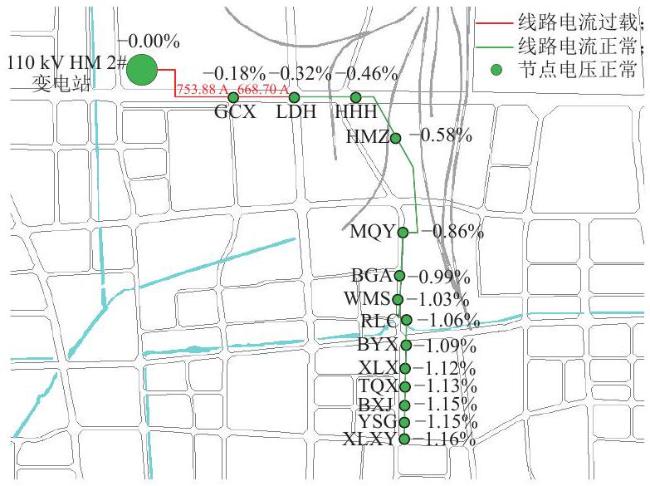
HM2#变电站是电源节点,电压为10 kV,各段线路的额定载流量为 600 A ,电阻为 0.05833Ω/km ,电抗为 0.08Ω/km ,各节点的功率因数为 0.95 。配电网安全校验的结果如表5图7所示。可以看出,节点 WMS 的等效视在功率超过了变压器容量限制,需要对该节点的变压器进行容量升级。所有节点的电压偏差均在 ±5% 以内,但线路 HM $2\#$变电站 → LDH 的电流均超过了额定载流量,需要对该段线路进行线型升级或线路并联以增加载流量,从而满足配电网的安全运行需求。

5 结论

本文均衡配电网运营、光伏发电、电动汽车聚合商和电动汽车用户等多主体利益,充分发挥有序充电和车网互动作用,提出了一种电动汽车充电站最优规划方法,并通过山东省某市实际电网仿真结果验证了其有效性,主要结论如下。
表5 变压器容量安全校验结果

Table 5 Security verification result of transformer capacity

节点 等效有功负荷/kW 等效视在功率/( kV⋅A 变压器容量/(kV⋅A) 校验结果
GCX 1475.32 1552.97 4000 不越限
LDH 1477.59 1555.36 2690 不越限
HHH 1787.08 1881.14 4000 不越限
HMZ 1665.71 1753.38 6250 不越限
MQY 329.49 346.83 500 不越限
BGA 1838.05 1934.79 3780 不越限
WMS 601.20 632.84 400 越限
RLC 639.96 673.64 1430 不越限
BYX 530.65 558.58 630 不越限
XLX 495.09 521.15 630 不越限
TQX 881.56 927.96 1260 不越限
BXJ 558.17 587.55 630 不越限
YSG 238.71 251.27 315 不越限
XLXY 538.97 567.34 630 不越限
图7 线路电流及节点电压安全校验结果

Fig. 7 Security verification result of line current and node voltage

1)动态电价可以实时反映电网负荷的削峰填谷需求;Sigmoid 函数死区—线性区—饱和区的划分,可以细致刻画不同 EV 用户参与需求响应的意愿与动态电价的关系。结合动态电价与用户响应,能够精确求解区域 EV 柔性充放电功率。
2)采用多主体利益均衡优化方法求得 EVCS的最优规划功率,同时满足了多主体的利益诉求,有效降低电网负荷偏差和 EV 用户的平均充电成本,并提高了 PVGO 和 EVA 的合作收益。
3)将最优规划功率在 CCS 和 DCS 间进行合理分配,再将普通充电桩和 V2G 充电桩细致划分为不同规格,精确匹配不同类型 EV 的充放电需求,最后进行配电网安全校验和配电设施的配套升级,实现 EVCS 的最优规划。
引入交通网流量模型,考虑路段通行时间,以体现交通拥堵和路网结构对用户选择集中式或分布式充电站行为的影响将成为后续研究的内容。
[1]
DAMIANAKIS N, MOULI G R C, BAUER P. Grid impact of photovoltaics,electric vehicles and heat pumps on distribution grids: an overview[J]. Applied Energy, 2025, 380( C).

[2]
ALBABA M, PIERCE M, YEŞILATA B. A real-world case study of solar PV integration for EV charging and residential energy demand in Ireland[J]. Sustainability, 2025, 17(21): 9447.

[3]
XU Z Y, LIU Y T, WANG C Y, et al. Load forecasting for electric vehicle charging stations using sequence decomposition and deep learning techniques[J]. IEEE Transactions on Instrumentation and Measurement, 2025, 74: 2542111.

[4]
袁洪涛, 徐潇源, 严正, 等. 电动汽车集中充换电设施规划和优化运行研究综述[J]. 电力系统保护与控制, 2024,52(19): 157-174. YUAN Hongtao,XU Xiaoyuan,YAN Zheng,et al. Review of centralized EV charging and battery swapping facility planning and optimal scheduling[J]. Power System Protection and Control,2024, 52(19):157-174.

[5]
周原冰, 龚乃玮, 王皓界, 等. 中国电动汽车发展及车网互动对新型储能配置的影响[J]. 中国电力, 2024,57( 10):1-11. ZHOU Yuanbing,GONG Naiwei,WANG Haojie,et al. Study on the influence of electric vehicle development and the vehicle-grid interaction on new energy storage configuration in China[J]. Electric Power,2024, 57(10):1-11.

[6]
胡梦锴, 陈胜, 卫志农, 等. 考虑 V2G 参与意愿与充电需求的配电网-电动汽车协同优化研究[J]. 浙江电力, 2025,44( 8):3-14. HU Mengkai,CHEN Sheng,WEI Zhinong,et al. Research on collaborative optimization of distribution network considering Vehicle-to-Grid and elastic queuing theory[J]. Zhejiang Electric Power,2025, 44(8):3-14.

[7]
孙雨乐, 漆淘懿, 赵宇明, 等. 路网耦合下计及电动汽车 V2G 潜力的充电站选址定容研究[J]. 综合智慧能源, 2024, 46(1):1-10. SUN Yule,QI Taoyi,ZHAO Yuming,et al. Siting and sizing of

electric vehicle charging stations under the coupling of transport and power networks considering V2G potential[J]. Integrated Intelligent Energy, 2024, 46(1):1-10.

[8]
HE C K, ZHU J Z, LI S L, et al. Sizing and locating planning of EV centralized-battery-charging-station considering battery logistics system[J]. IEEE Transactions on Industry Applications, 2022, 58(4): 5184-5197.

[9]
XIA F Z, CHEN H K, YAN M Y, et al. Market-based coordinated planning of fast charging station and dynamic wireless charging system considering energy demand assignment[J]. IEEE Transactions on Smart Grid, 2024, 15(2):1913-1925.

[10]
王超, 麻秀范. 基于电动汽车用户电价响应的充电负荷优化模型建立[J]. 内蒙古电力技术, 2017, 35(1):1-7.

WANG Chao, MA Xiufan. Charging load optimization model based on electric vehicle users'price response[J]. Inner Mongolia Electric Power, 2017, 35(1):1-7.

[11]
史一炜, 冯冬涵, Ella Zhou, 等. 基于主从博亦的充电服务商充电引导方法及其定价策略[J]. 电工技术学报, 2019, 34(S2):742-751.

SHI Yiwei, FENG Donghan, ZHOU Ella, et al. Stackelberg game based on supervised charging method and pricing strategy of charging service providers[J]. Transactions of China Electrotechnical Society, 2019, 34(S2):742-751.

[12]
YAO H T, XIANG Y, GU C H, et al. Optimal planning of distribution systems and charging stations considering PV-grid-EV transactions[J]. IEEE Transactions on Smart Grid, 2025, 16(1): 691-703.

[13]
戚成飞, 王亚超, 李文文, 等. 基于数据驱动的高渗透率电动汽车充电规划与优化[J]. 中国电力, 2026, 59(2):104-113.

QI Chengfei, WANG Yachao, LI Wenwen, et al. Data driven planning and optimization of high penetration electric vehicle charging[J]. Electric Power, 2026, 59(2):104-113.

[14]
李晓涵, 曹伟. 弹性充电需求下电动汽车调频激励机制及控制策略[J]. 中国电力, 2025, 58(4):148-158.

LI Xiaohan, CAO Wei. Frequency regulation incentive mechanism and control strategy for electric vehicles under elastic charging demand[J]. Electric Power, 2025, 58(4):148-158.

[15]
LIU Y T, FAN R, TERZIJA V. Power system restoration:a literature review from2006 to 2016[J]. Journal of Modern Power Systems and Clean Energy, 2016, 4(3):332-341.

[16]
谢宇峥, 章德, 杨祺铭, 等. 基于移动储能和电动汽车 V2G 的弹性配电网经济性灾后恢复决策方法[J]. 电工电能新技术, 2024,43(7): 91-101.XIE Yuzheng,ZHANG De,YANG Qiming,et al. Economic post- disaster restoration method of resilient distribution network based on mobile energy storage and electric vehicle V2G coordination[J]. Advanced Technology of Electrical Engineering and Energy,2024, 43(7):91-101.

[17]
刘达夫, 钟剑, 杨祺铭, 等. 基于 V2G 与应急通信的配电网信息物理协同快速恢复方法[J]. 电力系统自动化, 2024, 48(7):147-158.

LIU Dafu, ZHONG Jian, YANG Qiming, et al. Fast recovery method for distribution network through cyber-physical collaboration based on vehicle to grid and emergency communication[J]. Automation of Electric Power Systems, 2024, 48(7):147-158.

[18]
曾鸣, 武奏, 王昊婧, 等. 智能用电背景下考虑用户满意度的居民需求侧响应调控策略[J]. 电网技术, 2016, 40(10):2917-2923.

ZENG Ming, WU Geng, WANG Haojing, et al. Regulation strategies of demand response considering user satisfaction under smart power background[J]. Power System Technology, 2016, 40(10):2917-2923.

[19]
孙晓明, 王玮, 苏粟, 等. 基于分时电价的电动汽车有序充电控制策略设计[J]. 电力系统自动化, 2013, 37(1):191-195.

SUN Xiaoming, WANG Wei, SU Su, et al. Coordinated charging strategy for electric vehicles based on time-of-use price[J]. Automation of Electric Power Systems, 2013, 37(1):191-195.

[20]
叶文浩, 陈耀红, 颜勤, 等. 基于动态分时电价引导的电动汽车需求侧响应[J]. 电力科学与技术学报, 2024, 39(4):138-145.

YE Wenhao, CHEN Yaohong, YAN Qin, et al. Demand response of electric vehicle based on dynamic time-to-use electricity price[J]. Journal of Electric Power Science and Technology, 2024, 39(4): 138-145.

[21]
邓衍辉, 李剑, 卢国强, 等. 考虑分区域动态电价机制引导的电动汽车充电优化策略[J]. 电力系统保护与控制, 2024, 52(7):33-44.

DENG Yanhui, LI Jian, LU Guoqiang, et al. Charging optimization strategy of electric vehicles guided by the dynamic tariff mechanism of a subregion[J]. Power System Protection and Control, 2024, 52(7): 33-44.

[22]
陈中, 刘艺, 周涛, 等. 考虑移动特性的电动汽车最优分时充电定价策略[J]. 电力自动化设备, 2020, 40(4):96-102.

CHEN Zhong, LIU Yi, ZHOU Tao, et al. Optimal time-of-use charging pricing strategy of EVs considering mobile charac- teristics[J]. Electric Power Automation Equipment, 2020, 40(4): 96-102.

[23]
程杉, 陈梓铭, 徐康仪, 等. 基于合作博亦与动态分时电价的电动汽车有序充放电方法[J]. 电力系统保护与控制, 2020,48(21): 15-21. CHENG Shan,CHEN Ziming,XU Kangyi,et al. An orderly charging and discharging method for electric vehicles based on a cooperative game and dynamic time-of-use price[J]. Power System Protection and Control,2020, 48(21):15-21.

[24]
戴越繁, 杨伟. 计及电池放电损耗的电动汽车充放电优化调度策略[J]. 电工电气, 2019(10):1-8.

DAI Yuefan, YANG Wei. An optimal dispatching strategy for charging and discharging of electric vehicles accounting battery discharging loss[J]. Electrotechnics Electric, 2019(10):1-8.

[25]
颜俊, 罗宇杰, 颜安, 等. 计及用户响应特性的电动汽车充电站设备优化配置方法[J]. 中国电力, 2025, 58(4):140-147.

YAN Jun, LUO Yujie, YAN An, et al. Optimal equipment configuration method for electric vehicle charging stations considering user response characteristics[J]. Electric Power, 2025, 58(4):140-147.

[26]
潘廷哲, 靳丰源, 陆泳旲, 等. 智能小区电动汽车充电动态电价策略设计[J]. 中国电力, 2025, 58(11):14-24, 37.

PAN Tingzhe, JIN Fengyuan, LU Yonghao, et al. Design of dynamic pricing strategy for electric vehicles charging in smart communities[J]. Electric Power, 2025, 58(11):14-24, 37.

[27]
王明深, 袁晓冬, 曾飞, 等. 电动汽车充电设施规划运行关键技术研究综述[J]. 电力自动化设备, 2025, 45(5):65-76.

WANG Mingshen, YUAN Xiaodong, ZENG Fei, et al. Review of key technologies research for electric vehicle charging facilities planning and scheduling[J]. Electric Power Automation Equipment, 2025, 45(5):65-76.

[28]
ZHANG H C, HU Z C, XU Z W, et al. An integrated planning framework for different types of PEV charging facilities in urban area[J]. IEEE Transactions on Smart Grid, 2016, 7(5):2273-2284.

[29]
KHALKHALI K, ABAPOUR S, MOGHADDAS-TAFRESHI S M, et al. Application of data envelopment analysis theorem in plug-in hybrid electric vehicle charging station planning[J]. IET Generation, Transmission&Distribution, 2015, 9(7):666-676.

[30]
ZHAO Z H, LEE C K M, REN J Z, et al. Optimal EV fast charging station deployment based on a reinforcement learning framework[J]. IEEE Transactions on Intelligent Transportation Systems, 2023, 24(8):8053-8065.

[31]
HE C K, ZHU J Z, LAN J, et al. Optimal planning of electric vehicle battery centralized charging station based on EV load forecasting[J]. IEEE Transactions on Industry Applications, 2022, 58(5):6557-6575.

[32]
ZENG B, DONG H Q, XU F Q, et al. Bilevel programming approach for optimal planning design of EV charging station[J]. IEEE Transactions on Industry Applications, 2020, 56(3):2314-2323.

[33]
LI H W, SONG Y F, TAN J D, et al. Optimal urban EV charging station site selection and capacity determination considering comprehensive benefits of vehicle-station-grid[J]. iEnergy, 2024, 3(3):162-174.

[34]
庞松岭, 赵雨楠, 毕克凡, 等. 电动汽车聚合商参与需求响应定价策略及收益分配研究[J]. 电工电能新技术, 2024, 43(7):41-50.

PANG Songling, ZHAO Yunan, BI Kefan, et al. Research on pricing strategies and income distribution of electric vehicle aggregators participating in demand response[J]. Advanced Technology of Electrical Engineering and Energy, 2024, 43(7):41-50.

[35]
程瑜, 翟娜娜. 基于用户响应的分时电价时段划分[J]. 电力系统自动化, 2012, 36(9):42-46, 53.

CHENG Yu, ZHAI Nana. Electricity price peak and valley periods division based on customer response[J]. Automation of Electric Power Systems, 2012, 36(9):42-46, 53.

[36]
王敏, 吕林, 向月. 计及 V2G 价格激励的电动汽车削峰协同调度策略[J]. 电力自动化设备, 2022, 42(4):27-33, 85.

WANG Min, Lin, XIANG Yue. Coordinated scheduling strategy of electric vehicles for peak shaving considering V2G price incentive[J]. Electric Power Automation Equipment, 2022, 42(4): 27-33, 85.

[37]
LI G X, YANG Y L, WANG C Y, et al. User willingness-incorporated V2G optimization method for active distribution networks[C]// 2025 International Conference on Electrical Engineering,Automation and Information Science(EEAIS). Lanzhou,China.IEEE, 2025:70-74.

[38]
ZHANG K P, LIU T H, LIU Y T, et al. Two-stage multi-objective optimal dispatch of hybrid power generation system for ramp stress mitigation[J]. International Journal of Electrical Power&Energy Systems, 2024, 163: 110328.

Options
Outlines

/