 PDF(10027 KB)

Sulfate Radicals: A New Tool for Enhancing Sludge Dewatering
Yue Lai, Chao Wang, Jie Zhang, Shungui Zhou, Changgeng Liu, Jie Ye
Prog Chem ›› 2024, Vol. 36 ›› Issue (5) : 798-814.
PDF(10027 KB)
PDF(10027 KB)
Sulfate Radicals: A New Tool for Enhancing Sludge Dewatering
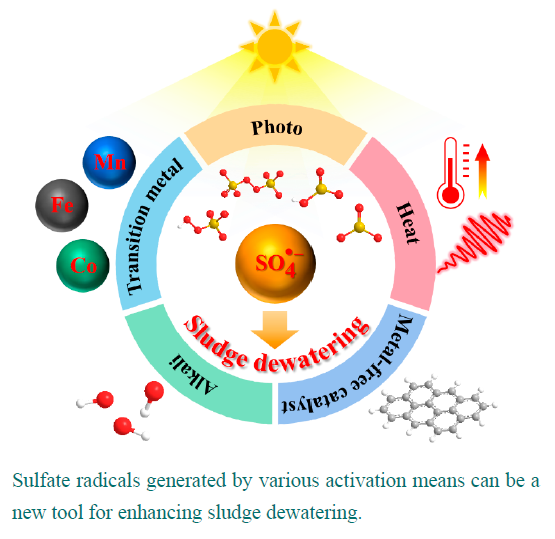
sludge is an inevitable by-product of the wastewater treatment process and due to its high water content,large volume,and inclusion of a large amount of toxic and hazardous substances,needs to be minimized and harmlessly treated.However,sludge possesses extracellular polymeric substances(EPS)formed by ionization of negatively charged functional groups,which maintain a stable hydrated colloidal structure and prevent the release of water.this is a key factor in the difficulty of sludge dewatering.in the last decade,sulfate radical-Based advanced oxidation processes(SR-AOPs)have received considerable attention due to their high efficiency for EPS disintegration,rapid reaction time and environmental friendliness,and thus sulfate radicals have become a new powerful tool for enhancing sludge dewaterability.in This paper,the development timeline and activation mechanisms of sulfate radicals are reviewed in detail,and the research advances of SR-AOPs for improving sludge dewaterability and removing micropollutants and heavy metals from sludge are systematically evaluated.based on the current scientific problems of SR-AOPs in sludge conditioning,the future research directions of SR-AOPs are proposed from the perspectives of mechanism research,cost-effectiveness,and experimental scale,in order to provide a solid theoretical reference for sludge conditioning in wastewater treatment plants in China。
1 Introduction
2 Timeline of sulfate radicals
3 Mechanism of sulfate radicals activation
3.1 Transition metal activation
3.2 Photo activation
3.3 Heat activation
3.4 Alkali activation
3.5 Metal-free catalyst activation
4 Sludge dewaterability improved by SR-AOPs
4.1 Iron activated methods
4.2 Heat activated methods
4.3 Electrochemically activated methods
4.4 Alkali activated methods
4.5 Other activation methods
5 Removal of micropollutants
6 Removal of heavy metals
7 Sludge dewatering mechanism
8 Conclusion and outlook
sulfate radicals / advanced oxidation process / sludge dewatering / conditioning mechanism / extracellular polymeric substances
| [1] |
|
| [2] |
|
| [3] |
|
| [4] |
|
| [5] |
|
| [6] |
|
| [7] |
|
| [8] |
|
| [9] |
|
| [10] |
|
| [11] |
(杨秦辉. 哈尔滨工业大学硕士论文, 2019).
|
| [12] |
(肖一帆. 南京农业大学硕士论文, 2019).
|
| [13] |
|
| [14] |
|
| [15] |
|
| [16] |
|
| [17] |
|
| [18] |
|
| [19] |
|
| [20] |
|
| [21] |
|
| [22] |
|
| [23] |
|
| [24] |
|
| [25] |
|
| [26] |
|
| [27] |
|
| [28] |
|
| [29] |
|
| [30] |
|
| [31] |
|
| [32] |
|
| [33] |
|
| [34] |
|
| [35] |
|
| [36] |
|
| [37] |
|
| [38] |
|
| [39] |
|
| [40] |
|
| [41] |
|
| [42] |
|
| [43] |
|
| [44] |
|
| [45] |
|
| [46] |
|
| [47] |
|
| [48] |
|
| [49] |
|
| [50] |
|
| [51] |
|
| [52] |
|
| [53] |
|
| [54] |
|
| [55] |
|
| [56] |
|
| [57] |
|
| [58] |
|
| [59] |
|
| [60] |
|
| [61] |
|
| [62] |
|
| [63] |
|
| [64] |
|
| [65] |
|
| [66] |
|
| [67] |
|
| [68] |
|
| [69] |
|
| [70] |
|
| [71] |
|
| [72] |
|
| [73] |
|
| [74] |
(刘军. 湖南大学硕士论文, 2017).
|
| [75] |
(薛茂. 哈尔滨工业大学硕士论文, 2019).
|
| [76] |
|
| [77] |
|
| [78] |
|
| [79] |
|
| [80] |
|
| [81] |
|
| [82] |
|
| [83] |
|
| [84] |
|
| [85] |
|
| [86] |
|
| [87] |
|
| [88] |
|
| [89] |
|
| [90] |
|
| [91] |
|
| [92] |
|
| [93] |
|
| [94] |
|
| [95] |
|
| [96] |
|
| [97] |
|
| [98] |
|
| [99] |
|
| [100] |
|
| [101] |
|
| [102] |
|
| [103] |
|
| [104] |
|
| [105] |
|
| [106] |
|
| [107] |
|
| [108] |
|
| [109] |
|
| [110] |
|
| [111] |
|
| [112] |
|
| [113] |
|
| [114] |
|
| [115] |
|
| [116] |
|
| [117] |
|
| [118] |
|
| [119] |
|
| [120] |
|
| [121] |
|
| [122] |
|
| [123] |
|
| [124] |
|
| [125] |
|
| [126] |
|
| [127] |
|
| [128] |
|
| [129] |
|
| [130] |
|
| [131] |
|
| [132] |
|
| [133] |
|
| [134] |
|
| [135] |
|
| [136] |
|
| [137] |
|
| [138] |
|
| [139] |
|
| [140] |
|
| [141] |
|
| [142] |
|
| [143] |
|
| [144] |
|
| [145] |
|
| [146] |
|
| [147] |
|
| [148] |
|
| [149] |
|
| [150] |
|
| [151] |
|
| [152] |
|
| [153] |
|
| [154] |
|
| [155] |
|
| [156] |
|
| [157] |
|
| [158] |
|
| [159] |
|
| [160] |
(李娜. 华中科技大学硕士论文, 2019).
|
| [161] |
|
| [162] |
|
| [163] |
|
/
| 〈 |
|
〉 |








