Abbreviation (ISO4): Journal of Materials Engineering
Editor in chief: Xiangbao CHEN
Journal of Materials Engineering >
Effect of citric acid on properties of (3-mercaptopropyl)trimethoxysilane modified xylan/polyvinyl alcohol composite film
Received date: 2022-02-25
Revised date: 2023-08-12
Online published: 2024-03-10
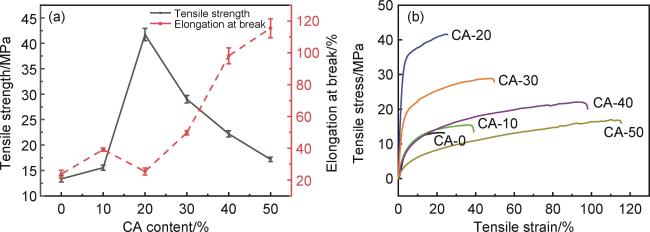
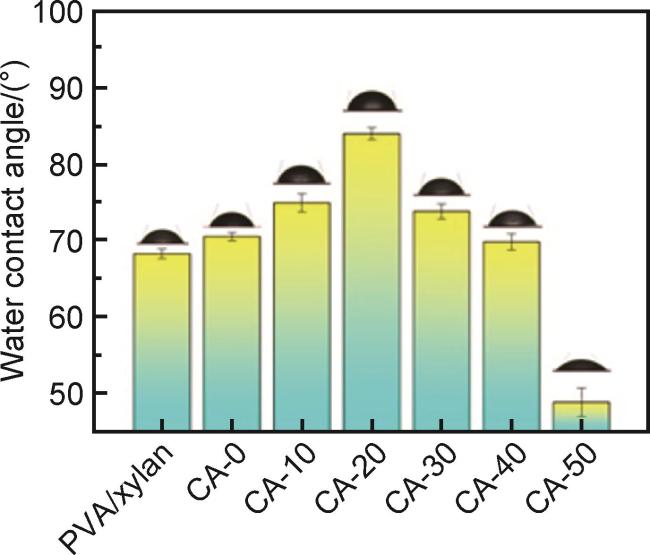
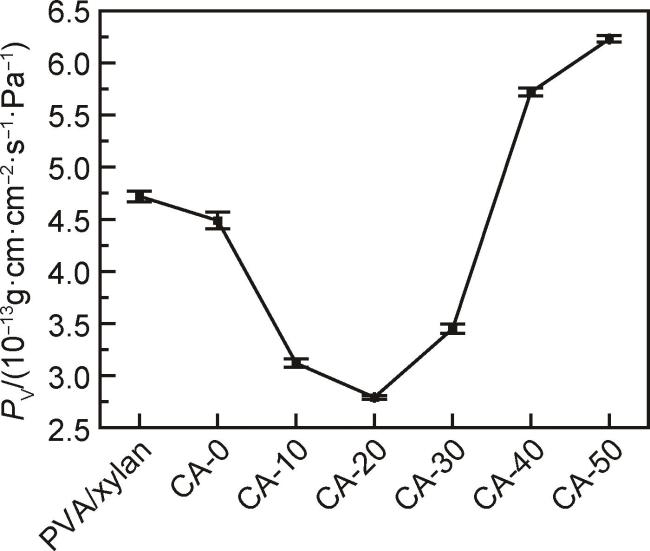
In order to improved the defects of xylan-based films such as strong hygroscopicity and low mechanical strength, a collaborative modification protocol of citric acid (CA) and MPTMS-modified xylan (MSMX) was proposed. Xylan from sugarcane bagasse was firstly modified by (3-mercaptopropyl)trimethoxysilane (MPTMS), and then citric acid was used as crosslinking agent or plasticizer. The MSMX/PVA/CA films were prepared by casting method and the effects of citric acid content on the structure and packaging performance of the composite film were studied. The results show that with the increase of CA content, the cross-linking degree of MSMX/PVA/CA films increases and the internal structure becomes more dense, which lead to the significant enhancement of mechanical properties and water vapor barrier performance. Meanwhile, the hydrophobicity of the MSMX/PVA/CA films is improved with the decrease of hydrophilice groups. When CA content is 20% (mass fraction), the tensile strength of MSMX/PVA/CA film is 41.8 MPa, water contact angle is 82°, and the water vapor transmittance reaches 2.79×10⁻¹³ g·cm·cm-2·s-1·Pa-1, which is 37.79% lower than that of film without CA. The addition of CA improves the moisture barrier properties and mechanical strength of xylan composite films, which makes it have a potential application in the field of food and drug packaging.
Key words: citric acid; xylan; polyvinyl alcohol; crosslinking agent; composite film
Jinhui LI , Yining WANG , Sixia YANG , Haisong WANG , Yanna LYU . Effect of citric acid on properties of (3-mercaptopropyl)trimethoxysilane modified xylan/polyvinyl alcohol composite film[J]. Journal of Materials Engineering, 2023 , 51(11) : 182 -188 . DOI: 10.11868/j.issn.1001-4381.2022.000076
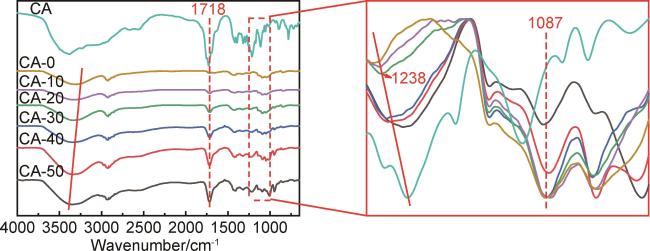
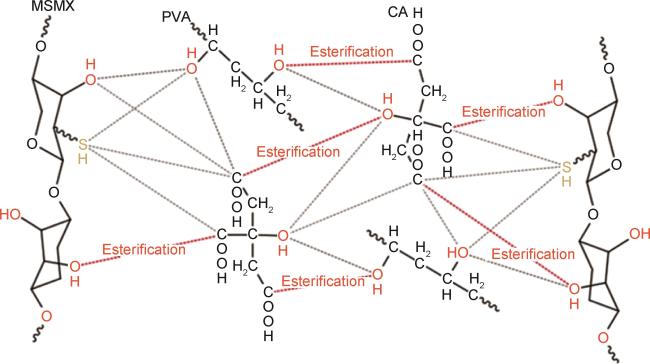
 O的伸缩振动吸收谱带逐渐尖锐变宽,伴随着1238 cm-1和1087 cm-1附近增强的C—O—C的伸缩振动吸收谱带,证实了酯基的存在,由此推测交联反应在薄膜基体中的发生[20]。值得注意的是,与不添加CA的复合膜在3316 cm-1的O—H特征峰相比,添加10%,20%,30%,40%,50%CA复合膜的O—H特征峰分别在3323,3327,3338,3342 cm-1和3349 cm-1处,振动频率红移,这可能是由于CA的加入降低了成膜液中的负电荷,导致PVA和MSMX暴露更多的反应性基团(如羟基或硫醇基)与CA暴露的羧基相互交联形成大量分子间和分子内氢键,以多聚体的形式存在,形成多重氢键交联[21]。氢键的存在还表明MSMX/PVA基体与CA间具有一定程度的相容性。氢键和酯基的形成表明,CA主要与MSMX/PVA基体的羟基进行交联,CA与MSMX和PVA之间的交联作用机理如图2所示。随着CA含量的增加,分子间氢键增强,酯化反应程度增大,促使交联程度增强,复合膜相容性提高。
| 1 |
|
| 2 |
|
| 3 |
|
| 4 |
|
| 5 |
|
| 6 |
代晴晴. 木聚糖功能化修饰磁性水凝胶的制备及其性能研究[D]. 广州: 华南理工大学, 2017.
|
| 7 |
|
| 8 |
|
| 9 |
温敬运, 邱晓宇, 李明飞, 等. 半纤维素基水凝胶制备及应用研究进展[J]. 材料工程, 2020, 441(2): 1-10.
|
| 10 |
|
| 11 |
|
| 12 |
|
| 13 |
|
| 14 |
|
| 15 |
|
| 16 |
|
| 17 |
|
| 18 |
|
| 19 |
陈祖云. 包装材料与容器手册[M]. 广州: 广东科技出版社, 1998.
|
| 20 |
|
| 21 |
DAS A,
|
| 22 |
|
| 23 |
周顺, 徐迎波, 王程辉, 等. 柠檬酸的热解特性[J]. 烟草科技, 2011(9): 45-49.
|
| 24 |
|
| 25 |
|
| 26 |
|
| 27 |
|
/
| 〈 |
|
〉 |