 PDF(2786 KB)

Continuous Flow Enzymatic/Chemo-Enzymatic Ring-Opening Polymerizations
Aiai Su, Yihuan Liu, Jin Huang, Hengquan Yang, Kai Guo, Ning Zhu
Prog Chem ›› 2026, Vol. 38 ›› Issue (2) : 274-282.
PDF(2786 KB)
PDF(2786 KB)
Continuous Flow Enzymatic/Chemo-Enzymatic Ring-Opening Polymerizations
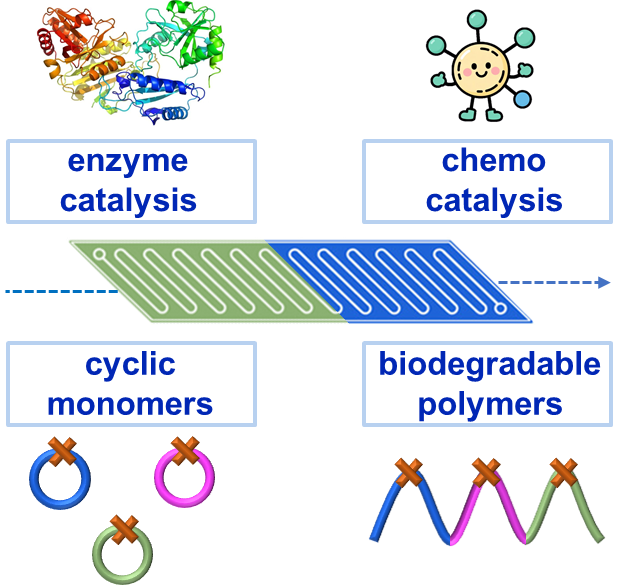
Ring-opening polymerizations (ROP) of cyclic monomers for the synthesis of biodegradable polymers have attracted growing research interest from polymer chemistry. As a green synthetic strategy,enzymatic ROP still suffers from bottlenecks,such as low efficiency and broad molecular weight distribution. In contrast to the traditional batch reactor,a microreactor featuring a huge surface-to-volume ratio and continuous flow characteristics enables process intensification and allows for applications in organic and polymeric synthesis. Recently,remarkable advantages have been demonstrated by the combination of microreactor-based flow chemistry and enzymatic ROP,such as accelerated apparent polymerization rate constant,lower polydispersity (Đ),and higher end-group fidelity. Moreover,continuous flow chemo-enzymatic platforms have been developed to efficiently prepare biodegradable block and bottlebrush copolymers. This review focuses on the advances in microreactor-based continuous flow enzymatic and chemo-enzymatic ring-opening polymerizations for the synthesis of biodegradable polymers. The challenges and opportunities are also discussed with the target for the development of biocatalysis and biodegradable polymers.
Contents
1 Introduction
2 Synthesis of biodegradable polymers by continuous flow enzymatic ROP
2.1 Water as initiator
2.2 Alcohol as initiator
2.3 Optimization of polymerizations
3 Synthesis of functional biodegradable polymers by continuous flow chemo-enzymatic routes
3.1 Block copolymers
3.2 Bottlebrush polymers
3.3 Polymer stabilized nanoparticles
4 Conclusion and outlook
continuous flow / enzymatic / chemo-enzymatic / ring-opening polymerizations / biodegradable polymers
| [1] |
|
| [2] |
|
| [3] |
|
| [4] |
|
| [5] |
|
| [6] |
|
| [7] |
|
| [8] |
|
| [9] |
|
| [10] |
(丁跃, 卢波, 季君晖. 化学进展, 2020, 32(6):738.)
|
| [11] |
|
| [12] |
|
| [13] |
|
| [14] |
|
| [15] |
(陈蕾蕾, 陶永鑫, 胡欣, 冯宏博, 朱宁, 郭凯. 化学进展, 2023, 35: 1613.)
|
| [16] |
(陶永鑫, 陈蕾蕾, 刘一寰, 胡欣, 朱宁, 郭凯. 高分子学报, 2022, 53: 1446.)
|
| [17] |
|
| [18] |
|
| [19] |
(王行, 薛小盼, 薛友淑, 张文娟, 马艳平, 孙文华. 化学进展, 2024, 36(10): 1425.)
|
| [20] |
|
| [21] |
|
| [22] |
|
| [23] |
|
| [24] |
(许茸, 陈春霞. 化学进展, 2012, 24(8): 1519.)
|
| [25] |
|
| [26] |
|
| [27] |
|
| [28] |
|
| [29] |
|
| [30] |
|
| [31] |
|
| [32] |
|
| [33] |
|
| [34] |
|
| [35] |
|
| [36] |
|
| [37] |
Elvira K S, i Solvas X C,
|
| [38] |
|
| [39] |
|
| [40] |
|
| [41] |
|
| [42] |
|
| [43] |
|
| [44] |
|
| [45] |
|
| [46] |
|
| [47] |
|
| [48] |
|
| [49] |
|
| [50] |
|
| [51] |
|
| [52] |
|
| [53] |
|
| [54] |
|
| [55] |
|
| [56] |
|
| [57] |
|
| [58] |
|
| [59] |
|
| [60] |
|
| [61] |
|
| [62] |
|
| [63] |
|
| [64] |
|
| [65] |
|
| [66] |
|
| [67] |
|
| [68] |
|
| [69] |
|
| [70] |
|
| [71] |
|
| [72] |
|
| [73] |
|
| [74] |
|
| [75] |
|
| [76] |
|
| [77] |
|
| [78] |
|
| [79] |
|
| [80] |
|
| [81] |
|
| [82] |
|
| [83] |
|
| [84] |
|
| [85] |
(陈柯睿, 胡欣, 邱江凯, 朱宁, 郭凯. 化学进展, 2020, 32(1): 93.)
|
| [86] |
|
| [87] |
|
| [88] |
|
| [89] |
|
| [90] |
|
| [91] |
|
| [92] |
|
| [93] |
|
| [94] |
|
| [95] |
|
| [96] |
|
| [97] |
|
| [98] |
|
/
| 〈 |
|
〉 |








