PDF(4810 KB)

Applications of Covalent Organic Frameworks in Electrocatalytic Reduction of CO2
Jingyang Li, Dongge Xu, Yunchao Ma, Keyu Cui, Chunbo Liu
Prog Chem ›› 2025, Vol. 37 ›› Issue (11) : 1622-1630.
PDF(4810 KB)
PDF(4810 KB)
Applications of Covalent Organic Frameworks in Electrocatalytic Reduction of CO2
Large emission of carbon dioxide leads to severe global warming effects. Therefore, it is urgent to convert carbon dioxide. Among various transformation technologies, electrocatalytic reduction of CO2 is able to efficiently and continuously convert carbon dioxide. However, the electrocatalytic reduction of CO2 needs to overcome a higher activation barrier. Traditional electrocatalysts such as metals, metal dichalcogenides, transition metal oxides and 2D metal-free catalysts (g-C3N4) are susceptible to inactivation in homogeneous systems and present low electron transfer efficiency, low ability to adsorb and activate carbon dioxide, low reaction kinetics and low selectivity. Covalent organic frameworks (COFs), which are fabricated through covalent bonds, are a class of emerging porous organic polymers. Ordered alignment and π-π interactions between layers facilitate the transportation of charge carriers. High specific surface area and appropriate pore size enable the adsorption of carbon dioxide and generate more active sites as well. All these unique advantages make COFs an ideal candidate for the electrocatalytic reduction of carbon dioxide. In this paper, we first summarize the synthesis and structural diversity of two- and three-dimensional covalent organic frameworks based on topology. Then, the development of 2D and 3D covalent organic frameworks for the electrocatalytic reduction of carbon dioxide is introduced, respectively. Finally, the potential development of COFs for electrochemical carbon dioxide reduction is discussed.
Contents
1 Introduction
2 Synthesis and structural diversity of COFs
3 COFs for electrocatalytic reduction of carbon dioxide
3.1 2D COFs electrocatalysts on CO2 reduction
3.2 3D COFs electrocatalysts on CO2 reduction
4 Conclusion and outlook
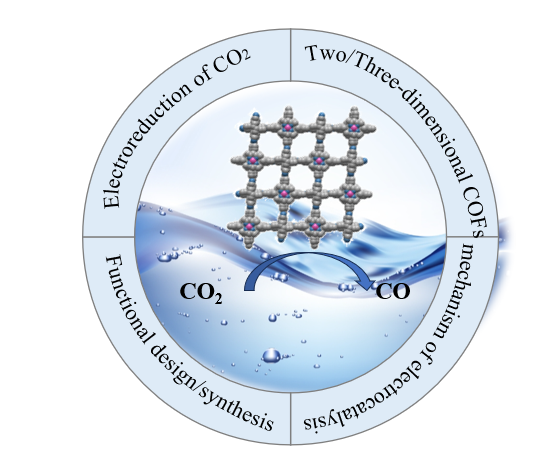
2D covalent organic frameworks / 3D covalent organic frameworks / structural synthesis, electrocatalysts / electrocatalytic reduction of carbon dioxide
| [1] |
|
| [2] |
|
| [3] |
|
| [4] |
|
| [5] |
|
| [6] |
|
| [7] |
|
| [8] |
|
| [9] |
|
| [10] |
|
| [11] |
|
| [12] |
|
| [13] |
|
| [14] |
|
| [15] |
|
| [16] |
|
| [17] |
|
| [18] |
|
| [19] |
|
| [20] |
|
| [21] |
|
| [22] |
|
| [23] |
|
| [24] |
|
| [25] |
|
| [26] |
|
| [27] |
|
| [28] |
|
| [29] |
|
| [30] |
|
| [31] |
|
| [32] |
|
| [33] |
|
| [34] |
|
| [35] |
|
| [36] |
|
| [37] |
|
| [38] |
|
| [39] |
|
| [40] |
|
| [41] |
|
| [42] |
|
| [43] |
|
| [44] |
|
| [45] |
|
| [46] |
|
| [47] |
|
| [48] |
|
| [49] |
|
| [50] |
|
| [51] |
|
| [52] |
|
| [53] |
|
| [54] |
|
| [55] |
|
| [56] |
|
| [57] |
|
| [58] |
|
| [59] |
|
| [60] |
|
| [61] |
|
| [62] |
|
| [63] |
|
| [64] |
|
| [65] |
|
| [66] |
|
| [67] |
|
| [68] |
|
| [69] |
|
| [70] |
|
| [71] |
|
/
| 〈 |
|
〉 |