The Sources, Emission Characteristics, and Environmental Management of Polychlorinated Naphthalenes

Yuyan Luo, Guorui Liu

Prog Chem ›› 2025, Vol. 37 ›› Issue (11) : 1704-1718.

PDF(2335 KB)
Home Journals Progress in Chemistry
Progress in Chemistry

Abbreviation (ISO4): Prog Chem      Editor in chief: Jincai ZHAO

About  /  Aim & scope  /  Editorial board  /  Indexed  /  Contact  / 
PDF(2335 KB)
Prog Chem ›› 2025, Vol. 37 ›› Issue (11) : 1704-1718. DOI: 10.7536/PC20250502
Review

The Sources, Emission Characteristics, and Environmental Management of Polychlorinated Naphthalenes

Author information +
History +

Abstract

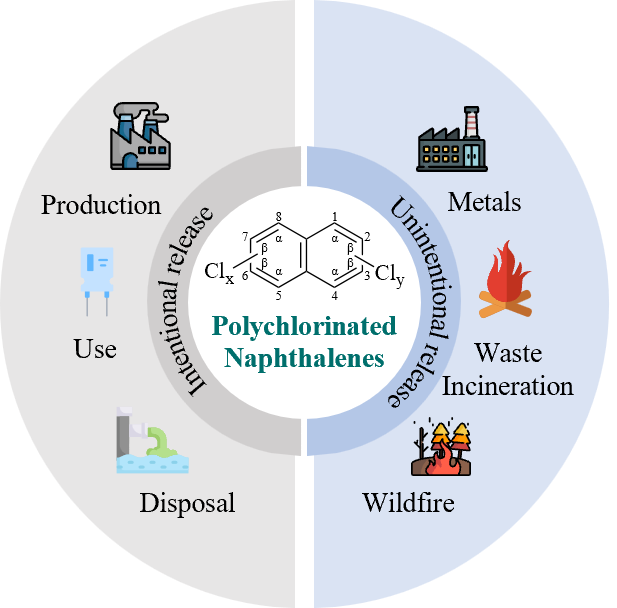
Polychlorinated naphthalenes (PCNs) are persistent organic compounds that are regulated by the Stockholm Convention. Because of their persistence and long-range transport, PCNs are widely distributed in the environment, even in the Tibetan Plateau and Arctic area. Historical manufacturing and unintentional release from human industrial activities are the two major sources of PCNs. Accurate characterization of PCNs is essential for the development of targeted pollution prevention strategies and effective reduction of their residual levels in the environment. In this paper we summarize the current status of emission studies on PCNs, including their emission sources, emission factors and progress in emission inventories. Historical emission studies show that PCN emissions are closely related to the industrialization process, with an increasing and then decreasing trend in most regions. Studies on unintentional emissions show that the emission factors of PCNs vary considerably between industries and processes and are strongly influenced by pollution control measures. Although some progress has been achieved, the systematic study of global emissions of PCNs is still inadequate, particularly in the determination of emission factors and the compilation of emission inventories. Future research is needed to further improve the emission inventory and strengthen monitoring and management to effectively control the environmental risks of PCNs.

Contents

1 Introduction

2 Properties of PCNs

2.1 Physicochemical properties of PCNs

2.2 Toxicity of PCNs

2.3 Environmental behavior of PCNs

3 Current status of global management policies for PCNs

4 Source of PCNs

5 Progress in the study of historical production and emission of PCNs

5.1 Estimation of historical production

5.2 Release of PCNs as historical chemicals

6 Unintentional emissions of PCNs

6.1 Emission factors for PCNs

6.2 Emission inventories of PCNs

7 Conclusion and outlook
Key words

polychlorinated naphthalenes / emission inventories / persistent organic pollutants / emission factors / environmental management

Cite this article

Download Citations
Yuyan Luo , Guorui Liu. The Sources, Emission Characteristics, and Environmental Management of Polychlorinated Naphthalenes[J]. Progress in Chemistry. 2025, 37(11): 1704-1718 https://doi.org/10.7536/PC20250502

References

[1]
Klimczak M, Liu G R, Fernandes A R, Kilanowicz A, Falandysz J. J. Hazard. Mater., 2023, 457: 131786.
[2]
Liu G R, Cai Z W, Zheng M H. Chemosphere, 2014, 94: 1.
[3]
UNEP. Report of the conference of the Parties to the Stockholm Convention on persistent organic pollutants on the work of its seventh meeting. SC-7/14: Listing of polychlorinated naphthalenes.: UNEP/POPS/COP.7/36., 2015.
[4]
Lin B C, Yang Y P, Yang L L, Liu G R, Li C L, Xu J, Hou S, Zheng M H. J. Hazard. Mater., 2022, 423: 127125.
[5]
Yang Y P, Yang L L, Wang M X, Yang Q T, Liu X Y, Shen J, Liu G R, Zheng M H. Chemosphere, 2020, 255: 126958.
[6]
Liu X Y, Yang L L, Wang M X, Zheng M H, Li C, Qin L J, Liu G R. Environ. Sci. Technol., 2021, 55(23): 15929.
[7]
Hu J C, Zheng M H, Liu W B, Li C L, Nie Z Q, Liu G R, Zhang B, Xiao K, Gao L R. Environ. Sci. Pollut. Res., 2013, 20(5): 2905.
[8]
Zhu Q Q, Zhang X, Dong S J, Gao L R, Liu G R, Zheng M H. Environ. Pollut., 2016, 212: 128.
[9]
Huang Z C, Wang C, Liu G R, Yang L L, Luo X, Liang Y, Wang P, Zheng M H. Environ. Pollut., 2024, 361: 124882.
[10]
Agunbiade I V, Adeniji A O, Okoh A I, Okoh O O. Environ. Geochem. Health, 2023, 45(5): 2051.
[11]
Bidleman T F, Helm P A, Braune B M, Gabrielsen G W. Sci. Total Environ., 2010, 408(15): 2919.
[12]
Li C, Zhang L, Li J G, Min Y H, Yang L L, Zheng M H, Wu Y N, Yang Y P, Qin L J, Liu G R. Environ. Int., 2020, 136: 105436.
[13]
Dong C. Sci. Total Environ., 2022, 849: 157883.
[14]
Qi Z Y, Zhang Z R, Jin R, Zhang L, Zheng M H, Li J G, Wu Y N, Li C, Lin B C, Liu Y H, Liu G R. J. Agric. Food Chem., 2024, 72(1): 773.
[15]
Qi Z Y, Jin R, Yang L L, Zhao C Y, Lin B C, Zheng M H, Liu G R. Chin. Sci. Bull., 2023, 68(18): 2366.
[16]
Jakobsson E, Asplund L. Polychlorinated naphthalenes (PCNs). Eds.: Hutzinger O, Paasivirta J. Berlin: Springer Berlin Heidelberg, 2000: 97.
[17]
UNEP. Risk profile on chlorinated naphthalenes: UNEP/POPS/POPRC.8/16/Add.1. 2012.
[18]
Concise International Chemical Assessment Document No. Chlorinated Naphthalenes. Ed.: IPCS. Geneva: World health organization, 2001.
[19]
ECCC. Screening assessment report for chlorinated naphthalenes. Environment and Climate Change Canada, 2009.
[20]
Agunbiade I V, Adeniji A O, Okoh A I, Okoh O O. Environ. Pollut. Bioavailab., 2020, 32(1): 154.
[21]
Falandysz J. Environ. Pollut., 1998, 101(1): 77.
[22]
Falandysz J, Puzyn T, Szymanowska B, Kawano M, Markuszewski M, Skurski P. Pol. J. Environ. Stud., 2001, 10(4): 217.
[23]
Fernandes A R, Kilanowicz A, Stragierowicz J, Klimczak M, Falandysz J. Sci. Total Environ., 2022, 837: 155764.
[24]
Klimczak M, Darago A, Bruchajzer E, Domeradzka-Gajda K, Stepnik M, Kuzajska K, Kilanowicz A. Environ. Toxicol., 2018, 33(6): 695.
[25]
Stragierowicz J, Bruchajzer E, Daragó A, Nasiadek M, Kilanowicz A. Environ. Pollut., 2018, 243: 1026.
[26]
Denison M S, Pandini A, Nagy S R, Baldwin E P, Bonati L. Chem. Biol. Interact., 2002, 141(1/2): 3.
[27]
Puzyn T, Mostrąg A, Suzuki N, Falandysz J. Atmos. Environ., 2008, 42(27): 6627.
[28]
Hanari N, Falandysz J, Yamazaki E, Yamashita N. Environ. Pollut., 2020, 263: 114672.
[29]
Mori T, Kitano S, Kondo R. Appl. Microbiol. Biotechnol., 2003, 61(4): 380.
[30]
Wania T Environ. Sci. Technol., 2003, 37(7): 1344-1351.
[31]
Harne T, Kylin H, Bidleman T F, Halsall C, Strachan W M J, Barrie L A, Fellin P. Environ. Sci. Technol., 1998, 32(21): 3257.
[32]
Dong C, Zhang Q H, Xiong S Y, Yang R Q, Pei Z G, Li Y M, Jiang G B. Environ. Sci. Technol., 2023, 57(44): 17076.
[33]
UNEP. Basel convention on the control of transboundary movements of hazardous wastes and their disposal. 2011.
[34]
OSPAR Commission. OSPAR List of Chemicals for Priority Action. OSPAR Convention: Vols. 2004-12. 2023.
[35]
UNECE. Decision 2009/2 on the Listing of short-chain chlorinated paraffins and polychlorinated naphthalenes in annexes I and II to the 1998 Protocol on Persistent Organic Pollutants: ECE/EB.AIR/99/ADD.1. United Nations Economic Commission for Europe, 2009.
[36]
Yamashita N, Taniyasu S, Hanari N, Horii Y, Falandysz J.J. Environ. Sci. Health Part A, 2003, 38(9): 1745.
[37]
EU. Commission Regulation (EU) No 519/2012 of 19 June 2012 amending Regulation (EC) No 850/2004 of the European Parliament and of the Council on persistent organic pollutants as regards Annex I. 2012.
[38]
EU. Commission Regulation (EU) No 1342/2014 - of 17 December 2014 - amending Regulation (EC) No 850/2004 of the European Parliament and of the Council on persistent organic pollutants as regards Annexes IV and V. EU Codex: EU 1342/2014. 2014: L 363/67-L 363/74.
[39]
EU. Regulation (EU) 2019/1021 of the European Parliament and of the Council - of 20 June 2019 - on persistent organic pollutants. EU Codex: EU 2019/1021. 2019: L 169/45-L 169/77.
[40]
UNEP. Risk management evaluation on chlorinated naphthalenes: UNEP/POPS/POPRC.9/13/Add.1. Rome, 2013: 19.
[41]
Ministry of Ecology and Environment of the People's Republic of China. Announcement on the Environmental Risk Control Requirements for Five Types of Persistent Organic Pollutants, Including Polychlorinated Naphthalenes. 2023
(中华人民共和国生态环境部. 关于多氯萘等5种类持久性有机污染物环境风险管控要求的公告. 2023).
[42]
Wang X Y, Thai P K, Mallet M, Desservettaz M, Hawker D W, Keywood M, Miljevic B, Paton-Walsh C, Gallen M, Mueller J F. Environ. Sci. Technol., 2017, 51(3): 1293.
[43]
Th Brinkman U A, Reymer H G M. J. Chromatogr. A, 1976, 127(3): 203.
[44]
Wu J, Hu J C, Wang S J, Jin J X, Wang R, Wang Y, Jin J. Chemosphere, 2018, 199: 382.
[45]
Nigar R, Zhao S Z, Liu X, Huang H F, Tian L L, Xiao Y W, Habib A, Zhang G. Emerg. Contam., 2024, 10(3): 100356.
[46]
Takasuga T, Nakano T, Shibata Y. Organohalogen Compd., 2012, 74: 1437.
[47]
Zhang L F, Yang W L, Zhang L L, Li X X. Chemosphere, 2015, 133: 1.
[48]
Liu G R, Zhan J Y, Zhao Y Y, Li L, Jiang X, Fu J, Li C, Zheng M. Chemosphere, 2016, 155: 348.
[49]
Teng Z C, Han Y N, He S M, Hadizadeh M H, Zhang Q, Bai X, Wang X, Sun Y, Xu F. IJMS, 2022, 23(11): 5866.
[50]
EPA.Environmental monitoring near industrial sites: Polychloronaphthalenes: EPA-560/6-77-019 1997/6. United States Environmental Protection Agency, 1997.
[51]
AMAP. AMAP Assessment 2002: The Influence of Global Change on Contaminant Pathways to, within, and from the Arctic. Ed.: Jensson H. Oslo: AMAP Arctic Monitoring and Assessment Programme, 2003.
[52]
Bogdal C, Schmid P, Kohler M, Müller C E, Iozza S, Bucheli T D, Scheringer M, Hungerbühler K. Environ. Sci. Technol., 2008, 42(18): 6817.
[53]
UNEP. Guidance on preparing inventories of polychlorinated naphthalenes (PCNs). Geneva, Switzerland: Secretariat of the Basel, Rotterdam and Stockholm Conventions, United Nations Environment Programme, 2021: 36.
[54]
Global Contamination Trends of Persistent Organic Chemicals. Eds.: Loganathan B G, Lam P K S. CRC Press, 2011.
[55]
EPA. Environmental hazard assessment report: Chlorinated naphthalenes: EPA-560/8-75-001 1975/12. United States Environmental Protection Agency, 1975.
[56]
Noma Y, Yamamoto T, Giraud R, Sakai S I. Chemosphere, 2006, 62(7): 1183.
[57]
UNEP. Draft guidance on preparing inventories of polychlorinated naphthalenes (PCNs): UNEP/POPS/COP.8/INF/19. Geneva: United Nations Environment Programme, 2017: 74.
[58]
Gevao B, Harner T, Jones K C. Environ. Sci. Technol., 2000, 34(1): 33.
[59]
Horii Y, Okada M, Amano K, Hanari N, Taniyasu S, Yamashita N. Bunseki Kagaku, 2002, 51(11): 1009.
[60]
Yamashita N, Kannan K, Imagawa T, Villeneuve D L, Hashimoto S, Miyazaki A, Giesy J P. Environ. Sci. Technol., 2000, 34(17): 3560.
[61]
Pan J, Yang Y L, Yang W X, Li G H, Tanbo S., Yamashita N. Acta Sci. Circum., 2011, 31(4): 816
(潘静, 杨永亮, 杨伟贤, 路国慧, 谷保佐知, 山下信义. 环境科学学报, 2011, 31(4): 816).
[62]
Pan J, Yang Y L, Taniyasu S, Yeung L W Y, Falandysz J, Yamashita N. Bull. Environ. Contam. Toxicol., 2012, 89(6): 1240.
[63]
Li A, Guo J H, Li Z N, Lin T, Zhou S S, He H, Ranansinghe P, Sturchio N C, Rockne K J, Giesy J P. J. Gt Lakes Res., 2018, 44(4): 682.
[64]
Lee H H, Lee S, Lee M, Moon H B. Environ. Geochem. Health, 2023, 45(9): 6793.
[65]
Odabasi M, Ozgunerge Falay E, Tuna G, Altiok H, Kara M, Dumanoglu Y, Bayram A, Tolunay D, Elbir T. Environ. Sci. Technol., 2015, 49(4): 2105.
[66]
Day M, Pouliot G, Hunt S, Baker K R, Beardsley M, Frost G, Mobley D, Simon H, Henderson B B, Yelverton T, Rao V. J. Air Waste Manag. Assoc., 2019, 69(9): 1023.
[67]
Huang H Y, Gao Y S, Wang Q. Energy Environ. Prot., 2023, 37(3): 204
(黄浩瑜, 高艳珊, 王强. 能源环境保护, 2023, 37(3): 204).
[68]
Nie Z Q, Liu G R, Liu W B, Zhang B, Zheng M H. Atmos. Environ., 2012, 57: 109.
[69]
Dat N D, Huang Y J, Chang M B. Chemosphere, 2020, 252: 126541.
[70]
Schneider M, Stieglitz L, Will R, Zwick G. Chemosphere, 1998, 37(9/10/11/12): 2055.
[71]
Liu G R, Lv P, Jiang X X, Nie Z Q, Zheng M H. Environ. Sci. Technol., 2014, 48(22): 13165.
[72]
Odabasi M, Dumanoglu Y, Kara M, Altiok H, Elbir T, Bayram A. Sci. Total Environ., 2017, 574: 1305.
[73]
Yamashita N, Kannan K, Imagawa T, Miyazaki A, Giesy J P. Environ. Sci. Technol., 2000, 34(19): 4236.
[74]
Huang J, Yu G, Yamauchi M, Matsumura T, Yamazaki N, Weber R. Environ. Sci. Pollut. Res., 2015, 22(19): 14471.
[75]
Ministry of Ecology and Environment of the People's Republic of China. Manual on Production and Emission Accounting Methods and Coefficients for Statistical Survey of Emission Sources. 2021
(中华人民共和国生态环境部. 排放源统计调查产排污核算方法和系数手册. 2021).
[76]
Behnisch P A, Hosoe K, Shiozaki K, Kiryu T, Komatsu K, Schramm K W, Sakai S I. Environ. Sci. Pollut. Res., 2002, 9(5): 337.
[77]
Helm P A, Bidleman T F. Environ. Sci. Technol., 2003, 37(6): 1075.
[78]
Takasuga T, Inoue T, Ohi E, Senthil Kumar K. Arch. Environ. Contam. Toxicol., 2004, 46(4): 3041.
[79]
Lee R G M, Coleman P, Jones J L, Jones K C, Lohmann R. Environ. Sci. Technol., 2005, 39(6): 1436.
[80]
Zhang J, Ni Y W, Zhang H J, Zhang X P, Zhang Q, Chen J P. Environ. Sci., 2009, 30(2): 568
(张婧, 倪余文, 张海军, 张雪萍, 张青, 陈吉平. 环境科学, 2009, 30(2): 568).
[81]
Wyrzykowska B, Hanari N, Orlikowska A, Yamashita N, Falandysz J. Chemosphere, 2009, 76(2): 255.
[82]
Ba T, Zheng M H, Zhang B, Liu W B, Su G J, Liu G R, Xiao K. Environ. Sci. Technol., 2010, 44(7): 2441.
[83]
Liu G R, Zheng M H, Lv P, Liu W B, Wang C Z, Zhang B, Xiao K. Environ. Sci. Technol., 2010, 44(21): 8156.
[84]
Nie Z Q, Zheng M H, Liu W B, Zhang B, Liu G R, Su G J, Lv P, Xiao K. Chemosphere, 2011, 85(11): 1707.
[85]
Liu G R, Zheng M H, Du B, Nie Z, Zhang B, Liu W, Li C, Hu J. Chemosphere, 2012, 89(4): 467.
[86]
Liu G R, Zheng M H, Du B, Nie Z Q, Zhang B, Hu J C, Xiao K. Environ. Sci. Pollut. Res., 2012, 19(8): 3645.
[87]
Nie Z Q, Zheng M H, Liu G R, Liu W B, Lv P, Zhang B, Su G J, Gao L R, Xiao K. J. Hazard. Mater., 2012, 215/216: 259.
[88]
Liu G R, Liu W B, Cai Z W, Zheng M H. J. Hazard. Mater., 2013, 261: 421.
[89]
Li S M, Zheng M H, Liu W B, Liu G R, Xiao K, Li C L. Environ. Sci. Pollut. Res., 2014, 21(12): 7361.
[90]
Liu G Q, Liu D H, Zhou Z H. J. Shenzhen Univ. Sci. Eng., 2015, 32(4): 398
(刘国卿, 刘德华, 周志华. 深圳大学学报(理工版), 2015, 32(4): 398).
[91]
Jiang X X, Liu G R, Wang M, Liu W B, Tang C, Li L, Zheng M H. J. Hazard. Mater., 2015, 286: 545.
[92]
Liu G R, Lv P, Jiang X X, Nie Z Q, Liu W B, Zheng M H. Chemosphere, 2015, 118: 112.
[93]
Wang M J, Liu W B, Hou M F, Li Q Q, Han Y, Liu G R, Li H F, Liao X, Chen X B, Zheng M H. Sci. Rep., 2016, 6: 26444.
[94]
Li S M, Liu G R, Zheng M H, Liu W B, Li J H, Wang M, Li C L, Chen Y. J. Hazard. Mater., 2017, 331: 63.
[95]
Gaga E O, Arı A, Akyol N, Üzmez Ö Ö, Kara M, Chow J C, Watson J G, Özel E, Döğeroğlu T, Odabasi M. Sci. Total Environ., 2018, 643: 1285.
[96]
Fan Y, Ren M H, Zhang H J, Geng N B, Li Y, Zhang N, Zhao L, Gao Y, Chen J P. Chemosphere, 2019, 224: 298.
[97]
Fang Y Y, Nie Z Q, Yang J Z, Die Q Q, He J, Yu H J, Zhou Q, Huang Q F. Environ. Sci. Pollut. Res., 2019, 26(13): 12731.
[98]
Jiang X X, Li Q S, Yang L L, Yang Y P, Zheng M H. Ecotoxicol. Environ. Saf., 2019, 184: 109674.
[99]
Wang M J, Li Q Q, Liu W B. Environ. Pollut., 2019, 255: 113096.
[100]
Ren M H, Lv Z Y, Xu L, Lu Q Q, Zhang X F, Yu Y, Fan Y, Gao Y, Chen J P, Zhang H J. Sci. Total Environ., 2020, 735: 139134.
[101]
Chen C Z, Wang H Y, Liu G R, Lin B C, Yang L L, Jin R, Sun Y X, Guo J P, Li Y M, Yang N, Li A H, Li C L, Hou S, Xu J, Zheng M H. Sci. Total Environ., 2023, 854: 158793.
[102]
Yang L L, Shen J, Liu G R, Zhao X G, Zheng M H. Chin. Sci. Bull., 2022, 67(3): 278
(杨莉莉, 申佳, 刘国瑞, 赵晓光, 郑明辉. 科学通报, 2022, 67(3): 278).
[103]
Dat N D, Huang Y J, Hsu Y C, Chang M B. Chemosphere, 2020, 253: 126651.
[104]
Denier van der Gon H, van het Bolscher M, Visschedijk A, Zandveld P. Atmos. Environ., 2007, 41(40): 9245.
[105]
Yang L L, Zheng M H, Zhu Q Q, Yang Y P, Li C, Liu G R. Environ. Sci. Technol., 2020, 54(2): 842.
[106]
Huang Y, Huang L, Li Y, Sidikjan N, Zhang Y S, Chen Y, Chen Y M, Li Y, Du W, Chen L, Wu Y, Zhang S S, Yang J, Meng W J, Shen G F, Liu M, Tao S. J. Environ. Sci., 2025, 148: 221.

Funding

Strategic Priority Research Program of the Chinese Academy of sciences(XDB0750400)
National Natural Science Foundation of China(22376204)
National Natural Science Foundation of China(22576189)
PDF(2335 KB)

Accesses

Citation

Detail

Sections
Recommended

/