 PDF(22576 KB)

Synthesis of Graphynes and Their Applications in Third-Order Nonlinear Optics
Juemin Zhao, Bin Liang, Yaxing Tang, Jie Li, Zheng Xie
Prog Chem ›› 2025, Vol. 37 ›› Issue (12) : 1917-1930.
PDF(22576 KB)
PDF(22576 KB)
Synthesis of Graphynes and Their Applications in Third-Order Nonlinear Optics
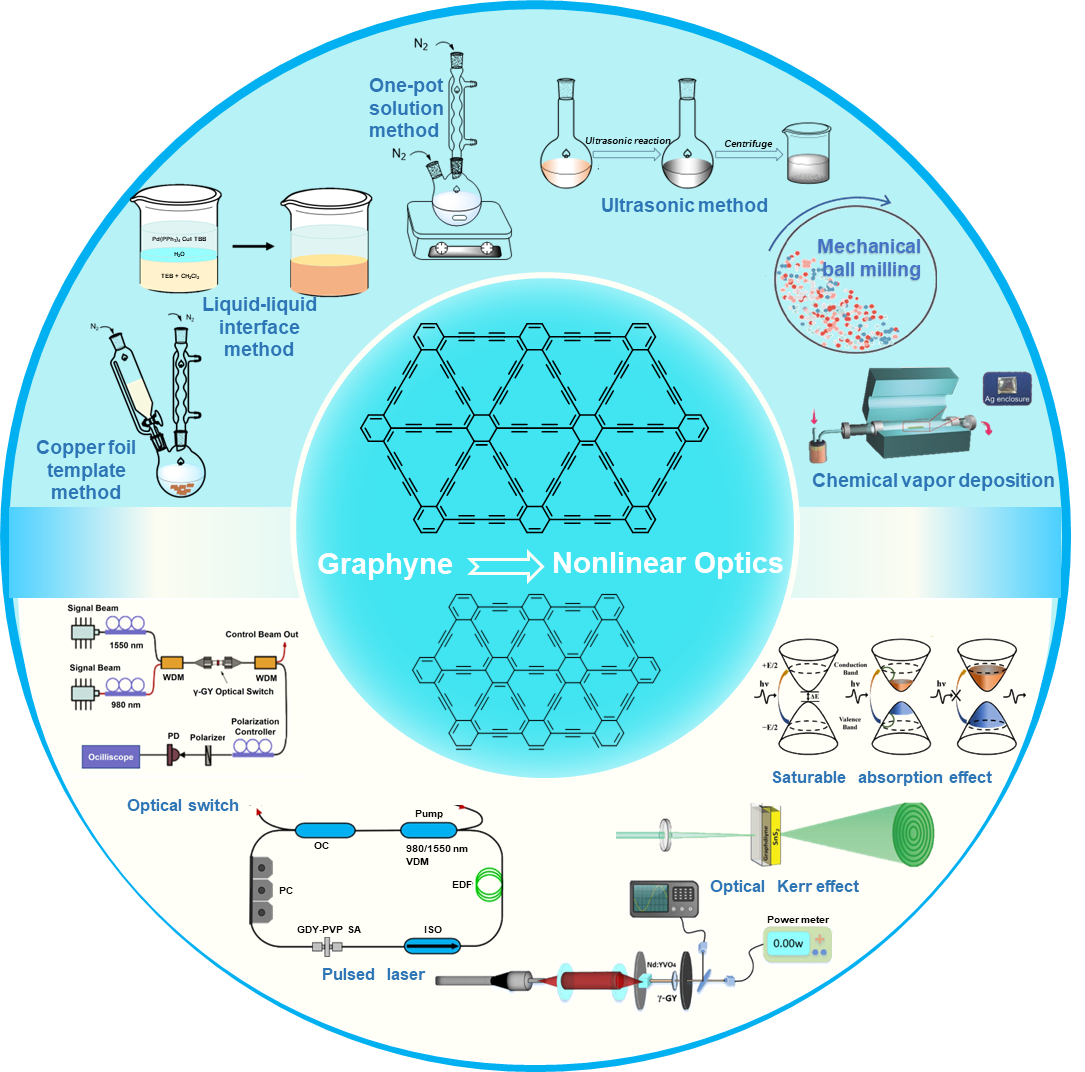
Graphynes are a kind of low-dimensional carbon material composed of sp- and sp²-hybridized carbon atoms with unique electronic conjugation topologies and tunable chemical properties. Recently, significant progress has been made in the synthesis methods of graphynes. Various derivative structures as well as different morphologies from nanosheets to macroscopic films have been achieved through dry or wet chemical methods, which provide important theoretical and experimental supports for designing new carbon materials. Due to the high specific surface areas, abundant chemically active sites, and adjustable bandgap structures, graphyne derivatives exhibit high nonlinear optical coefficients and ultra-fast carrier migration rates, revealing great application potential in nonlinear optics. In this paper, the structural classification, synthesis strategies, and third-order nonlinear optical properties of graphynes are systematically reviewed, aiming to provide references for practical applications of graphynes in optical and optoelectronic fields.
1 Introduction
2 Structure of Graphyne
2.1 Structure of intrinsic Graphyne
2.2 Structure of Graphyne derivatives
3 Preparation of graphyne carbon materials
3.1 Preparation of graphdiynes
3.2 Preparation of graphynes
4 Applications of graphynes in third‑order nonlinear optics
4.1 Optical Kerr effect
4.2 Saturable absorption
4.3 Reverse saturable absorption
5 Conclusion and outlook
graphyne / graphyne derivatives / nonlinear optics / optoelectionic devices
| [1] |
|
| [2] |
|
| [3] |
|
| [4] |
Tahir,
|
| [5] |
|
| [6] |
|
| [7] |
|
| [8] |
|
| [9] |
|
| [10] |
|
| [11] |
|
| [12] |
|
| [13] |
|
| [14] |
|
| [15] |
|
| [16] |
|
| [17] |
|
| [18] |
|
| [19] |
|
| [20] |
|
| [21] |
|
| [22] |
|
| [23] |
|
| [24] |
|
| [25] |
|
| [26] |
|
| [27] |
|
| [28] |
|
| [29] |
|
| [30] |
|
| [31] |
|
| [32] |
|
| [33] |
|
| [34] |
|
| [35] |
|
| [36] |
|
| [37] |
|
| [38] |
|
| [39] |
|
| [40] |
|
| [41] |
|
| [42] |
|
| [43] |
|
| [44] |
|
| [45] |
|
| [46] |
|
| [47] |
|
| [48] |
|
| [49] |
|
| [50] |
|
| [51] |
|
| [52] |
|
| [53] |
|
| [54] |
|
| [55] |
|
| [56] |
|
| [57] |
|
| [58] |
|
| [59] |
|
| [60] |
|
| [61] |
|
| [62] |
|
| [63] |
(李乔丹, 李永, 唐佳宁, 崔晓莉. 物理化学学报, 2018, 34(9): 1080)
|
| [64] |
|
| [65] |
|
| [66] |
|
| [67] |
|
| [68] |
|
| [69] |
|
| [70] |
|
| [71] |
|
| [72] |
|
| [73] |
|
| [74] |
|
| [75] |
|
| [76] |
|
| [77] |
|
| [78] |
|
| [79] |
|
| [80] |
|
| [81] |
|
| [82] |
|
| [83] |
|
| [84] |
|
| [85] |
|
| [86] |
|
| [87] |
|
| [88] |
|
| [89] |
|
| [90] |
|
| [91] |
|
| [92] |
|
| [93] |
|
| [94] |
|
| [95] |
|
| [96] |
|
| [97] |
|
/
| 〈 |
|
〉 |








