 PDF(29043 KB)

Application of UiO-66 Series MOFs in Proton Exchange Membranes
Mengxin Wang, Xiaocan Zhang, Qiong Zhou
Prog Chem ›› 2025, Vol. 37 ›› Issue (12) : 1731-1757.
PDF(29043 KB)
PDF(29043 KB)
Application of UiO-66 Series MOFs in Proton Exchange Membranes
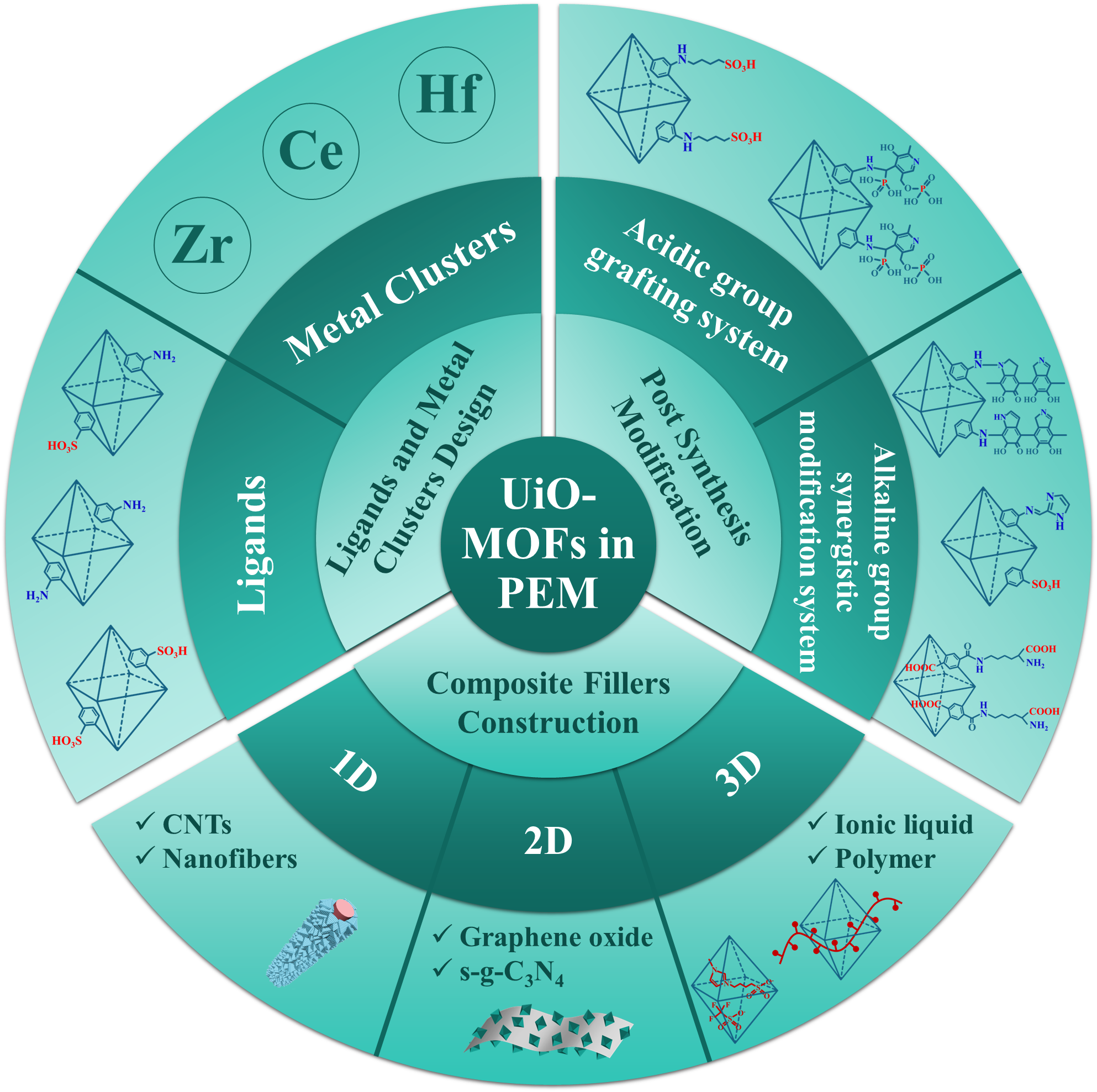
Metal-organic frameworks (MOFs) are emerging proton-conducting materials widely used in the modification of proton exchange membranes (PEM). Among them, the UiO-66 series MOFs (UiO-MOFs) exhibit high thermal and chemical stability, and are easy to synthesize and modify, making them ideal for PEM modification. This paper primarily reviews related research on UiO-MOFs used for PEM modification over the past five years from the perspective of filler design and preparation. Section II introduces the materials and proton conduction mechanisms of UiO-MOFs. Section III summarizes the design of ligands and metal clusters in UiO-MOFs, such as acid/base group modifications and metal cluster replacements. Section IV consolidates the methods for post-synthetic modifications of UiO-MOFs, such as grafting acid/base groups using active functional groups from external crystal structures. Section V presents various composite schemes involving UiO-MOFs and other materials to construct composite fillers with different dimensionalities. Finally, the summary highlights unresolved issues regarding the use of UiO-MOFs in PEMs and proposes future research directions.
1 Introduction
2 UiO-MOFs and proton conduction mechanism
2.1 UiO-MOFs material properties
2.2 Proton conduction mechanism
3 Design strategy of UiO-MOFs ligands and metal clusters
3.1 Ligand functionalization regulation strategy
3.2 Metal clusters regulation strategy
4 Post-synthetic modification of UiO-MOFs
4.1 Acid group grafting system
4.2 Alkaline group synergistic modification system
5 Construction of UiO-MOFs composite fillers
5.1 Construction strategy of 1D ordered composite fillers
5.2 Construction strategy of 2D composite fillers
5.3 Multi-dimensional control strategy for 3D composite fillers
6 Conclusion and future work
proton exchange membrane / metal organic frameworks / UiO-66 / proton conduction / composite materials
| [1] |
|
| [2] |
|
| [3] |
|
| [4] |
|
| [5] |
|
| [6] |
|
| [7] |
|
| [8] |
|
| [9] |
|
| [10] |
|
| [11] |
|
| [12] |
|
| [13] |
|
| [14] |
|
| [15] |
|
| [16] |
|
| [17] |
|
| [18] |
|
| [19] |
|
| [20] |
|
| [21] |
|
| [22] |
|
| [23] |
|
| [24] |
|
| [25] |
|
| [26] |
|
| [27] |
|
| [28] |
|
| [29] |
|
| [30] |
|
| [31] |
|
| [32] |
|
| [33] |
|
| [34] |
|
| [35] |
|
| [36] |
|
| [37] |
|
| [38] |
|
| [39] |
|
| [40] |
|
| [41] |
|
| [42] |
|
| [43] |
|
| [44] |
|
| [45] |
|
| [46] |
|
| [47] |
|
| [48] |
|
| [49] |
|
| [50] |
|
| [51] |
|
| [52] |
|
| [53] |
|
| [54] |
|
| [55] |
|
| [56] |
|
| [57] |
|
| [58] |
|
| [59] |
|
| [60] |
|
| [61] |
|
| [62] |
|
| [63] |
|
| [64] |
|
| [65] |
|
| [66] |
|
| [67] |
|
| [68] |
|
| [69] |
|
| [70] |
|
| [71] |
|
| [72] |
|
| [73] |
|
| [74] |
|
| [75] |
|
| [76] |
|
| [77] |
|
| [78] |
|
| [79] |
|
| [80] |
|
| [81] |
|
| [82] |
|
| [83] |
|
| [84] |
|
| [85] |
|
| [86] |
|
| [87] |
|
| [88] |
|
| [89] |
|
| [90] |
|
| [91] |
|
| [92] |
|
| [93] |
|
| [94] |
|
| [95] |
|
| [96] |
|
| [97] |
|
| [98] |
|
| [99] |
|
| [100] |
|
| [101] |
|
| [102] |
|
| [103] |
|
| [104] |
|
| [105] |
|
| [106] |
|
| [107] |
|
| [108] |
|
| [109] |
|
| [110] |
|
| [111] |
|
| [112] |
|
| [113] |
|
| [114] |
|
| [115] |
|
| [116] |
|
| [117] |
|
| [118] |
|
| [119] |
|
| [120] |
|
| [121] |
|
| [122] |
|
| [123] |
|
| [124] |
|
| [125] |
|
| [126] |
|
| [127] |
|
| [128] |
|
| [129] |
|
| [130] |
|
| [131] |
|
| [132] |
|
| [133] |
|
| [134] |
|
| [135] |
|
| [136] |
|
| [137] |
|
| [138] |
|
| [139] |
|
| [140] |
|
| [141] |
|
| [142] |
|
| [143] |
|
| [144] |
|
| [145] |
|
| [146] |
|
| [147] |
|
| [148] |
|
| [149] |
|
| [150] |
|
| [151] |
|
| [152] |
|
/
| 〈 |
|
〉 |








