 PDF(8508 KB)

Construction Methods and Application Progress of Liquid-Like Surfaces
Yan Bao, Chuang Fu, Renhao Li, Wenbo Zhang
Prog Chem ›› 2025, Vol. 37 ›› Issue (12) : 1866-1876.
PDF(8508 KB)
PDF(8508 KB)
Construction Methods and Application Progress of Liquid-Like Surfaces
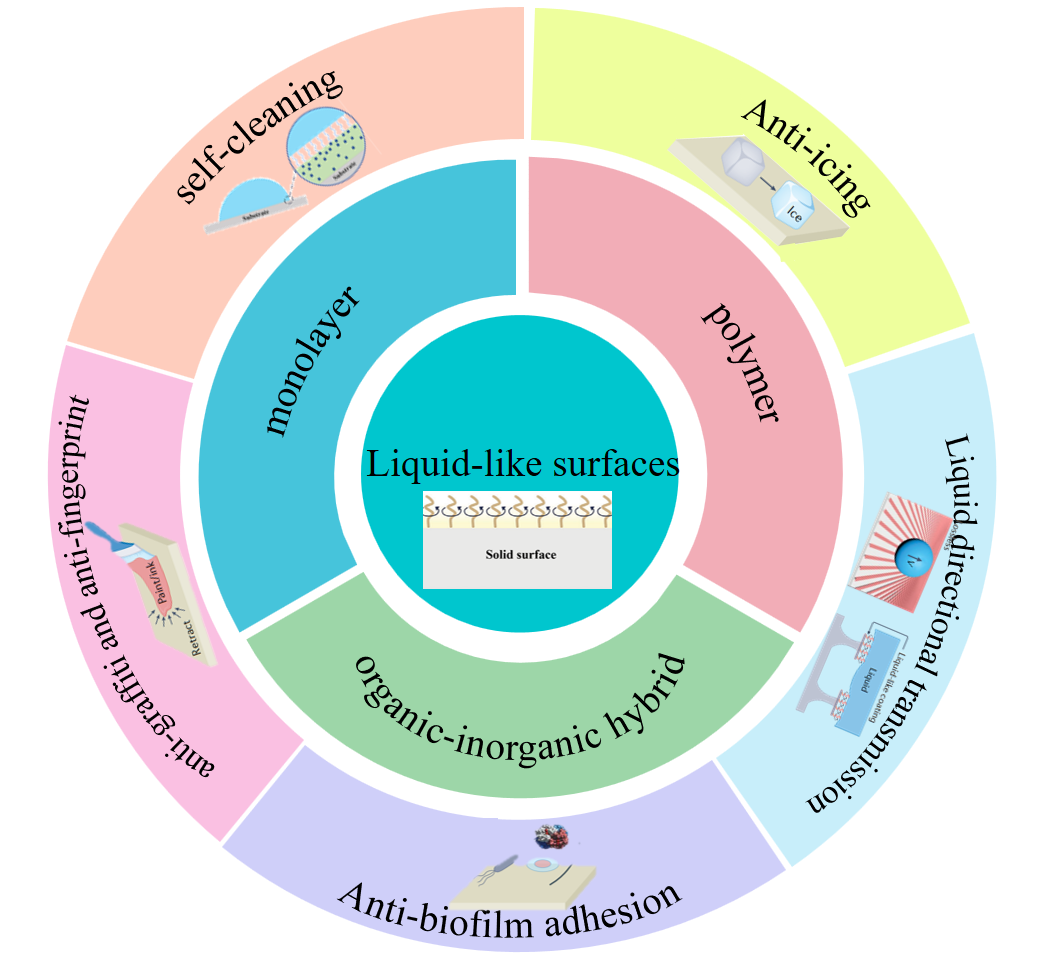
Liquid-like surfaces (LLS), as novel bioinspired interfacial materials, form dynamic molecular brush interfaces through the covalent grafting of flexible polymers or alkyl molecular chains. This approach overcomes the limitations of traditional superhydrophobic surfaces (SHPS) and slippery liquid-infused porous surfaces (SLIPS), which heavily rely on micro/nanostructures or external lubricants. The core advantage of LLS lies in the high mobility of its molecular chains, which significantly reduces contact angle hysteresis (CAH) and sliding angle (SA), enabling droplet self-cleaning at minimal tilt angles or even on horizontal surfaces. This paper first elaborates on the liquid-repellent mechanism of LLS, which involves the use of flexible chains to mask substrate defects and reduce contact line pinning effects, thereby achieving dynamic droplet dewetting. Subsequently, it summarizes the three main types of LLS, including monolayers, polymer layers, and organic-inorganic hybrid layers, and analyzes the relationship between different structures and liquid-repellent performance. Next, the applications of LLS coatings in anti-icing, self-cleaning, graffiti resistance, anti-bioadhesion, directional liquid transport, anti-scaling, and membrane fouling inhibition are reviewed. Finally, the challenges faced by LLS coatings, such as mechanical durability and chemical stability, are discussed, along with future prospects for advancing multifunctional integration.
1 Introduction
2 Mechanism of liquid-like surface
3 The construction method of liquid-like surfaces
3.1 The surface of a liquid-like monolayer
3.2 The surface of liquid-like polymers
3.3 The surface of liquid-like organic-inorganic hybrid
4 Applications on liquid-like surfaces
4.1 Anti-icing
4.2 Self-cleaning
4.3 Anti-fingerprint and anti-graffiti
4.4 Anti-biofilm adhesion
4.5 Liquid directional transmission
4.6 Anti-fouling
4.7 Mitigating membrane fouling
5 Conclusion and outlook
liquid-like surfaces / liquid repellency / flexible polymer brushes / coatings
| [1] |
|
| [2] |
|
| [3] |
|
| [4] |
|
| [5] |
|
| [6] |
|
| [7] |
|
| [8] |
|
| [9] |
|
| [10] |
|
| [11] |
|
| [12] |
(李玥, 卢亚妹, 王鹏飞, 曹莹泽, 戴春爱. 化学进展, 2021, 33(12): 2362)
|
| [13] |
(许宁, 林雨, 雒玉欣, 马家辉, 杨翘宇, 王卓, 蒲永平, 丁旭东. 陕西科技大学学报, 2024, 42(03): 119)
|
| [14] |
|
| [15] |
|
| [16] |
|
| [17] |
|
| [18] |
(许金凯, 蔡倩倩, 于占江, 廉中旭, 田纪文, 于化东. 化学进展, 2021, 33(6): 958)
|
| [19] |
|
| [20] |
|
| [21] |
|
| [22] |
|
| [23] |
|
| [24] |
(
|
| [25] |
|
| [26] |
|
| [27] |
|
| [28] |
|
| [29] |
|
| [30] |
|
| [31] |
|
| [32] |
|
| [33] |
|
| [34] |
|
| [35] |
|
| [36] |
(蓝敏杰, 文庆珍, 朱金华. 材料保护, 2020, 53(03): 129.)
|
| [37] |
|
| [38] |
(韦代东, 李惠枝, 曾娟娟, 赵传国, 李士强. 中国塑料, 2023, 37(02): 15)
|
| [39] |
(
|
| [40] |
(汪雪, 谢晖, 黄莉, 朱小龙, 赵金国, 曾其昕. 南京工业大学学报(自然科学版), 2024, 46(05): 521)
|
| [41] |
(王文静, 曾显华, 刘鹏碧. 广东化工, 2024, 51(20): 30)
|
| [42] |
|
| [43] |
|
| [44] |
|
| [45] |
|
| [46] |
|
| [47] |
|
| [48] |
|
| [49] |
|
| [50] |
|
| [51] |
|
| [52] |
|
| [53] |
|
| [54] |
|
| [55] |
|
| [56] |
|
| [57] |
|
| [58] |
|
| [59] |
|
| [60] |
|
| [61] |
|
| [62] |
|
| [63] |
|
| [64] |
|
| [65] |
|
| [66] |
|
| [67] |
|
| [68] |
|
| [69] |
|
| [70] |
|
| [71] |
|
| [72] |
|
| [73] |
|
| [74] |
|
| [75] |
|
| [76] |
|
| [77] |
|
| [78] |
|
| [79] |
|
| [80] |
|
| [81] |
|
| [82] |
|
| [83] |
|
| [84] |
|
| [85] |
|
| [86] |
|
| [87] |
|
| [88] |
|
| [89] |
|
| [90] |
|
| [91] |
|
| [92] |
|
| [93] |
|
| [94] |
(李承刚, 吴石莲, 常国华, 关润泽, 周炳见, 杨彤, 杨宇. 材料导报, 2024, 38(23): 247)
|
| [95] |
|
| [96] |
|
| [97] |
|
| [98] |
|
| [99] |
(张群利, 崔琳琳, 高雪. 精细化工, 2022, 39(05): 892.)
|
| [100] |
|
| [101] |
|
| [102] |
|
| [103] |
|
| [104] |
|
| [105] |
|
| [106] |
|
| [107] |
|
/
| 〈 |
|
〉 |








