PDF(3923 KB)

Research Progress on Surface Reconstruction Regulated Oxygen Evolution Electrocatalyst Performance
Junjie Wen, Lixiang Ding, Zhen Yuan, Junyi Zhang, Wen Lei, Haijun Zhang
Prog Chem ›› 2026, Vol. 38 ›› Issue (2) : 237-251.
PDF(3923 KB)
PDF(3923 KB)
Research Progress on Surface Reconstruction Regulated Oxygen Evolution Electrocatalyst Performance
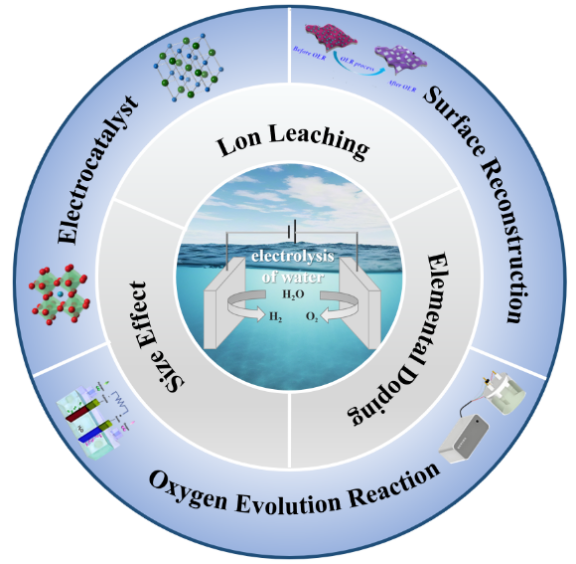
During the oxygen evolution reaction (OER),the surface reconstruction phenomenon of catalysts is closely related to the enhancement of their catalytic performance. However,the mechanistic understanding of catalyst surface reconstruction remains incomplete,particularly the technical bottlenecks in achieving controlled surface reconstruction and precise regulation of active sites. To address this,this article systematically elucidates two OER catalytic mechanisms-the adsorbate evolution mechanism (AEM) and the lattice oxygen oxidation mechanism (LOM) and analyzes the influence of pH,temperature,and applied potential on the surface reconstruction behavior of catalysts. Key mechanisms such as ion leaching (cation/anion leaching),elemental doping (metal/non-metal doping),and size effect modulation are summarized to reveal the relationship between surface reconstruction and catalytic activity of the OER catalysts. This work aims to provide theoretical support for the development of high-performance OER electrocatalysts. Finally,based on the challenges and prospects faced by surface-reconstructed OER catalysts,the potential impact of controlled reconstruction on the catalytic performance is prospected.
Contents
1 Introduction
2 OER catalytic mechanisms
2.1 Adsorbate evolution mechanism
2.2 Lattice oxygen oxidation mechanism
3 Surface reconstruction
3.1 Fundamental principles of surface reconstruction
3.2 Factors influencing surface reconstruction
4 Strategies for modulating oer catalyst surface reconstruction
4.1 Ion leaching
4.2 Elemental doping
4.3 Size regulation
5 Conclusion and outlook
oxygen evolution reaction / surface reconstruction / catalytic performance
| [1] |
|
| [2] |
|
| [3] |
|
| [4] |
|
| [5] |
|
| [6] |
|
| [7] |
|
| [8] |
|
| [9] |
(高秋璐, 刁鹏. 工程科学学报, 2025, 47(4): 923.)
|
| [10] |
|
| [11] |
|
| [12] |
|
| [13] |
|
| [14] |
|
| [15] |
|
| [16] |
|
| [17] |
|
| [18] |
|
| [19] |
|
| [20] |
|
| [21] |
|
| [22] |
|
| [23] |
|
| [24] |
|
| [25] |
|
| [26] |
|
| [27] |
|
| [28] |
|
| [29] |
|
| [30] |
|
| [31] |
|
| [32] |
|
| [33] |
|
| [34] |
|
| [35] |
|
| [36] |
|
| [37] |
|
| [38] |
|
| [39] |
(孙正印, 向俊英, 叶壮, 章海霞. 功能材料, 2024, 55(12): 12192.)
|
| [40] |
(卢明龙, 张晓云, 杨帆, 王练, 王育乔. 化学进展, 2022, 34(3): 547.)
|
| [41] |
|
| [42] |
|
| [43] |
|
| [44] |
|
| [45] |
|
| [46] |
|
| [47] |
(廖凡, 陈子亮, 康振辉. 稀有金属, 2023, 47(1): 1.)
|
| [48] |
(薛世翔, 吴攀, 赵亮, 南艳丽, 雷琬莹. 化学进展, 2022, 34(12): 2686.)
|
| [49] |
|
| [50] |
|
| [51] |
|
| [52] |
|
| [53] |
|
| [54] |
|
| [55] |
|
| [56] |
|
| [57] |
|
| [58] |
|
| [59] |
(许文涛, 莫栩妍, 周洋, 翁祖贤, 莫坤玲, 吴炎桦, 蒋欣霖, 李丹, 蓝汤淇, 文欢, 郑伏琴, 樊友军, 陈卫. 物理化学学报, 2024, 40(8): 46.)
|
| [60] |
|
| [61] |
|
| [62] |
|
| [63] |
|
| [64] |
|
| [65] |
|
| [66] |
|
| [67] |
|
| [68] |
(黄琳尧, 罗密, 杨天华, 王晨光. 燃料化学学报(中英文), 2025, 53(3): 1.)
|
| [69] |
|
| [70] |
|
| [71] |
|
| [72] |
(雷航, 麦文杰. 科学通报, 2023, 68(4): 293.)
|
| [73] |
(张晓君, 马梁, 孙迎辉. 材料导报, 2021, 35(23): 23040.)
|
| [74] |
|
| [75] |
|
| [76] |
|
| [77] |
(杜茹雪, 滕慧雅. 化工科技, 2025, 33(2): 67.)
|
| [78] |
|
| [79] |
|
| [80] |
|
| [81] |
|
| [82] |
|
| [83] |
|
/
| 〈 |
|
〉 |