PDF(18241 KB)

Peptides Secondary Structure of α-Sheet
Zhaoyu Chen, Xiaoyue Ma, Henghao Yu, Hai Xu
Prog Chem ›› 2026, Vol. 38 ›› Issue (2) : 319-336.
PDF(18241 KB)
PDF(18241 KB)
Peptides Secondary Structure of α-Sheet
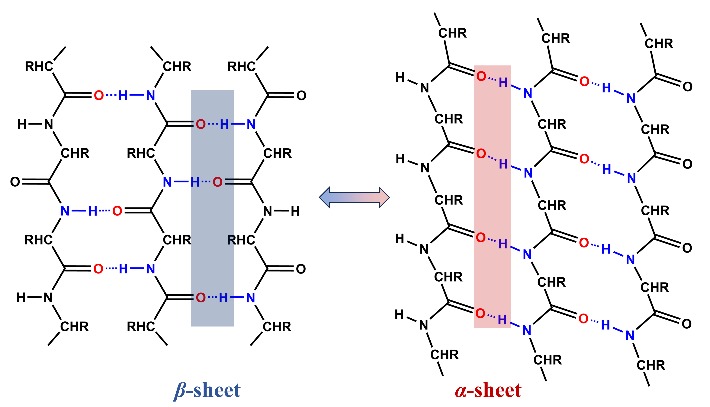
α-sheet is a rare secondary structure of peptides. Unlike common peptides secondary structures,α-sheet exhibits polarity with orderly arranged inter-strand hydrogen bonds while maintaining an extended conformation of α-strand. Due to its unstable molecular arrangement,it has long been ignored as a temporary product during the protein folding process. With the advancement of crystallography and molecular dynamics simulation technologies,research on amyloid proteins causing various neurodegenerative diseases has found that α-sheet might be a critical intermediate in the formation of amyloid fibrils. Therefore,defining the formation cause and assembly mechanism of α-sheet can help to further understand the pathogenic principle of amyloid-related diseases and propose early diagnosis and targeted treatment strategies,as well as help to design self-assembly peptide biomaterials with various functions,such as piezoelectricity,biomimetic catalysis and drug delivery. In this review,we summarize recent progress of the peptides secondary structure,especially the rare secondary structures led by α-sheet,and focus on reviewing the self-assembly mechanism,regulatory mode and supramolecular structure of α-sheet peptides. In addition,the development potential of biomaterials based on self-assembly peptides has also been discussed.
Contents
1 Introduction
2 Peptide secondary structure in neurodegenerative diseases
2.1 β-sheet amyloid fibril
2.2 α-sheet intermediate
2.3 α to β conformational change
2.4 α-sheet peptide targeted therapy
3 Self-assembly peptides based on different chirality
4 Self-assembly peptides based on different secondary structure
4.1 β-sheet
4.2 α-helix
4.3 α-sheet
5 Conclusion and outlook
α-sheet / peptide secondary structure / Alzheimer’s disease / peptide self-assembly / nanostructure
| [1] |
|
| [2] |
|
| [3] |
|
| [4] |
|
| [5] |
|
| [6] |
|
| [7] |
|
| [8] |
|
| [9] |
|
| [10] |
|
| [11] |
|
| [12] |
|
| [13] |
|
| [14] |
|
| [15] |
|
| [16] |
|
| [17] |
|
| [18] |
|
| [19] |
|
| [20] |
|
| [21] |
|
| [22] |
|
| [23] |
|
| [24] |
|
| [25] |
|
| [26] |
|
| [27] |
|
| [28] |
|
| [29] |
|
| [30] |
|
| [31] |
|
| [32] |
|
| [33] |
|
| [34] |
|
| [35] |
|
| [36] |
|
| [37] |
|
| [38] |
|
| [39] |
|
| [40] |
|
| [41] |
|
| [42] |
|
| [43] |
|
| [44] |
|
| [45] |
|
| [46] |
|
| [47] |
|
| [48] |
|
| [49] |
|
| [50] |
|
| [51] |
|
| [52] |
|
| [53] |
|
| [54] |
|
| [55] |
|
| [56] |
|
| [57] |
|
| [58] |
|
| [59] |
|
| [60] |
|
| [61] |
(林代武, 邢起国, 王跃飞, 齐崴, 苏荣欣, 何志敏. 化学进展, 2019, 31(12): 1623.)
|
| [62] |
(王继乾, 闫宏宇, 李洁, 张丽艳, 赵玉荣, 徐海. 化学进展, 2018, 30(8): 1121.)
|
| [63] |
|
| [64] |
|
| [65] |
|
| [66] |
|
| [67] |
|
| [68] |
|
| [69] |
|
| [70] |
|
| [71] |
|
| [72] |
|
| [73] |
|
| [74] |
|
| [75] |
|
| [76] |
|
| [77] |
|
| [78] |
|
| [79] |
|
| [80] |
|
| [81] |
|
| [82] |
|
| [83] |
|
| [84] |
|
| [85] |
|
| [86] |
|
| [87] |
|
| [88] |
|
| [89] |
(苗君萍, 张昭乾, 辛少鹏, 胡云霞. 化学进展, 2025, 37(2): 195.)
|
| [90] |
|
| [91] |
|
/
| 〈 |
|
〉 |