PDF(8996 KB)

TiO2-Based Nanomaterials for High-Efficiency Photocatalytic Hydrogen Production
Jiarui Zhang, Yongchao Yang
Prog Chem ›› 2026, Vol. 38 ›› Issue (2) : 210-236.
PDF(8996 KB)
PDF(8996 KB)
TiO2-Based Nanomaterials for High-Efficiency Photocatalytic Hydrogen Production
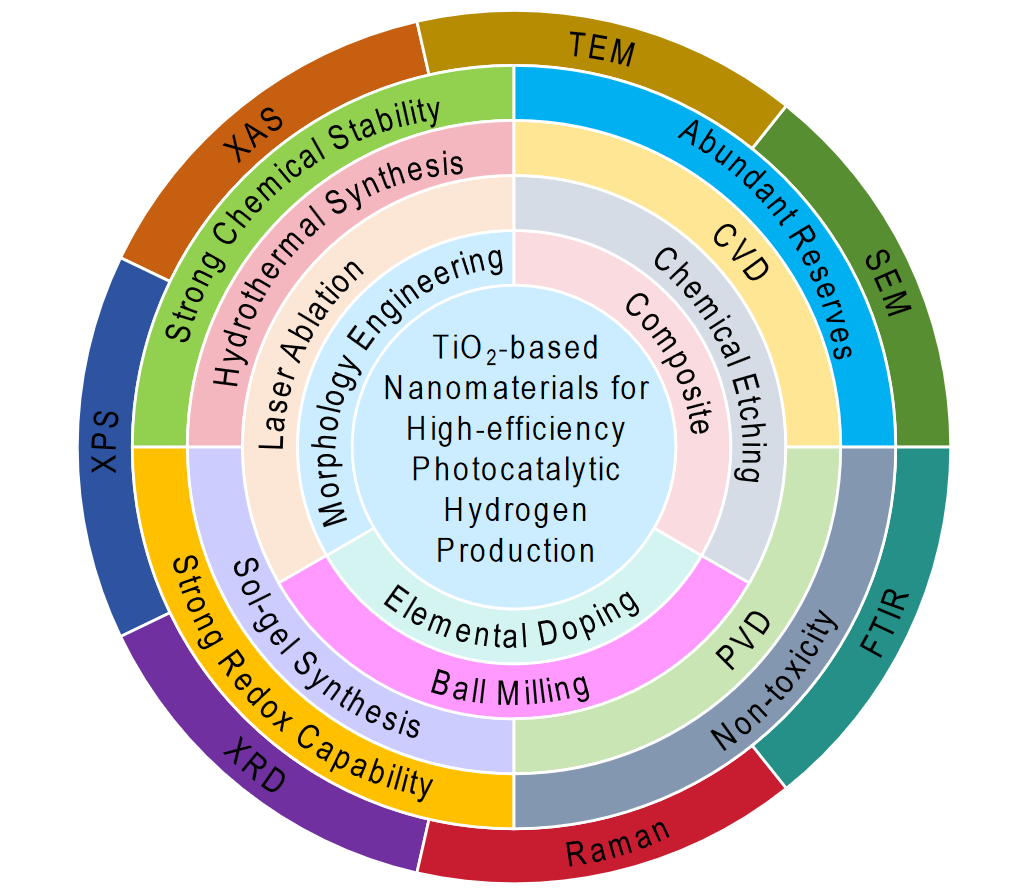
In response to the global energy crisis and environmental challenges,photocatalytic hydrogen (H2) production has emerged as a sustainable alternative toward clean energy conversion. Among diverse photocatalysts investigated,TiO2-based nanomaterials have attracted significant attention due to their unique physicochemical properties,such as high chemical stability,strong redox capacity and tunable electronic structures,along with high cost-effectiveness. Extensive research on TiO2-based photocatalysts proves their enormous potential in the field of H2 production. This timely and critical review explores the recent advances in TiO2-based photocatalysts,discussing their distinctive advantages and synthesis methods in photocatalytic H2 production. Modification strategies,such as elemental doping (e.g.,precious metals,non-precious metals and non-metals),morphology engineering and composite formation,are summarised to improve photocatalytic efficiency. Advanced in/ex situ characterization techniques employed to probe photocatalytic mechanisms are also highlighted. Finally,major challenges,such as limited visible-light activity and charge recombination,are outlined,with perspectives on emerging TiO2-based nanomaterials and design strategies to overcome current bottlenecks. And the research focus in the future is prospected,such as atomic interface engineering,machine learning auxiliary material design and large-scale preparation technology. This work aims to provide insights into the rational design of TiO2-based photocatalysts for next-generation H2 production systems.
Contents
1 Introduction
2 Unique advantages of TiO2-based photocatalysts
3 Various preparation methods of TiO2-based photocatalysts
3.1 Top-down synthesis
3.2 Bottom-up synthesis
4 Design strategies of TiO2-based photocatalysts for H2 production
4.1 Elemental doping
4.2 Morphology engineering
4.3 Composite
5 Advanced characterization techniques for TiO2-based photocatalysts
5.1 X-ray diffraction (XRD)
5.2 XPS
5.3 X-ray absorption spectroscopy (XAS)
5.4 TEM and SEM
5.5 Raman and FTIR
6 Conclusions and outlook
photocatalysis / hydrogen production / TiO2 / semiconductor materials / surface modification
| [1] |
|
| [2] |
|
| [3] |
|
| [4] |
|
| [5] |
|
| [6] |
|
| [7] |
|
| [8] |
|
| [9] |
|
| [10] |
|
| [11] |
|
| [12] |
|
| [13] |
|
| [14] |
|
| [15] |
|
| [16] |
|
| [17] |
|
| [18] |
|
| [19] |
|
| [20] |
|
| [21] |
|
| [22] |
|
| [23] |
|
| [24] |
|
| [25] |
|
| [26] |
|
| [27] |
|
| [28] |
|
| [29] |
|
| [30] |
|
| [31] |
|
| [32] |
|
| [33] |
|
| [34] |
|
| [35] |
|
| [36] |
|
| [37] |
|
| [38] |
|
| [39] |
|
| [40] |
|
| [41] |
|
| [42] |
|
| [43] |
|
| [44] |
|
| [45] |
|
| [46] |
|
| [47] |
|
| [48] |
|
| [49] |
|
| [50] |
|
| [51] |
|
| [52] |
|
| [53] |
|
| [54] |
|
| [55] |
|
| [56] |
|
| [57] |
|
| [58] |
|
| [59] |
|
| [60] |
|
| [61] |
|
| [62] |
|
| [63] |
|
| [64] |
|
| [65] |
|
| [66] |
|
| [67] |
|
| [68] |
|
| [69] |
|
| [70] |
|
| [71] |
|
| [72] |
|
| [73] |
|
| [74] |
|
| [75] |
|
| [76] |
|
| [77] |
|
| [78] |
|
| [79] |
|
| [80] |
|
| [81] |
|
| [82] |
|
| [83] |
|
| [84] |
|
| [85] |
|
| [86] |
|
| [87] |
|
| [88] |
|
| [89] |
|
| [90] |
|
| [91] |
|
| [92] |
|
| [93] |
|
| [94] |
|
| [95] |
|
| [96] |
|
| [97] |
|
| [98] |
|
| [99] |
|
| [100] |
|
| [101] |
|
| [102] |
|
| [103] |
|
| [104] |
|
| [105] |
|
| [106] |
|
| [107] |
|
| [108] |
|
/
| 〈 |
|
〉 |