PDF(4458 KB)

Carbon Dots as Fluorescent Probes in Environmental Monitoring
Congyin Zhang, Kuiyu Yi, Jia Feng, Hongwei Shi
Prog Chem ›› 2026, Vol. 38 ›› Issue (2) : 298-318.
PDF(4458 KB)
PDF(4458 KB)
Carbon Dots as Fluorescent Probes in Environmental Monitoring
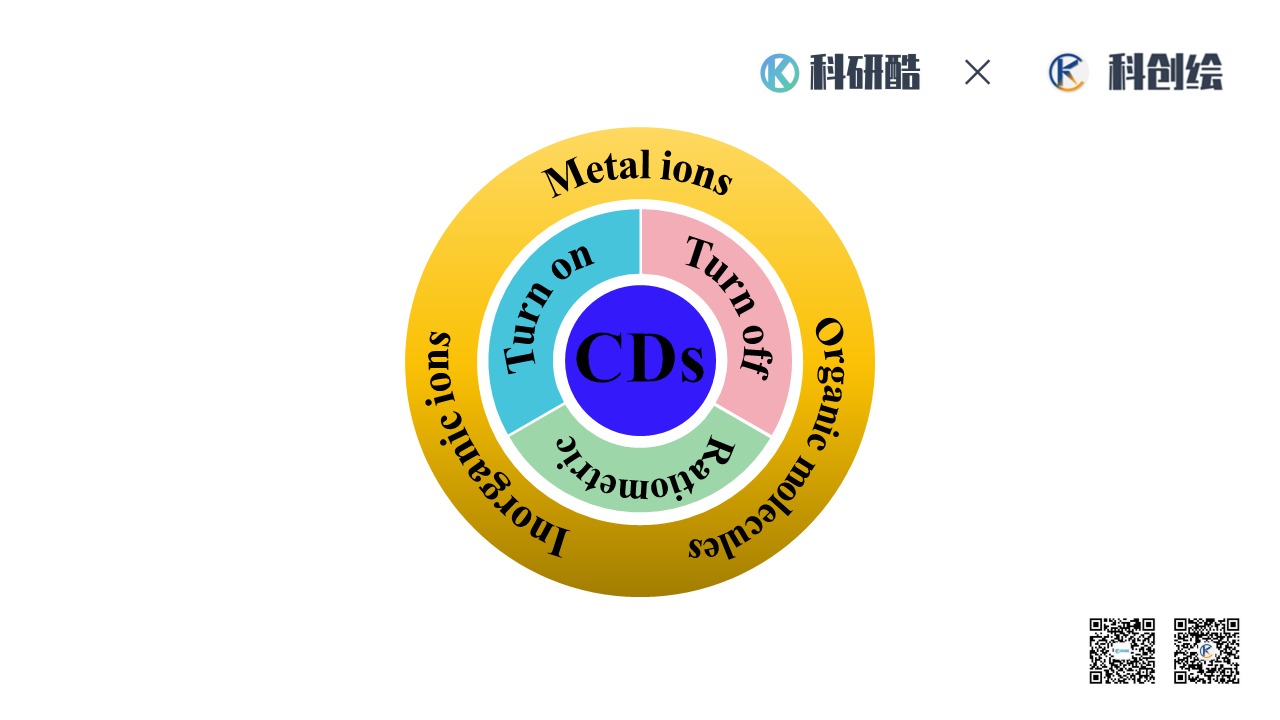
With the acceleration of industrialization and urbanization,the types of environmental pollutants have multiplied,and sample matrices have become increasingly complex,placing higher demands on the selectivity and anti-interference capability of detection technologies. Conventional methods such as ICP-MS and GC-MS are limited by cumbersome sample pretreatment and high operational costs,making them unsuitable for rapid and on-site monitoring. Carbon dots (CDs),as a promising class of zero-dimensional carbon-based nanomaterials,offer a green and sensitive alternative for constructing fluorescent probes due to their exceptional optical properties,low toxicity,and tunable surface functionalities. This review systematically summarizes recent advances in CDs-based fluorescent probes for environmental monitoring,covering synthesis strategies,luminescence mechanisms,characterization techniques,and their applications in detecting metal ions,inorganic anions,and organic pollutants. Special emphasis is placed on the design principles and response mechanisms of three types of probes:fluorescence quenching,fluorescence enhancement,and ratiometric fluorescence sensing. Notably,ratiometric probes utilize built-in reference signals to achieve self-calibration in complex matrices,significantly improving accuracy and anti-interference performance. Furthermore,this review highlights the integration of CDs-based probes with smartphone-based sensing platforms,demonstrating their great potential for on-site,rapid,and visual detection of pollutants. These advances provide a clear pathway toward making environmental monitoring more convenient and intelligent. Finally,current challenges and future prospects in material design,mechanism studies,application expansion,and intelligent platform development are discussed,offering theoretical and technical support for further innovations in the field.
Contents
1 Introduction
2 Carbon dots
2.1 Synthesis of carbon dots
2.2 Carbon dots fluorescence detection mechanism
2.3 Characterization of carbon dots
3 The application of carbon dots in environmental detection
3.1 Environmental detection applications of fluorescence quenched carbon dots
3.2 Environmental detection applications of fluorescence enhanced carbon dots
3.3 Environmental detection applications of ratiometric fluorescent carbon dots
4 Conclusion and outlook
carbon dots / fluorescence probes / environmental detection / ratiometric fluorescence sensing / smartphone sensing platform / environmental pollutants
| [1] |
|
| [2] |
|
| [3] |
|
| [4] |
|
| [5] |
|
| [6] |
|
| [7] |
|
| [8] |
|
| [9] |
|
| [10] |
|
| [11] |
|
| [12] |
|
| [13] |
|
| [14] |
|
| [15] |
|
| [16] |
|
| [17] |
|
| [18] |
|
| [19] |
|
| [20] |
|
| [21] |
|
| [22] |
|
| [23] |
|
| [24] |
|
| [25] |
|
| [26] |
|
| [27] |
|
| [28] |
|
| [29] |
|
| [30] |
|
| [31] |
|
| [32] |
|
| [33] |
|
| [34] |
|
| [35] |
|
| [36] |
|
| [37] |
|
| [38] |
|
| [39] |
|
| [40] |
|
| [41] |
|
| [42] |
|
| [43] |
|
| [44] |
|
| [45] |
|
| [46] |
|
| [47] |
|
| [48] |
|
| [49] |
|
| [50] |
|
| [51] |
|
| [52] |
|
| [53] |
|
| [54] |
|
| [55] |
|
| [56] |
|
| [57] |
|
| [58] |
|
| [59] |
|
| [60] |
|
| [61] |
|
| [62] |
|
| [63] |
|
| [64] |
|
| [65] |
|
| [66] |
|
| [67] |
|
| [68] |
|
| [69] |
|
| [70] |
|
| [71] |
|
| [72] |
(陈倍宁, 王恩语, 杨正爽, 付翯云. 环境化学, 2024, 43(3): 875.)
|
| [73] |
|
| [74] |
|
| [75] |
|
| [76] |
|
| [77] |
|
| [78] |
|
| [79] |
|
| [80] |
|
| [81] |
|
| [82] |
|
| [83] |
|
| [84] |
|
| [85] |
|
| [86] |
|
| [87] |
|
| [88] |
|
| [89] |
|
| [90] |
|
| [91] |
|
| [92] |
|
| [93] |
|
| [94] |
|
| [95] |
|
| [96] |
|
| [97] |
|
| [98] |
|
| [99] |
|
| [100] |
|
| [101] |
|
| [102] |
|
/
| 〈 |
|
〉 |