PDF(2895 KB)

The Single-Cell RNA Sequencing Technology Based on Microfluidic Chips
Luxi Shu, Yan Zhang
Prog Chem ›› 2026, Vol. 38 ›› Issue (2) : 283-297.
PDF(2895 KB)
PDF(2895 KB)
The Single-Cell RNA Sequencing Technology Based on Microfluidic Chips
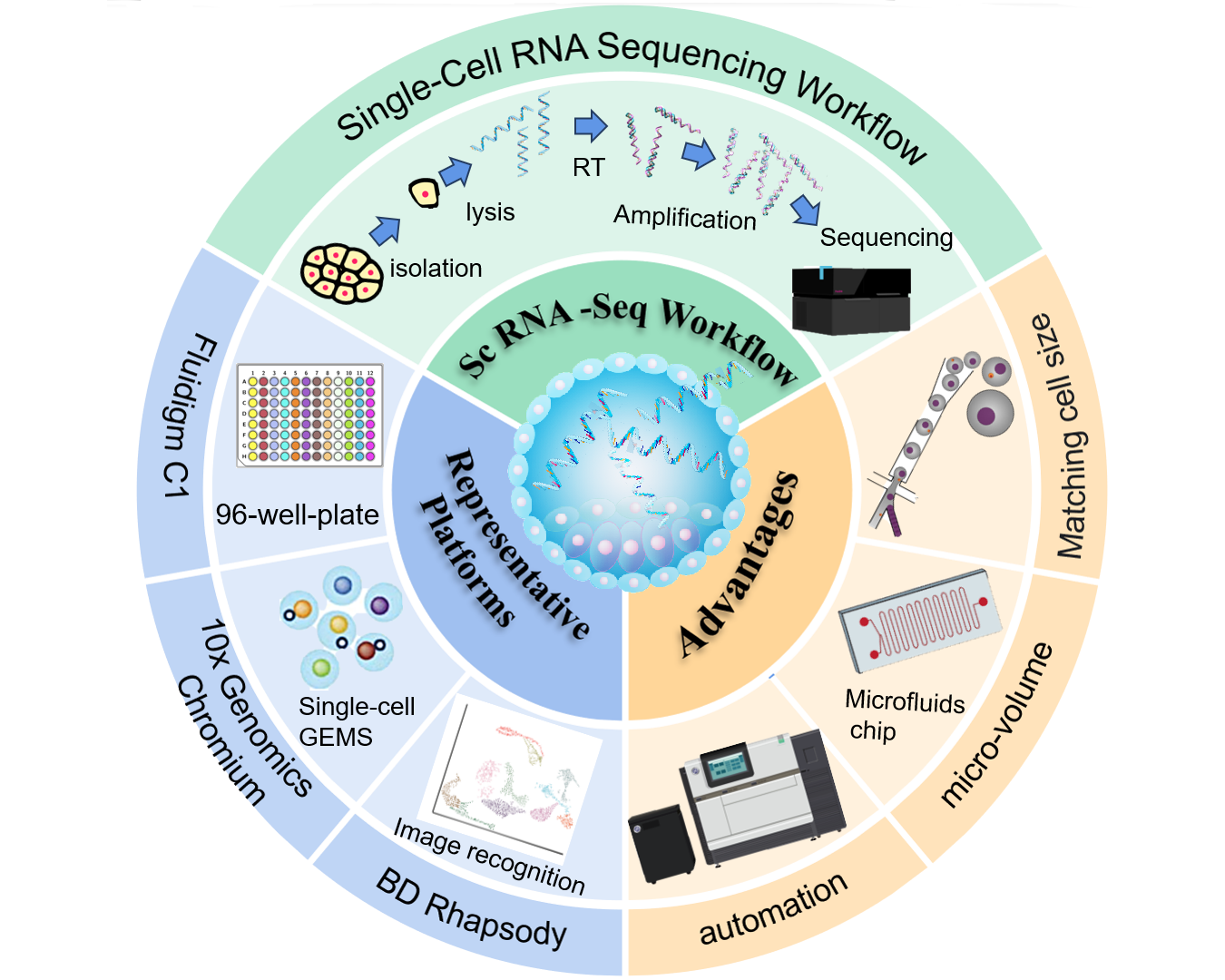
Cell heterogeneity is key to understanding life processes such as embryonic development and disease evolution,while traditional bulk cell RNA sequencing cannot resolve gene expression differences at the single-cell level. Although single-cell RNA sequencing (scRNA-seq) technology can construct transcriptomic maps at single-cell resolution,it faces challenges such as low efficiency in single-cell isolation and capture,and large deviations in trace RNA manipulation. Microfluidic chip technology,through a microscale fluid manipulation system,integrates processes such as single-cell isolation,lysis,reverse transcription,amplification,and sequencing library construction,achieving high-throughput,low sample loss,and automated operations,which significantly improve the efficiency and data reliability of scRNA-seq. This paper outlines the sequencing process of scRNA-seq,including steps such as single-cell isolation and capture,RNA extraction,reverse transcription and amplification,and single-cell sequencing. It analyzes the core advantages of microfluidic chips in adapting to single cells,precisely controlling reaction volumes,and realizing process automation,and briefly describes the technical principles and characteristics of representative platforms such as Fluidigm C1,10X Genomics Chromium,and BD Rhapsody. Microfluidic chip technology provides an efficient and precise technical platform for scRNA-seq. In the future,with the continuous optimization of chip design and the improvement of multi-omics integrated analysis capabilities,we expect it to play a more profound role in resolving complex biological systems,revealing disease mechanisms,and even promoting precision medicine.
Contents
1 Introduction
2 Single-cell RNA sequencing workflow
2.1 Isolation and capture of single cells
2.2 RNA extraction,reverse transcription and amplification
2.3 Single-cell sequencing
3 Single-cell RNA sequencing technology based on microfluidic chips
3.1 Development history of scRNA-seq based on microfluidic chips
3.2 Core advantages of microfluidic chips in scRNA-seq
4 Representative microfluidic single-cell RNA sequencing platforms
4.1 Fluidigm C1 platform
4.2 10X Genomics chromium platform
4.3 BD rhapsody platform
5 Summary and prospects
single-cell RNA sequencing / microfluidic chip / Fluidigm C1 / 10X Genomics / BD Rhapsody
| [1] |
|
| [2] |
|
| [3] |
|
| [4] |
|
| [5] |
|
| [6] |
|
| [7] |
|
| [8] |
|
| [9] |
|
| [10] |
|
| [11] |
|
| [12] |
|
| [13] |
|
| [14] |
|
| [15] |
|
| [16] |
|
| [17] |
|
| [18] |
|
| [19] |
|
| [20] |
|
| [21] |
|
| [22] |
|
| [23] |
|
| [24] |
|
| [25] |
|
| [26] |
|
| [27] |
|
| [28] |
|
| [29] |
|
| [30] |
|
| [31] |
|
| [32] |
|
| [33] |
|
| [34] |
|
| [35] |
|
| [36] |
|
| [37] |
|
| [38] |
|
| [39] |
|
| [40] |
|
| [41] |
|
| [42] |
|
| [43] |
|
| [44] |
|
| [45] |
|
| [46] |
|
| [47] |
|
| [48] |
|
| [49] |
|
| [50] |
|
| [51] |
|
| [52] |
|
| [53] |
|
| [54] |
|
| [55] |
|
| [56] |
|
| [57] |
|
| [58] |
|
| [59] |
|
| [60] |
|
| [61] |
|
| [62] |
|
| [63] |
|
| [64] |
|
| [65] |
|
| [66] |
|
| [67] |
|
| [68] |
|
| [69] |
|
| [70] |
|
| [71] |
|
| [72] |
|
| [73] |
|
| [74] |
|
| [75] |
|
| [76] |
|
| [77] |
|
| [78] |
|
| [79] |
|
| [80] |
|
| [81] |
|
| [82] |
|
| [83] |
|
| [84] |
|
| [85] |
|
| [86] |
|
| [87] |
|
| [88] |
|
| [89] |
|
| [90] |
|
| [91] |
|
| [92] |
|
| [93] |
|
| [94] |
|
| [95] |
|
| [96] |
|
| [97] |
|
| [98] |
|
| [99] |
|
| [100] |
|
| [101] |
|
| [102] |
|
| [103] |
|
| [104] |
|
| [105] |
|
| [106] |
|
| [107] |
|
| [108] |
|
/
| 〈 |
|
〉 |