PDF(4685 KB)

Biological Metal-Organic Framework Materials for CO2 Capture Performance
Hao Wang, Xi Liu, Kongkong Zhao, Shuzhao Pei, Zhida Li, Hongjun Wu
Prog Chem ›› 2026, Vol. 38 ›› Issue (5) : 941-956.
PDF(4685 KB)
PDF(4685 KB)
Biological Metal-Organic Framework Materials for CO2 Capture Performance
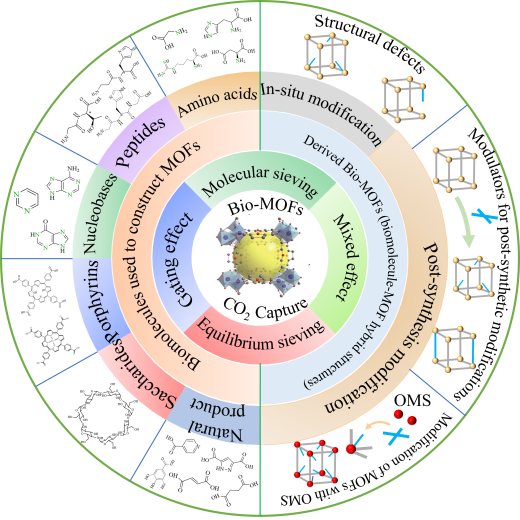
Efficient capture and selective separation of CO2 is one of the important means to realize the “dual carbon” goal and mitigate climate change, and metal-organic frameworks (MOFs) show great potential in gas separation and storage due to their structural peculiarities. The potential of MOFs in the field of gas separation and storage is enormous. Among them, biological metal-organic framework (Bio-MOFs) are constructed by green synthesis pathway using natural biomolecules (e.g., amino acids, nucleobases, peptides, etc.) as ligands, and they are both environmentally friendly and cost-effective, providing innovative solutions for CO2 capture. This paper will focus on the following: systematically summarizing the structural properties of the bio-ligands and their modulation of the framework pores and chemical properties; exploring the mechanism of direct synthesis and post-synthesis modification (e.g., amine functionalization, ion exchange) and other strategies to enhance the performance of the materials; analyzing the adsorption behaviors of the Bio-MOFs of CO2 in complex media, elucidating the synergistic roles of molecular sieving, equilibrium sieving, and gating effects; and analyzing the CO2 adsorption behaviors of the Bio-MOFs in complex media, synergistic effect; and the challenges and future development direction of Bio-MOFs are also prospected.
1 Introduction
2 Overview of Bio-MOFs
2.1 Basic definition and characteristics of Bio-MOFs
2.2 Bio-MOFs constructed from bio-like molecules
2.3 Derived Bio-MOFs (biomolecule-MOF hybrid structures)
3 Application of CO2 adsorption of Bio-MOFs
3.1 Classification of CO2 adsorption behavior by bio-MOFs
3.2 CO2 adsorption by Bio-MOFs
3.3 Derived Bio-MOFs CO2 adsorption
4 Summary and prospects
biological metal-organic framework(Bio-MOFs) / CO2 capture / porous materials / functionalized modifications / adsorption
| [1] |
CO2 emissions in 2022. IEA. Paris. https://www.iea.org/reports/co2-emissions-in-2022.
|
| [2] |
|
| [3] |
|
| [4] |
(孙增智, 薛程, 宋莉芳, 邱树君, 褚海亮, 夏永鹏, 孙立贤. 材料导报, 2019, 33: 541.)
|
| [5] |
(袁士义, 马德胜, 李军诗, 周体尧, 姬泽敏, 韩海水. 石油勘探与开发, 2022, 49: 828.)
|
| [6] |
|
| [7] |
|
| [8] |
|
| [9] |
|
| [10] |
|
| [11] |
|
| [12] |
(张晋维, 李平, 张馨凝, 马小杰, 王博. 化学学报, 2020, 78: 597.)
|
| [13] |
|
| [14] |
|
| [15] |
|
| [16] |
|
| [17] |
|
| [18] |
|
| [19] |
|
| [20] |
|
| [21] |
|
| [22] |
(纪成山. 哈尔滨工业大学博士论文, 2024.)
|
| [23] |
|
| [24] |
|
| [25] |
|
| [26] |
|
| [27] |
|
| [28] |
|
| [29] |
|
| [30] |
|
| [31] |
|
| [32] |
|
| [33] |
|
| [34] |
|
| [35] |
|
| [36] |
|
| [37] |
|
| [38] |
|
| [39] |
|
| [40] |
|
| [41] |
|
| [42] |
|
| [43] |
|
| [44] |
|
| [45] |
|
| [46] |
|
| [47] |
|
| [48] |
|
| [49] |
|
| [50] |
|
| [51] |
|
| [52] |
|
| [53] |
|
| [54] |
|
| [55] |
|
| [56] |
|
| [57] |
|
| [58] |
|
| [59] |
(才红, 吴光伟, 赖佳丽, 陈锦萍, 陈燕飞, 李丹. 无机化学学报, 2019, 35: 2083.)
|
| [60] |
|
| [61] |
|
| [62] |
|
| [63] |
|
| [64] |
|
| [65] |
|
| [66] |
|
| [67] |
|
| [68] |
|
| [69] |
|
| [70] |
|
| [71] |
|
| [72] |
|
| [73] |
|
| [74] |
|
| [75] |
|
| [76] |
|
| [77] |
|
| [78] |
|
| [79] |
|
| [80] |
|
| [81] |
|
| [82] |
|
| [83] |
|
| [84] |
|
| [85] |
|
| [86] |
|
| [87] |
|
| [88] |
|
| [89] |
|
| [90] |
|
| [91] |
|
| [92] |
|
| [93] |
|
| [94] |
|
| [95] |
|
| [96] |
|
| [97] |
|
| [98] |
|
| [99] |
|
| [100] |
|
| [101] |
|
| [102] |
|
| [103] |
|
| [104] |
|
| [105] |
|
| [106] |
|
| [107] |
|
| [108] |
|
/
| 〈 |
|
〉 |