PDF(5379 KB)

Self-Healing Hydrogels Based on Different Driving Forces and Their Applications
Mengru Wang, Qiang Ma, Xiao Chang, Jiale Li, Zetao He, Guohe Xu, Ruihui Dai
Prog Chem ›› 2026, Vol. 38 ›› Issue (6) : 1126-1143.
PDF(5379 KB)
PDF(5379 KB)
Self-Healing Hydrogels Based on Different Driving Forces and Their Applications
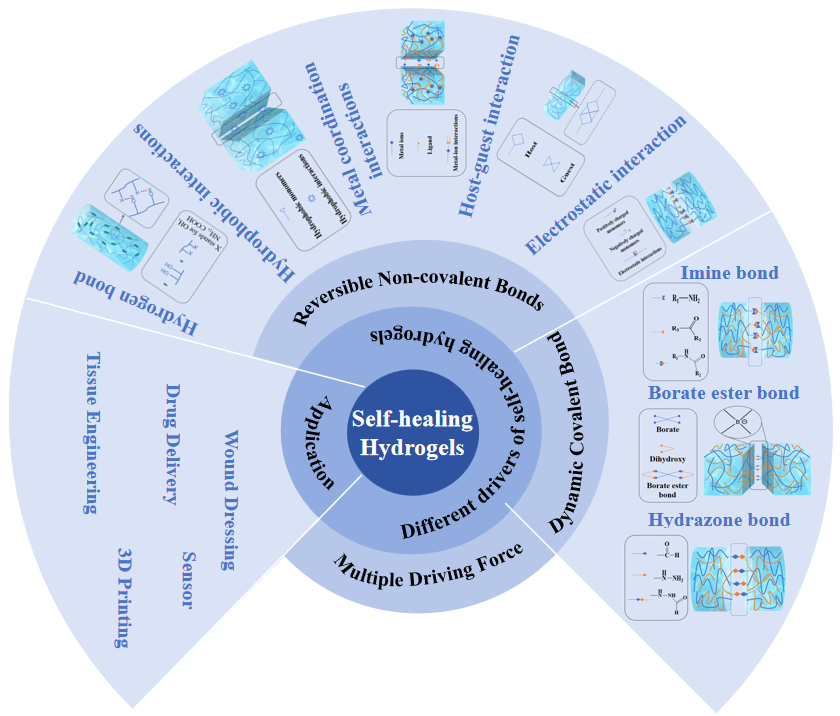
Hydrogel is a three-dimensional cross-linked network capable of absorbing and retaining large amounts of water. Furthermore, it exhibits good biocompatibility and excellent chemical and physical properties. Therefore, hydrogels became a representative of soft materials. However, traditional hydrogels have shortcomings such as easy damage and short lifespan, which limit their development. Recently, self-healing hydrogels have been developed rapidly due to they can restore the damage without destroying their own functions, thereby prolongingtheir service life. In this review, the research status of self-healing hydrogels with different driving forces are reviewed. The self-healing hydrogels constructed by single driving forces and multiple driving forces, respectively. Among them, single driving forces include reversible non-covalent bonds and dynamic covalent bonds. Reversible non-covalent bonds encompass hydrogen bonds, hydrophobic interactions, metal coordination interactions, host-guest interactions and electrostatic interactions. Dynamic covalent bonds include imine bonds, boronic ester bonds and hydrazone bonds. The application of self-healing hydrogels in wound dressings, drug delivery, tissue engineering, sensors, and 3D printing are also discussed. Finally, some problems in the performance optimization of self-healing hydrogels(such as cumbersome experimental procedures, poor mechanical properties, poor antifreeze performance, and scientific issues related to mechanism research and clinical transformation)and their development are prospected.
1 Introduction
2 Different drivers of self-healing hydrogels
2.1 Reversible non-covalent bonds
2.2 Dynamic covalent bond
2.3 Multiple driving force
3 Application of self-healing hydrogels
3.1 Wound dressing
3.2 Drug delivery
3.3 Tissue engineering
3.4 Sensor
3.5 3D printing
4 Conclusion and outlook
hydrogels / self-healing / noncovalent dynamic interaction / dynamic covalent bond / applications
| [1] |
|
| [2] |
|
| [3] |
|
| [4] |
|
| [5] |
|
| [6] |
|
| [7] |
|
| [8] |
|
| [9] |
|
| [10] |
|
| [11] |
|
| [12] |
|
| [13] |
|
| [14] |
|
| [15] |
|
| [16] |
|
| [17] |
|
| [18] |
|
| [19] |
|
| [20] |
|
| [21] |
|
| [22] |
|
| [23] |
|
| [24] |
|
| [25] |
|
| [26] |
|
| [27] |
|
| [28] |
|
| [29] |
|
| [30] |
|
| [31] |
|
| [32] |
|
| [33] |
|
| [34] |
|
| [35] |
|
| [36] |
|
| [37] |
|
| [38] |
|
| [39] |
|
| [40] |
|
| [41] |
|
| [42] |
|
| [43] |
|
| [44] |
|
| [45] |
|
| [46] |
|
| [47] |
|
| [48] |
|
| [49] |
|
| [50] |
|
| [51] |
|
| [52] |
|
| [53] |
|
| [54] |
|
| [55] |
|
| [56] |
|
| [57] |
|
| [58] |
|
| [59] |
|
| [60] |
|
| [61] |
|
| [62] |
|
| [63] |
|
| [64] |
|
| [65] |
|
| [66] |
|
| [67] |
|
| [68] |
|
| [69] |
|
| [70] |
|
| [71] |
|
| [72] |
|
| [73] |
|
| [74] |
|
| [75] |
|
| [76] |
|
| [77] |
|
| [78] |
|
| [79] |
|
| [80] |
|
| [81] |
|
| [82] |
(宫悦, 程一竹, 胡银春. 化学进展, 2022, 34(3): 616.)
|
| [83] |
|
| [84] |
|
| [85] |
|
| [86] |
|
| [87] |
|
| [88] |
|
| [89] |
|
| [90] |
|
| [91] |
|
| [92] |
|
| [93] |
|
| [94] |
|
| [95] |
|
/
| 〈 |
|
〉 |