 PDF(6463 KB)

Self-Enhanced Electrochemiluminescence: From Construction Principles to Advanced Applications in Bioanalytical and Environmental Sensing
Fangxin Du, Gen Liu
Prog Chem ›› 2026, Vol. 38 ›› Issue (3) : 601-614.
PDF(6463 KB)
PDF(6463 KB)
Self-Enhanced Electrochemiluminescence: From Construction Principles to Advanced Applications in Bioanalytical and Environmental Sensing
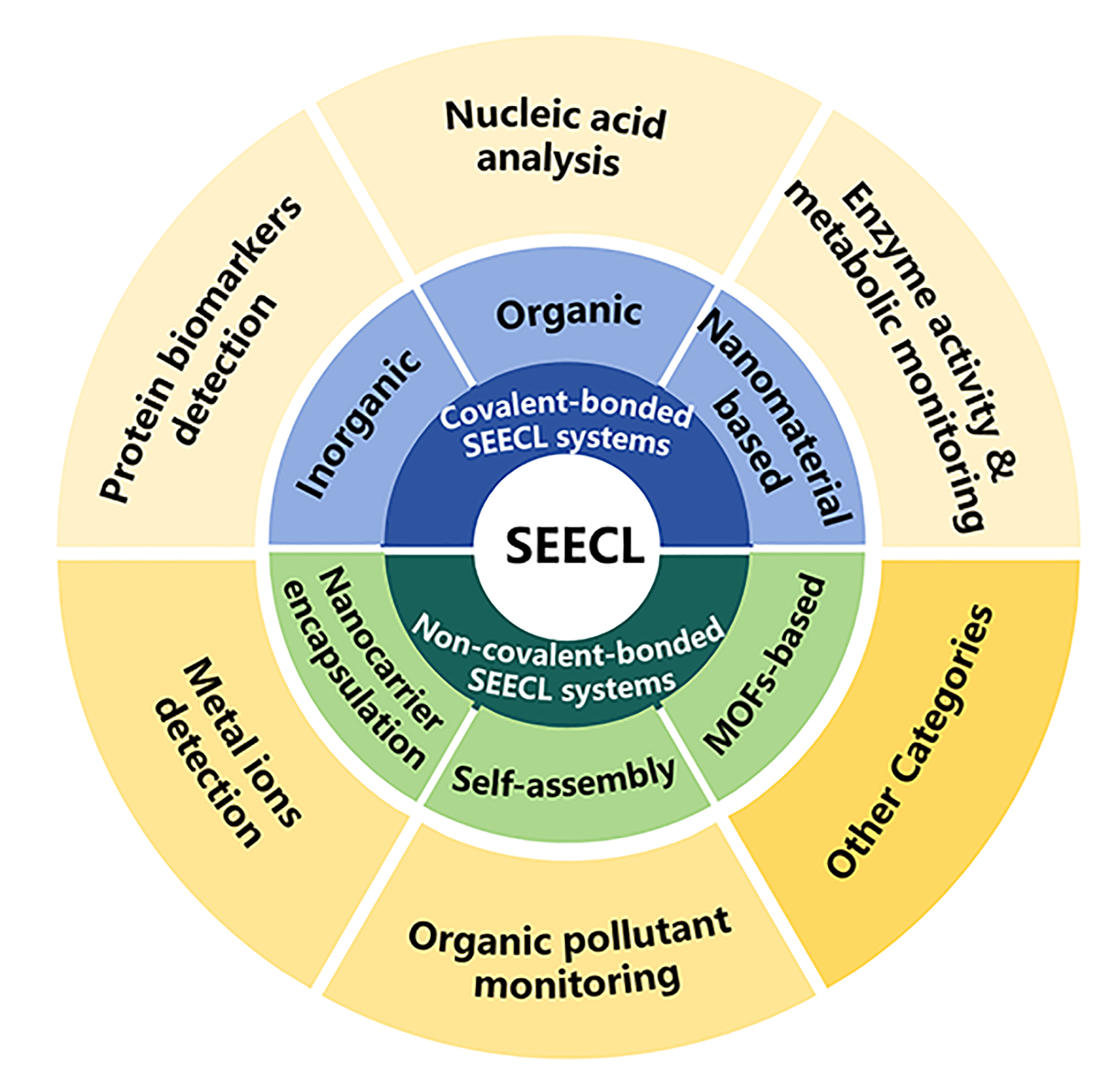
Self-enhanced electrochemiluminescence (SEECL), as an emerging analytical technique, significantly enhances electrochemiluminescence (ECL) efficiency by integrating luminophores and co-reactants into unified nanostructures or molecular frameworks, demonstrating substantial value in the fields of bioanalysis and environmental sensing. Based on the integration mode of luminophores and co-reactants, SEECL structures can be categorized into two types: covalently bonded SEECL and non-covalently bonded SEECL. Covalently bonded SEECL can be further divided into inorganic, organic, and nanoscale covalent bonding SEECL systems, while non-covalently bonded SEECL includes structures such as nanocarrier encapsulation, self-assembly, and metal-organic framework (MOF)-based SEECL. On the basis of summarizing the construction principle of SEECL, this paper summarizes its applications in areas including bioanalysis (protein biomarker detection, nucleic acid analysis, and enzyme activity monitoring), environmental sensing (trace detection of heavy metal ions and organic pollutants), food safety testing, wearable devices, and point-of-care testing (POCT). Additionally, the article addresses unresolved issues such as the stability, biocompatibility of SEECL materials and interference from complex matrices, and prospects its future development directions, providing a reference for subsequent research on SEECL.
1 Introduction
2 Construction of SEECL systems
2.1 Mechanistic insights into SEECL
2.2 Covalent-bonded SEECL systems
2.3 Non-covalent-bonded SEECL Systems
3 Applications of SEECL
3.1 Bioanalysis
3.2 Environmental sensing
3.3 Other categories
4 Conclusions and prospects
self-enhanced electrochemiluminescence (SEECL) / bioanalysis / environmental monitoring / sensing
| [1] |
|
| [2] |
|
| [3] |
(杨钰昆, 王小敏, 方国臻, 云雅光, 郭婷, 王硕. 化学进展, 2016, 28(9): 1351.)
|
| [4] |
|
| [5] |
|
| [6] |
(宫苗, 王晓英, 王晓宁. 化学进展, 2019, 31(6): 894.)
|
| [7] |
|
| [8] |
(林瑜, 谭学才, 吴叶宇, 韦富存, 吴佳雯, 欧盼盼. 化学进展, 2022, 34(4): 898.)
|
| [9] |
|
| [10] |
(王慧静, 孙蝶, 王睿颖, 张卉. 化学进展, 2024, 36(12): 1972.)
|
| [11] |
|
| [12] |
|
| [13] |
|
| [14] |
|
| [15] |
|
| [16] |
|
| [17] |
|
| [18] |
|
| [19] |
|
| [20] |
|
| [21] |
|
| [22] |
|
| [23] |
|
| [24] |
|
| [25] |
|
| [26] |
|
| [27] |
|
| [28] |
|
| [29] |
|
| [30] |
|
| [31] |
|
| [32] |
|
| [33] |
|
| [34] |
|
| [35] |
|
| [36] |
|
| [37] |
|
| [38] |
|
| [39] |
|
| [40] |
|
| [41] |
|
| [42] |
|
| [43] |
|
| [44] |
|
| [45] |
|
| [46] |
|
| [47] |
|
| [48] |
|
| [49] |
|
| [50] |
|
| [51] |
|
| [52] |
|
| [53] |
|
| [54] |
|
| [55] |
|
| [56] |
|
| [57] |
|
| [58] |
|
| [59] |
|
| [60] |
|
| [61] |
|
| [62] |
|
| [63] |
|
| [64] |
|
| [65] |
|
| [66] |
|
| [67] |
|
| [68] |
|
| [69] |
|
| [70] |
|
| [71] |
|
| [72] |
|
| [73] |
|
| [74] |
|
| [75] |
|
| [76] |
|
| [77] |
|
| [78] |
|
| [79] |
|
| [80] |
|
| [81] |
|
| [82] |
|
| [83] |
|
| [84] |
|
| [85] |
|
| [86] |
|
| [87] |
|
| [88] |
|
| [89] |
|
| [90] |
|
| [91] |
|
| [92] |
|
| [93] |
|
| [94] |
|
| [95] |
|
| [96] |
|
| [97] |
|
| [98] |
|
| [99] |
|
| [100] |
|
| [101] |
|
| [102] |
|
| [103] |
|
| [104] |
|
| [105] |
|
| [106] |
|
| [107] |
|
| [108] |
|
| [109] |
|
| [110] |
|
| [111] |
|
| [112] |
|
| [113] |
|
| [114] |
|
/
| 〈 |
|
〉 |








