 PDF(10710 KB)

Mechanistic Insights into Electrocatalytic Urea Oxidation Reaction Through in situ Characterizations
Suzhen Bai, Yi Zeng, Zhengshan Tian, Kesheng Cao, Xingwu Li, Haoqi Wang
Prog Chem ›› 2025, Vol. 37 ›› Issue (12) : 1769-1791.
PDF(10710 KB)
PDF(10710 KB)
Mechanistic Insights into Electrocatalytic Urea Oxidation Reaction Through in situ Characterizations
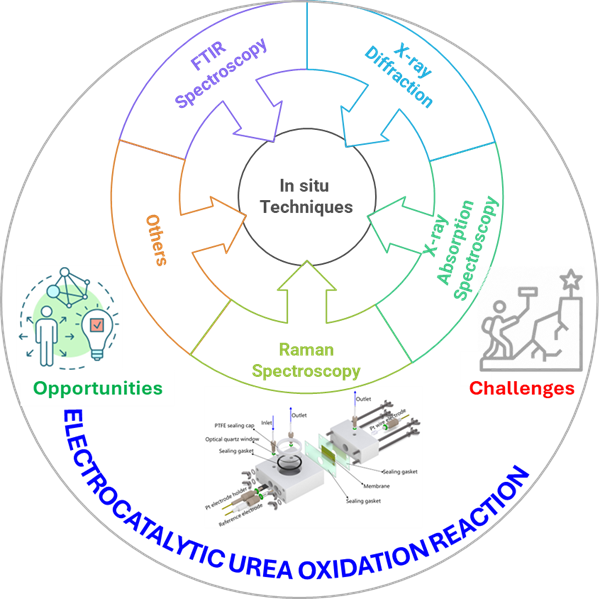
The electrocatalytic urea oxidation reaction (UOR) has emerged as an energy-efficient alternative to the traditional oxygen evolution reaction for hydrogen production, with mechanistic understanding being critical for the rational design of catalysts. This review systematically summarizes recent advances in in situ characterization techniques for elucidating the dynamic reaction mechanisms of UOR. Studies reveal that phase transitions, valence state migration, and electronic structure evolution of catalysts under operational conditions are key factors governing activity and stability. Techniques such as in situ X-ray diffraction, X-ray absorption spectroscopy, Raman spectroscopy, and Fourier-transform infrared spectroscopy enable real-time monitoring of catalyst reconstruction, intermediate evolution, and interfacial adsorption behavior, overcoming the environmental deviations inherent in conventional ex situ characterization. When combined with theoretical calculations, these methods provide direct evidence for identifying active-site configurations, reaction pathways, and rate-determining steps. In addition, special emphasis is placed on multimodal in situ strategies for deciphering synergistic effects in nickel-based catalysts, while current challenges, including non-alkaline systems, real wastewater environments, and multi-metal cooperation mechanisms, are critically discussed. Future research should focus on developing novel in situ approaches for complex systems and establishing a mutually reinforcing framework integrating theoretical prediction and experimental validation, thereby advancing UOR catalyst design from empirical exploration to mechanism-guided optimization.
1 Introduction
2 Overview of the electrocatalytic UOR
3 Overview of in situ characterizations
4 In situ monitoring the dynamic evolution of catalysts during UOR
5 In situ characterizations to reveal the UOR mechanism
6 Conclusions and perspectives
urea oxidation reaction / mechanistic insight / in-situ characterizations / active sites / dynamic evolution
| [1] |
|
| [2] |
|
| [3] |
|
| [4] |
|
| [5] |
|
| [6] |
|
| [7] |
|
| [8] |
(薛世翔, 吴攀, 赵亮, 南艳丽, 雷琬莹. 化学进展, 2022, 34(12): 2686)
|
| [9] |
|
| [10] |
|
| [11] |
|
| [12] |
|
| [13] |
|
| [14] |
|
| [15] |
|
| [16] |
|
| [17] |
|
| [18] |
|
| [19] |
|
| [20] |
|
| [21] |
|
| [22] |
|
| [23] |
|
| [24] |
|
| [25] |
|
| [26] |
|
| [27] |
|
| [28] |
|
| [29] |
|
| [30] |
|
| [31] |
|
| [32] |
|
| [33] |
|
| [34] |
|
| [35] |
|
| [36] |
|
| [37] |
|
| [38] |
|
| [39] |
|
| [40] |
|
| [41] |
|
| [42] |
|
| [43] |
|
| [44] |
|
| [45] |
|
| [46] |
|
| [47] |
|
| [48] |
|
| [49] |
|
| [50] |
|
| [51] |
|
| [52] |
|
| [53] |
|
| [54] |
|
| [55] |
|
| [56] |
|
| [57] |
|
| [58] |
|
| [59] |
(丰收, 湛佳宇, 张鲁华. 化学进展, 2022, 34(4): 983)
|
| [60] |
|
| [61] |
|
| [62] |
|
| [63] |
|
| [64] |
|
| [65] |
|
| [66] |
|
| [67] |
|
| [68] |
|
| [69] |
|
| [70] |
|
| [71] |
(陈信, 王镜朝, 崔翔明, 周密, 王嘉楠, 延卫. 化学进展, 2025, 37(5): 758)
|
| [72] |
|
| [73] |
|
| [74] |
|
| [75] |
|
| [76] |
(卢明龙, 张晓云, 杨帆, 王练, 王育乔. 化学进展, 2022, 34(3): 547)
|
| [77] |
|
| [78] |
|
| [79] |
|
| [80] |
|
| [81] |
|
| [82] |
|
| [83] |
|
| [84] |
|
| [85] |
|
/
| 〈 |
|
〉 |








