 PDF(15065 KB)

Fluorescent Copper Nanoclusters: From Synthesis to Environmental Pollutants Sensing
Lingwei Hu, Xiangqian Li, Zhuohan Zhou, Rumeng Zhao, Lingling Sun, Jitao Li
Prog Chem ›› 2025, Vol. 37 ›› Issue (12) : 1792-1819.
PDF(15065 KB)
PDF(15065 KB)
Fluorescent Copper Nanoclusters: From Synthesis to Environmental Pollutants Sensing
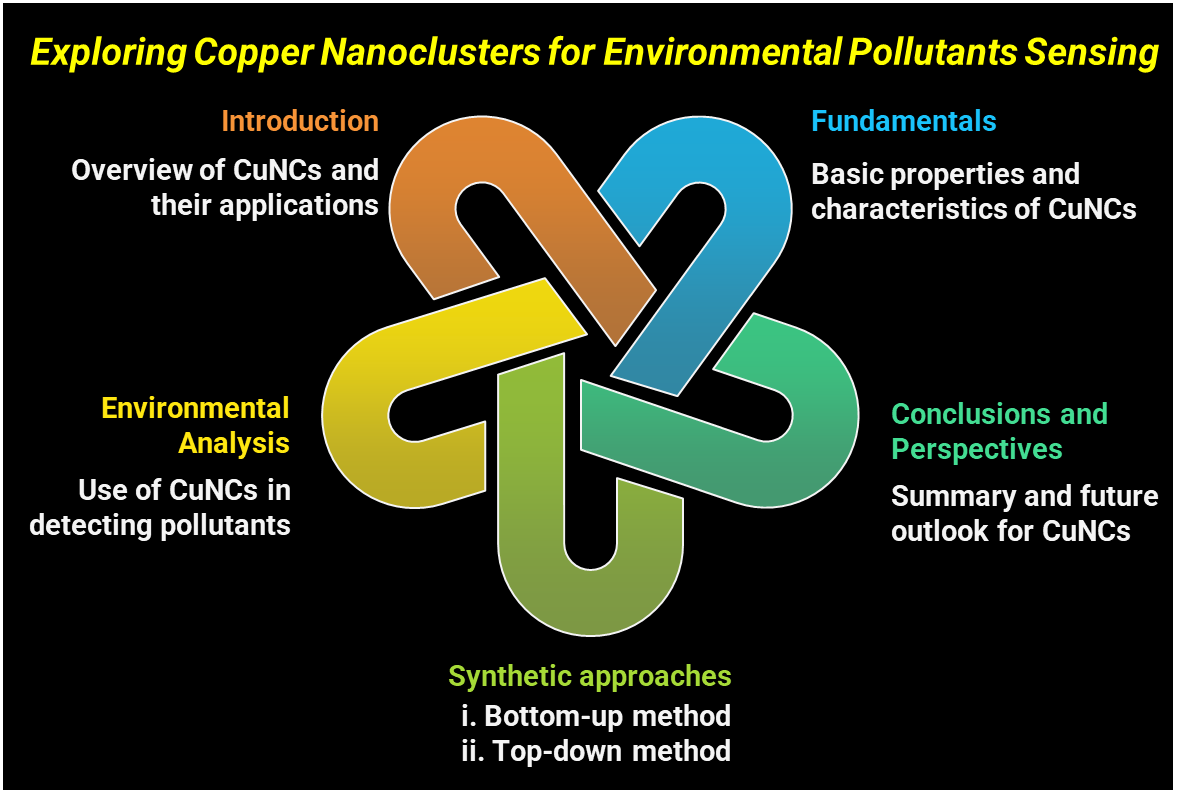
Copper nanoclusters (CuNCs) have gained prominence due to their remarkable color-tunable light emission and cost-effective, versatile solution-based synthesis. The use of various functional ligands in the synthesis of CuNCs enables the modulation of their emission wavelengths and enhances their environmental stability. These nanoclusters have found applications across diverse fields, including catalysis, sensing, bioimaging, and optoelectronics. This review offers a focused and up-to-date perspective by covering literature from the past decade (2015―2025) with an explicit emphasis on practical environmental matrices, including heavy metal ions, organic pollutants, pharmaceuticals, and other environmental contaminants. It systematically compares sensing mechanisms (e.g., fluorescence quenching, turn-on responses, ratiometric and inner-filter effects) and provides tabulated limits of detection for key heavy metals, organic pollutants, and pharmaceuticals to facilitate direct benchmarking. Finally, the review highlights translational gaps for in-field deployment, such as matrix interferences, long-term stability of ligand-stabilized CuNCs, sample pre-treatment needs, and the absence of standardized validation protocols and proposes targeted research directions to bridge laboratory advances with real-world environmental monitoring.
1 Introduction
2 Fundamental of CuNCs
2.1 Chemical composition and structural properties
2.2 Fluorescence properties
2.3 Sensing mechanisms
3 Synthetic approaches of CuNCs
3.1 Bottom-up method
3.2 Top-down method
3.3 Inter-cluster conversion method
3.4 Monolayer-protected method
3.5 Etching method
3.6 Electrochemical synthesis
3.7 Template method
4 Recent advances of CuNCs for environmental pollutants analysis
4.1 Ions
4.2 Organic pollutants
4.3 Pharmaceutical/Pesticides
4.4 H2O and H2O2
4.5 Biomacromolecules and small biomolecules
4.6 Enzyme activity detection
4.7 Others
5 Conclusions and perspectives
copper nanoclusters / synthetic approaches / ligand design / environmental pollutant
| [1] |
|
| [2] |
|
| [3] |
|
| [4] |
|
| [5] |
|
| [6] |
|
| [7] |
(黄家麟, 秦垚华, 唐盛, 孔德昭, 刘畅. 化学进展, 2024, 36(1): 120)
|
| [8] |
(周存银, 黄娟, 王琼, 唐浩, 胡云楚, 王文磊. 化学进展, 2024, 36(6): 893)
|
| [9] |
(彭倩, 张晶晶, 房新月, 倪杰, 宋春元. 化学进展, 2022, 34(12): 2573)
|
| [10] |
(张浩哲, 许文龙, 孟繁升, 赵强, 乔英云, 田原宇. 化学进展, 2025, 37(2): 226)
|
| [11] |
|
| [12] |
|
| [13] |
|
| [14] |
|
| [15] |
|
| [16] |
|
| [17] |
|
| [18] |
|
| [19] |
|
| [20] |
|
| [21] |
|
| [22] |
|
| [23] |
|
| [24] |
|
| [25] |
|
| [26] |
|
| [27] |
|
| [28] |
|
| [29] |
|
| [30] |
|
| [31] |
|
| [32] |
|
| [33] |
|
| [34] |
|
| [35] |
|
| [36] |
|
| [37] |
|
| [38] |
|
| [39] |
|
| [40] |
|
| [41] |
|
| [42] |
|
| [43] |
|
| [44] |
|
| [45] |
|
| [46] |
|
| [47] |
|
| [48] |
|
| [49] |
|
| [50] |
|
| [51] |
|
| [52] |
|
| [53] |
|
| [54] |
|
| [55] |
|
| [56] |
|
| [57] |
|
| [58] |
|
| [59] |
|
| [60] |
|
| [61] |
|
| [62] |
|
| [63] |
|
| [64] |
|
| [65] |
|
| [66] |
|
| [67] |
|
| [68] |
|
| [69] |
|
| [70] |
|
| [71] |
|
| [72] |
|
| [73] |
|
| [74] |
|
| [75] |
|
| [76] |
|
| [77] |
|
| [78] |
|
| [79] |
|
| [80] |
|
| [81] |
|
| [82] |
|
| [83] |
|
| [84] |
|
| [85] |
|
| [86] |
|
| [87] |
|
| [88] |
|
| [89] |
|
| [90] |
|
| [91] |
|
| [92] |
|
| [93] |
|
| [94] |
|
| [95] |
|
| [96] |
|
| [97] |
|
| [98] |
|
| [99] |
|
| [100] |
|
| [101] |
|
| [102] |
|
| [103] |
|
| [104] |
|
| [105] |
|
| [106] |
|
| [107] |
|
| [108] |
|
| [109] |
|
| [110] |
|
| [111] |
|
| [112] |
|
| [113] |
|
| [114] |
|
/
| 〈 |
|
〉 |








