Research Progress on Self-Healing Materials in the Aerospace Field

Jianfeng Zhang, Qingqing Li, Fengli Zhang, Zhongquan Wan, Ke Wang, Chunyang Jia

Prog Chem ›› 2026, Vol. 38 ›› Issue (6) : 1093-1111.

PDF(5519 KB)
Home Journals Progress in Chemistry
Progress in Chemistry

Abbreviation (ISO4): Prog Chem      Editor in chief: Jincai ZHAO

About  /  Aim & scope  /  Editorial board  /  Indexed  /  Contact  / 
PDF(5519 KB)
Prog Chem ›› 2026, Vol. 38 ›› Issue (6) : 1093-1111. DOI: 10.7536/PC20250905
Review

Research Progress on Self-Healing Materials in the Aerospace Field

Author information +
History +

Abstract

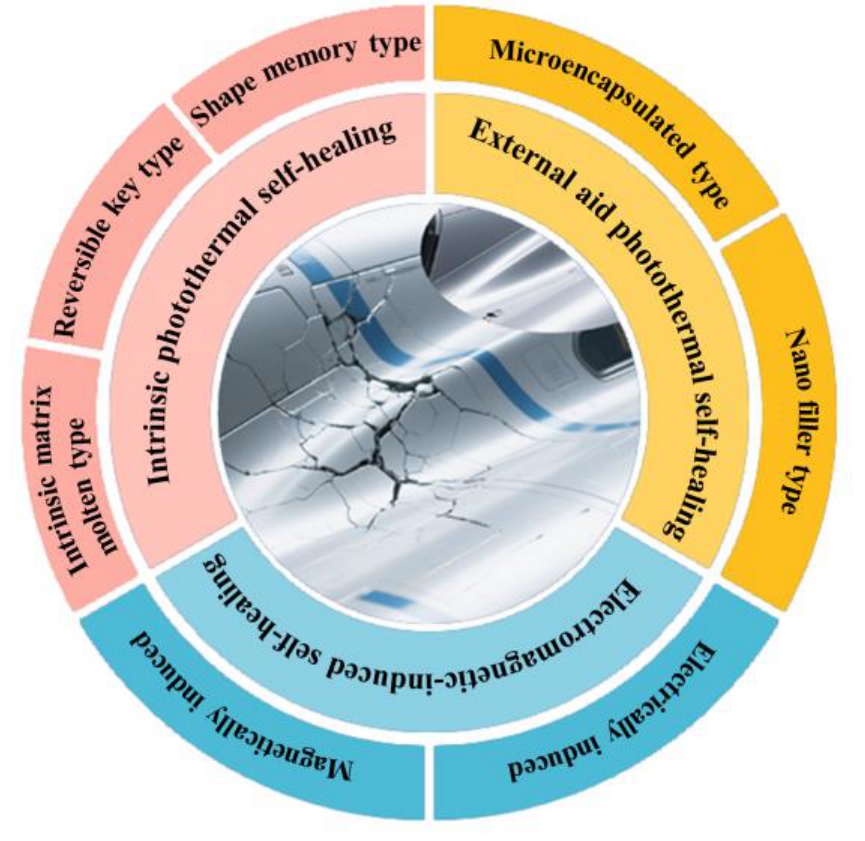
When spacecraft operate in extreme space environments over extended periods—subjected to atomic oxygen erosion, high and low temperature cycling, micrometeorite impacts, and other hazards—their surface materials are prone to microcracking and structural damage, which can compromise mission safety and lifespan. Self-healing materials offer innovative solutions for spacecraft surface protection by mimicking the healing mechanisms found in living organisms. This review systematically summarizes recent research progress in self-healing materials for spacecraft surfaces, focusing on intrinsic and external photothermal self-healing systems, as well as electromagnetic-induced healing technologies. Intrinsic self-healing materials achieve repair through reversible breaking and reformation of dynamic covalent bonds—such as disulfide bonds, borate ester bonds, and imine bonds—as well as non-covalent interactions like hydrogen bonds and coordination bonds. Among these, materials such as epoxy vitrimers and dynamic polyurethanes demonstrate excellent recyclability and healing efficiency via topological rearrangement networks. Externally assisted self-healing systems typically rely on microcapsules that encapsulate healing agents or on nanofillers such as POSS and carbon nanotubes. These materials achieve healing efficiency through crack-triggered release of healing agents or via synergistic effects enabled by nanoparticles. Electromagnetic-induced self-healing materials, on the other hand, utilize Joule heating or magnetic response mechanisms to remotely activate the healing process. When combined with conductive or magnetic nanofillers—such as graphene or Fe3O4—they enable precise and localized repair. Studies indicate that advances in photothermal conversion, optimization of dynamic bonds, and multifunctional integrated designs have significantly improved the environmental adaptability of such materials. For example, silicon-based nanocomposites achieve both anti-atomic oxygen properties and self-healing capability through surface passivation layers, while magnetic microcapsules enable targeted repair under magnetic guidance. Although the feasibility of existing self-healing materials has been validated in laboratory and simulated environments, several challenges remain for practical aerospace applications. These include ensuring the stability of dynamic bonds, maintaining durability under extreme conditions, and balancing healing efficiency with mechanical performance.

Contents

1 Introduction

2 Intrinsic aerospace photothermal self-healing materials

2.1 Shape memory type self-healing

2.2 Reverisible bond type self-healing

2.3 matrix melting type self-healing

3 External aid type aerospace photothermal self-healing materials

3.1 Microencapsulated type self-healing

3.2 Nano-filler type self-healing

4 Electromagnetic induced aerospace self-healing materials

4.1 Electrically induced self-healing

4.2 Magnetically induced self-healing

5 Conclusions and outlook
Key words

spacecraft coating / surface micro-cracks / self-healing materials / photothermal synergy mechanism / electromagnetic induction mechanism

Cite this article

Download Citations
Jianfeng Zhang , Qingqing Li , Fengli Zhang , et al . Research Progress on Self-Healing Materials in the Aerospace Field[J]. Progress in Chemistry. 2026, 38(6): 1093-1111 https://doi.org/10.7536/PC20250905

References

[1]
Liu L T, Miao Y G, Deng Q, Hu X B, Zhang Y, Wang R F, Wang Y S, Su M J, Mai Y W. Compos. Sci. Technol., 2025, 259: 110914.
[2]
Speck O, Speck T. Biomimetics, 2019, 4(1): 26.
[3]
Wang Y, Wang J K, Huang L Y, Ding X L, Chen Z B, Ren C H, Hao W K, Ma L W, Zhang D W. Prog. Org. Coat., 2023, 185: 107886.
[4]
Fang L, Chen J M, Zou Y T, Chen S P, Fang T Y, Lu C H, Xu Z Z. Macromol. Mater. Eng., 2017, 302(9): 1700059.
[5]
Liu Y J, Du H Y, Liu L W, Leng J S. Smart Mater. Struct., 2014, 23(2): 023001.
[6]
Dong Y H, Gong M, Huang D, Gao J, Zhou Q. Prog. Org. Coat., 2019, 136: 105232.
[7]
Bai Y K, Zhang J W, Wen D D, Gong P W, Liu J M, Ju J P, Chen X. Compos. Sci. Technol., 2020, 187: 107940.
[8]
Chen J, Sun D X, Gu T, Qi X D, Yang J H, Lei Y Z, Wang Y. Compos. Sci. Technol., 2022, 217: 109123.
[9]
Zhuo H T, He Z, Liu J, Ma G C, Ren Z H, Zeng Y H, Chen S J. Polymers, 2023, 15(4): 809.
[10]
Jamil H, Faizan M, Adeel M, Jesionowski T, Boczkaj G, Balčiūnaitė A. Molecules, 2024, 29(6): 1267.
[11]
Chen Y J, Sui Z H, Du J. Anti Corros. Meth. Mater., 2025, 72(2): 170.
[12]
Fu F Y, Huang M Q, Zhang W L, Zhao Y, Liu X D. Sci. Rep., 2018, 8(1): 10325.
[13]
Ha Y M, Kim Y O, Ahn S, Lee S K, Lee J S, Park M, Chung J W, Jung Y C. Eur. Polym. J., 2019, 118: 36.
[14]
Zhao Z H, Wang D P, Zuo J L, Li C H. ACS Mater. Lett., 2021, 3(9): 1328.
[15]
Song K, Ye W J, Gao X C, Fang H G, Zhang Y Q, Zhang Q, Li X L, Yang S Z, Wei H B, Ding Y S. Mater. Horiz., 2021, 8(1): 216.
[16]
Wang X H, Li Y X, Qian Y H, Qi H, Li J, Sun J Q. Adv. Mater., 2018, 30(36): 1803854.
[17]
Yang Y, Xu Y S, Ji Y, Wei Y. Prog. Mater. Sci., 2021, 120: 100710.
[18]
Singh G, Sundararaghavan V. Chem. Phys. Lett., 2020, 760: 137966.
[19]
Zhou L S, Zhang G C, Feng Y J, Zhang H M, Li J T, Shi X T. J. Mater. Sci., 2018, 53(9): 7030.
[20]
Ma Y J, Lu X, Xin Z. ACS Appl. Polym. Mater., 2025, 7(10): 6384.
[21]
Shao Y Q, Zhu H X, Chen K, Jin T Y, Wang Z W, Luo Z X, Wang J H, Sun H Y, Wei S Y, Gao Z H. Polymers, 2025, 17(7): 897.
[22]
Sarrafan S, Li G Q. Adv. Funct. Mater., 2024, 34(11): 2308085.
[23]
Mandal T, Ozten U, Vaught L, Meyer J L, Amiri A, Polycarpou A, Naraghi M. J. Compos. Sci., 2024, 8(7): 252.
[24]
Xiang R, An L. J. Phys.: Conf. Ser., 2024, 2808(1): 012065.
[25]
Luo Z Y, Pan X J, Liu F Q, Yi Q X, Zeng Y N, Chen Y H, Wang C Y. Eur. Polym. J., 2024, 202: 112606.
[26]
Zhang Q H, Li M Z, Feng P F, Meng L L, Jian X G, Xu J. J. Polym. Res., 2024, 31(3): 87.
[27]
Li W B, Chang Q Y, Xiao L H, Zhang K, Huang J R, Wang Y G, Chen J, Nie X A. ACS Appl. Polym. Mater., 2023, 5(6): 4498.
[28]
Liang C, Gracida-Alvarez U R, Gallant E T, Gillis P A, Marques Y A, Abramo G P, Hawkins T R, Dunn J B. Environ. Sci. Technol., 2021, 55(20): 14215.
[29]
Felsenthal L M, Kim S, Dichtel W R. ACS Appl. Mater. Interfaces, 2024, 16(42): 57687.
[30]
Wang H B, Yan R, Zou Y K, Xing D M, Zhong K. J. Mater. Chem. B, 2022, 10(7): 1085.
[31]
Zhao J B, Zhu J S, Zhang J F, Huang Z C, Qi D M. React. Funct. Polym., 2024, 199: 105886.
[32]
Yao Y, Xu Z Y, Liu B, Xiao M, Yang J H, Liu W G. Adv. Funct. Mater., 2021, 31(4): 2006944.
[33]
Kazemi-Lari M A, Malakooti M H, Sodano H A. Smart Mater. Struct., 2017, 26(5): 055003.
[34]
Ha Y M, Kim Y N, Jung Y C. Polymers, 2021, 13(8): 1274.
[35]
Xiao P S, Li G H, Ma S P, Cai Z H, Huang L, Huang Y. J. Appl. Polym. Sci., 2022, 139(8): 51690.
[36]
White S R, Sottos N R, Geubelle P H, Moore J S, Kessler M R, Sriram S R, Brown E N, Viswanathan S. Nature, 2001, 409(6822): 794.
[37]
Chong Y B, Sun D W, Zhang X, Yue C Y, Yang J L. Chem. Eng. J., 2019, 372: 496.
[38]
Adil M M, Rabbi M S, Tasnim T. Alex. Eng. J., 2025, 122: 1.
[39]
Lee J S, Kim H W, Lee J S, An H S, Chung C M. Materials, 2021, 14(20): 6198.
[40]
Hasanzadeh M, Shahidi M, Kazemipour M. Prog. Org. Coat., 2015, 80: 106.
[41]
Thanawala K, Mutneja N, Khanna A, Raman R. Materials, 2014, 7(11): 7324.
[42]
Zhu Y Y, Cao K L, Chen M, Wu L M. ACS Appl. Mater. Interfaces, 2019, 11(36): 33314.
[43]
Li P H, Guo W C, Ma K X, Chang L, Tian K S, Li X A, Wang H Y. Appl. Surf. Sci., 2023, 616: 156537.
[44]
Hia I L, Lam W H, Chai S P, Chan E S, Pasbakhsh P. Mater. Chem. Phys., 2018, 215: 69.
[45]
Niratiwongkorn T, Luckachan G E, Mittal V. RSC Adv., 2016, 6(49): 43237.
[46]
Koh E, Lee S, Shin J, Kim Y W. Ind. Eng. Chem. Res., 2013, 52(44): 15541.
[47]
Zhang L, Wang H Y, He F, Chen H, Xie G X, Wei B, Luo J B, He B, Wu Z P. Compos. Part B Eng., 2022, 232: 109566.
[48]
Pulikkalparambil H, Siengchin S, Parameswaranpillai J. Nano Struct. Nano Objects, 2018, 16: 381.
[49]
Kausar A, Ahmad I, Maaza M, Bocchetta P. J. Compos. Sci., 2023, 7(4): 148.
[50]
Li X B, Al-Ostaz A, Jaradat M, Rahmani F, Nouranian S, Rushing G, Manasrah A, Alkhateb H, Finckenor M, Lichtenhan J. Eur. Polym. J., 2017, 92: 233.
[51]
Zhang Y, Wu H, Guo Y D, Yang Y B, Yu Q, Liu J G, Wu B H, Lv F Z. Nanomaterials, 2021, 11(1): 141.
[52]
Wu B H, Zhang Y, Yang D Y, Yang Y B, Yu Q, Che L, Liu J G. Polymers, 2019, 11(6): 1013.
[53]
Xu H Z, Cao X X, Shi Y, Cong T X, Liu H T, Gao Y. Prog. Org. Coat., 2023, 182: 107703.
[54]
Miyazaki E, Tagawa M, Yokota K, Yokota R, Kimoto Y, Ishizawa J. Acta Astronaut., 2010, 66(5/6): 922.
[55]
Lei X F, Chen Y, Zhang H P, Li X J, Yao P, Zhang Q Y. ACS Appl. Mater. Interfaces, 2013, 5(20): 10207.
[56]
Xu M, Zhao Y P, Zhang X Y, Li Z H, Zhao L, Wang Z M, Gao W S. ACS Appl. Polym. Mater., 2019, 1(12): 3253.
[57]
Jackson E M, Laibinis P E, Collins W E, Ueda A, Wingard C D, Penn B. Compos. Part B Eng., 2016, 89: 362.
[58]
Lalire T, Longuet C, Taguet A. Carbon, 2024, 225: 119055.
[59]
Kang H, Kim H T, Woo H J, Kim H, Kim D H, Lee S, Kim S, Song Y J, Kim S W, Cho J H. Nano Energy, 2019, 58: 227.
[60]
Zamal H H, Barba D, Aïssa B, Haddad E, Rosei F. Sci. Rep., 2020, 10: 2973.
[61]
Willocq B, Bose R K, Khelifa F, Garcia S J, Dubois P, Raquez J M. J. Mater. Chem. A, 2016, 4(11): 4089.
[62]
Wang H M, Yang Y, Zhang M C, Wang Q, Xia K L, Yin Z, Wei Y, Ji Y, Zhang Y Y. ACS Appl. Mater. Interfaces, 2020, 12(12): 14315.
[63]
Orellana J, Moreno-Villoslada I, Bose R K, Picchioni F, Flores M E, Araya-Hermosilla R. Polymers, 2021, 13(4): 649.
[64]
Sánchez-Romate X F, Sans A, Jiménez-Suárez A, Prolongo S G. Compos. Sci. Technol., 2021, 213: 108950.
[65]
Le H H, Böhme F, Sallat A, Wießner S, auf der Landwehr M, Reuter U, Stöckelhuber K W, Heinrich G, Radusch H J, Das A. Macromol. Mater. Eng., 2017, 302(4): 1600385.
[66]
Zhou M, Liu W Q, Fu H Q. J. Alloys Compd., 2023, 968: 171931.
[67]
Loura N, Gkartzou E, Trompeta A F, Konstantopoulos G, Klonos P A, Kyritsis A, Carbon Res., 2023, 9(4): 111.
[68]
Wen Z, Luan Y B, Li Y C. J. Phys.: Conf. Ser., 2023, 2529(1): 012008.
[69]
Ryan E A, Seibers Z D, Reynolds J R, Shofner M L. J. Appl. Polym. Sci., 2024, 141(15): e55225.
[70]
Gómez-Sánchez J, Sánchez-Romate X X F, del Rosario G, González-Prolongo S, Jiménez-Suárez A. Prog. Org. Coat., 2025, 200: 109018.
[71]
Cerdan K, Van Assche G, van Puyvelde P, Brancart J. Polymer, 2020, 204: 122819.
[72]
Sun P T, Liu F Q, Sima W X, Yuan T, Yang M, Liang C, Zhao M K, Yin Z. Nanoscale, 2022, 14(6): 2199.
[73]
Sun P T, Niu C L, Sima W X, Yuan T, Yang M, Zhao M K, Fang Z, Liu Q C, Deng Q. Prog. Org. Coat., 2023, 183: 107752.
[74]
Wang W, Li W H, Fan W J, Zhang X Y, Song L Y, Xiong C S, Gao X, Liu X J. Chem. Eng. J., 2018, 332: 658.
[75]
Ren Q, Zhang X Y, Wu Y R, Sun D W, Zhang X. Compos. Sci. Technol., 2025, 259: 110944.
[76]
Yilmaz D, Du Fraysseix M, Lewandowski S, Perraud S, Ibarboure E, Llevot A, Carlotti S. ACS Appl. Mater. Interfaces, 2024, 16(16): 21161.
[77]
Li W Y, Gu H, Liu Z H, Zhang H W, Jiang L, Zhou X. Eur. Polym. J., 2024, 202: 112633.
[78]
Chen Y, Zhao X, Li Y, Jin Z Y, Yang Y, Yang M B, Yin B. J. Mater. Chem. C, 2021, 9(16): 5515.
[79]
Liu Y P, Zhan Y C, Tian L M, Zhao J, Sun J Y. Prog. Org. Coat., 2024, 186: 108047.
[80]
Romero-Fierro D, Bustamante-Torres M, Bravo-Plascencia F, Esquivel-Lozano A, Ruiz J C, Bucio E. Polymers, 2022, 14(19): 4084.
[81]
Cerdan K, Moya C, Van Puyvelde P, Bruylants G, Brancart J. Molecules, 2022, 27(12): 3796.

Funding

National Natural Science Foundation of China(51773027)
State Key Laboratory of Space Environment Interaction with Matters.
PDF(5519 KB)

Accesses

Citation

Detail

Sections
Recommended

/