PDF(13163 KB)

Construction and Application of Phenothiazine-Based Fluorescent Probes for the Detection of Hypochlorous Acid
Yuehua Yuan, Chaoyi Yue, Mengqing Du, Feng Feng, Maozhong Tian
Prog Chem ›› 2026, Vol. 38 ›› Issue (5) : 921-940.
PDF(13163 KB)
PDF(13163 KB)
Construction and Application of Phenothiazine-Based Fluorescent Probes for the Detection of Hypochlorous Acid
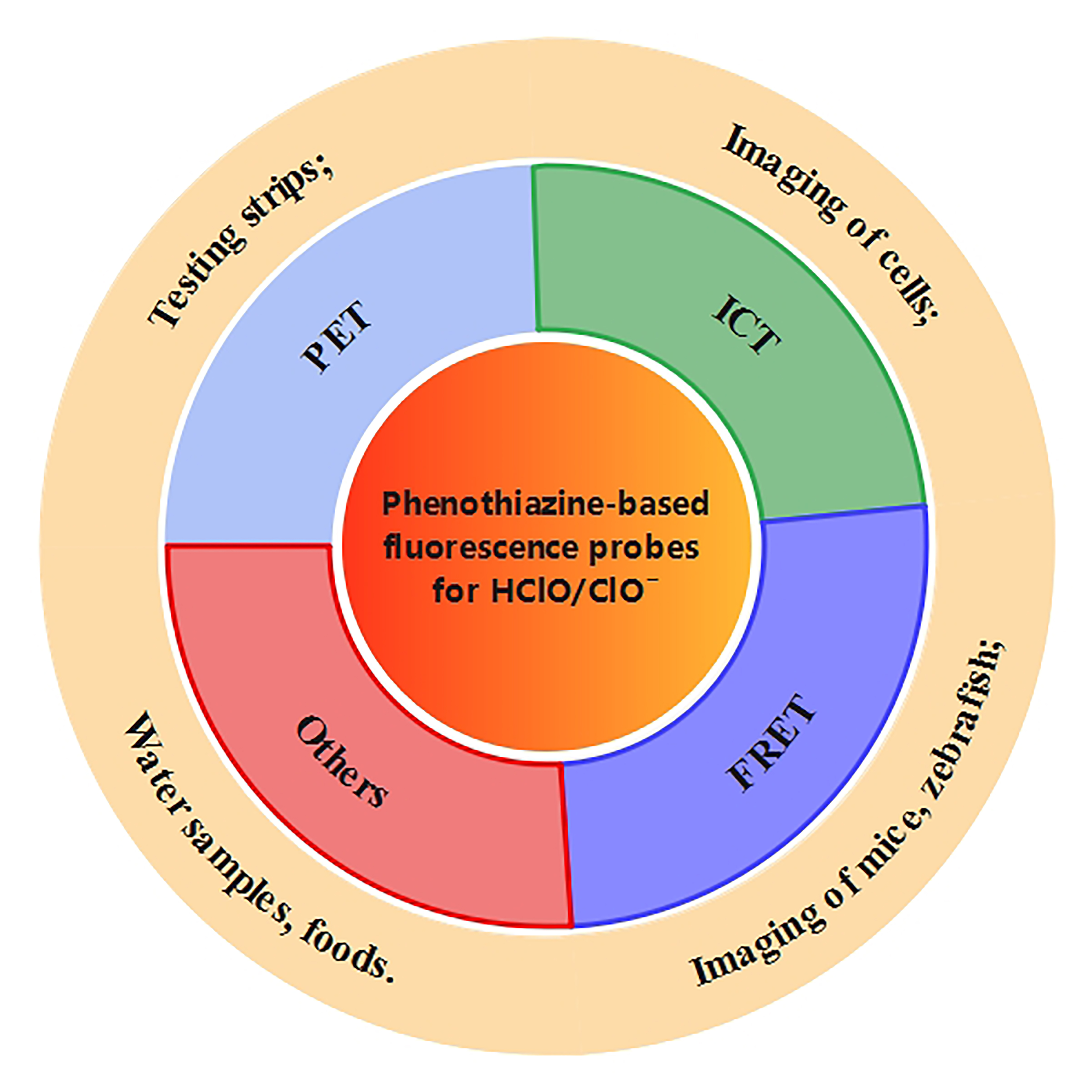
Hypochlorous acid/hypochlorite (HClO/ClO-) is one of the prominent reactive oxygen species (ROS), which has pivotal impacts in both daily life and complex biological processes. Excessive HClO/ClO- can lead to a series of diseases, such as arthritis, cardiovascular diseases and cancer, etc. Therefore, it is of great significance to detect HClO/ClO- in biological systems rapidly, sensitively and selectively. Phenothiazine (PTZ) and its derivatives with electron-rich properties are a class of significant fluorophores. At the main modification sites of a PTZ fluorophore, electron-donating or electron-withdrawing groups can be easily introduced to effectively regulate the photophysical properties of phenothiazine molecules. Moreover, they also have the advantages of non-planar butterfly-shaped curved structures that can fully inhibit the formation of molecular aggregates and environmental friendliness. Hence, they show obvious superiorities in the construction of HClO/ClO- fluorescent probes. In this review, we systematically discuss the research progress of phenothiazine-based fluorescent probes for HClO/ClO-. The sensing mechanism, relevant performance parameters and practical application of these fluorescent probes are highlighted, and the prospects for phenothiazine-based fluorescent probes for HClO/ClO- are discussed.
1 Introduction
2 Fluorescent probes for HClO/ClO- based on PET
3 Fluorescent probes for HClO/ClO- based on ICT
4 Fluorescent probes for HClO/ClO- based on other detection mechanism
5 Conclusion and outlook
phenothiazine / hypochlorous acid / hypochlorite / fluorescence probe / recognition mechanism / practical application
| [1] |
|
| [2] |
(李海东, 樊江莉, 彭孝军. 化学进展, 2017, 29(1): 17.)
|
| [3] |
|
| [4] |
|
| [5] |
|
| [6] |
(任春平, 聂雯, 冷俊强, 刘振波. 化学进展, 2021, 33(6): 942.)
|
| [7] |
|
| [8] |
|
| [9] |
|
| [10] |
|
| [11] |
|
| [12] |
|
| [13] |
|
| [14] |
|
| [15] |
|
| [16] |
|
| [17] |
(张志强, 李海朝, 龙英. 化学进展, 2025, 37(6): 918.)
|
| [18] |
|
| [19] |
|
| [20] |
|
| [21] |
(薛志伟, 曹彦, 杨小峰. 分析试验室, 2025, 44(3): 324.)
|
| [22] |
|
| [23] |
|
| [24] |
|
| [25] |
|
| [26] |
|
| [27] |
|
| [28] |
|
| [29] |
|
| [30] |
|
| [31] |
|
| [32] |
|
| [33] |
|
| [34] |
|
| [35] |
|
| [36] |
|
| [37] |
|
| [38] |
|
| [39] |
|
| [40] |
|
| [41] |
|
| [42] |
|
| [43] |
|
| [44] |
|
| [45] |
|
| [46] |
|
| [47] |
|
| [48] |
|
| [49] |
|
| [50] |
|
| [51] |
|
| [52] |
|
| [53] |
|
| [54] |
|
| [55] |
|
| [56] |
|
| [57] |
|
| [58] |
|
| [59] |
|
| [60] |
|
| [61] |
|
| [62] |
|
| [63] |
|
| [64] |
|
| [65] |
|
| [66] |
(沈岩, 咸东旭, 沙米西奴尔, 陈旭, 侯嫣楠, 陈颂. 分析试验室, 2021, 40(11): 1294.)
|
| [67] |
|
| [68] |
|
| [69] |
|
| [70] |
|
| [71] |
|
| [72] |
|
| [73] |
|
| [74] |
|
| [75] |
|
| [76] |
|
| [77] |
|
| [78] |
|
| [79] |
|
| [80] |
|
| [81] |
|
| [82] |
|
| [83] |
|
| [84] |
|
| [85] |
|
| [86] |
|
| [87] |
|
| [88] |
|
| [89] |
|
| [90] |
|
| [91] |
|
| [92] |
|
| [93] |
|
| [94] |
|
| [95] |
|
| [96] |
|
| [97] |
|
| [98] |
|
| [99] |
|
| [100] |
|
| [101] |
|
| [102] |
|
| [103] |
|
| [104] |
|
| [105] |
|
| [106] |
|
| [107] |
|
| [108] |
|
| [109] |
|
| [110] |
|
| [111] |
|
| [112] |
|
| [113] |
|
| [114] |
|
/
| 〈 |
|
〉 |