 PDF(7184 KB)

Copper Sulfide-Based Nanomaterials:Synthesis and Applications in Electromagnetic Interference Shielding
Yanying Nie, Qian Miao, Jiayi Wang, Bing Lian, Liwen Xu, Zheng Xu
Prog Chem ›› 2026, Vol. 38 ›› Issue (6) : 1144-1162.
PDF(7184 KB)
PDF(7184 KB)
Copper Sulfide-Based Nanomaterials:Synthesis and Applications in Electromagnetic Interference Shielding
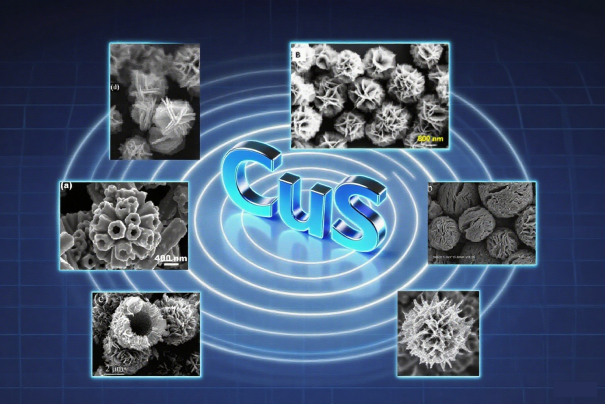
With the rapid development of communication and microelectronics technology, electromagnetic wave pollution has become an important issue affecting human health and the performance of microelectronic devices. Copper sulfide, as an important P-type semiconductor chalcogenide material, has become a research hotspot in the field of electromagnetic shielding materials in recent years due to its high carrier concentration, strong electronic polarization relaxation ability, excellent optoelectronic properties, and special nanostructure. This article will provide a tutorial review of the preparation of copper sulfide and copper sulfide based composite materials, as well as their latest application progress in the field of electromagnetic shielding materials.
1 Introduction
2 Synthesis and morphology control mechanisms of CuS nanomaterials
2.1 Hydrothermal method
2.2 Solvothermal method
2.3 Regulatory effects of surfactants and ligands
2.4 Fabrication of hollow-structured CuS nanomaterials
3 Electromagnetic absorption and shielding performance of pure-phase CuS nanomaterials
3.1 Principles of electromagnetic shielding
3.2 Electromagnetic absorption and shielding of pure-phase CuS nanomaterials
4 Preparation and electromagnetic shielding performance of CuS-based composite nanomaterials
4.1 Core-shell structured CuS composites
4.2 CuS/polymer composite films
4.3 CuS/polymer fiber-based fabrics
4.4 CuS-based binary composites
4.5 CuS-based multicomponent composites
4.6 CuS-based multifunctional composites
5 Conclusions and prospects
copper sulfide / electromagnetic shielding / Composite materials / wave absorption
| [1] |
|
| [2] |
|
| [3] |
|
| [4] |
|
| [5] |
|
| [6] |
|
| [7] |
|
| [8] |
|
| [9] |
|
| [10] |
|
| [11] |
|
| [12] |
|
| [13] |
|
| [14] |
|
| [15] |
|
| [16] |
|
| [17] |
|
| [18] |
|
| [19] |
|
| [20] |
|
| [21] |
|
| [22] |
|
| [23] |
|
| [24] |
|
| [25] |
|
| [26] |
|
| [27] |
|
| [28] |
|
| [29] |
|
| [30] |
|
| [31] |
|
| [32] |
|
| [33] |
|
| [34] |
|
| [35] |
|
| [36] |
|
| [37] |
|
| [38] |
|
| [39] |
|
| [40] |
(宋军旺, 王博涛. 兵器材料科学与工程, 2018, 41(3): 86.)
|
| [41] |
|
| [42] |
|
| [43] |
|
| [44] |
|
| [45] |
|
| [46] |
|
| [47] |
|
| [48] |
(郁思冲, 沈勇, 沈逸飞, 胡小赛, 吕佳颖, 王珂. 现代化工, 2017, 37(11): 110.)
|
| [49] |
|
| [50] |
|
| [51] |
|
| [52] |
|
| [53] |
|
| [54] |
|
| [55] |
|
| [56] |
|
| [57] |
|
| [58] |
|
| [59] |
|
| [60] |
|
| [61] |
|
| [62] |
|
| [63] |
|
| [64] |
|
| [65] |
|
| [66] |
|
| [67] |
|
| [68] |
|
| [69] |
|
| [70] |
|
| [71] |
|
| [72] |
|
| [73] |
|
| [74] |
|
| [75] |
|
| [76] |
|
| [77] |
|
| [78] |
|
| [79] |
|
| [80] |
|
/
| 〈 |
|
〉 |








