PDF(2061 KB)

Quantitative Methods and Application of Global Atmospheric Hydroxy Radicals Concentrations
Hong Huang, Zhaofeng Tan, Keding Lu, Yuanhang Zhang
Prog Chem ›› 2026, Vol. 38 ›› Issue (5) : 974-988.
PDF(2061 KB)
PDF(2061 KB)
Quantitative Methods and Application of Global Atmospheric Hydroxy Radicals Concentrations
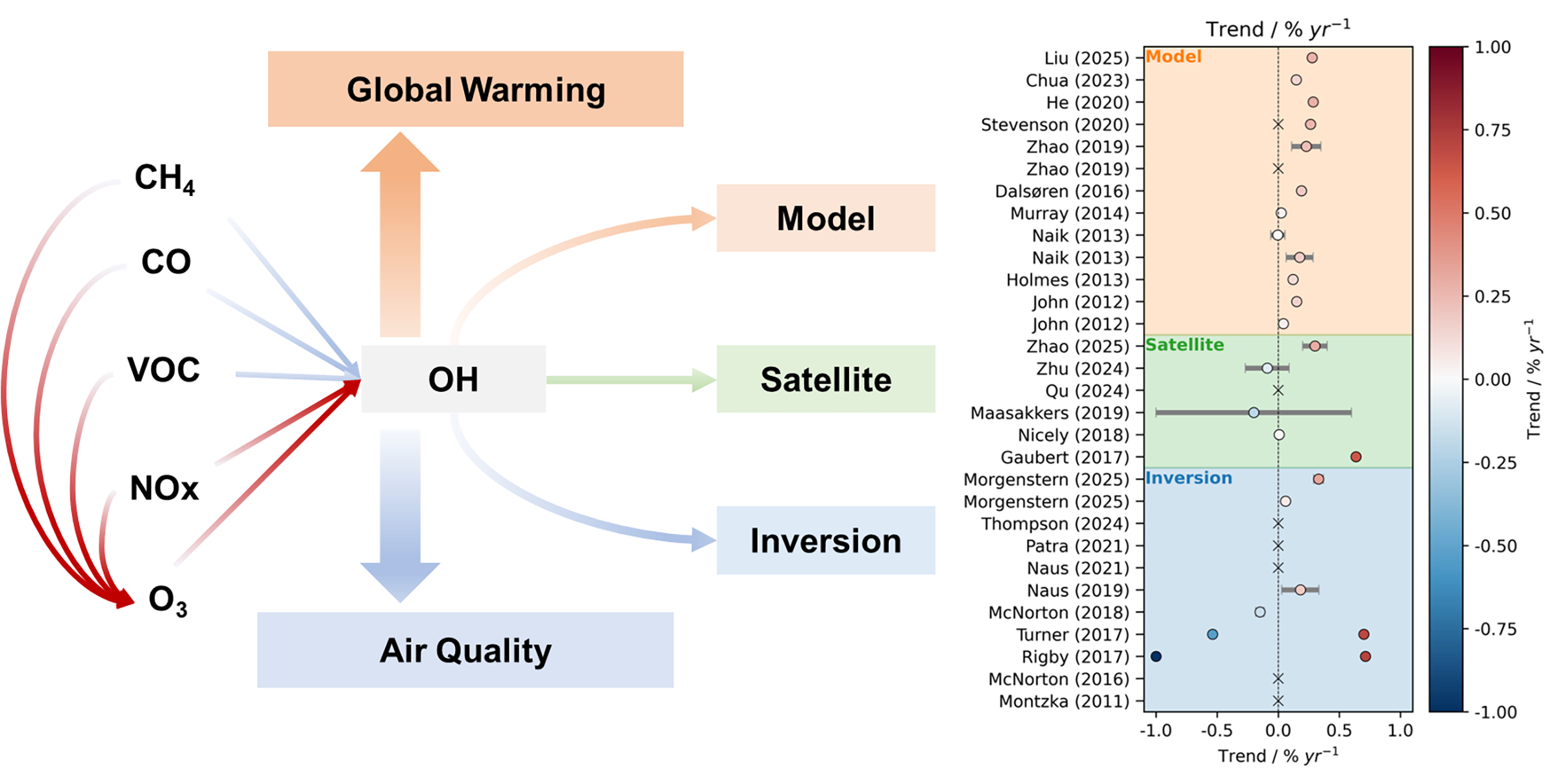
Hydroxyl (OH) radicals, as key oxidants in the atmosphere, play a critical role in regulating atmospheric chemical composition and influencing both air quality and climate change. Accurately assessing the global OH concentration levels and trends is essential for understanding atmospheric chemical processes and evaluating environmental and climate conditions. This paper systematically reviews the global OH evaluation indicators, and summarizes the current quantitative methods for global OH in research, including inversion of ground-based indicator observation, model simulations, and satellite-based evaluation methods. Existing research on OH concentration trends reveal discrepancies between ground-based indicator inversion methods and forward model simulations regarding long-term trends. Results from indicator inversion methodsvary across studies, while model-based studies suggest an increasing trend in OH concentrations after 1980. Satellite methods still exhibit significant uncertainties in OH assessment and require further development. In the future, it is necessary to further strengthen the relevant observations of indicators and precursors to provide more observational constraints for OH assessment. At the same time, it is essential to further develop new indicators, optimize atmospheric chemical model mechanisms, and explore new assessment methods to improve the accuracy and reliability of global OH assessment.
1 Introduction
2 Evaluation indicators for global OH
2.1 Concentration evaluation indicators
2.2 Trend evaluation indicators
3 Atmospheric chemical processes and influencing factors of OH
4 Quantitative methods for global OH
4.1 Inversion of ground-based indicator observation
4.2 Model simulations
4.3 Satellite-based evaluation methods
5 Recent research progress on global OH evaluation
6 Current theoretical and technical limitations
6.1 Inherent uncertainty based on climate variability
6.2 Sources of uncertainty based on inversion methods
6.3 Sources of uncertainty based on model simulations
7 Summary and outlook
hydroxyl radical (OH) / atmospheric oxidizing capacity / quantitative method / trend / interannual variability
| [1] |
|
| [2] |
|
| [3] |
|
| [4] |
|
| [5] |
|
| [6] |
|
| [7] |
|
| [8] |
|
| [9] |
|
| [10] |
|
| [11] |
|
| [12] |
|
| [13] |
|
| [14] |
|
| [15] |
|
| [16] |
|
| [17] |
|
| [18] |
|
| [19] |
|
| [20] |
|
| [21] |
|
| [22] |
|
| [23] |
|
| [24] |
|
| [25] |
|
| [26] |
|
| [27] |
|
| [28] |
|
| [29] |
|
| [30] |
|
| [31] |
|
| [32] |
|
| [33] |
|
| [34] |
|
| [35] |
|
| [36] |
|
| [37] |
|
| [38] |
|
| [39] |
|
| [40] |
|
| [41] |
|
| [42] |
|
| [43] |
|
| [44] |
|
| [45] |
|
| [46] |
|
| [47] |
|
| [48] |
|
| [49] |
|
| [50] |
|
| [51] |
|
| [52] |
|
| [53] |
|
| [54] |
|
| [55] |
|
| [56] |
|
| [57] |
|
| [58] |
|
| [59] |
|
| [60] |
|
| [61] |
|
| [62] |
|
| [63] |
|
| [64] |
|
| [65] |
|
| [66] |
|
| [67] |
|
| [68] |
|
| [69] |
|
| [70] |
|
| [71] |
|
| [72] |
|
| [73] |
|
| [74] |
|
| [75] |
|
| [76] |
PCDMI. ESGF CMIP6 Data Holdings. [2025-07-17]. https://pcmdi.llnl.gov/CMIP6/ArchiveStatistics/esgf_data_holdings/.
|
| [77] |
|
| [78] |
|
| [79] |
|
| [80] |
|
| [81] |
|
| [82] |
|
| [83] |
|
| [84] |
|
| [85] |
|
| [86] |
|
| [87] |
|
| [88] |
|
| [89] |
|
| [90] |
|
| [91] |
|
| [92] |
|
| [93] |
|
| [94] |
|
| [95] |
|
| [96] |
|
| [97] |
|
| [98] |
|
| [99] |
|
/
| 〈 |
|
〉 |