PDF(6420 KB)

Layered Zn3In2S6-Based Nanomaterials for Photocatalytic Hydrogen Production
Fengqin Wang, Yi Zhang, Yang Wang, Muhammad Tayyab, Sugang Meng
Prog Chem ›› 2026, Vol. 38 ›› Issue (3) : 384-420.
PDF(6420 KB)
PDF(6420 KB)
Layered Zn3In2S6-Based Nanomaterials for Photocatalytic Hydrogen Production
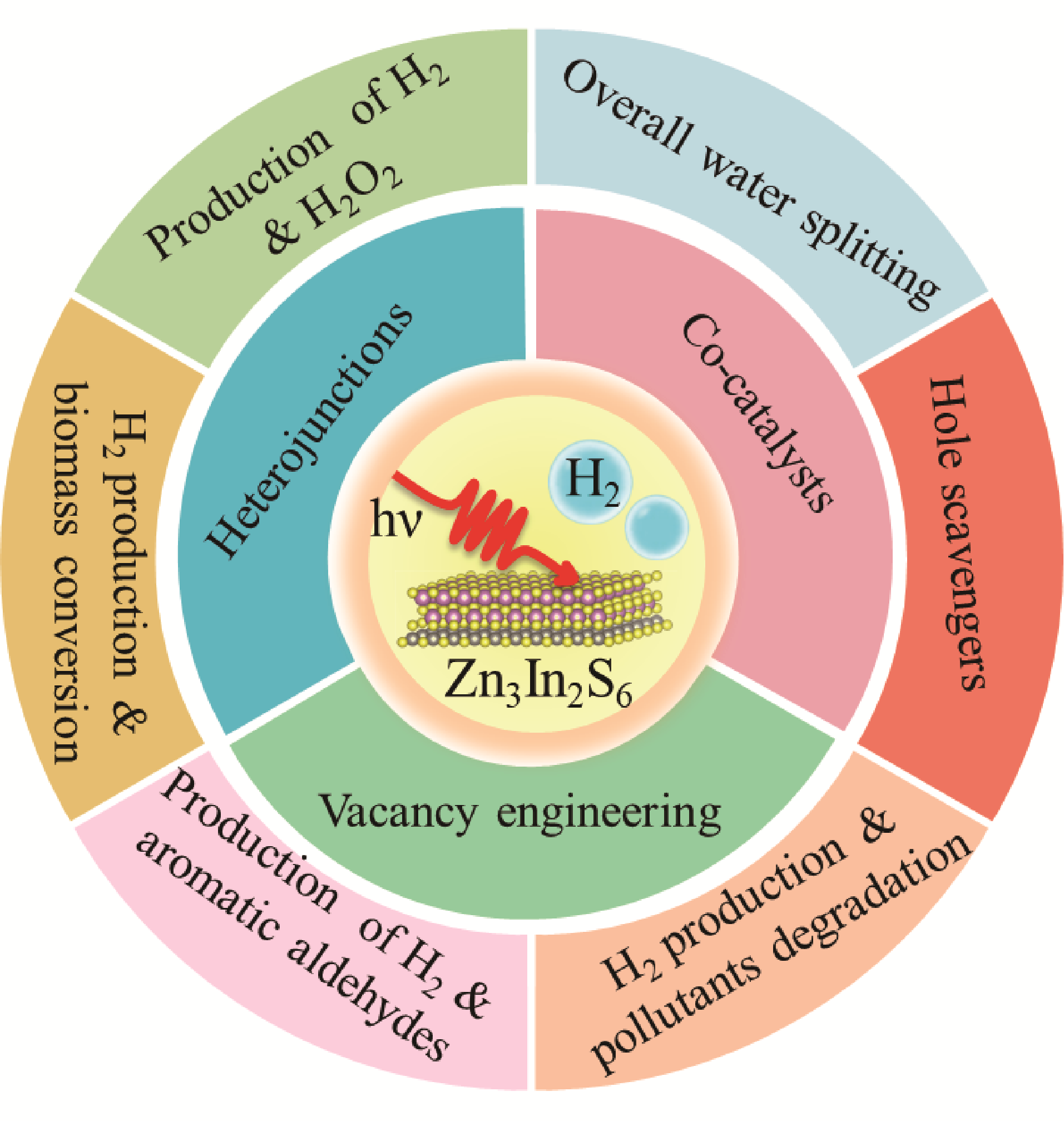
Photocatalytic water splitting for hydrogen production is recognized as one of the most promising solutions to alleviate global energy crises and mitigate environmental pollution. As a typical ternary chalcogenide semiconductor with a layered structure, Zn3In2S6 (ZIS) has garnered significant attention in the field of photocatalytic hydrogen evolution, thanks to its favorable energy band structure, excellent visible-light response capability, and abundant surface active sites. This review comprehensively summarizes the latest research progress of ZIS-based nanomaterials in photocatalytic hydrogen production. First, it systematically elaborates on the fundamental properties of ZIS, including its hexagonal layered crystal structure and its energy band characteristics, as well as the core mechanism of photocatalytic hydrogen production centered on the separation and migration of photogenerated carriers. Then, the review focuses on the application progress of ZIS-based nanomaterials in different photocatalytic hydrogen production systems: overall water splitting (achieving efficient carrier separation via S-scheme heterojunctions), hydrogen production in sacrificial agent systems (optimizing hole consumption paths with agents like lactic acid, formic acid, and triethanolamine to enhance efficiency), and bifunctional coupled reaction systems (including organic pollutant degradation coupled with hydrogen production, selective oxidation of alcohols such as benzyl alcohol and 5-hydroxymethylfurfural coupled with hydrogen production, and hydrogen peroxide synthesis coupled with hydrogen production). For each system, a comparative analysis is conducted on reaction mechanisms, advantages, disadvantages, performance optimization strategies (e.g., heterojunction construction, cocatalyst loading, defect engineering), and technical economy. Finally, the review discusses the current challenges faced by ZIS-based photocatalytic materials, especially in bifunctional coupled reaction systems, such as limited selectivity in organic oxidation, catalyst deactivation, and complex product separation, and proposes future development directions, including the design of atomically dispersed cocatalysts, in situ mechanism studies using advanced characterization technologies, and integration with practical application scenarios like wastewater treatment. This review provides a systematic reference for the rational design and further development of high-performance ZIS-based photocatalytic materials for hydrogen production.
1 Introduction
2 Structure and properties of ZIS-based nanomaterials
2.1 Crystal structure
2.2 Optical properties and energy band structure
3 Mechanism of photocatalytic hydrogen production
4 Research progress on photocatalytic hydrogen production by ZIS-based nanomaterials
4.1 Overall water splitting for hydrogen production by ZIS
4.2 Photocatalytic hydrogen production in sacrificial agents systems
4.3 Photocatalytic degradation of organic pollutants coupled with hydrogen production
4.4 Photocatalytic selective oxidation of BA/biomass alcohols coupled with hydrogen production
4.5 Photocatalytic hydrogen production coupled with hydrogen peroxide synthesis
5 Conclusions, future outlook, and challenges
5.1 Conclusions
5.2 Future outlook and challenges
Zn3In2S6 / photocatalytic hydrogen production / heterojunction / modification strategy / coupled reaction
| [1] |
|
| [2] |
|
| [3] |
|
| [4] |
|
| [5] |
|
| [6] |
|
| [7] |
(范倩倩, 温璐, 马建中. 化学进展, 2022, 34(8): 1809.)
|
| [8] |
(刘雨菲, 张蜜, 路猛, 兰亚乾. 化学进展, 2023, 35(3): 349.)
|
| [9] |
(马晓清. 化学进展, 2022, 34(5): 1042.)
|
| [10] |
|
| [11] |
|
| [12] |
(郭丽君, 李瑞, 刘建新, 席庆, 樊彩梅. 化学进展, 2020, 32(1): 46.)
|
| [13] |
|
| [14] |
|
| [15] |
|
| [16] |
|
| [17] |
|
| [18] |
|
| [19] |
|
| [20] |
|
| [21] |
|
| [22] |
|
| [23] |
|
| [24] |
|
| [25] |
|
| [26] |
|
| [27] |
|
| [28] |
|
| [29] |
(淡猛, 蔡晴, 向将来, 李筠连, 于姗, 周莹. 化学进展, 2020, 32(7): 917.)
|
| [30] |
(陈春城, 赵进才. 化学进展, 2022, 34(11): 2329.)
|
| [31] |
(唐晨柳, 邹云杰, 徐明楷, 凌岚. 化学进展, 2022, 34(1): 142.)
|
| [32] |
|
| [33] |
|
| [34] |
|
| [35] |
|
| [36] |
(王丹丹, 蔺兆鑫, 谷慧杰, 李云辉, 李洪吉, 邵晶. 化学进展, 2023, 35(4): 606.)
|
| [37] |
|
| [38] |
|
| [39] |
|
| [40] |
|
| [41] |
|
| [42] |
|
| [43] |
|
| [44] |
|
| [45] |
|
| [46] |
|
| [47] |
|
| [48] |
|
| [49] |
|
| [50] |
|
| [51] |
|
| [52] |
|
| [53] |
|
| [54] |
|
| [55] |
|
| [56] |
|
| [57] |
|
| [58] |
|
| [59] |
|
| [60] |
|
| [61] |
|
| [62] |
|
| [63] |
|
| [64] |
(毕洪飞, 刘劲松, 吴正颖, 索赫, 吕学良, 付云龙. 化学进展, 2021, 33(12): 2334.)
|
| [65] |
|
| [66] |
|
| [67] |
|
| [68] |
|
| [69] |
|
| [70] |
|
| [71] |
|
| [72] |
|
| [73] |
|
| [74] |
|
| [75] |
|
| [76] |
|
| [77] |
|
| [78] |
|
| [79] |
|
| [80] |
|
| [81] |
|
| [82] |
|
| [83] |
|
| [84] |
|
| [85] |
|
| [86] |
|
| [87] |
XinYan,
|
| [88] |
|
| [89] |
|
| [90] |
|
| [91] |
|
| [92] |
|
| [93] |
|
| [94] |
|
| [95] |
|
| [96] |
|
| [97] |
|
| [98] |
|
| [99] |
|
| [100] |
|
| [101] |
|
| [102] |
|
| [103] |
|
| [104] |
|
| [105] |
|
| [106] |
|
| [107] |
|
| [108] |
|
| [109] |
|
| [110] |
|
| [111] |
|
| [112] |
|
| [113] |
(于江波, 于婧, 刘杰, 吴占超, 匡少平. 化学进展, 2024, 36(1): 95.)
|
| [114] |
(占兴, 熊巍, 梁国熙. 化学进展, 2022, 34(11): 2503.)
|
| [115] |
|
| [116] |
|
| [117] |
|
| [118] |
|
| [119] |
|
| [120] |
|
| [121] |
|
| [122] |
|
| [123] |
|
| [124] |
(李晓微, 张雷, 邢其鑫, 昝金宇, 周晋, 禚淑萍. 化学进展, 2022, 34(4): 950.)
|
| [125] |
(庞欣, 薛世翔, 周彤, 袁蝴蝶, 刘冲, 雷琬莹. 化学进展, 2022, 34(3): 630.)
|
| [126] |
|
| [127] |
|
| [128] |
|
| [129] |
|
| [130] |
|
| [131] |
|
| [132] |
|
| [133] |
|
| [134] |
|
| [135] |
|
| [136] |
|
| [137] |
|
| [138] |
|
| [139] |
|
| [140] |
|
| [141] |
(李锋, 何清运, 李方, 唐小龙, 余长林. 化学进展, 2023, 35(2): 330.)
|
| [142] |
|
| [143] |
|
| [144] |
|
| [145] |
|
| [146] |
|
| [147] |
|
/
| 〈 |
|
〉 |