PDF(11649 KB)

Conductive Hydrogel-Based Flexible Mechanical Sensors: Material Design, Performance Mechanisms, and Multifunctional Applications
Zhiping Feng, Chenxing Xiang, Youran Qiu, Qiang He
Prog Chem ›› 2026, Vol. 38 ›› Issue (3) : 479-501.
PDF(11649 KB)
PDF(11649 KB)
Conductive Hydrogel-Based Flexible Mechanical Sensors: Material Design, Performance Mechanisms, and Multifunctional Applications
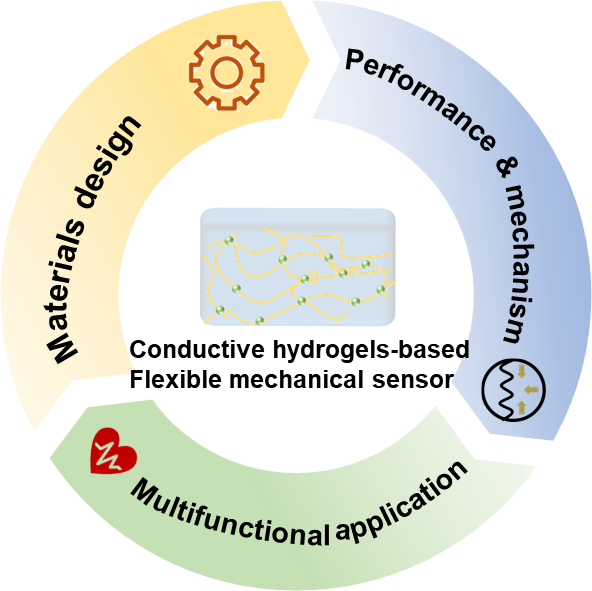
Flexible mechanical sensors (FMSs) show significant promise for applications including health monitoring, human motion tracking, electronic skin, and human-machine interaction, and have thus emerged as a key research area within flexible electronics and wearable technology. Hydrogels, with their outstanding stretchability, flexibility, and biocompatibility, offer conformal contact with tissues or skin for stable signal acquisition, making them a prime candidate for constructing FMSs. In recent years, the incorporation of different conductive materials has led to the development of various conductive hydrogels, thereby advancing multifunctional FMSs. This review summarizes recent progress in conductive hydrogel-based FMSs (CHFMSs), with a focus on constituent materials (e.g., conductive nanofillers, ionic additives, or conductive polymers), performance characteristics, and conductive mechanisms. A classification of FMSs based on the conduction mechanisms (resistive, capacitive, piezoelectric, and triboelectric) is also provided. Furthermore, the potential applications of FMSs in various practical scenarios are discussed. Finally, the key challenges and prospects in the developing field are outlined.
1 Introduction
2 Types of CHs
2.1 Nanocomposite-based CHs
2.2 Ionic-based CHs
2.3 Conductive polymer-based CHs
2.4 Hybrid CHs
2.5 Analysis of different types of CHs
3 Classification and performance of CHFMSs
3.1 Classification of CHFMSs
3.2 Multimodal sensing based on CHFMSs
3.3 Performance of CHFMSs
3.4 Interfacial engineering for CHFMSs
4 Application of conductive CHFMSs
4.1 Healthcare monitoring
4.2 Human motion monitoring
4.3 Human-machine interaction
5 Challenges and prospects
conductive hydrogel / flexible mechanical sensor / wearable electronics / multifunctional application
| [1] |
|
| [2] |
|
| [3] |
|
| [4] |
|
| [5] |
|
| [6] |
|
| [7] |
|
| [8] |
|
| [9] |
|
| [10] |
|
| [11] |
|
| [12] |
|
| [13] |
|
| [14] |
|
| [15] |
|
| [16] |
|
| [17] |
|
| [18] |
|
| [19] |
|
| [20] |
|
| [21] |
|
| [22] |
|
| [23] |
|
| [24] |
|
| [25] |
|
| [26] |
|
| [27] |
|
| [28] |
|
| [29] |
|
| [30] |
|
| [31] |
|
| [32] |
|
| [33] |
|
| [34] |
|
| [35] |
|
| [36] |
|
| [37] |
|
| [38] |
|
| [39] |
|
| [40] |
|
| [41] |
|
| [42] |
|
| [43] |
|
| [44] |
|
| [45] |
|
| [46] |
|
| [47] |
|
| [48] |
|
| [49] |
|
| [50] |
|
| [51] |
|
| [52] |
|
| [53] |
|
| [54] |
|
| [55] |
|
| [56] |
|
| [57] |
|
| [58] |
|
| [59] |
|
| [60] |
|
| [61] |
|
| [62] |
|
| [63] |
|
| [64] |
|
| [65] |
|
| [66] |
|
| [67] |
|
| [68] |
|
| [69] |
|
| [70] |
|
| [71] |
|
| [72] |
|
| [73] |
|
| [74] |
|
| [75] |
|
| [76] |
|
| [77] |
|
| [78] |
|
| [79] |
|
| [80] |
|
| [81] |
|
| [82] |
|
| [83] |
(齐琨, 代云玲, 欧康康, 王梦婷, 苏宇, 王鸿博. 化学进展, 2024, 8(36): 1269.)
|
| [84] |
(鲍艳, 许佳琛, 郭茹月, 马建中. 化学进展, 2023, 5(35): 709.)
|
| [85] |
|
| [86] |
|
| [87] |
|
| [88] |
|
| [89] |
|
| [90] |
|
| [91] |
|
| [92] |
|
| [93] |
|
| [94] |
|
| [95] |
|
| [96] |
|
| [97] |
|
| [98] |
|
| [99] |
|
| [100] |
|
| [101] |
|
| [102] |
|
| [103] |
|
| [104] |
|
| [105] |
|
| [106] |
|
| [107] |
|
| [108] |
|
| [109] |
|
| [110] |
|
| [111] |
|
| [112] |
|
| [113] |
|
| [114] |
|
| [115] |
|
| [116] |
|
| [117] |
|
| [118] |
|
| [119] |
|
| [120] |
|
| [121] |
|
| [122] |
|
| [123] |
|
| [124] |
|
| [125] |
|
| [126] |
|
| [127] |
|
| [128] |
|
| [129] |
|
| [130] |
|
| [131] |
|
| [132] |
|
| [133] |
|
| [134] |
|
| [135] |
|
| [136] |
|
| [137] |
|
| [138] |
|
| [139] |
|
| [140] |
|
| [141] |
|
| [142] |
|
| [143] |
|
| [144] |
|
| [145] |
|
| [146] |
|
| [147] |
|
| [148] |
|
| [149] |
|
| [150] |
|
| [151] |
|
/
| 〈 |
|
〉 |