PDF(2885 KB)

Design and Applications of Carborane-Based Luminescent Materials
Qing Jiang, Xinyi Li, Yunjun Shen, Yuzhen Zhang
Prog Chem ›› 2026, Vol. 38 ›› Issue (6) : 1073-1084.
PDF(2885 KB)
PDF(2885 KB)
Design and Applications of Carborane-Based Luminescent Materials
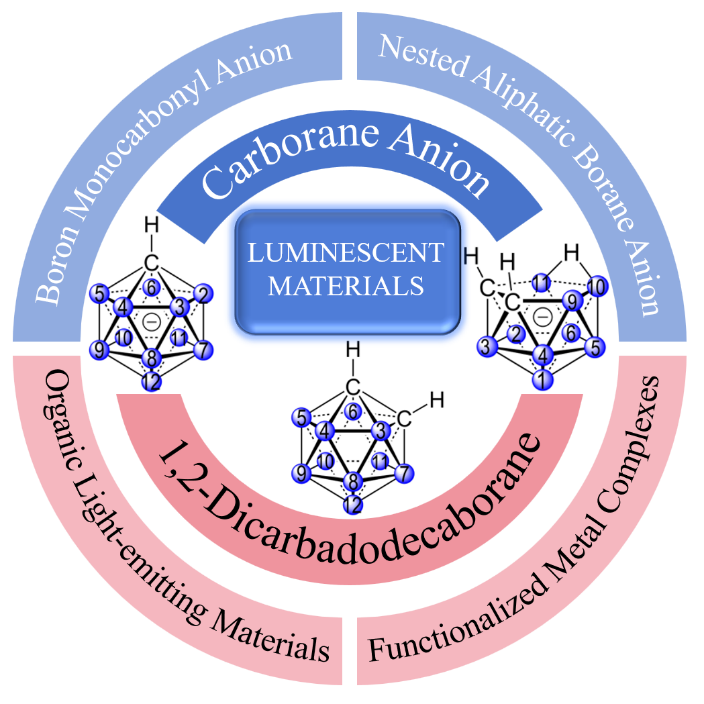
Cage-like carboranes,with their unique polyhedral spatial architecture and three-dimensional(3D)delocalized electron system,are regarded as 3D analogs of benzene rings and exhibit 3D aromaticity that is not found in classical two-dimensional(2D)aromatic systems. These compounds generally possess high chemical stability,high thermal stability,and excellent biocompatibility,endowing them with broad application prospects in the fields such as organic optoelectronic materials and biomedicine. This article systematically reviews the significant research progress achieved in recent years regarding carborane-based luminescent materials,focusing on aspects such as molecular design strategies and application field. In terms of molecular design,researchers have effectively regulated the aggregated structure,charge transfer properties,and excited-state characteristics of molecules by means of embedding carborane cages into conjugated backbones,using them as pendant groups,or employing them to construct donor-acceptor(D-A)systems. This regulation,in turn,enables the enhancement of luminescent quantum yield and the tuning of emission wavelength ranges. In the field of applications,this class of materials not only demonstrates great potential in high-performance optoelectronic materials but also exhibits prominent application value in fields such as circularly polarized luminescence(CPL),stimuli-responsive materials,and bioimaging. Finally,the article provides an outlook on the challenges and development prospects for the future development of this category of materials.
1 Introduction
2 o-Carborane based luminescent materials
2.1 o-Carborane C2B10H12 based organic luminescent materials
2.2 o-Carborane C2B10H12 based metal complex luminescent materials
3 Carborane anion luminescent materials
3.1 nido-Carborane anion [nido-C2B9H12]⁻ based luminescent materials
3.2 Monocarba-closo-dodecaborate anion [CB11H12]⁻ luminescent materials
4 Conclusion and outlook
luminescent material / carborane / synthesis / photophysical property / functional application
| [1] |
|
| [2] |
|
| [3] |
|
| [4] |
|
| [5] |
|
| [6] |
|
| [7] |
|
| [8] |
(赵薇佳, 贺嘉俊, 芦昌盛. 大学化学, 2019, 34(1): 39.)
|
| [9] |
|
| [10] |
|
| [11] |
|
| [12] |
|
| [13] |
|
| [14] |
|
| [15] |
(张昊, 赵晓青, 聂永. 中国化学会第八届全国物理无机化学学术会议论文集(一). 太原: 中国化学会, 国家自然科学基金委员会, 2018, 122.)
|
| [16] |
(陈雨, 武伟, 张丽敏, 李军峰. 广州化学, 2025, 50(3): 20.)
|
| [17] |
|
| [18] |
|
| [19] |
|
| [20] |
|
| [21] |
|
| [22] |
|
| [23] |
|
| [24] |
|
| [25] |
|
| [26] |
靳小平, 吴雪岩, 吕燕, 郭继玺. 新疆大学学报(自然科学版)(中英文), 2022, 39(4): 446.)
|
| [27] |
(闫鹏泽, 高淑莉, 李天瑞, 苗金玲, 蒋绪川, 聂永. 有机化学, 2025, 45(8): 2677.)
|
| [28] |
(燕红, 涂德双. 中国化学会第八届全国物理无机化学学术会议论文集(二). 太原: 中国化学会, 国家自然科学基金委员会, 2018, 262.)
|
| [29] |
|
| [30] |
|
| [31] |
|
| [32] |
|
| [33] |
|
| [34] |
|
| [35] |
|
| [36] |
|
| [37] |
|
| [38] |
|
| [39] |
|
| [40] |
|
| [41] |
|
| [42] |
|
| [43] |
|
| [44] |
|
| [45] |
|
| [46] |
|
| [47] |
|
| [48] |
|
| [49] |
|
| [50] |
|
| [51] |
|
| [52] |
|
| [53] |
|
| [54] |
|
| [55] |
|
| [56] |
|
| [57] |
|
| [58] |
|
| [59] |
|
| [60] |
|
| [61] |
|
| [62] |
|
| [63] |
|
| [64] |
|
| [65] |
|
/
| 〈 |
|
〉 |