PDF(36745 KB)

Ion Doping of P2-Type Cathodes for Sodium-Ion Batteries
Xuantian Feng, Bowen Xu, Da Zhang, Feng Liang
Prog Chem ›› 2026, Vol. 38 ›› Issue (6) : 1038-1058.
PDF(36745 KB)
PDF(36745 KB)
Ion Doping of P2-Type Cathodes for Sodium-Ion Batteries
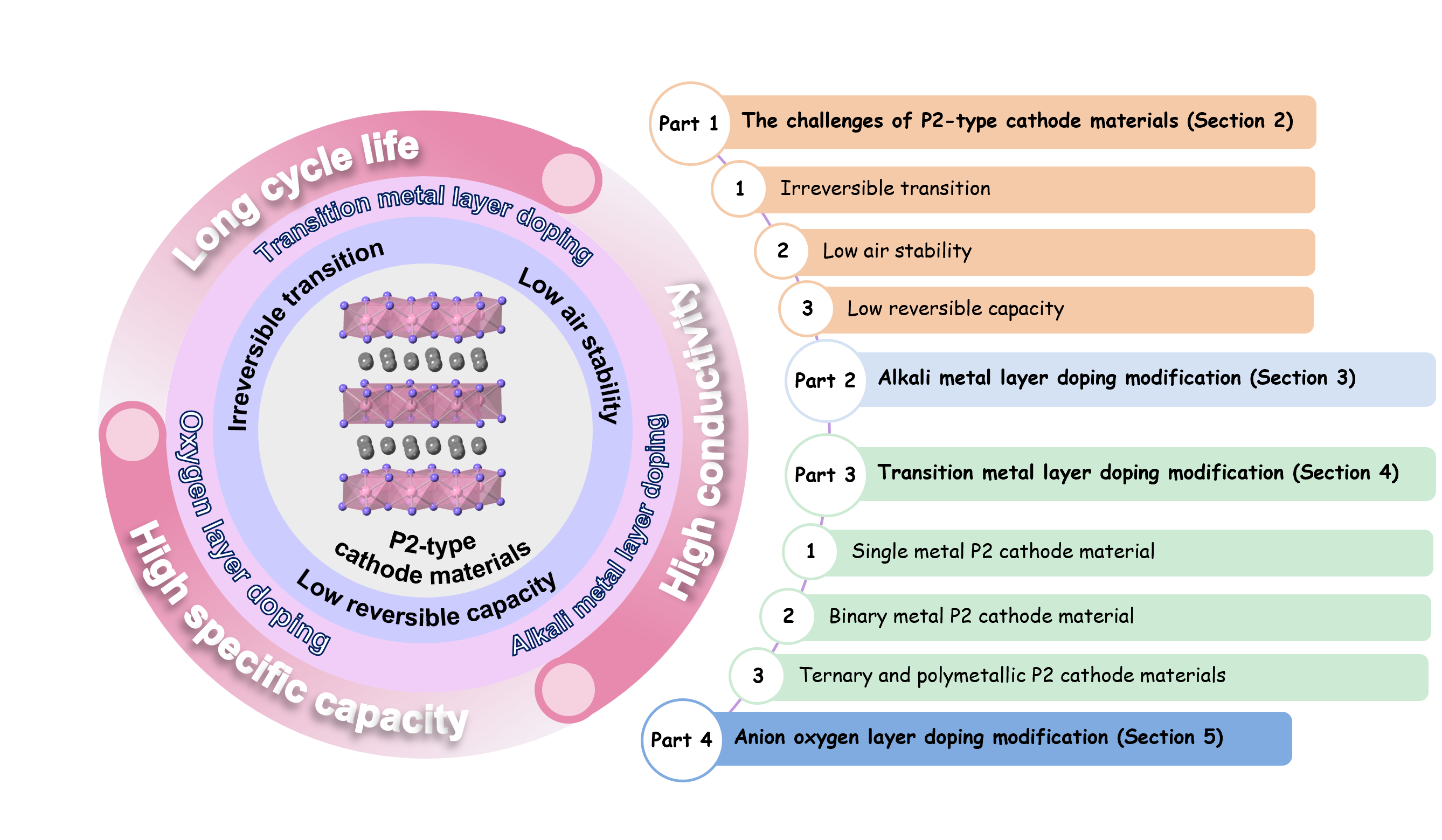
Sodium-ion batteries(SIBs)have attracted increasing attention as a promising alternative to conventional lithium-ion batteries owing to their abundant resources,low cost,and improved safety. Among various cathode systems for SIBs,P2-type layered transition metal oxides stand out due to their relatively simple crystal structures,mature synthesis processes,and fast Na+ diffusion kinetics,rendering them highly attractive for practical applications. Nevertheless,their commercialization is still hindered by several intrinsic challenges,including frequent structural phase transitions during cycling,insufficient air stability,and limited reversible capacity. To address these issues,extensive efforts have been devoted to performance optimization strategies such as ionic doping,composite structure design,surface coating,and morphology regulation,among which ionic doping has emerged as an effective and versatile approach. Despite numerous reports,existing studies are predominantly organized according to dopant species or material systems,while a systematic understanding from the perspective of coordination environment regulation remains lacking. In this review,recent advances in ionic doping strategies for P2-type layered oxide cathodes are comprehensively summarized with an emphasis on coordination environments,and the roles of dopant ions located in the alkali metal layers,transition metal layers,and anionic frameworks are systematically discussed,with particular attention to their mechanisms in stabilizing crystal structures,suppressing unfavorable phase transitions,and enhancing electrochemical performance. Furthermore,the key challenges and limitations associated with ionic doping strategies are critically analyzed,their practical applicability is evaluated,and perspectives on future research directions and development opportunities for P2-type layered cathode materials are provided.
1 Introduction
2 The challenges of P2-type cathode materials
2.1 Irreversible transition
2.2 Low air stability
2.3 Low reversible capacity
3 Alkali metal layer doping modification
4 Transition metal layer doping modification
4.1 Single metal P2 cathode material
4.2 Binary metal P2 cathode material
4.3 Ternary and polymetallic P2 cathode materials
5 Anion oxygen layer doping modification
6 Conclusion and outlook
sodium ion battery / P2-type cathode materials / coordination environment / ion doping
| [1] |
|
| [2] |
|
| [3] |
|
| [4] |
|
| [5] |
|
| [6] |
|
| [7] |
|
| [8] |
|
| [9] |
|
| [10] |
|
| [11] |
|
| [12] |
|
| [13] |
|
| [14] |
|
| [15] |
|
| [16] |
|
| [17] |
|
| [18] |
|
| [19] |
|
| [20] |
|
| [21] |
|
| [22] |
|
| [23] |
|
| [24] |
|
| [25] |
|
| [26] |
|
| [27] |
|
| [28] |
|
| [29] |
|
| [30] |
|
| [31] |
|
| [32] |
|
| [33] |
|
| [34] |
|
| [35] |
|
| [36] |
|
| [37] |
|
| [38] |
|
| [39] |
|
| [40] |
|
| [41] |
|
| [42] |
|
| [43] |
|
| [44] |
|
| [45] |
|
| [46] |
|
| [47] |
|
| [48] |
|
| [49] |
|
| [50] |
|
| [51] |
|
| [52] |
|
| [53] |
|
| [54] |
|
| [55] |
|
| [56] |
|
| [57] |
|
| [58] |
|
| [59] |
|
| [60] |
|
| [61] |
|
| [62] |
|
| [63] |
|
| [64] |
|
| [65] |
|
| [66] |
|
| [67] |
|
| [68] |
|
| [69] |
|
| [70] |
|
| [71] |
|
| [72] |
|
| [73] |
|
| [74] |
|
| [75] |
|
| [76] |
|
| [77] |
|
| [78] |
|
| [79] |
|
| [80] |
|
| [81] |
|
| [82] |
|
| [83] |
|
| [84] |
|
| [85] |
|
| [86] |
|
| [87] |
|
| [88] |
|
| [89] |
|
| [90] |
|
| [91] |
|
| [92] |
|
| [93] |
|
| [94] |
|
| [95] |
|
| [96] |
|
| [97] |
|
| [98] |
|
| [99] |
|
| [100] |
|
| [101] |
|
| [102] |
|
| [103] |
|
| [104] |
|
| [105] |
|
| [106] |
|
| [107] |
|
| [108] |
|
| [109] |
|
| [110] |
|
| [111] |
|
| [112] |
|
| [113] |
|
| [114] |
|
| [115] |
|
| [116] |
|
| [117] |
|
| [118] |
|
| [119] |
|
| [120] |
|
| [121] |
|
| [122] |
|
| [123] |
|
| [124] |
|
| [125] |
|
/
| 〈 |
|
〉 |