PDF(8291 KB)

Design of Metal-Organic Frameworks Based Photocatalysts and Their Application in Uranium Reduction
Ying Peng, Xiaowen Zhang, Mi Li, Yu Zhang, Yilong Hua, Xiaoyan Wu
Prog Chem ›› 2026, Vol. 38 ›› Issue (5) : 832-848.
PDF(8291 KB)
PDF(8291 KB)
Design of Metal-Organic Frameworks Based Photocatalysts and Their Application in Uranium Reduction
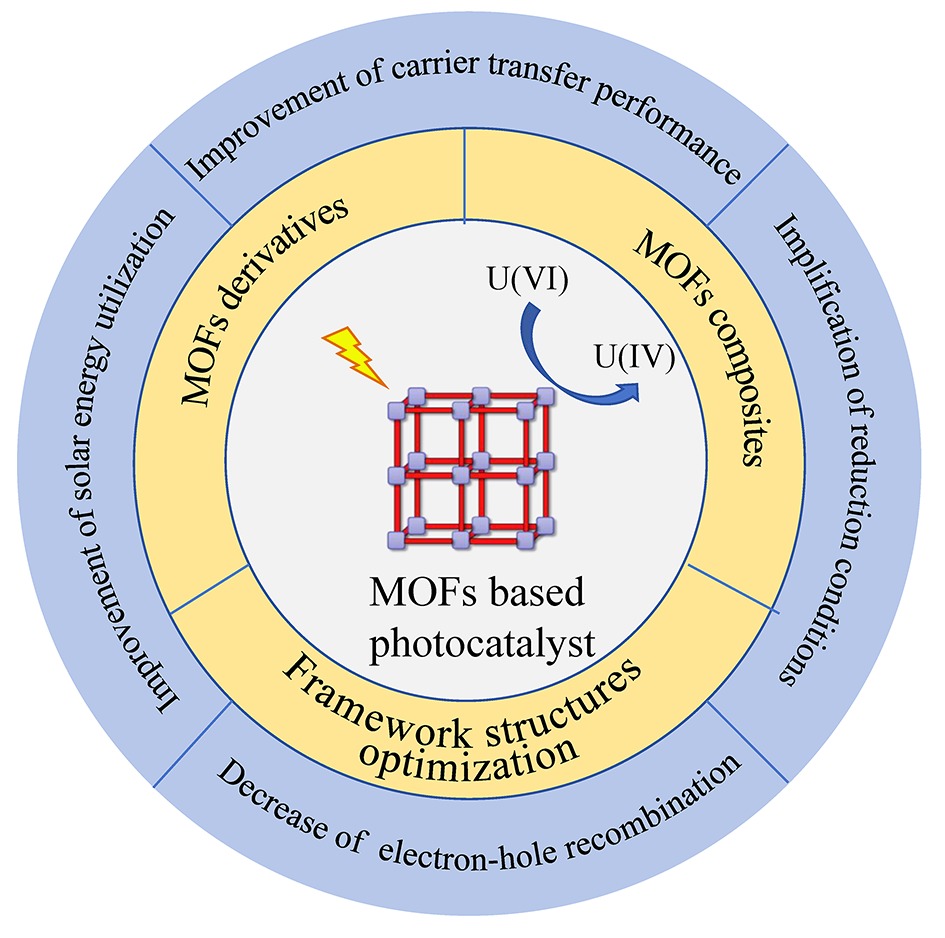
The photocatalytic reduction of uranium can utilize sunlight, and convert soluble U(VI) into recyclable solid substances, thereby solving the two major problems of radioactive wastewater treatment and seawater uranium extraction. Metal-organic frameworks (MOFs), a new type of functional porous three-dimensional (3D) crystalline materials, have large specific surface area, special metal clusters, designable organic ligands, adjustable unique morphology and pore structure, hence attracted extensive attention in the fields of photocatalysis and photochemistry. This review summarizes the design strategies for optimizing the performance of MOFs-based photocatalysts, probes into the mechanism of photocatalytic U(VI) reduction by MOFs, and elaborates on the application of MOFs in photocatalytic U(VI) reduction. Finally, the current challenges of MOFs photocatalysts in the application of U(VI) reduction are discussed, and a forward-looking perspective on the future research directions are proposed.
1 Introduction
2 Design of MOFs-based photocatalysts
2.1 Optimization of MOFs structure
2.2 Synthesis of MOFs composites
2.3 Synthesis of MOFs derivatives
3 Application of MOFs-based photocatalysts in U(Ⅵ) reduction
3.1 Mechanism of photocatalytic U(Ⅵ) reduction
3.2 Design directions of MOFs-based photocatalysts
3.3 Performances of different MOFs-based photo-catalysts for U(Ⅵ) reduction
4 Conclusion and outlook
metal-organic frameworks / photocatalysis / uranium reduction / mechanism
| [1] |
(王晶晶. 兰州大学博士论文, 2023.)
|
| [2] |
|
| [3] |
|
| [4] |
|
| [5] |
|
| [6] |
|
| [7] |
|
| [8] |
(封啸, 任颜卫, 江焕峰. 化学进展, 2020, 32(11): 1697.)
|
| [9] |
(陈仕健, 潘雨萱, 程丽华, 钱俊峰, 王慧. 化学进展, 2024, 36(4): 511.)
|
| [10] |
(赵丹, 廖再添, 张旺, 陈治洲, 孙为银. 无机化学学报. 2021, 37(7): 1153.)
|
| [11] |
|
| [12] |
|
| [13] |
|
| [14] |
|
| [15] |
|
| [16] |
|
| [17] |
|
| [18] |
(陈慧. 湖南大学博士论文, 2023.)
|
| [19] |
|
| [20] |
|
| [21] |
|
| [22] |
|
| [23] |
(张中伟, 郭瑞堂, 秦阳, 郭德宇, 潘卫国. 材料导报, 2021, 35(21): 21058.)
|
| [24] |
|
| [25] |
|
| [26] |
|
| [27] |
|
| [28] |
|
| [29] |
|
| [30] |
|
| [31] |
|
| [32] |
(朱鹏飞, 史雨翰, 娄晨思, 曾春阳, 王传义.天然气化工—C1化学与化工, 2022, 47(4): 145.)
|
| [33] |
|
| [34] |
|
| [35] |
(符浩. 广西大学博士论文, 2024.)
|
| [36] |
|
| [37] |
|
| [38] |
|
| [39] |
|
| [40] |
|
| [41] |
(王侯. 湖南大学博士论文, 2016.)
|
| [42] |
|
| [43] |
|
| [44] |
|
| [45] |
|
| [46] |
|
| [47] |
|
| [48] |
|
| [49] |
|
| [50] |
|
| [51] |
|
| [52] |
|
| [53] |
|
| [54] |
|
| [55] |
|
| [56] |
|
| [57] |
(俞朝珂. 吉林化工大学硕士学位论文, 2024.)
|
| [58] |
|
| [59] |
|
| [60] |
(禹凡, 郑涛, 汤涛, 金梦婷, 朱海霖, 于斌. 纺织学报, 2022, 43(3): 139.)
|
| [61] |
|
| [62] |
(吴依璇, 朱文君, 李欣, 左小华, 王浩南. 化工新型材料, 2024, 52(S2): 299.) : 299.)
|
| [63] |
|
| [64] |
|
| [65] |
|
| [66] |
|
| [67] |
|
| [68] |
|
| [69] |
|
| [70] |
|
| [71] |
|
| [72] |
|
| [73] |
|
| [74] |
|
| [75] |
|
| [76] |
|
| [77] |
|
| [78] |
|
| [79] |
|
| [80] |
|
| [81] |
|
| [82] |
|
| [83] |
|
| [84] |
|
| [85] |
|
| [86] |
|
| [87] |
|
| [88] |
|
| [89] |
|
| [90] |
|
| [91] |
|
| [92] |
|
| [93] |
|
| [94] |
(谢汶珂, 陈洁. 精细化工, 2020, 37(12): 2386.)
|
| [95] |
|
| [96] |
|
| [97] |
(余珊珊, 王哲, 陈靖, 陆跃翔. 核化学与放射化学, 2024, 46(4): 314.)
|
| [98] |
(闫增元, 习海玲, 袁立永. 环境科学, 2019, 40(4): 1819.)
|
| [99] |
|
| [100] |
|
| [101] |
|
| [102] |
|
| [103] |
|
| [104] |
|
| [105] |
|
| [106] |
|
| [107] |
|
| [108] |
|
| [109] |
|
| [110] |
|
| [111] |
|
| [112] |
|
| [113] |
|
| [114] |
|
| [115] |
|
| [116] |
|
| [117] |
|
| [118] |
|
| [119] |
|
| [120] |
|
| [121] |
|
| [122] |
|
| [123] |
|
| [124] |
|
| [125] |
|
/
| 〈 |
|
〉 |