PDF(7191 KB)

Online Monitoring of Greenhouse Gases for Sustainable Agriculture: The Role and Prospects of Semiconductor Sensing Technology
Kunmei Yang, Bingchen Zhu, Maojie Xu, Jia Yan, Hui Xu, Zhilong Song
Prog Chem ›› 2026, Vol. 38 ›› Issue (3) : 561-576.
PDF(7191 KB)
PDF(7191 KB)
Online Monitoring of Greenhouse Gases for Sustainable Agriculture: The Role and Prospects of Semiconductor Sensing Technology
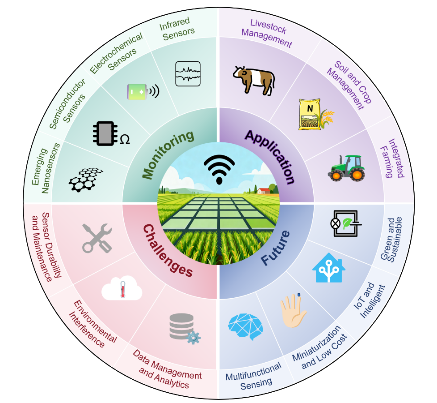
Agricultural activities constitute a significant source of greenhouse gases including methane (CH4), nitrous oxide (N2O), and carbon dioxide (CO2). Achieving continuous, real-time, and large-scale online monitoring of these gases represents a crucial means of advancing sustainable agriculture and addressing climate change. Although monitoring technologies such as infrared spectroscopy and electrochemical sensing have demonstrated mature performance in terms of accuracy and selectivity, their high cost, energy consumption, and complex deployment methods have limited widespread adoption in agricultural settings. This review highlights that semiconductor gas sensors, with their advantages of low cost, ease of integration, suitability for large-scale deployment, and deep integration with the Internet of things, are emerging as the ideal core technology for constructing future agricultural monitoring networks. The paper systematically reviews recent research advances inenhancing semiconductor sensor sensitivity, selectivity, and stability through strategies including nanomaterial regulation, heterostructure construction, catalytic and surface engineering, and signal processing algorithm integration. It also delves into practical challenges encountered in real agricultural environments—such as environmental interference, humidity effects, cross-sensitivity, and long-term stability—within livestock management and soil monitoring applications. Finally, this paper outlines future development trends for semiconductor gas sensors in agriculture: intelligent design of sensing materials, high integration of sensing nodes with IoT, multi-gas collaborative monitoring, and AI-based gas identification and emission modelling. Collectively, these advancements will drive the formation of future smart agricultural systems integrating precise monitoring, intelligent decision-making, and ecological management.
1 Introduction
2 Greenhouse gas detection technologies
2.1 Benchmark monitoring technologies
2.2 Semiconductor gas sensors
2.3 Comparison of technical pathways and evolutionary trends
3 Agricultural application scenarios
3.1 Livestock management
3.2 Soil and crop management
3.3 Greenhouse gas monitoring and control
4 Technical challenges and resolution pathways
4.1 Environmental interference
4.2 Long-term stability and power consumption
5 Outlook for sustainable integrated agriculture
5.1 Intelligent sensing and network architecture
5.2 Implementation of management closed-loop systems and comprehensive benefit assessment
greenhouse gases / sustainable agriculture / continuous online monitoring / semiconductor gas sensors / internet of things / precision agriculture
| [1] |
|
| [2] |
|
| [3] |
|
| [4] |
|
| [5] |
|
| [6] |
Intergovernmental Panel on Climate C. Climate Change 2014: Mitigation of Climate Change: Working Group III Contribution to the IPCC Fifth Assessment Report. Cambridge: Cambridge University Press, 2015.
|
| [7] |
|
| [8] |
|
| [9] |
|
| [10] |
|
| [11] |
|
| [12] |
|
| [13] |
|
| [14] |
|
| [15] |
|
| [16] |
|
| [17] |
|
| [18] |
|
| [19] |
|
| [20] |
|
| [21] |
|
| [22] |
|
| [23] |
|
| [24] |
|
| [25] |
|
| [26] |
|
| [27] |
|
| [28] |
|
| [29] |
|
| [30] |
|
| [31] |
|
| [32] |
|
| [33] |
|
| [34] |
|
| [35] |
|
| [36] |
|
| [37] |
|
| [38] |
|
| [39] |
|
| [40] |
|
| [41] |
|
| [42] |
|
| [43] |
|
| [44] |
|
| [45] |
|
| [46] |
|
| [47] |
|
| [48] |
|
| [49] |
|
| [50] |
|
| [51] |
|
| [52] |
|
| [53] |
|
| [54] |
|
| [55] |
|
| [56] |
|
| [57] |
|
| [58] |
|
| [59] |
|
| [60] |
|
| [61] |
|
| [62] |
|
| [63] |
|
| [64] |
|
| [65] |
|
| [66] |
|
| [67] |
|
| [68] |
|
| [69] |
|
| [70] |
|
| [71] |
|
| [72] |
|
| [73] |
|
| [74] |
|
| [75] |
|
| [76] |
|
| [77] |
|
| [78] |
|
| [79] |
|
| [80] |
|
| [81] |
|
| [82] |
|
/
| 〈 |
|
〉 |