PDF(20107 KB)

Challenges and Solutions in Dry Electrode Technology
Pengcheng Liang, Chongyang Yang, Mingxia Wu
Prog Chem ›› 2026, Vol. 38 ›› Issue (6) : 1112-1125.
PDF(20107 KB)
PDF(20107 KB)
Challenges and Solutions in Dry Electrode Technology
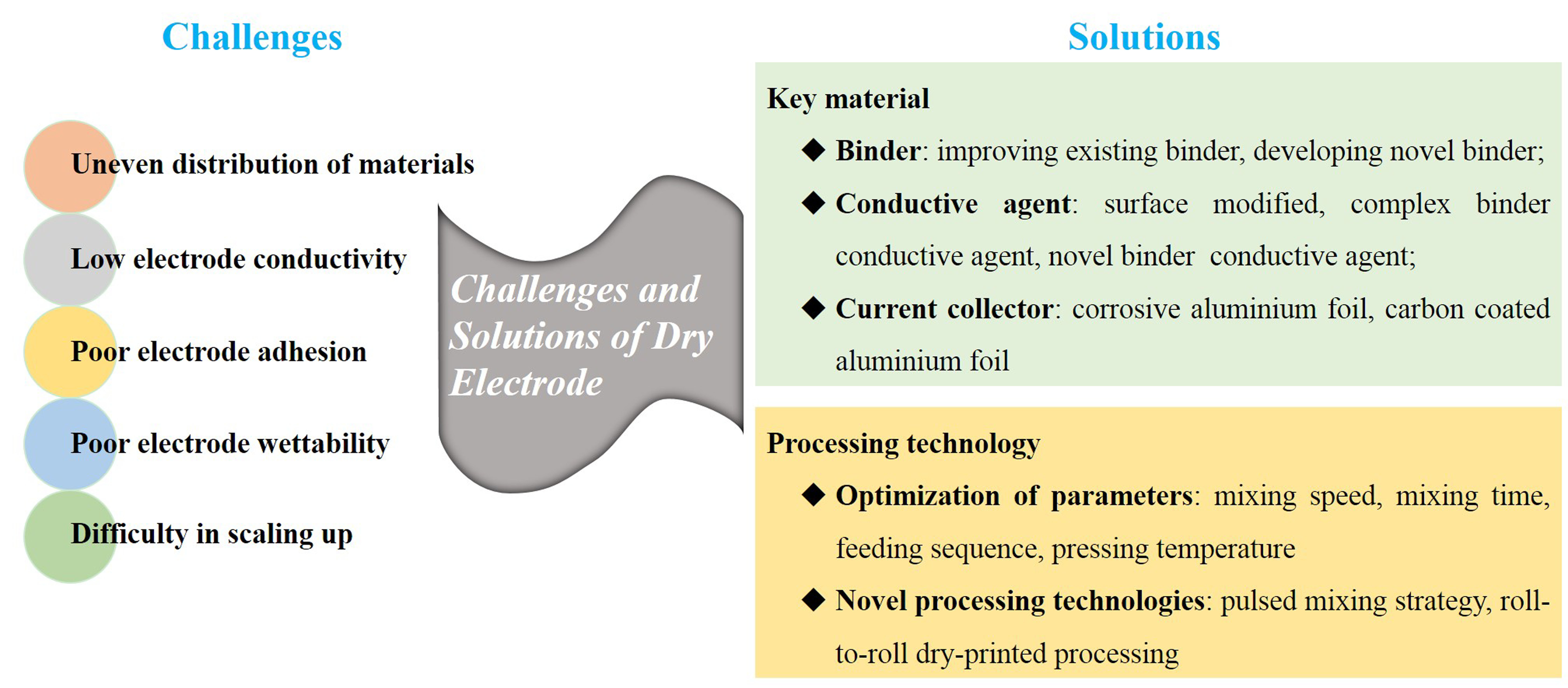
Dry electrode technology has attracted increasing attention for its low cost and environmental friendliness. However, the widespread application of dry electrode technology still faces considerable challenges due to some issues. Therefore, this article aims at comprehensively exploring the current developing status and challenges, and summarizing effective solutions from recent research progress. First we introduce the types of dry electrode technology, including polymer fibrillation, spray deposition, vapor deposition, hot melt extrusion, powder pressing, and 3D printing. Then the challenges of dry electrode technology are divided into several types, such as uneven material distribution, low electrode conductivity, poor adhesion, poor wettability with electrolyte, and difficulty in scaling up. The existing problems are disadvantageous to the electrochemical performance of dry electrode. Therefore, it is great importance to solve these problems to further improve the dry electrode. Next, we reviewed the latest strategies in recent years from the aspects of materials and processes. As the key materials, binders, conductive agents, current collectors are important for the resistance of dry electrode. Among them, binder is an elastic network connecting the active material particle and conductive agent. Its types and proportion should be properly chosen to achieve the expected performances. The processing parameters such as stirring parameters, stirring sequence have been continuously optimized to improve the electrochemical performance and simplified the process technology. Besides, novel processing technologies are also proposed and signified the paradigm innovation in dry electrode field. This article will provide a certain research foundation for the future development of dry electrodes.
1 Introduction
2 Classification of dry electrode technologies
3 Challenges faced by dry electrode technology
3.1 Uneven distribution of materials
3.2 Low electrode conductivity
3.3 Poor electrode adhesion
3.4 Poor electrode wettability
3.5 Difficulties in scaling up
4 Solution strategy for dry electrode technology
4.1 Key materials
4.2 Processing technology
5 Conclusion and outlook
dry electrode / challenge / review / strategies / binder
| [1] |
|
| [2] |
|
| [3] |
|
| [4] |
|
| [5] |
|
| [6] |
|
| [7] |
|
| [8] |
|
| [9] |
|
| [10] |
|
| [11] |
|
| [12] |
|
| [13] |
(阮晶晶, 巫湘坤, 李勇慧, 赵冲冲, 李珅珅, 王童飞, 梁圣杰, 高桂红. 储能科学与技术, 2025, 6: 2248.)
|
| [14] |
|
| [15] |
(徐桂培, 刘浩, 赖洁文, 卢毅锋, 黄辉, 邸会芳, 王振兵. 储能科学与技术, 2025, 4: 1445.)
|
| [16] |
|
| [17] |
|
| [18] |
|
| [19] |
|
| [20] |
|
| [21] |
|
| [22] |
|
| [23] |
|
| [24] |
|
| [25] |
|
| [26] |
|
| [27] |
|
| [28] |
|
| [29] |
|
| [30] |
|
| [31] |
|
| [32] |
|
| [33] |
|
| [34] |
|
| [35] |
|
| [36] |
|
| [37] |
|
| [38] |
|
| [39] |
|
| [40] |
|
| [41] |
|
| [42] |
|
| [43] |
|
| [44] |
|
| [45] |
|
| [46] |
(徐美玲, 汪宇, 邹娜, 姜会, 何美琪, 李风海, 邱介山. 化工进展. 2025, 44(4): 2020.)
|
| [47] |
|
| [48] |
|
| [49] |
|
| [50] |
|
| [51] |
|
| [52] |
|
| [53] |
|
| [54] |
|
| [55] |
|
| [56] |
|
| [57] |
|
| [58] |
|
| [59] |
|
| [60] |
|
| [61] |
|
| [62] |
|
| [63] |
|
| [64] |
|
| [65] |
|
| [66] |
|
| [67] |
|
| [68] |
|
| [69] |
|
| [70] |
|
| [71] |
|
| [72] |
|
/
| 〈 |
|
〉 |