 PDF(20219 KB)

Recent Advances in the Application of Element Doped Carbon Dots in Multimodal Biological Imaging
Zhihong Liu, Faqi Liang, Qitong Huang, Shuisheng Hu, Xiaofeng Lin, Weijia Zeng
Prog Chem ›› 2026, Vol. 38 ›› Issue (3) : 577-600.
PDF(20219 KB)
PDF(20219 KB)
Recent Advances in the Application of Element Doped Carbon Dots in Multimodal Biological Imaging
Carbon dots (CDs), as an emerging class of zero-dimensional carbon nanomaterials, have demonstrated significant potential in the field of biomedical imaging due to their unique photoluminescence properties, excellent biocompatibility, and low toxicity. This review systematically summarizes the recent progress in the application of CDs as dual-modal or multimodal probes in computed tomography (CT), magnetic resonance imaging (MRI), and fluorescence imaging (FL). It particularly focuses on the synergistic effects of metal ion and heteroatom doping on the physicochemical properties of CDs, with an emphasis on their optical, magnetic, and X-ray attenuation characteristics. The findings reveal that element doping and surface functionalization can significantly enhance the performance of multimodal imaging. For instance, doping with metal ions or heteroatoms can effectively improve the relaxivity in MRI/FL dual-modal imaging and optimize the X-ray attenuation properties in CT/FL dual-modal imaging. Furthermore, some CD-based nanomaterials have successfully achieved MRI/CT/FL trimodal imaging, providing innovative solutions for precision medicine. Despite the progress made, CDs-based multimodal probes still face several challenges, including the imbalance in multimodal performance and the lack of comprehensive long-term biosafety assessments. For future clinical translation, further optimization of material design and the implementation of standardized toxicological evaluations will be essential. These efforts will significantly advance the diagnosis and treatment of diseases.
1 Introduction
2 Classification and synthesis of doped CDs
2.1 Solvothermal method
2.2 Microwave method
2.3 Pyrolysis method
2.4 Other methods
3 Properties of doped CDs
3.1 Optical properties
3.2 Biocompatibility
3.3 Magnetic properties
3.4 X-ray attenuation properties
4 Advances in multimodal imaging applications
4.1 Doped CDs for CT/FL imaging
4.2 Doped CDs for MRI/FL imaging
4.3 Doped CDs for MRI/CT/FL imaging
4.4 The potential of multimodal imaging for clinical applications
5 Conclusion
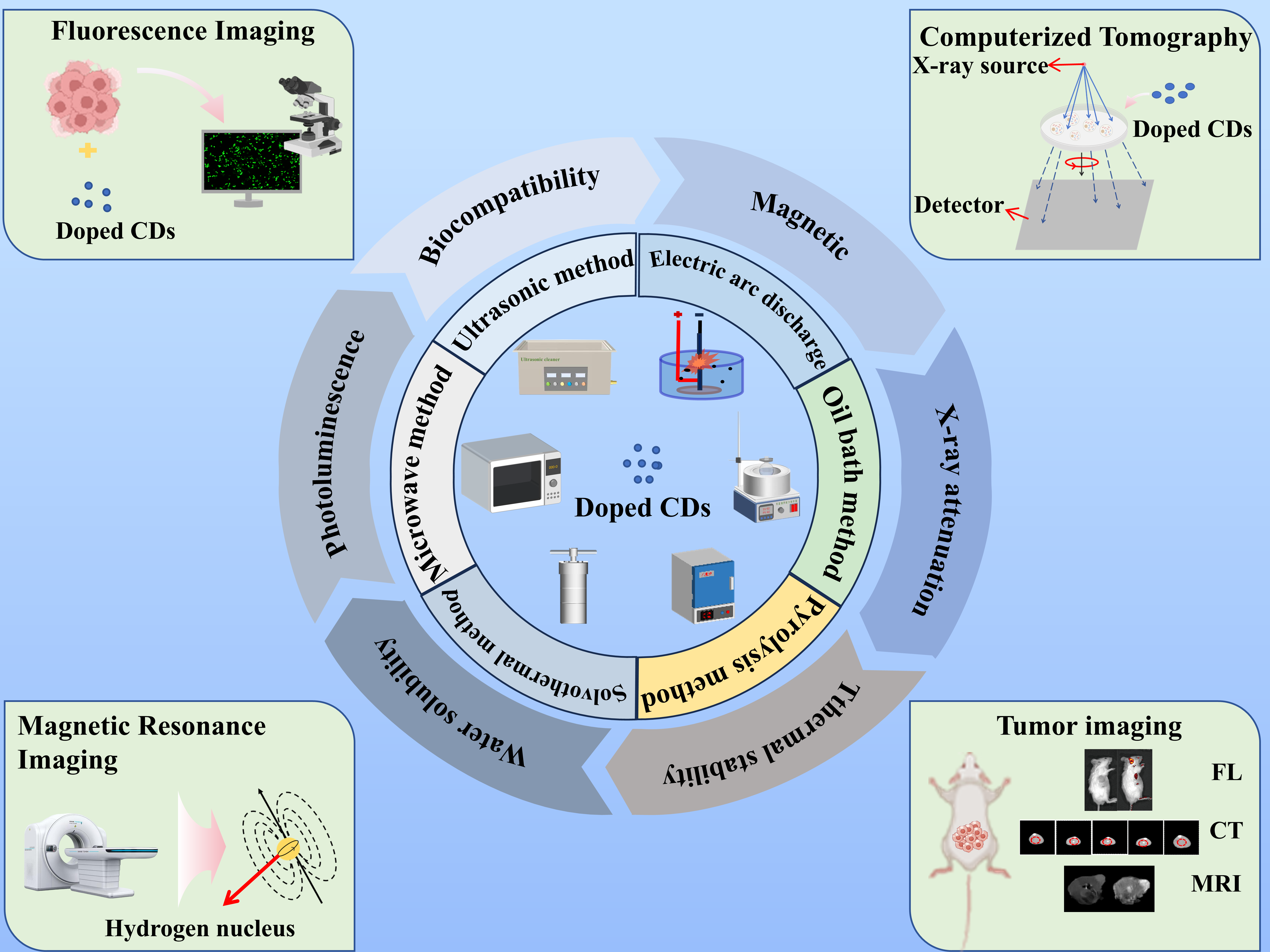
carbon dots / magnetic resonance imaging / computed tomography / fluorescence imaging
| [1] |
|
| [2] |
|
| [3] |
|
| [4] |
|
| [5] |
|
| [6] |
|
| [7] |
|
| [8] |
|
| [9] |
(何静, 陈佳, 邱洪灯. 化学进展, 2023, 35(5): 655.)
|
| [10] |
|
| [11] |
(党永强, 黄瑞, 冯香钰, 刘国阳, 朱由余, 张亚婷. 化学进展, 2024, 36(4): 575.)
|
| [12] |
(王军丽, 王亚玲, 郑静霞, 于世平, 杨永珍, 刘旭光. 化学进展, 2018, 30(8): 1186.)
|
| [13] |
|
| [14] |
|
| [15] |
|
| [16] |
|
| [17] |
|
| [18] |
(秦苗, 徐梦洁, 黄棣, 魏延, 孟延锋, 陈维毅. 化学进展, 2020, 32(9): 1264.)
|
| [19] |
(马婷, 邓春宇, 李杰, 王周玉, 周倩, 余孝其. 化学进展, 2025, 37(4): 519.)
|
| [20] |
|
| [21] |
|
| [22] |
|
| [23] |
|
| [24] |
|
| [25] |
|
| [26] |
|
| [27] |
|
| [28] |
|
| [29] |
|
| [30] |
|
| [31] |
|
| [32] |
|
| [33] |
|
| [34] |
|
| [35] |
|
| [36] |
|
| [37] |
|
| [38] |
|
| [39] |
|
| [40] |
|
| [41] |
|
| [42] |
|
| [43] |
|
| [44] |
|
| [45] |
|
| [46] |
|
| [47] |
|
| [48] |
|
| [49] |
|
| [50] |
|
| [51] |
|
| [52] |
|
| [53] |
|
| [54] |
|
| [55] |
|
| [56] |
|
| [57] |
|
| [58] |
|
| [59] |
|
| [60] |
|
| [61] |
|
| [62] |
|
| [63] |
|
| [64] |
|
| [65] |
|
| [66] |
|
| [67] |
|
| [68] |
|
| [69] |
|
| [70] |
|
| [71] |
|
| [72] |
|
| [73] |
|
| [74] |
|
| [75] |
|
| [76] |
|
| [77] |
|
| [78] |
|
| [79] |
|
| [80] |
|
| [81] |
|
| [82] |
|
| [83] |
|
| [84] |
|
| [85] |
|
| [86] |
|
| [87] |
|
| [88] |
|
| [89] |
|
| [90] |
|
| [91] |
|
| [92] |
|
| [93] |
|
| [94] |
|
| [95] |
|
| [96] |
|
| [97] |
|
| [98] |
|
| [99] |
|
| [100] |
|
| [101] |
|
| [102] |
|
| [103] |
|
| [104] |
|
| [105] |
|
| [106] |
|
| [107] |
|
| [108] |
|
| [109] |
|
| [110] |
|
| [111] |
|
| [112] |
|
| [113] |
|
| [114] |
|
/
| 〈 |
|
〉 |








