Home Journals Progress in Chemistry
Progress in Chemistry

Abbreviation (ISO4): Prog Chem      Editor in chief: Jincai ZHAO

About  /  Aim & scope  /  Editorial board  /  Indexed  /  Contact  / 
Review

Anode Design for High-Performance Aluminum Batteries: Challenges and Strategies

  • Shanshan Zeng 1, 2 ,
  • Tongbo Wang 3 ,
  • Lisi Liang 1 ,
  • Xu Zhang , 1, 2, * ,
  • Haijun Yu , 1, 2, *
Expand
  • 1 Institute of Advanced Battery Materials and Devices, College of Materials Science and Engineering, Beijing University of Technology, Beijing 100124, China
  • 2 Key Laboratory of Advanced Functional Materials, Ministry of Education, Beijing University of Technology, Beijing 100124, China
  • 3 Chinalco Research Institute of Science and Technology Co., Ltd., Beijing 102200, China
(Xu Zhang)

Received date: 2024-08-19

  Revised date: 2024-11-04

  Online published: 2025-06-15

Supported by

National Key R&D Program of China(2022YFB2402600)

National Key R&D Program of China(2022YFB2404400)

National Natural Science Foundation of China(22075007)

National Natural Science Foundation of China(92263206)

Abstract

Because of the advantages of aluminum including high volumetric/gravimetric capacity, high safety, and low cost, aluminum batteries have become one of the most attractive new electrochemical energy storage devices. High-performance battery materials are the bottleneck issues impeding the development of aluminum batteries. Compared with various cathode materials, the design of aluminum anode is a common key technology for aluminum batteries. However, the current aluminum anodes still suffer from diverse problems such as surface passivation, local corrosion, and dendrite growth, which greatly influence the electrochemical performance of aluminum batteries. In this review paper, targeting on these problems, we first analyze the key factors governing the electrochemical performance of anode from the viewpoint of reaction mechanisms. Then, we summarize recent important progress about the aluminum anode design, analyze the critical strategies for optimizing aluminum anodes, and discuss their optimization effect and mechanism. Finally, perspectives on the crucial challenges and development trends of aluminum anodes are presented, with a hope to shed light on the design of high-performance aluminum batteries.

Contents

1 Introduction

2 Main types of aluminum batteries

2.1 Aqueous aluminum batteries

2.2 Nonaqueous aluminum batteries

3 The issues and mechanisms of aluminum metal anodes

3.1 Surface passivation

3.2 Corrosion

3.3 Dendrite growth

4 Optimization strategy for performance design of aluminum anode

4.1 Aluminum alloy anode

4.2 Surface modification of aluminum anode

4.3 In situ SEI regulation

4.4 3D structural design

4.5 Aluminum based composite material construction

4.6 Aluminum free anode

5 Conclusion and outlook

Cite this article

Shanshan Zeng , Tongbo Wang , Lisi Liang , Xu Zhang , Haijun Yu . Anode Design for High-Performance Aluminum Batteries: Challenges and Strategies[J]. Progress in Chemistry, 2025 , 37(6) : 827 -842 . DOI: 10.7536/PC240807

1 Introduction

The extensive use of fossil fuels has caused severe energy shortages and environmental pollution, which urgently needs to be addressed by establishing a clean energy system. Energy storage technology plays a pivotal role in the utilization of clean energy. Among various technologies, electrochemical energy storage offers advantages such as high energy density, high conversion efficiency, fast response speed, and flexibility, and has experienced rapid development in recent years. Lithium-ion batteries, benefiting from their high energy density and long cycle life, have been widely applied in consumer electronics, electric transportation, and large-scale energy storage. However, their further large-scale application is hindered by issues such as limited resources, high costs, and safety concerns. Therefore, it is imperative to develop new secondary batteries based on abundant elements that feature high energy density, long lifespan, low cost, and high safety. Among various secondary batteries, aluminum batteries exhibit notable advantages: (1) Aluminum metal possesses the highest volumetric capacity (8046 mAh·cm·3) among metals and a gravimetric capacity second only to lithium metal (2980 mAh·g·1), which facilitates high energy density in aluminum batteries; (2) Aluminum is the most abundant metallic element in the Earth's crust (8.1%), providing significant cost advantages; (3) Aluminum metal can be processed and manufactured in air, and aluminum battery electrolytes are less flammable, contributing to high safety during battery production and operation. Therefore, developing aluminum batteries with excellent electrochemical performance has become one of the most promising and significant research directions in both academic and industrial fields.
Aluminum metal as a battery electrode material can be traced back to the 1850s. In 1850, Hulot proposed the concept of using aluminum as the cathode in a Zn(Hg)/H2SO4/Al battery, but it did not achieve practical application[5]. In 1857, the first Al/HNO3/C battery (Buff battery) was successfully assembled, marking the beginning of aluminum metal as a battery anode and signifying the initial development stage of aluminum batteries[6]. In the 1950s, the development of Leclanche-type dry batteries (Al‖MnO2) advanced aluminum batteries toward practical application[7]. In the early 1960s, Zaromb et al.[8] demonstrated the feasibility of aluminum-air battery technology in alkaline media. However, all these batteries were primary batteries and could not achieve multiple charge-discharge cycles. In 1972, Holleck constructed an Al‖Cl2 battery in a NaCl-KCl-AlCl3 molten salt electrolyte and explored the feasibility of its charge-discharge cycling[9]. Nevertheless, the high operating temperature of the molten salt electrolyte[10] significantly limited battery assembly and application scenarios, resulting in slow progress in aluminum battery research[11]. In the 1980s, room-temperature ionic liquid electrolytes based on AlCl3 were developed, providing an electrolyte solution for reversible electrochemical deposition and dissolution of aluminum[12]. In 2010, AlCl3/chloride 1-ethyl-3-methylimidazole (AlCl3/[EMIM]Cl) ionic liquid electrolytes were applied in the construction of rechargeable aluminum ion batteries (RABs)[13]. In this work, an aluminum ion battery composed of a V2O5 cathode and an aluminum metal anode achieved over 20 reversible cycles[14]. In 2015, Lin et al.[15] successfully developed a stable aluminum-graphene battery based on AlCl3/[EMIM]Cl ionic liquid electrolyte, achieving a significant breakthrough in aluminum ion secondary batteries. Since then, aluminum ion batteries have been widely studied and entered a new development phase.
Although aluminum battery research has made significant progress, many challenges remain to be addressed. High-performance materials are key factors that limit the performance of aluminum batteries. Currently, various high-performance cathode materials and electrolytes have been reported. Taking cathode materials as an example, several types of materials have been developed, including carbon-based materials[15-16], transition metal oxides[17-18], transition metal sulfides[19], organic materials[20-21], elemental sulfur[22], and elemental selenium[23]. Among them, sulfur-based cathode materials have attracted widespread attention due to their advantages of high theoretical capacity, high energy density, and low cost[24-25]. However, sulfur cathode materials also face numerous challenges, such as the polysulfide shuttle effect, volume expansion, low electrical conductivity, and severe side reactions with the electrolyte, which significantly limit the practical application of aluminum-sulfur batteries[26]. To address these issues, numerous effective strategies have been explored and utilized[27], which have greatly advanced the development of aluminum batteries. As a crucial component of aluminum batteries, the aluminum metal anode is also one of the key factors affecting battery performance and holds universal significance for aluminum battery research. However, the aluminum metal anode still faces many challenges in practical applications, primarily including surface passivation, localized corrosion, and dendrite growth. Firstly, the aluminum metal surface is prone to form a dense alumina passivation film, which hinders the transport rate of aluminum ions at the anode interface and reduces deposition/dissolution efficiency, leading to significant electrochemical polarization and interfacial impedance. Secondly, during the electrochemical process, the aluminum metal is susceptible to localized non-uniform corrosion caused by highly corrosive electrolytes and impurities, resulting in interfacial instability, volume expansion, and powder shedding. Furthermore, dendrite growth may occur during the electrochemical deposition/dissolution of aluminum metal; these dendrites can pierce the separator, causing short circuits and even safety incidents. To tackle the aforementioned challenges, researchers have conducted a series of studies and proposed several effective design and optimization strategies for aluminum anodes, achieving initial performance improvements in aluminum batteries.
Therefore, this paper focuses on the design and optimization of aluminum battery anodes, systematically discussing the performance degradation mechanisms and key influencing factors of metallic aluminum anodes in aluminum batteries. It reviews significant research advancements in aluminum anodes in recent years, and separately introduces and analyzes effective design and optimization approaches and strategies, including alloying, surface modification, three-dimensional structural design, in-situ solid-electrolyte interphase (SEI) regulation, construction of aluminum composite materials, and aluminum-free anodes. The mechanisms through which these strategies enhance the electrochemical performance of aluminum batteries are also discussed. On this basis, the paper analyzes the remaining challenging issues facing aluminum anodes, proposes future development trends and directions for anode design and optimization, and provides a reference for developing high-performance aluminum batteries.

2 Main Types of Aluminum Batteries

2.1 Aqueous Aluminum-Ion Batteries

Aluminum-ion batteries can be categorized into aqueous aluminum batteries and non-aqueous aluminum batteries based on the characteristics of the electrolyte. Aqueous aluminum batteries include primary aluminum-air batteries, secondary aluminum-air batteries, and aqueous aluminum-ion batteries[28]. Aqueous aluminum batteries typically use aqueous solutions of aluminum salt electrolytes. The development of aqueous electrolytes such as trifluoromethanesulfonate (OTF-) and "water-in-salt" has expanded the electrochemical stability window of aqueous electrolytes[29], enabling aluminum-air batteries to possess advantages such as high theoretical energy density, good safety, convenient operation, environmental friendliness, and low cost[3,30]. However, current research on aqueous aluminum batteries is still in its early stages, and the energy density and cycle life remain unsatisfactory, mainly due to the following reasons: (1) Compared with other metal anodes, aluminum metal has a relatively low theoretical reduction potential (-1.662 V vs SHE), leading to hydrogen evolution reactions occurring prior to the reduction of Al3+. Consequently, hydrogen evolution corrosion easily occurs on the aluminum anode in aqueous electrolytes, making reversible deposition/dissolution of aluminum difficult and shortening battery lifespan[30]; (2) According to the Nernst equation, the thermodynamic oxidation potential (φθO2/H2O = 1.23 - 0.0592pH) and reduction potential (φθH2O/H2 = -0.0592pH) of water vary dynamically with pH, resulting in a narrow electrochemical stability window (ESW) of water (ESW = φθO2/H2O - φθH2O/H2 = 1.23 V), which limits the operating voltage range of the battery and leads to insufficient energy density of aqueous aluminum-ion batteries (AAIBs)[31-32]; (3) Aluminum metal tends to form an insulating passivation oxide layer on its surface in aqueous solutions, reducing ionic conductivity, increasing battery polarization, and hindering reversible deposition/dissolution of aluminum; (4) The high surface charge density of Al3+ can lead to strong electrostatic interactions with the cathode material (including repulsion from metal cations and attraction to anions), adversely affecting the diffusion kinetics of Al3+[33]. Therefore, the development of aqueous aluminum batteries still faces significant challenges, and the design and construction of high-energy and stable aluminum anodes are crucial for improving the performance of aqueous aluminum batteries.

2.2 Non-aqueous Aluminum Batteries

To avoid the hydrogen evolution reaction and enhance the energy density of batteries, replacing aqueous electrolytes with nonaqueous electrolytes featuring wide electrochemical windows and high ionic conductivity is a promising approach for achieving reversible deposition and dissolution of aluminum metal while suppressing the occurrence of hydrogen evolution side reactions. However, Al3+ exhibits a higher surface charge density compared to Li+, leading to strong Coulombic interactions between cations and anions. This results in poor ionic conductivity and solubility of aluminum salts in organic solvents, as well as sluggish reaction kinetics. Therefore, developing nonaqueous electrolytes that function effectively at ambient temperatures is crucial for realizing high-specific-energy rechargeable aluminum batteries.
Important progress has been made in the research of electrolytes for non-aqueous aluminum batteries. Common non-aqueous electrolytes include inorganic molten salts, eutectic solvents, ionic liquids, organic solvents, polymers, and quasi-solid-state gel electrolytes. In the 1970s, the development of chloroaluminate inorganic molten salt electrolytes capable of efficient reversible aluminum deposition and dissolution, such as binary NaCl-AlCl3[10,34], ternary AlCl3-KCl-NaCl, AlCl3-LiCl-KCl, AlCl3-NaCl-KCl, AlCl3-NaCl-LiCl[35-36], and even quaternary AlCl3-NaCl-LiCl-KCl[37] molten salt electrolytes promoted the rapid development of aluminum ion batteries[10]. Adjusting parameters such as component ratios, concentrations, and temperature in molten salt electrolytes can improve the ionic conductivity of the electrolyte, reduce viscosity, and widen the electrochemical window, thereby enhancing aluminum battery performance[38]. However, the high-temperature operating conditions of molten salt electrolytes limit their further development. The successful development of novel room-temperature ionic liquid electrolytes composed of AlCl3 and imidazolium chlorides, as well as eutectic solvent electrolytes (quasi-ionic liquids) formed by AlCl3 and organic molecules, truly achieved reversible aluminum ion deposition and dissolution at room temperature, providing feasible strategies for constructing secondary aluminum batteries at ambient temperatures[39]. Taking imidazolium chloride ionic liquid electrolytes as an example, adjusting the molar ratio of AlCl3 to imidazolium chloride can regulate properties such as pH, ionic conductivity, viscosity, and melting point of the electrolyte to improve battery performance. In the AlCl3/[EMIM]Cl ionic liquid electrolyte, when the molar ratio of AlCl3 to [EMIM]Cl is 1.3, the ionic conductivity is relatively high (≈10-2 S·cm-1)[40]. In fact, in electrolyte environments based on ionic liquids or eutectic solvents containing ions such as AlCl4- and Al2Cl7-, metallic aluminum is highly susceptible to corrosion by the electrolyte, leading to irreversible capacity loss[13,41]. Additionally, similar to lithium metal, aluminum metal can also experience uneven deposition, resulting in dendrite formation[42-43], which reduces the cycling stability of aluminum batteries, causes dendritic penetration of the separator leading to battery failure, and even poses safety hazards[41,44]. These issues severely hinder the further development of aluminum ion batteries. Therefore, optimizing the design of the aluminum anode is equally crucial in non-aqueous electrolytes. In addition to the aforementioned non-aqueous liquid electrolytes, quasi-solid gel electrolytes and polymer electrolytes can be used in aluminum-sulfur battery systems to suppress the polysulfide shuttle effect[45], inhibit aluminum dendrite growth, and aid in developing lightweight, flexible, and bendable batteries[46]. However, this approach may reduce the adhesion and interfacial contact between the electrode and electrolyte, resulting in poor electrode wettability, increased interfacial impedance, insufficient utilization of active materials, and low energy density. Current technologies remain immature and require further research to address these challenges[47].

3 Problems and Mechanisms of Aluminum Metal Anodes

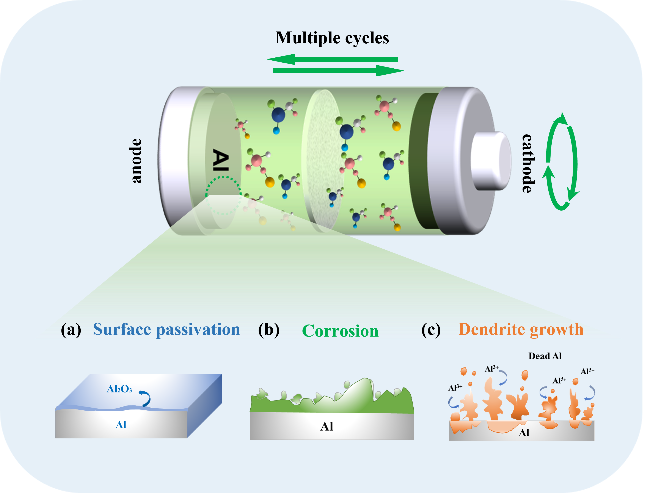
Currently, aluminum batteries mainly use metallic aluminum foil directly as the anode. However, the aluminum foil anode presents several prominent issues, posing significant challenges to the practical application of aluminum batteries (Fig. 1). First, the highly active aluminum metal surface reacts with oxygen in the air, forming an extremely thin insulating aluminum oxide layer (Al2O3), which limits ion/electron transfer during charging and discharging processes, leading to reduced conductivity of the aluminum anode, increased interfacial impedance, and enhanced polarization. Second, the aluminum metal anode exhibits relatively significant localized corrosion phenomena in both aqueous electrolytes and ionic liquids, resulting in irregular structural damage to the anode surface. Additionally, during cycling, dendritic growth can occur on the aluminum anode, potentially piercing the separator and causing battery short circuits, as well as leading to anode pulverization and the formation of dead aluminum. These issues not only severely affect the performance of aluminum batteries but also easily trigger safety concerns. Therefore, this paper will discuss the three main problems associated with aluminum metal anodes based on relevant reaction mechanisms and provide corresponding solutions.
图1 铝金属负极存在的主要问题:(a)表面钝化;(b)局部腐蚀;(c)枝晶生长

Fig.1 The key problems in aluminum metal anodes. (a) surface passivation, (b) local corrosion, and (c) dendrite growth

3.1 Surface Passivation

The formation of the passivation oxide layer (Al2O3) on the surface of metallic aluminum is a complex process influenced by multiple factors, including the inherent chemical properties of aluminum, environmental conditions, and processing techniques. Initially, pure aluminum exhibits high chemical reactivity and readily reacts with O2 in air, forming a nanoscale dense insulating Al2O3 passivation film on its surface. While this passivation layer protects aluminum from further oxidation, allowing it to be processed and utilized as an important metallic material in air environments[48], it also mitigates the corrosion of the aluminum anode by the electrolyte. However, the formation of Al2O3 causes the actual electrode potential of aluminum to be lower than its theoretical value. Moreover, the Al2O3 layer is both ionically and electronically insulating, significantly hindering the migration of ions and electrons during charging and discharging processes, thereby increasing interfacial impedance and battery polarization, ultimately affecting the energy density of the battery[49]. Furthermore, the passivation oxide layer is non-uniform and unstable; when exposed to corrosive environments such as electrolytes, it can be easily corroded, leading to structural damage of the anode and causing irreversible capacity loss[50]. Additionally, issues such as non-uniform thickness distribution, cracks and pores, and lattice defects within the oxide layer further reduce the interfacial stability of the aluminum anode, affecting the cycling life of the battery[51]. These defects in the alumina layer significantly limit the practical application of aluminum batteries. Therefore, appropriate anode modification strategies need to be implemented to remove or alleviate the damage caused by the alumina layer to the performance of the aluminum metal anode, thereby enhancing the performance of aluminum metal-based batteries.

3.2 Localized Corrosion

Aluminum metal anodes are prone to localized corrosion in both aqueous and non-aqueous electrolytes, leading to structural damage on the anode surface. Uneven corrosion affects the interfacial stability of batteries, thereby reducing their cycle life. The corrosion of aluminum anodes is mainly influenced by factors such as the type of electrolyte, temperature, surface morphology of the aluminum anode, impurities, and additives[52]. First, as a crucial component of aluminum batteries, the composition and properties of the electrolyte significantly affect the corrosion behavior of the aluminum anode. In aqueous electrolytes, due to the standard electrode potential of aluminum metal being lower than that of the standard hydrogen electrode (-1.662 V vs SHE), the aluminum metal anode is susceptible to hydrogen evolution corrosion[31]. Although replacing aqueous electrolytes with non-aqueous electrolytes can effectively avoid hydrogen evolution corrosion, most non-aqueous electrolytes currently are based on corrosive chloroaluminate ionic liquid electrolytes. The aluminum metal anode is easily eroded by the acidic environment, where the protective passive layer on its surface is destroyed, resulting in decreased cycling stability of the battery[53]. Second, temperature is one of the key factors affecting the rate of electrochemical reactions. At higher temperatures, the electrochemical reaction between the aluminum anode and the electrolyte accelerates, thus increasing the corrosion rate. Therefore, the corrosion problem of aluminum anodes is particularly pronounced in high-temperature environments[54]. Furthermore, the surface morphology of the aluminum anode also significantly influences its corrosion behavior. For example, anodes with rough surfaces are more reactive with the electrolyte, accelerating the corrosion process[55]. In addition, trace impurity metals (such as iron and copper) in the aluminum metal anode can form local galvanic cells with the aluminum metal under the electrolyte environment, accelerating the self-corrosion rate of the aluminum metal anode and causing structural damage to the anode[56]. During the research and application of aluminum-ion batteries, these factors must be comprehensively considered, and appropriate measures should be taken to suppress or reduce the corrosion rate of the aluminum metal anode, improve the electrochemical performance of the battery, and extend its cycle life.

3.3 Dendritic Growth

Similar to metallic lithium, metallic aluminum also exhibits dendrite growth during electrochemical deposition, which can lead to membrane penetration, resulting in dead aluminum or battery short circuits, significantly reducing the Coulombic efficiency, cycling stability, and safety performance of aluminum batteries. Currently, the formation and growth mechanisms of lithium dendrites have been widely studied, but the growth mechanism of aluminum dendrites has not yet been clearly elucidated[43]. Density functional theory (DFT) calculations indicate that the diffusion rate of Al3+ on the aluminum surface is faster than that of monovalent metals, making dendrite formation on the aluminum metal surface highly unlikely[57]. However, structural analysis of the aluminum anode after cycling reveals that the aluminum anode can form dendrites with various morphologies[58], and as cycling continues, more and more dendrites grow in an increasingly pointed manner[59].
Dendritic growth is influenced by multiple factors, such as current density, ion diffusion rate, temperature, and electrolyte type[51,60]. The growth of aluminum dendrites in aluminum batteries involves multiple aspects, including electrochemical properties, mass transfer processes, and nucleation and growth rates[51]. She et al.[60] investigated aluminum dendritic growth through in situ optical microscopy observations and theoretical simulations. Their study revealed that aluminum dendritic growth involves a series of complex processes including nucleation, growth, and stripping, and that dendrite density increases with increasing current density. Additionally, the morphological evolution changes with increasing current density. Finite element simulations have shown that aluminum deposition concentrates at surface defects or active sites, where dendrites exhibit lower activity compared to the original aluminum anode. Furthermore, the presence of dendrites leads to uneven current distribution, affecting the uniform evolution of the electrode surface. To date, research on the dendritic growth mechanisms in rechargeable aluminum batteries remains limited and requires further investigation.

4 Optimization Strategies for Performance Design of Aluminum Anodes

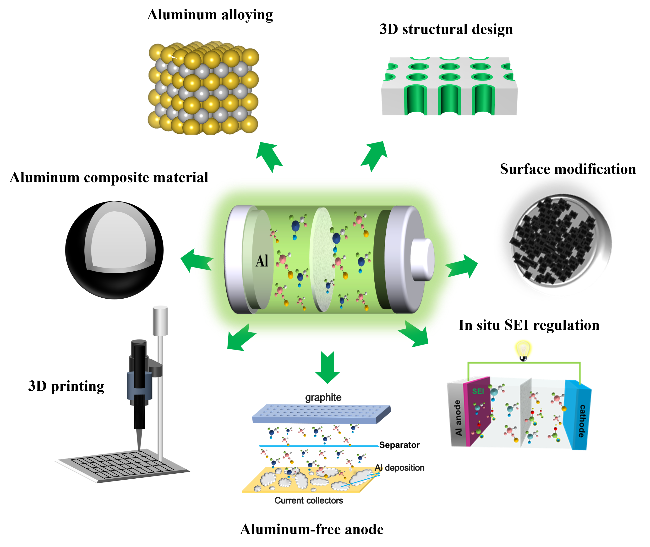
As mentioned above, the aluminum anode still has many prominent issues, which bring great challenges to the practical application of aluminum batteries. To address these problems, researchers have conducted extensive explorations and studies, including alloying, surface modification, in-situ SEI regulation, three-dimensional structure design, construction of aluminum-based composites, and aluminum-free anodes (Figure 2), effectively improving the electrochemical performance of aluminum anodes.
图2 高性能铝负极的典型设计优化策略

Fig.2 Representative design and optimization strategies of high-performance aluminum anode

4.1 Alloying of Aluminum Anodes

The purity of the aluminum anode is one of the key factors affecting the performance of aluminum batteries. Low-purity aluminum anodes often contain trace impurity elements, which act as cathodes and form local galvanic cells with the aluminum metal, accelerating the self-corrosion rate of the aluminum anode[61-62]. Research indicates that the purity of the aluminum anode directly influences the conductivity and mechanical strength of the battery. Under certain conditions, higher aluminum purity results in better electrical conductivity and higher mechanical strength. When the purity of the aluminum anode exceeds 99.9%, the self-corrosion reaction is suppressed, and the hydrogen evolution rate significantly decreases[41]. However, when selecting an aluminum anode, both performance and cost must be considered. The cost of aluminum anodes increases with higher purity; for example, 5N-purity aluminum costs 10 to 20 times more than 2N5-purity aluminum, and such high costs are difficult to meet commercial requirements[63].
On the other hand, the rational utilization of aluminum anode alloying can also improve the performance of the aluminum anode. Commonly used alloying elements include Cu, Mg, Zn, Si, Fe, Mn, and others. Adding appropriate amounts of these alloying elements can not only mitigate the self-corrosion reaction of the aluminum anode[64-65], enhance the interfacial stability of the anode[51], but also modify the aluminum electrode potential and increase the discharge voltage of the battery. Furthermore, they can suppress the formation of the passivation film on the aluminum anode surface, induce uniform nucleation and growth of aluminum on the anode surface, alleviate localized stress and volume expansion on the metal surface, thereby enhancing the structural stability of the aluminum anode[66]. For example, silicon can inhibit grain growth in aluminum alloys, refine the grains, and increase the number of grain boundaries, thus improving the strength, hardness, and toughness of the aluminum alloy[67]. Additionally, silicon can form a dense silica oxide film, which effectively reduces oxidation and corrosion of the aluminum alloy, thereby extending the service life of the aluminum alloy anode[68].
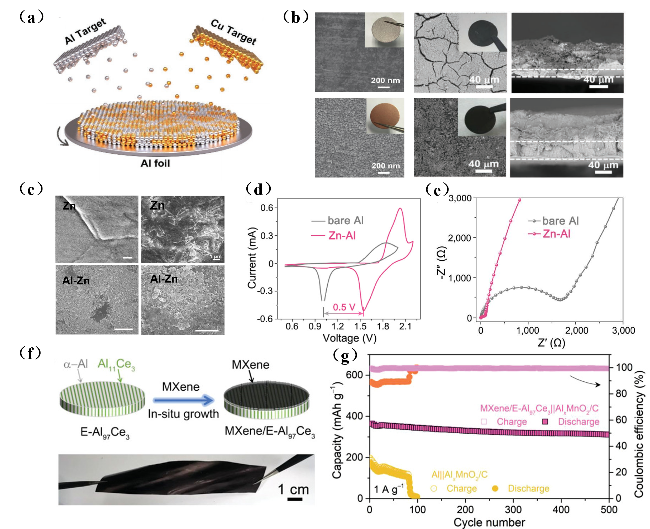
Zhang et al.[69] employed an inactive (Cu) and active (Al) co-deposition strategy to construct an Al-Cu alloy layer on the aluminum anode surface (Fig. 3a), forming uniformly distributed alloy sites that induce uniform aluminum nucleation and alleviate local stress caused by aluminum volume expansion, thereby enhancing the structural stability of the aluminum anode. By comparing the surface morphology changes of untreated Al and Cu-Al@Al anodes after 100 cycles at a current density of 2 mA·cm-2 (Fig. 3b), it was found that the untreated Al anode exhibited small cracks after 100 cycles and severe deformation and obvious cracks after 200 cycles, whereas the Cu-Al@Al anode showed almost no morphological changes after 200 cycles, confirming that the Al-Cu alloy anode can alleviate volume expansion and structural pulverization caused by non-uniform deposition/dissolution of aluminum, significantly improving the cycling stability of Al‖Al symmetric batteries. Ran et al.[72] similarly utilized a heterogeneous Al-Cu alloy as the anode for aluminum batteries, achieving ultra-long stable cycling while reducing battery polarization. Yu et al.[70] prepared a high-performance Zn-Al alloy anode by depositing aluminum onto a zinc foil substrate, effectively suppressing passivation and self-discharge reactions and significantly improving Coulombic efficiency. Compared with Zn2+, Al3+ has a lower redox potential in aqueous solution; during Zn2+/Al3+ deposition, Al3+ can form a positively charged electrostatic shielding layer that inhibits the growth of metal dendrites (Fig. 3c). Figs. 3d and 3e show that compared with the Al anode, the Zn-Al anode enables aluminum batteries to have smaller interfacial impedance and a higher discharge platform (1.6 V). Jiang et al.[71] used ultrathin MXene material combined with a eutectic aluminum-cerium alloy (E-Al97Ce3) to fabricate a highly flexible, reversible, and dendrite-free anode material (MXene/E-Al97Ce3) (Fig. 3f), significantly improving the charge-discharge performance of aqueous rechargeable aluminum-ion batteries. The E-Al97Ce3 alloy consists of alternating symbiotic layers of α-Al metal and intermetallic Al11Ce3 nanosheets, with different corrosion potentials forming periodic local galvanic couples that induce directional and reversible deposition of aluminum. Additionally, MXene alleviates the passivation effect of the alumina layer and suppresses the occurrence of hydrogen evolution side reactions. Therefore, the MXene/E-Al97Ce3‖AlxMnO2/C battery exhibited a Coulombic efficiency as high as 99% during subsequent cycling and retained 85% capacity after 500 cycles (Fig. 3g). In addition to the above binary alloy anodes, using multi-element aluminum alloy anodes can also improve the electrochemical performance of aluminum anodes. For example, ternary alloys such as Al-Zn-Cu[64], Al-Mg-Zn-In[65], and Al-Mg-Ga-Sn-Mn[66] have been employed as aluminum battery anodes, where adjusting the elemental ratios can reduce the anode interfacial impedance and suppress surface self-corrosion of the anode, thereby reducing battery polarization and improving cycling stability of aluminum batteries.
图3 典型铝负极合金化策略:(a)Cu-Al@Al负极的制备工艺,(b)基于pristine Al和Cu-Al@Al负极组装的对称电池在2 mA·cm-2循环100圈前后的形貌对比[69];(c)Zn-Al和bare Al负极循环100圈后的SEM图像对比,(d)扫描速率为0.1 mV·s-1时bare Al‖AlxMnO2与Al-Zn‖AlxMnO2的CV曲线对比,(e)Zn-Al与bare Al负极的EIS对比[70];(f)MXene/E-Al97Ce3杂化电极材料的制备示意图与电极照片,(g)MXene/E-Al97Ce3‖AlxMnO2/C和Al‖AlxMnO2/C电池的长循环性能对比[71]

Fig.3 Typical aluminum anode alloying strategies. (a) The production process of Cu-Al@Al anode, and (b) SEM images showing the morphologies of pristine Al and Cu-Al@Al anodes before and after 100 cycles at 2 mA·cm-2[69], Copyright 2019, John Wiley and Sons; (c) SEM images showing the morphologies of bare Al and Zn-Al alloy anodes after 100 cycles, (d) comparison of CV curves of bare Al‖AlxMnO2 and Al-Zn‖AlxMnO2 batteries at a scanning rate of 0.1 mV·s-1, and (e) comparison of impedance of Zn-Al and bare Al anodes[70], Copyright 2020, American Chemical Society; (f) Preparation diagram and electrode photo of MXene/E-Al97Ce3 hybrid electrode material, and (g) The comparison of long-cycle performance of MXene/E-Al97Ce3‖AlxMnO2/C and Al‖AlxMnO2/C cells[71], Copyright 2022, John Wiley and Sons

In summary, aluminum anode alloying has been explored and applied in some aluminum battery systems. In addition to the main alloying elements mentioned above, such as Cu, Mg, Zn, Si, Fe, and Mn, other elements including Ni, Ti, Cr, and Li also significantly influence the performance of aluminum alloys.[73] In practice, due to the inherent properties of the aluminum anode and the battery system, the selection of applicable alloying elements is limited. For example, in aqueous aluminum batteries, alloying elements should possess a high hydrogen evolution overpotential, an electrode potential higher than that of aluminum, and good solid solubility in the aluminum matrix,[56] which are fundamental characteristics that can effectively mitigate the hydrogen evolution reaction and suppress the formation of a surface passivation layer. Therefore, the selection of alloying elements is crucial for aluminum anodes.

4.2 Surface Modification of Aluminum Anodes

Surface modification is one of the key approaches to regulate the interfacial electrochemical reactions of electrode materials, and common methods include surface chemical reactions, surface coating, and surface compositing[74]. The surface modification of aluminum anodes can be achieved by adjusting the surface composition and microstructure[75], for example, through methods such as manual coating or atomic layer deposition (ALD), organic or inorganic materials can be deposited onto the aluminum anode surface to form a uniform protective layer[76], thereby creating a physical barrier between the anode and the electrolyte. This barrier ensures ion transport capability while suppressing interfacial side reactions such as self-corrosion, guiding uniform and reversible deposition and dissolution of aluminum, and preventing dendrite formation[77]. In addition, surface modification of the aluminum anode can also inhibit cracking and pulverization caused by excessive local volume expansion, helping to maintain structural integrity. Therefore, appropriately designing and constructing anode modification layers can enhance the electrochemical stability of aluminum batteries.
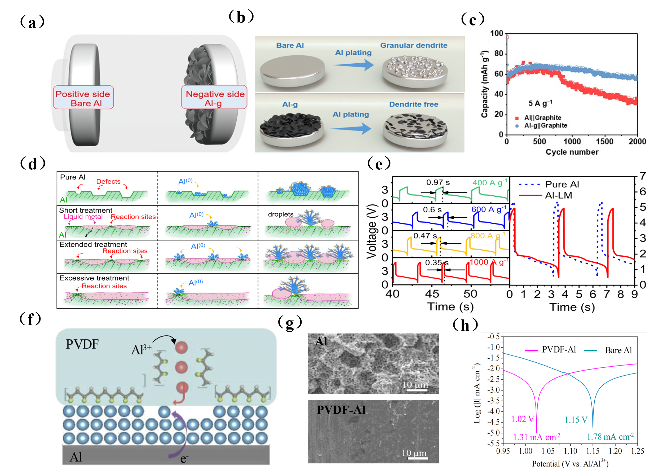
Carbon materials often possess characteristics favorable for ion intercalation, such as layered structures, and generally exhibit high chemical stability and electrical conductivity. Therefore, carbon materials are among the commonly used and effective surface modification materials. Coating carbon materials onto an aluminum anode can alleviate surface passivation, reduce localized corrosion, and promote uniform deposition of aluminum while suppressing dendrite growth. Yu et al.[78] utilized a graphite-coated aluminum anode (Al-g) to regulate the reversible deposition/stripping behavior of aluminum (see Figure 4a). Electrochemical studies and DFT calculations revealed that the graphite coating can induce preferential uniform deposition of aluminum on the graphite, suppressing dendrite formation (see Figure 4b), and the graphite coating possesses sufficient pores to accommodate the deposited aluminum metal, alleviating volume changes in the anode and improving the structural stability of the aluminum anode. Consequently, compared to a pure Al anode, the Al-g anode enables the Al-g‖graphite battery to exhibit better cycling stability (see Figure 4c), maintaining stable cycling for over 2000 cycles at 5 A·g-1. Jiao et al.[77] designed a nitrogen-doped nanocarbon array to modify the surface of the aluminum metal anode; the N-containing functional groups can induce uniform deposition of Al3+ on the anode surface, while the carbon nanoframework enhances the conductivity of the aluminum anode, regulating aluminum nucleation and suppressing dendrite growth. Benefiting from the stability of the carbon nanotube array structure, the Al‖Al symmetric battery exhibits excellent cycling stability and low voltage hysteresis (~80 mV). The full battery assembled using this anode demonstrates a long cycling life (over 1500 cycles) and high Coulombic efficiency (100%±1%).
图4 典型铝负极表面改性策略:(a)基于石墨修饰铝负极(Al-g)组装的不对称Al‖Al-g电池示意图,(b)纯Al和Al-g表面的铝沉积示意图,(c)Al‖graphite电池和Al-g‖graphite电池的循环稳定性对比[78]。(d)纯铝与不同处理时间的Al-LM上铝沉积的示意图,(e)Al-LM与Al负极在不同倍率下的充放电曲线对比[75]。(f)Al3+在PVDF涂层上的迁移路径示意图,(g)基于Al和PVDF-Al为电极的对称电池在0.1 mA·cm-2电流密度下50圈循环后的SEM对比图,(h)纯Al和PVDF-Al塔菲尔线性极化曲线对比[79]

Fig.4 Typical surface modification strategies for aluminum anodes. (a) Diagram of asymmetric Al‖Al-g battery assembled based on graphite-modified aluminum anode(Al-g), (b) the Al plating behaviors of pure Al and Al-g, and (c) comparison of cycle stability of Al||graphite battery and Al-g‖graphite battery[78], Copyright 2023, Royal Society of Chemistry; (d) Schematic diagram of pure Al deposition on Al-LM with different treatment time, and (e) comparison of charge and discharge curves of Al-LM and Al anodes[75], Copyright 2021, Springer Nature; (f) Migration path diagram of Al3+ on PVDF coated Al, (g) SEM comparison of Al and PVDF-Al anodes in symmetrical cells after 50 cycles at 0.1mA·cm-2, and (h) the Tafel linear polarization curves of pure Al and PVDF-Al[79], Copyright 2022, Elsevier

Liquid metal (LM) coating is also one of the commonly used strategies for interfacial modification of aluminum anodes. Tan et al.[75] constructed a gallium-based liquid metal (Galinstan) coating on the surface of metallic aluminum anodes. The liquid metal can naturally penetrate and fill the grains, grain boundaries, and defective areas on the aluminum surface, forming a solid region rich in aluminum with trace gallium and a liquid region rich in gallium with trace aluminum. The interface between these two regions is a highly amorphous aluminum-rich area, which can act as a high-energy site for subsequent aluminum deposition (Figure 4d). An appropriately thick liquid metal coating can induce uniform aluminum deposition and suppress dendrite growth. Moreover, an aluminum-ion battery assembled using an Al-LM active anode can achieve ultrafast charging, fully charging the battery in just 0.35 s. Compared with a pure aluminum anode, the Al-LM anode exhibits lower charging voltage and reduced voltage polarization (Figure 4e). Jiao et al.[80] also utilized liquid metal gallium to modify the aluminum anode. Gallium remains in the liquid state during cycling, effectively alleviating issues such as dendrite formation, corrosion, and pulverization on the aluminum anode surface. Compared with metallic aluminum anodes, aluminum-gallium anodes exhibit higher stability and longer cycling life. Yu et al.[81] designed a eutectic gallium-indium liquid metal (E-Ga-In), which was coated onto the aluminum anode surface to form a uniform protective layer. An Al‖Al symmetric battery assembled using this modified anode exhibited significantly reduced polarization and enhanced stability during subsequent cycling, confirming that liquid metal interfacial modification can improve the structural integrity of the aluminum anode surface and enable long-term stable cycling of aluminum batteries.
Artificial polymer membranes can also enhance the stability of metal anodes. Polymer coatings can introduce abundant polar groups, which are capable of binding with metal ions, effectively improving the electrochemical and mechanical properties of the anodes. Li et al.[79] designed a bifunctional PVDF coating to alleviate the corrosion problem of aluminum metal anodes in aqueous electrolytes. The strong interaction between C-F functional groups and Al3+ enables the uniform and compact PVDF coating to suppress contact between free H2O in the electrolyte and the aluminum anode, thereby inhibiting the hydrogen evolution side reaction and enhancing the structural stability of the aluminum anode in the electrolyte (see Figure 4f). The SEM image in Figure 4g shows that after 50 h of cycling, the surface of the aluminum anode exhibits numerous corrosion micropores, whereas the PVDF-Al anode surface remains flat without noticeable corrosion marks. Further comparison of the linear polarization curves of PVDF-Al and Al reveals that PVDF-Al exhibits a lower corrosion potential and corrosion current density than the Al anode (see Figure 4h). This confirms that the PVDF coating effectively suppresses side reactions such as corrosion and enhances the stability of the aluminum anode in the electrolyte. In addition to single-layer organic polymer films, Chen et al.[82] designed a dual-protection composite interface composed of an inner zinc metal layer and an outer organic glutamic acid layer on the aluminum anode of an aluminum-air battery. The polar side-chain groups of glutamic acid molecules can form hydrogen bonds with H2O, reducing the number and activity of H2O molecules on the surface of the metal anode, effectively suppressing hydrogen evolution corrosion of the aluminum anode while stabilizing the inner zinc protective layer. This study provides a new approach for suppressing interfacial hydrogen evolution corrosion of aluminum anodes.
In addition to the aforementioned modification methods, surface modification can also be achieved by coating the anode surface with a Janus-type membrane[76] or MXene materials[83]. Regardless of the modification method used, the process must be carried out without compromising the electrochemical performance of the aluminum anode. Therefore, the construction of the surface modification layer must comprehensively consider the effects of factors such as the electrochemical properties of the aluminum anode, surface microstructure, and types of impurity elements on the modification layer[84-85]. Additionally, the surface modification layer must exhibit good compatibility with both the anode material and the electrolyte, be uniformly distributed, possess excellent stability, and be able to adapt to variations in conditions during battery cycling, such as temperature and electrolyte concentration[75]. Therefore, further research is required on the chemical properties of aluminum metal, surface modification techniques, production processes, and material compatibility to identify more effective solutions.

4.3 In-situ SEI Regulation

The interface between the electrolyte and the anode is the site of ion exchange and various electrochemical reactions, playing a crucial role in ion transport and suppression of side reactions.[86] Therefore, constructing an interfacial layer between electrodes is critical for optimizing the aluminum anode. The aforementioned interfacial optimization strategies mainly involve the formation of ex situ interfacial layers to protect the aluminum anode.[87] In contrast, in situ regulation of the solid-electrolyte interphase (SEI) offers advantages such as simplicity, efficiency, and low cost. In situ SEI formation can be achieved through optimized electrolyte design, for example, by introducing suitable additives into the electrolyte to guide the formation of a uniform and dense SEI layer on the aluminum anode surface via electrochemical reactions. The in situ SEI layer plays a key role in aluminum metal batteries. First, it can induce uniform deposition of aluminum ions, effectively suppressing the growth of aluminum dendrites and maintaining the stability of the aluminum anode-electrolyte interface.[88-89] Second, in situ SEI can suppress side reactions at the aluminum anode, reduce electrode cross-talk, and enhance the reversibility and efficiency of electrochemical reactions. Moreover, the in situ SEI layer can alleviate strain caused by aluminum deposition and dissolution, improving the mechanical stability of the metallic aluminum anode.[90] Therefore, constructing an in situ SEI layer is one of the important approaches to improve the performance, stability, and cycling life of aluminum metal batteries.[91] By designing and optimizing the structure and composition of the SEI layer, key challenges facing aluminum metal batteries can be effectively addressed, promoting their practical applications.
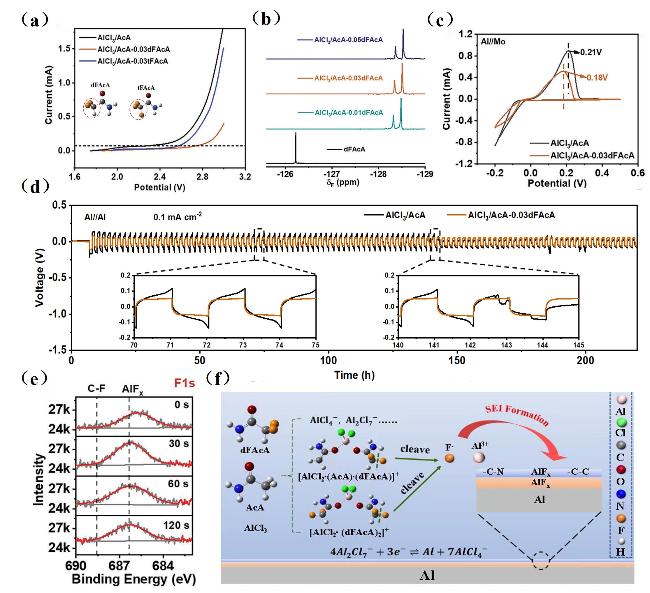
Recently, Yu et al.[92] introduced fluoroacetamide (dFAcA, tFAcA) additives into the previously developed low-cost AlCl3/AcA eutectic solvent electrolyte, fabricating a low-cost and highly stable eutectic solvent electrolyte that enables in-situ construction of an SEI layer containing AlFx. Comparison of LSV curves of AlCl3/AcA electrolytes with different additives revealed that dFAcA can better enhance the high-voltage stability of the electrolyte and widen the electrochemical window of the battery (Figure 5a). 19F-nuclear magnetic resonance (19F-NMR) results showed that the characteristic peak of dFAcA in the AlCl3/AcA-0.03dFAcA electrolyte disappeared and new characteristic peaks appeared, indicating that dFAcA can fully coordinate with aluminum salts in the electrolyte to form complex ions/molecules (Figure 5b). The Al‖Al symmetric battery assembled with this electrolyte also exhibited low battery polarization and excellent cycling stability (Figure 5c, d). Furthermore, X-ray photoelectron spectroscopy (XPS) was employed to explore the reasons behind the improved battery performance. XPS depth profiles in Figure 5e show that the introduction of dFAcA can form an in-situ SEI layer containing fluorine on the anode surface, which has high uniformity and stability and can provide Al3+ ion transport pathways, thus reducing the impact of the SEI layer on ion transport. In addition, electrochemical analysis confirmed that the formation of the AlFx layer enhances the Coulombic efficiency and cycling stability of the aluminum anode during reversible cycling, while reducing the interfacial resistance. Figure 5f illustrates the process of dFAcA-induced formation of an SEI layer containing AlFx on the aluminum anode surface. This study provides new insights for constructing high-performance AIBs from the perspective of in-situ SEI design.
图5 原位构筑含AlFx的SEI层调控铝负极电化学性能:(a)AlCl3/AcA、AlCl3/AcA-0.03dFAcA和AlCl3/AcA-0.03dFAcA电解液的LSV曲线(0.03代表添加摩尔比为0.03),(b)不同dFAcA添加量的电解液的19F-NMR谱,(c, d)由AlCl3/AcA和AlCl3/AcA-0.03dFAcA电解液组装的Al‖Al电池的CV曲线(c)和长循环曲线(d)对比,(e)由AlCl3/AcA-0.03dFAcA电解液组装的Al‖Al对称电池循环100 h后的负极XPS F1s纵深谱,(f)dFAcA添加剂诱导Al负极表面原位SEI层形成示意图[92]

Fig.5 Adjustment of electrochemical performance of aluminum anode by the in-situ fabrication of AlFx-containing SEI. (a) Linear sweep voltammetry (LSV) curve of AlCl3/AcA, AlCl3/AcA-0.03dFAcA, and AlCl3/AcA-0.03dFAcA electrolytes, (b) 19F-NMR spectra of electrolytes with different contents of dFAcA additive, (c, d) comparison of CV curves (c) and long-cycle performance (d) of Al‖Al batteries assembled with AlCl3/AcA and AlCl3/AcA-0.03dFAcA electrolytes, (e) in-depth XPS F1s spectra of Al anodes in Al‖Al symmetric batteries assembled with AlCl3/AcA-0.03dFAcA electrolyte after cycling for 100 h, and (f) schematic diagram of in situ fabrication of SEI on the Al anode induced by dFAcA additive in the AlCl3/AcA electrolyte[92], Copyright 2023, John Wiley and Sons

Seh et al.[93] reported a novel aluminum-ion battery electrolyte based on aluminum trifluoromethanesulfonate (Al(OTf)3) and tetrabutylammonium chloride (TBAC) additives. TABC can promote the decomposition of Al(OTf)3 and the formation of OTf- ions, and in-situ form a stable SEI layer on the anode, thereby enhancing the cycling stability of the battery. Furthermore, Pathak et al.[86] introduced additives such as vinylene carbonate (VC) and fluoroethylene carbonate (FEC) into the ethylene carbonate (EC) electrolyte. Experimental results indicated that FEC can suppress the decomposition of the electrolyte, induce more aluminum ions to nucleate on the anode surface, and facilitate the formation of a stable SEI layer on the anode surface. Therefore, selecting suitable additives can form a stable SEI layer on the anode, reduce electrolyte consumption, and thereby improve the cycling life of the battery.
Compared with the artificial SEI layer, which suffers from issues such as poor adhesion to the anode and easy detachment[93], the in-situ SEI formed via electrochemical reactions exhibits uniformity and compactness. However, the formation of SEI consumes active ions, leading to low initial Coulombic efficiency and capacity[94]. Furthermore, the in-situ SEI layer is not an absolute insulator. Studies have shown that during the voltage increase of the battery, organic molecules within the SEI layer can leak electrons, causing the SEI to transition into a semiconductor, which consequently deteriorates battery performance and shortens its lifespan[95]. In addition, constructing an in-situ SEI layer must consider the composition of the electrolyte[96]. For example, in aqueous electrolytes, strong hydrogen evolution reactions make it difficult for solid components of the SEI to adhere and nucleate on the anode surface. More electrons are required to participate in the construction of the SEI layer on the anode surface, meaning more electrolyte or cathode components need to be consumed to compensate for the electron loss[97]. Therefore, rational design of the electrolyte composition is necessary to meet the requirements for normal battery cycling and SEI layer formation. In summary, the construction of an in-situ SEI layer still faces numerous challenges that require further investigation.

4.4 Three-dimensional Structure Design

During cycling, the aluminum anode undergoes volume expansion, structural pulverization, and structural collapse, leading to poor cycling performance, battery failure, and even safety issues. Therefore, it is urgently necessary to modify the aluminum metal anode structurally to enhance its structural stability. Three-dimensional structural design optimization is one of the effective strategies to improve the structural stability of the anode. The three-dimensional structured anode offers a higher specific surface area compared to aluminum foil, providing more active sites, thereby enhancing the battery's practical capacity and energy density[98]. Secondly, the three-dimensional structure can effectively alleviate volume expansion and localized stress during charging and discharging, improving the battery's cycling stability and lifespan[99]. Moreover, the three-dimensional structure facilitates electrolyte infiltration and aluminum ion diffusion, reducing interfacial impedance and enhancing the battery's rate performance and power density[100]. Additionally, the three-dimensional structure can induce uniform deposition of aluminum within the pores of the anode through physical barriers and chemical guidance, thereby reducing localized current density and effectively suppressing the growth of aluminum dendrites, improving battery safety and stability. For instance, designing a three-dimensional porous structured anode can alleviate localized stress and volume expansion at the anode surface, provide more nucleation sites, suppress dendrite growth, promote electrolyte mass transfer, and potentially reduce interfacial impedance[101]. Therefore, designing a three-dimensional structure on the surface of the aluminum anode is beneficial for improving its electrochemical performance.
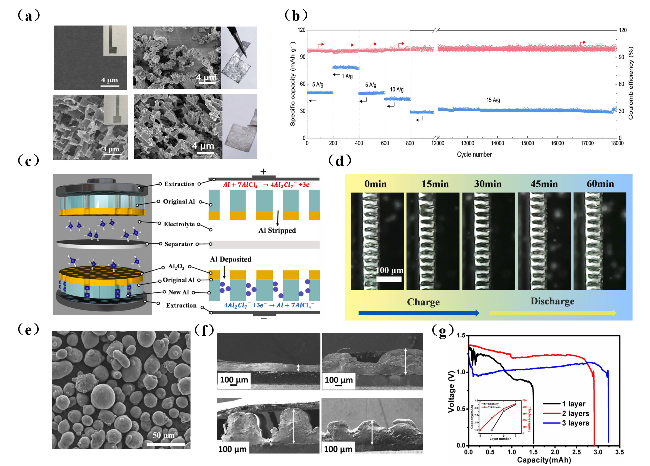
Yang et al.[3] constructed a porous aluminum anode to suppress aluminum dendrite growth and enhance battery stability. Figure 6a shows a morphological comparison of aluminum foil and porous aluminum after multiple cycles. Unlike the extensive corrosion and dendrite formation observed on the surface of conventional aluminum foil, porous aluminum exhibits better structural integrity, with no significant corrosion or dendrite growth on its surface. This is primarily attributed to the interconnected pore structure that reduces the local current density and disperses the ion flux, thereby inducing uniform and reversible deposition of aluminum. Experimental results demonstrate that the porous aluminum can maintain stable cycling within a current density range of 1 to 15 mA·cm-2 and an area capacity range of 0.25 to 1 mAh·cm-2. Moreover, an aluminum-graphite full battery assembled using the porous aluminum anode and a natural graphite cathode achieves up to 18,000 reversible cycles (Figure 6b), indicating that the porous structural design of the aluminum anode enhances the cycling stability of aluminum batteries. Xiong et al.[103] fabricated a surface-oxidized porous aluminum anode (P-Al2O3/Al) via anode oxidation and laser etching. The insulating Al2O3 layer improves the mechanical strength of the anode, mitigates corrosion of the aluminum anode by ionic liquids, and prevents the uneven deposition of aluminum on the anode surface, while regularly arranged etched through-holes induce aluminum deposition within the pores, simultaneously avoiding the issue of reduced effective active area caused by the increasing thickness of the surface Al2O3 layer (Figure 6c). Experimental results indicate that the P-Al2O3/Al anode increases the effective electrochemical area of the anode, leading to a more uniform surface current density distribution and inhibiting aluminum dendrite growth (Figure 6d). The Al‖Al battery based on the P-Al2O3/Al anode exhibits excellent cycling and rate performance, maintaining stable cycling for over 1400 h at an area capacity of 5 mAh·cm-2. Additionally, Tang et al.[89] developed a three-dimensional carbon-coated hollow aluminum nanosphere (CHAA) anode for dual-ion batteries (DIBs), significantly enhancing the cycling stability and rate capability of aluminum-based dual-ion batteries. The CHAA can function simultaneously as an anode and a current collector; the hollow nanosphere structure alleviates surface stress in the anode, effectively suppressing volume expansion during cycling, maintaining structural integrity of the aluminum anode, and forming an ultra-stable solid electrolyte interphase (SEI) layer on the anode surface.
图6 铝负极三维结构设计典型方案:(a)铝箔与多孔铝负极循环前后SEM形貌对比,(b)基于多孔负极组装的铝-石墨电池在不同电流密度下的长循环稳定性[3];(c)P-Al2O3/Al‖P-Al2O3/Al对称电池中的铝沉积示意图,(d)P-Al2O3/Al‖P-Al2O3/Al对称电池原位光学观测[103];(e)3D打印用CNTs-Al复合粉末SEM图像[104];(f)不同3D打印层数的铝负极截面图,(g)不同激光烧结功率下铝-空气电池的首圈循环放电曲线对比[105]

Fig.6 Typical 3D structure design strategies of aluminum anodes. (a) SEM morphology comparison between Al foil and porous Al before and after cycling, and (b) cycle performance of Al batteries based on porous Al anode at different rates[3],Copyright 2020, Elsevier; (c) Schematic diagram of Al deposition in P-Al2O3/Al‖P-Al2O3/Al symmetric battery, and (d) in-situ optical observation of P-Al2O3/Al‖P-Al2O3/Al symmetric battery[103],Copyright 2023,Elsevier; (e) SEM images of CNT-Al composite powder for 3D printing[104], Copyright 2020,Elsevier; (f) cross-section images of Al anodes with different 3D printing layers, (g) discharge profiles of aluminum-air batteries in the first cycle using 3D printed Al anode under different laser sintering powers[105], Copyright 2018, IOP Publishing

Emerging technologies such as 3D printing have also been applied to the design and construction of anode materials[106]. 3D printing differs significantly from traditional casting methods; in these two processes, differences in the solidification rate of aluminum metal lead to notably different microstructures on the surface of the fabricated aluminum anodes, resulting in variations in performance. Currently, various 3D technologies have been utilized in the manufacturing of aluminum alloys, among which 3D-printed carbon nanotube-aluminum (CNT-Al) composites have been prepared[104] (Figure 6e). Furthermore, 3D printing can also enable interface construction of aluminum anodes. The 3D-printed surface shown in Figure 6f exhibits a wavy structured aluminum anode, achieving a larger surface area compared to planar structures, thereby enabling better contact between the electrolyte and electrode. Additionally, the morphology of the aluminum anode can be adjusted by controlling the degree of laser sintering, achieving superior discharge capacity (Figure 6g), thus confirming that 3D printing can enhance the electrochemical performance of aluminum anodes[105]. It is anticipated that 3D printing will become one of the key strategies for designing high-performance aluminum anodes in the future.

4.5 Construction of Aluminum Matrix Composites

Aluminum matrix composites, which are composed of aluminum as the base material combined with other materials (such as carbon fiber, silicon particles, ceramics, titanium, etc.), can combine the lightweight property of aluminum with the advantages of other materials, exhibiting excellent mechanical properties, good electrical conductivity, and high corrosion resistance[107]. Using aluminum matrix composites as the anode for aluminum batteries is also one of the strategies to enhance the electrochemical performance of aluminum batteries. Through appropriate composite design, non-metallic materials can influence the density and electrochemical activity of the surface passivation layer of metallic aluminum. For example, studies have found that aluminum-graphene composite anodes exhibit higher electrical conductivity and better corrosion resistance compared to pure aluminum[108]. Adding graphene into aluminum can increase the electrode potential of aluminum, reduce battery polarization, and improve the energy density of the battery. Moreover, using aluminum matrix composites can reduce anode surface corrosion and suppress surface dendrite growth, thereby enhancing the cycling stability of the battery and reducing its capacity decay[84].
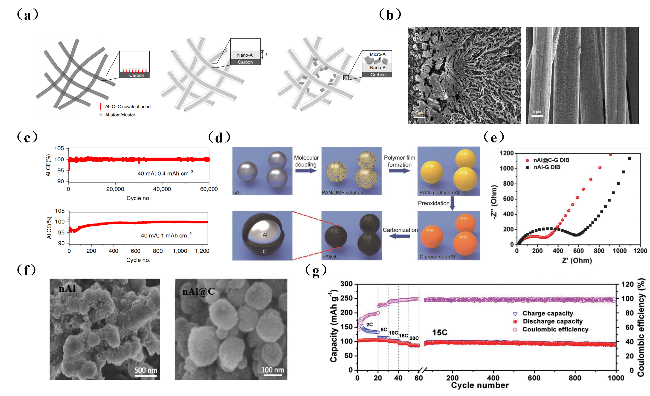
Zheng et al.[109] enhanced the driving force for aluminum metal nucleation by constructing Al-O-C chemical bonds on the carbon fiber surface that are tightly bonded with the aluminum metal coating, inducing uniform nucleation of aluminum metal on the carbon fiber substrate, thereby successfully preparing an aluminum-carbon fiber composite anode with high cycling stability and long lifespan (Fig. 7a). In contrast to aluminum-stainless steel (Al-SS) composite anodes that suffer from corrosion and even dendrite growth, the aluminum-carbon fiber composite anode maintained nearly unchanged structural morphology after numerous cycles at high current densities, preserving a nanoscale dense aluminum deposition layer (Fig. 7b). Under a current density of 40 mA·cm-2 and an areal capacity of 0.4 mAh·cm-2, an Al‖Al symmetric battery based on a planar stainless steel foil substrate failed rapidly in less than 5 min of cycling, whereas an Al‖Al battery based on the aluminum-carbon fiber composite anode achieved over 60,000 cycles with a high coulombic efficiency of 99.96% (Fig. 7c). Xie et al.[111] employed deformation-driven metallurgy (DDM) technology to fabricate an aluminum-based fluorinated nanographene composite anode (Al-5.5Mg-1.5F-GNPs) to enhance the reversible passivation process of the aluminum anode in aqueous aluminum-air batteries and suppress its self-corrosion. The DMM technique forms a uniform nanosphere-structured passivation film on the composite anode surface, preventing the hydrogen evolution reaction and suppressing anode self-corrosion. The strong bonding between magnesium-containing alumina and fluorinated graphene nanolayers enhances the stability of the surface nanosphere-structured passivation layer and improves anode utilization. This strategy is instructive for overcoming self-corrosion in aluminum-air batteries and also provides insights for non-aqueous rechargeable aluminum batteries.
图7 铝基复合材料设计优化策略:(a)铝金属与碳纤维强键合影响铝沉积示意图,(b)在40 mA·cm-2电流密度下,不锈钢和碳纤维上铝沉积的SEM图,(c)基于铝碳纤维复合负极的CE与循环指数[109];(d)nAl@C制备过程示意图,(e)基于nAl和nAl@C负极的DIB在100 kHz~10 mHz范围内充放电100次后的Nyquist图,(f)nAl和nAl@C负极在3.0~5.0 V电压范围内循环1000次后的SEM图像,(g)nAl@C-G基DIB的长循环性能[110]

Fig.7 Design and optimization strategies of aluminum composite anodes. (a) Scheme of Al deposition influenced by strong bonding between Al and carbon fiber substrate, (b) SEM images of Al deposition on stainless steel and carbon fiber at 40 mA cm-2, and (c) CE and cycle performance of Al batteries based on Al-carbon fiber composite anodes[109], Copyright 2021, Springer Nature; (d) The preparation process scheme of nAl@C, (e) the Nyquist result of DIB using nAl and nAl@C anodes between 100 kHz~10 mHz after 100 cycles, (f) the SEM images of nAl and nAl@C anodes after 1000 cycles between 3.0~5.0 V, and (g) the long-cycle performance of nAl@C-G based DIB[110], Copyright 2017, John Wiley and Sons

Tang et al.[110] designed a core/shell structured aluminum@carbon nanosphere (aluminum@carbon nanospheres, nAl@C) anode to optimize the electrochemical performance of aluminum-based dual-ion batteries (Fig. 7d). This nanostructure consists of an aluminum nanosphere core and an amorphous carbon shell, where the core/shell architecture facilitates the formation of a stable SEI layer during cycling, the amorphous carbon shell enhances the electrical conductivity of the aluminum anode, reduces interfacial impedance, and mitigates surface corrosion of the aluminum anode (Fig. 7e, f). The nAl@C‖G DIB assembled using the nAl@C nanosphere anode exhibits excellent cycling stability (Fig. 7g). Although this work is applied in dual-ion batteries, it also provides significant reference value for the design of anodes in aluminum batteries. Furthermore, Zhao et al.[112] developed an aluminum-carbon nanotube composite anode, fabricated by electrodepositing aluminum onto the surface of oriented single-wall/multi-wall carbon nanotubes, which serve as a conductive substrate. The composite anode surface is free of a passivation film and highly active, enabling better reversible deposition of Al3+. The secondary aluminum battery based on this composite anode achieves a higher energy density compared to batteries with pure aluminum anodes.
As an emerging strategy, aluminum-based composite anode materials have many advantages such as high energy density, high conductivity, high cycling stability, and lightweight. However, there are still many issues that need to be explored, such as the limited types of composites and the relatively complicated preparation processes. Future research should focus on optimizing the structure and properties of aluminum-based composite anode materials, enhancing their electrochemical performance and stability, reducing manufacturing costs, and expanding their application scope.

4.6 Aluminum-Free Anode

Currently, aluminum batteries commonly use excess aluminum metal as the anode, which significantly reduces the actual energy density of aluminum batteries[113]. Moreover, the aluminum anode suffers from defects such as corrosion, passivation, and dendrite growth, which are difficult to fundamentally resolve. Researchers have explored alternative approaches by employing carbon materials or other metal-based materials as current collectors, avoiding direct use of aluminum metal anodes. Compared to traditional designs, the aluminum-free anode design offers several notable advantages. First, it can reduce the proportion of non-active components in the battery, thereby enhancing the overall energy density. Second, aluminum metal may experience localized corrosion and dendrite growth during battery cycling, leading to battery failure and even safety incidents. The aluminum-free anode design avoids the use of aluminum metal; studies have shown that aluminum can achieve relatively uniform and reversible deposition on carbon-based and other suitable metal-based materials, with almost no dendrite growth or structural corrosion, thereby minimizing such potential risks. However, since the active aluminum in aluminum-free anodes originates from the electrolyte or cathode materials, this design imposes high requirements on the reversible deposition efficiency and utilization rate of Al3+, necessitating optimized design of all battery components to achieve this.
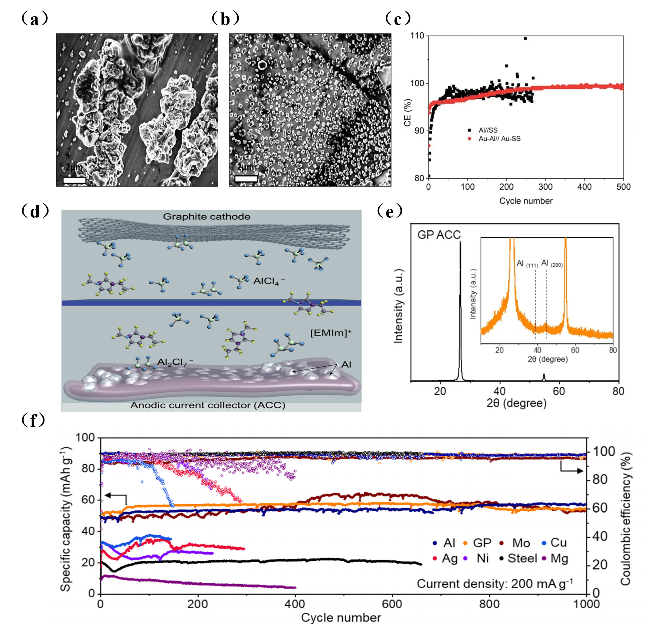
Zhao et al.[114] assembled a full battery using two-dimensional gold (Au) nanosheets as the current collector and graphite as the positive electrode, achieving capacity retention of 80% and 74% after 1000 and 2000 charge-discharge cycles, respectively, which significantly surpasses the cycle life (≤200 cycles) of aluminum batteries based on stainless steel (SS) current collectors. SEM images show the surface morphology of aluminum deposition on stainless steel (Figure 8a) and gold nanosheets (Figure 8b), clearly revealing large aggregated aluminum deposits on the stainless steel surface, while uniformly dispersed aluminum nanoparticles are observed on the gold nanosheet surface. This is attributed to the similar crystal structure between aluminum and gold, and the (111) crystal plane of gold with low surface energy, which can induce uniform aluminum deposition on the surface of gold nanosheets. Comparing the reversible aluminum deposition in Al‖SS batteries with and without Au nanosheet protection (Figure 8c), the Coulombic efficiency of the Al‖SS battery is highly unstable and quickly leads to short circuits. In contrast, the Au-Al‖Au-SS battery achieves stable cycling for over 500 cycles with a high Coulombic efficiency of more than 99%, confirming that the Au nanosheet anode enables uniform aluminum deposition and ultra-long-term stability for aluminum batteries. Additionally, Meng et al.[113] designed an ultrathin lattice-matched Au layer on Ti foil to regulate reversible aluminum deposition. Experimental and theoretical calculation results demonstrate that the Au@Ti electrode can guide uniform and reversible aluminum deposition, where the Au layer prolongs the nucleation process, enhances nucleation density, and reduces the nucleation particle size. Consequently, compared with Al‖Al symmetric batteries, Al‖Au@Ti batteries exhibit lower nucleation overpotential and improved long-term cycling stability, achieving a Coulombic efficiency of 99.92% and a long cycling life of over 4500 h.
图8 无铝负极电池的设计方案及其性能:(a, b)电流密度为1 mA·cm-2时不锈钢(a)和金纳米片(b)集流体上电沉积铝的SEM图像,(c)有无Au层保护的Al‖SS电池的循环性能对比[114]。(d)由GP正极与各种负极集流体组成的无铝负极AIBs示意图,(e)充电状态下GP ACC的XRD图,(f)基于铝负极或各种ACCs组成的AIBs的长循环性能对比图[115]

Fig.8 The design scheme and electrochemical performance of anode-free aluminum battery. (a, b) SEM images of Al electrodeposited on stainless steel (SS) (a) and gold nanosheets (b) when the current density is 1 mA·cm-2, and (c) comparison of cycle performance of Al‖SS batteries with or without gold nanosheet protection [114], Copyright 2020, Royal Society of Chemistry; (d) Scheme illustration of an anode-free Al batteries composed of a graphite paper cathode and a variety of anodic current collectors (ACCs), (e) XRD pattern of GP ACC in the charge state, and (f) long-cycle performance comparison of AIBs based on Al anode or various ACCs[115],Copyright 2021, Elsevier

Jin et al.[115] successfully assembled initial anode-free AIBs and achieved stable cycling using commercial graphite paper (graphite paper, GP) as the cathode, AlCl3/[EMIM]Cl electrolyte, and various anodic current collectors (ACCs), such as GP, Mo, Cu, Ag, Ni, stainless steel (SS304), and Mg foil. The broad XRD diffraction peaks of the GP ACC at the end of charging showed corresponding diffraction peaks of aluminum metal particles at 38.7° and 43.4°, corresponding to the (111) and (200) planes respectively (Figure 8e), confirming reversible aluminum deposition on the GP ACC. By comparing the electrochemical performance of aluminum batteries assembled with GP cathodes, IL electrolytes, and various ACCs, the results indicated that Cu, Ag, Ni, SS, and Mg foils exhibited lower specific capacities and faster capacity decay during long-term cycling due to varying degrees of Cl- corrosion. In contrast, GP and Mo foils demonstrated excellent cycling stability and high Coulombic efficiency comparable to aluminum metal anodes due to their strong corrosion resistance. Therefore, GP and Mo are both excellent ACC materials for AIBs (Figure 8f). The concept of an aluminum-free anode provides a strategy to fundamentally address the drawbacks of aluminum anodes and enhance the energy density of aluminum batteries.
In conclusion, aluminum-free metal anode design offers significant advantages in terms of energy density, safety, cycling performance, production cost, and application scope, providing new directions and possibilities for the development of battery technology. However, practical implementation of this design requires consideration of additional factors such as the feasibility of manufacturing processes and the stability of material sources.[116] Furthermore, in some studies, aluminum-free anode batteries have exhibited rapid capacity fading and impedance growth after tens of cycles, ultimately leading to a sharp decline in energy density.[117] Therefore, aluminum-free metal anode design needs to be combined with electrolyte interface engineering to reduce side reactions and losses during charging and discharging processes, thereby improving the battery's cycle life.

5 Conclusion and Prospect

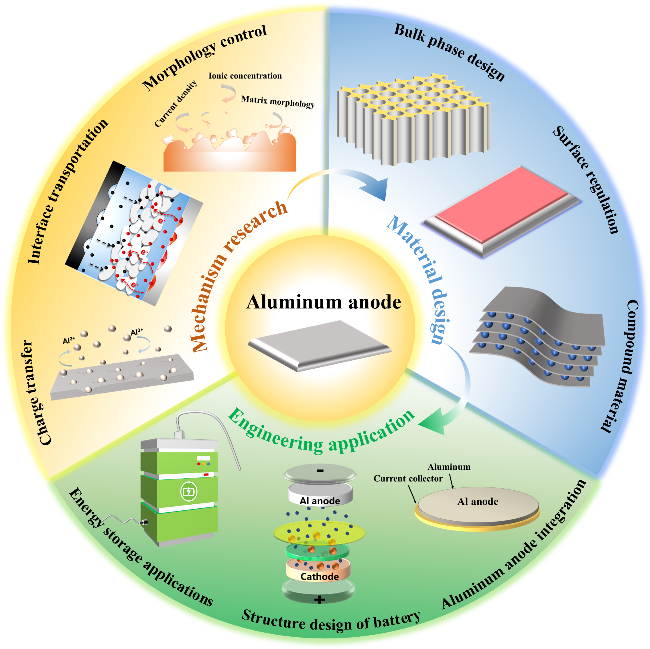
In conclusion, aluminum batteries, as one of the most promising metal battery systems for the "post-lithium era," have attracted increasing attention. The design and optimization of aluminum anodes are crucial for enhancing the performance of aluminum batteries (Fig. 9). Surface passivation is one of the issues associated with metallic aluminum, where the alumina layer limits interfacial conductivity and ion transport performance of the aluminum anode. Therefore, regulating the passivation layer of the aluminum anode is vital for improving battery performance. By employing anode pretreatment strategies, such as surface modification, three-dimensional structural design, and alloying of the aluminum anode, the passivation layer can be improved, thereby enhancing the performance of aluminum batteries. Localized corrosion is another challenge faced by aluminum anodes. Anode alloying, surface modification, and constructing aluminum-based composite materials are currently effective solutions for suppressing self-corrosion of aluminum anodes, which are also applicable to non-aqueous rechargeable aluminum batteries. Additionally, using non-corrosive organic electrolytes and introducing functional additives for interface modification are important approaches to addressing corrosive electrolytes. Aluminum dendrites can easily penetrate the separator, causing safety hazards, and detached dendrites can form dead aluminum, reducing the coulombic efficiency. Strategies such as constructing in-situ SEI layers, three-dimensional structural design, surface modification, 3D printing technology, and anode-free designs can control the diffusion rate of Al3+ and the charge transfer/nucleation rate, enabling uniform deposition of aluminum and thus suppressing dendrite growth.
图9 高性能铝电池负极的发展前景

Fig.9 The development prospect of high-performance aluminum battery anode

However, the research on aluminum anodes is still in its preliminary stage overall, and numerous challenging issues remain to be systematically addressed. In terms of mechanism studies, the multi-electron transfer and ion interfacial transport mechanisms of Al3+ in different electrolyte systems are still unclear. The kinetic mechanisms of electrochemical deposition and dissolution reactions on aluminum anodes are not well understood, and the key influencing factors remain ambiguous, leading to a lack of theoretical basis for controlling the microstructure of aluminum anode surfaces. Therefore, it is urgent to conduct mechanistic studies related to aluminum anode interface reactions, particularly by developing in situ characterization techniques with high temporal/spatial/energy resolution applicable to aluminum battery electrolyte systems, to achieve a real-time, dynamic, and comprehensive understanding of the electrochemical laws and mechanisms at the aluminum anode interface. Compared with lithium-ion batteries, the current characterization methods applicable to aluminum batteries are limited, which is related to the unique properties of metallic aluminum anodes, the distinct electrolytes, and reaction mechanisms of aluminum batteries. As a result, the electrochemical testing and characterization methods used for lithium and sodium batteries cannot be directly applied to aluminum batteries. Therefore, targeted research on aluminum battery mechanisms should be carried out to explore novel testing and characterization methods suitable for aluminum batteries, while also adapting, screening, and modifying testing and characterization techniques from other battery systems in accordance with the characteristics of aluminum batteries. In terms of material design, many aluminum anodes currently fail to meet the demands of aluminum battery development, especially with limited reports on pouch full cells, and insufficient investigation into the electrochemical performance of existing aluminum anodes under practical conditions such as low N/P ratios and large-area configurations. Therefore, further efforts are needed to refine the theoretical framework and methodologies for aluminum anode design from aspects such as bulk material design, surface regulation, and construction of composite anodes, while also considering scalability and cost control. Regarding engineering applications, adequate research on large-scale aluminum anode fabrication processes and full-cell design is still lacking, which restricts the application of battery devices in energy storage. Thus, it is essential to develop and improve large-scale aluminum anode fabrication techniques, including integrated design of aluminum anodes and current collectors, and on this basis, design and optimize full-cell structures to realize high-performance large-capacity pouch full-cell devices, while preliminarily exploring and evaluating the application of aluminum batteries in energy storage systems. In summary, aluminum batteries have enormous development space and application potential. The design and construction of high-performance aluminum anodes will significantly promote the advancement and practical application of aluminum batteries.
[1]
Wang Y, Chen R, Chen T, Lv H, Zhu G, Ma L, Wang C, Jin Z, Liu J. Energy Storage Mater., 2016, 4: 103.

[2]
Zhang Y, Liu S Q, Ji Y J, Ma J M, Yu H J. Adv. Mater., 2018, 30(38): 1706310.

[3]
Chao D L, Zhou W H, Xie F X, Ye C, Li H, Jaroniec M, Qiao S Z. Sci. Adv., 2020, 6(21): eaba4098.

[4]
Liang Y L, Dong H, Aurbach D, Yao Y. Nat. Energy, 2020, 5(9): 646.

[5]
Li Q F, Qiu Z X. J. Northeast. Univ., 2001, 22(2): 130

(李庆峰, 邱竹贤. 东北大学学报, 2001, 22(2): 130).

[6]
Han X M, Bai Y, Zhao R, Li Y, Wu F, Wu C. Prog. Mater. Sci., 2022, 128: 100960.

[7]
Zagal J H. J. Solid State Electrochem., 2020, 24(9): 2195.

[8]
Zaromb S. J. Electrochem. Soc., 1962, 109(12): 1125.

[9]
Gifford P R, Palmisano J B. J. Electrochem. Soc., 1988, 135(3): 650.

[10]
Nayak B, Misra M M. J. Appl. Electrochem., 1977, 7(1): 45.

[11]
Gifford P R, Palmisano J B. J. Electrochem. Soc., 1987, 134(3): 610.

[12]
Dymek C J, Williams J L, Groeger D J, Auborn J J. J. Electrochem. Soc., 1984, 131(12): 2887.

[13]
Zein El Abedin S, Giridhar P, Schwab P, Endres F. Electrochem. Commun., 2010, 12(8): 1084.

[14]
Jayaprakash N, Das S K, Archer L A. Chem. Commun., 2011, 47(47): 12610.

[15]
Lin M C, Gong M, Lu B G, Wu Y P, Wang D Y, Guan M Y, Angell M, Chen C X, Yang J, Hwang B J, Dai H J. Nature, 2015, 520(7547): 324.

[16]
Wang D Y, Wei C Y, Lin M C, Pan C J, Chou H L, Chen H A, Gong M, Wu Y P, Yuan C Z, Angell M, Hsieh Y J, Chen Y H, Wen C Y, Chen C W, Hwang B J, Chen C C, Dai H J. Nat. Commun., 2017, 8: 14283.

[17]
Wang L, Lin H N, Kong W H, Hu Y, Chen R P, Zhao P Y, Shokouhimehr M, Zhang X L, Tie Z X, Jin Z. Nanoscale, 2020, 12(23): 12531.

[18]
Ju S L, Ye J K, Meng Y, Xia G L, Yu X B. Adv. Energy Mater., 2022, 12(33): 2201653.

[19]
Feng X Q, Ma Y L, Hong N, Zhang S Y, An C S, Li J F. Prog.Chem., 2022, 34(2): 319

(冯小琼, 马云龙, 红宁, 张世英, 安长胜, 李劲风. 化学进展, 2022, 34(2): 319).

[20]
Yoo D J, Heeney M, Glöcklhofer F, Choi J W. Nat. Commun., 2021, 12: 2386.

[21]
Guo Y X, Wang W, Lei H P, Wang M Y, Jiao S Q. Adv. Mater., 2022, 34(13): 2110109.

[22]
Zhang D, Zhang X, Wang B Y, He S M, Liu S Q, Tang M X, Yu H J. J. Mater. Chem. A, 2021, 9(14): 8966.

[23]
Liu Y S, Li Y H, Zuo F K, Liu J, Xu Y F, Yang L, Zhang H, Wang H Z, Zhang X Y, Liu C Y, Li Q, Li H S. Small, 2022, 18(34): 2203236.

[24]
Zhang D, Chu W Q, Wang D Y, Li S X, Zhao S, Zhang X, Fu Y Z, Yu H J. Adv. Funct. Mater., 2022, 32(39): 2205562.

[25]
Ma L, Lv Y, Wu J, Chen Y, Jin Z. Adv. Energy Mater., 2021, 11(24): 2100770.

[26]
Huang Z, Wang W, Song W L, Wang M Y, Chen H S, Jiao S Q, Fang D N. Angew. Chem. Int. Ed., 2022, 61(24): e202202696.

[27]
Sungjemmenla , Soni C B, Kumar V. Nanoscale Adv., 2021, 3(6): 1569.

[28]
Geng X, Hou X, He X, Fan H J. Adv. Energy Mater., 2024, 14(12): 2304094.

[29]
Balland V, Mateos M, Singh A, Harris K D, Laberty-Robert C, Limoges B. Small, 2021, 17(23): 2101515.

[30]
Jia B E, Thang A Q, Yan C S, Liu C T, Lv C D, Zhu Q, Xu J W, Chen J, Pan H G, Yan Q Y. Small, 2022, 18(43): 2107773.

[31]
Dong C R, Xu F, Chen L, Chen Z X, Cao Y L. Small Struct., 2021, 2(7): 2100001.

[32]
Wang Y G, Yi J, Xia Y Y. Adv. Energy Mater., 2012, 2(7): 830.

[33]
Hu E H, Jia B E, Zhu Q, Xu J W, Loh X J, Chen J, Pan H G, Yan Q Y. Small, 2024: 2309252.

[34]
Chen C Y, Tsuda T, Kuwabata S. Chem. Commun., 2020, 56(97): 15297.

[35]
Holleck G L. J. Electrochem. Soc., 1972, 119(9): 1158.

[36]
Pang Q Q, Meng J S, Gupta S, Hong X F, Kwok C Y, Zhao J, Jin Y X, Xu L K, Karahan O, Wang Z Q, Toll S, Mai L Q, Nazar L F, Balasubramanian M, Narayanan B, Sadoway D R. Nature, 2022, 608(7924): 704.

[37]
Tu J G, Wang J X, Zhu H M, Jiao S Q. J. Alloys Compd., 2020, 821: 153285.

[38]
Wang K Y, Liu K, Yang C, Chen Z Y, Zhang H T, Wu Y L, Long Y Z, Jin Y, He X M, Li M C, Wu H. Energy Storage Mater., 2022, 48: 356.

[39]
Liu Q X, El Abedin S Z, Endres F. Surf. Coat. Technol., 2006, 201(3/4): 1352.

[40]
Li C, Patra J, Li J, Rath P C, Lin M H, Chang J K. Adv. Funct. Mater., 2020, 30(12): 1909565.

[41]
Choi S, Go H, Lee G, Tak Y. Phys. Chem. Chem. Phys., 2017, 19(13): 8653.

[42]
Das S K, Mahapatra S, Lahan H. J. Mater. Chem. A, 2017, 5(14): 6347.

[43]
Long Y, Li H, Ye M C, Chen Z Y, Wang Z H, Tao Y, Weng Z, Qiao S Z, Yang Q H. Energy Storage Mater., 2021, 34: 194.

[44]
Zhang X L, Tang Y B, Zhang F, Lee C S. Adv. Energy Mater., 2016, 6(11): 1502588.

[45]
Huang Z, Wang W, Kou M Y, Lei H P, Luo Y W, Jiao S Q. J. Mater. Sci. Technol., 2023, 152: 86.

[46]
Lin Z J, Mao M L, Yue J M, Liu B H, Wu C, Suo L M, Hu Y S, Li H, Huang X J, Chen L Q. ACS Mater. Lett., 2020, 2(7): 808.

[47]
Huang Z, Song W L, Liu Y J, Wang W, Wang M Y, Ge J B, Jiao H D, Jiao S Q. Adv. Mater., 2022, 34(8): 2104557.

[48]
Yu H J, He S M. J. Beijing Univ. Technol., 2020, 46(6): 0254

(尉海军, 何世满. 北京工业大学学报, 2020, 46(6):0254).

[49]
Liu H Q, He Y N, Cao K Z, Jiang Y, Liu X G, Jing Q S, Jiao L F. Chem. Eng. J., 2022, 433: 133572.

[50]
Loaiza L C, Lindahl N, Johansson P. J. Electrochem. Soc., 2023, 170(3): 030512.

[51]
Yang H Y, Wu F, Bai Y, Wu C. J. Energy Chem., 2020, 45: 98.

[52]
Zhu Y, Hua Z F, Lu Y, Wang Z Y, Tian Z L, Peng K. Energy Fuels, 2023, 37(15): 11367.

[53]
Meng P Y, Huang J, Yang Z H, Wang F, Lv T, Zhang J, Fu C P, Xiao W. Adv. Mater., 2022, 34(8): 2106511.

[54]
Hao L S, Zheng F, Chen X P, Li J Y, Wang S P, Fan Y P. Materials, 2020, 13(3): 779.

[55]
Sabi N, Palanisamy K, Rahide F, Daboss S, Kranz C, Dsoke S. Batter. Supercaps, 2023, 6(11): e202300298.

[56]
Moghanni-Bavil-Olyaei H, Arjomandi J. RSC Adv., 2016, 6(33): 28055.

[57]
Li M, Lu J, Ji X L, Li Y G, Shao Y Y, Chen Z W, Zhong C, Amine K. Nat. Rev. Mater., 2020, 5(4): 276.

[58]
Jiang Y D, Fang L P, Luo L Z, Wang S F, Wang X L. J. Appl. Electrochem., 2018, 48(7): 827.

[59]
Chen H, Xu H Y, Zheng B N, Wang S Y, Huang T Q, Guo F, Gao W W, Gao C. ACS Appl. Mater. Interfaces, 2017, 9(27): 22628.

[60]
She D M, Song W L, He J, Li N, Chen H S, Jiao S Q, Fang D N. J. Electrochem. Soc., 2020, 167(13): 130530.

[61]
Ren J M, Fu C P, Dong Q, Jiang M, Dong A P, Zhu G L, Zhang J, Sun B D. ACS Sustainable Chem. Eng., 2021, 9(5): 2300.

[62]
Mokhtar M, Talib M Z M, Majlan E H, Tasirin S M, Ramli W M F W, Daud W R W, Sahari J. J. Ind. Eng. Chem., 2015, 32: 1.

[63]
Cho Y J, Park I J, Lee H J, Kim J G. J. Power Sources, 2015, 277: 370.

[64]
Ferdian D, Pratesa Y, Togina I, Adelia I. Procedia Eng., 2017, 184: 418.

[65]
Ma J L, Wen J B, Zhu H X, Li Q A. J. Power Sources, 2015, 293: 592.

[66]
Ma J L, Wen J B, Gao J W, Li Q A. J. Power Sources, 2014, 253: 419.

[67]
Sharma S S, Crowley P J, Manthiram A. ACS Sustainable Chem. Eng., 2021, 9(43): 14515.

[68]
Fu G S, Kang J X. Spec. Cast. Nonferrous Alloys, 1999, (S1): 33

(傅高升, 康积行. 特种铸造及有色合金, 1999, (S1):33).

[69]
Zhang M, Xiang L, Galluzzi M, Jiang C L, Zhang S Q, Li J Y, Tang Y B. Adv. Mater., 2019, 31(18): 1900826.

[70]
Yan C S, Lv C D, Wang L G, Cui W, Zhang L Y, Dinh K N, Tan H T, Wu C, Wu T P, Ren Y, Chen J Q, Liu Z, Srinivasan M, Rui X H, Yan Q Y, Yu G H. J. Am. Chem. Soc., 2020, 142(36): 15295.

[71]
Ran Q, Zeng S P, Zhu M H, Wan W B, Meng H, Shi H, Wen Z, Lang X Y, Jiang Q. Adv. Funct. Mater., 2023, 33(1): 2211271.

[72]
Ran Q, Shi H, Meng H, Zeng S P, Wan W B, Zhang W, Wen Z, Lang X Y, Jiang Q. Nat. Commun., 2022, 13: 576.

[73]
Liu P. Metall. Anal., 2018, 38(04): 32

(刘攀. 冶金分析, 2018, 38(04): 32).

[74]
Wang X, Zu Y, Li X E. Chem. Ind. Eng. Prog., 2000, 019(01): 67

(王训, 祖庸, 李晓娥. 化工进展, 2000, 019(01): 67).

[75]
Shen X J, Sun T, Yang L, Krasnoslobodtsev A, Sabirianov R, Sealy M, Mei W N, Wu Z J, Tan L. Nat. Commun., 2021, 12: 820.

[76]
Wang Y F, Yu Y, Wang J L, Peng L H, Zuo Y X, Zuo C C. Adv. Mater. Interfaces, 2021, 8(19): 2100786.

[77]
Jiao H D, Jiao S Q, Song W L, Xiao X, She D M, Li N, Chen H S, Tu J G, Wang M Y, Fang D N. Nano Res., 2021, 14(3): 646.

[78]
He S M, Wang J, Zhang X, Chu W Q, Zhao S, He D P, Zhu M, Yu H J. J. Mater. Chem. A, 2023, 11(32): 17020.

[79]
Hao Q F, Chen F, Chen X T, Meng Q H, Qi Y, Li N. Electrochim. Acta, 2022, 421: 140495.

[80]
Jiao H D, Jiao S Q, Li S J, Song W L, Chen H S, Tu J G, Wang M Y, Tian D H, Fang D N. Chem. Eng. J., 2020, 391: 123594.

[81]
Xu T, Yao L, Xia G L, Yu X B. Energy Storage Mater., 2023, 63: 103057.

[82]
Wei M H, Wang K L, Zuo Y Y, Wang H W, Zhao S Y, Zhang P F, Zhang S M, Shui Y F, Pei P C, Chen J F. Energy, 2023, 267: 126610.

[83]
Yao L, Ju S L, Xu T, Wang W B, Yu X B. ACS Nano, 2023, 17(24): 25027.

[84]
Yu J S, Hu Z F, Du Z X. J. Electrochem. Soc., 2020, 167(14): 140514.

[85]
Kumar S, Rama P, Lieu W Y, Zhang C, Busayaporn W, Chinnadurai D, Yang G L, Xing Z X, Li Y J, Abbas Z, Liu W, Seh Z W. Energy Storage Mater., 2024, 65: 103087.

[86]
Das S, Manna S S, Pathak B. ACS Appl. Energy Mater., 2022, 5(11): 13398.

[87]
Kumar S, Salim T, Verma V, Manalastas W, Srinivasan M. Chem. Eng. J., 2022, 435: 134742.

[88]
Chang S Z, Jin X, He Q Y, Liu T C, Fang J B, Shen Z H, Li Z H, Zhang S, Dahbi M, Alami J, Amine K, Li A D, Zhang H G, Lu J. Nano Lett., 2022, 22(1): 263.

[89]
Qin P P, Wang M, Li N, Zhu H L, Ding X, Tang Y B. Adv. Mater., 2017, 29(17): 1606805.

[90]
Kim S, Lee T K, Kwak S K, Choi N S. ACS Energy Lett., 2022, 7(1): 67.

[91]
Kumar S, Rama P, Yang G L, Lieu W Y, Chinnadurai D, Seh Z W. Nano-Micro Lett., 2023, 15: 21.

[92]
Chu W, Zhang X, Zhao S, Tang M, Li S, Liu S, Yu H. Adv. Funct. Mater., 2023, 34(3): 2305194.

[93]
Liu W, Liu P C, Mitlin D. Adv. Energy Mater., 2020, 10(43): 2002297.

[94]
Zhang S J, Ye J J, Ao H S, Zhang M Y, Li X L, Xu Z B, Hou Z G, Qian Y T. Nano Res., 2023, 16(1): 449.

[95]
Xu Y B, Jia H, Gao P Y, Galvez-Aranda D E, Beltran S P, Cao X, Le P M L, Liu J F, Engelhard M H, Li S, Ren G, Seminario J M, Balbuena P B, Zhang J G, Xu W, Wang C M. Nat. Energy, 2023, 8(12): 1345.

[96]
Hu P, Chen W, Wang Y, Chen T, Qian X H, Li W Q, Chen J Y, Fu J J. ACS Nano, 2023, 17(16): 16239.

[97]
Zhu X Z, Lin Z J, Lai J N, Lv T S, Lin T, Pan H Y, Feng J N, Wang Q Y, Han S, Chen R J, Chen L Q, Suo L M. Angew. Chem. Int. Ed., 2024, 63(5): e202317549.

[98]
Chen J Y, Liu G Y, Han X R, Wu H B, Hu T, Huang Y H, Zhang S H, Wang Y Z, Shi Z X, Zhang Y, Shi L, Ma Y W, Alshareef H N, Zhao J. ACS Nano, 2024, 18(21): 13662.

[99]
Cao J Q, Qian G Y, Lu X Y, Lu X. Small, 2023, 19(10): 2205653.

[100]
He X, Ni Y X, Li Y X, Sun H X, Lu Y, Li H X, Yan Z H, Zhang K, Chen J. Adv. Mater., 2022, 34(15): 2106565.

[101]
Liu X S, Long K C, Qing P, Huang S Z, Xiao P F, Ling C H, Wu Z B, Chen L B. Sci. China Mater., 2023, 66(11): 4349.

[102]
Liu H, Wang E R, Zhang Q, Ren Y B, Guo X W, Wang L, Li G Y, Yu H J. Energy Storage Mater., 2019, 17: 253.

[103]
Wang S X, Guo Y, Du X F, Xiong L L, Huang Z, Li X, Ma M B, Liang Z S, Xie Y H. Energy Storage Mater., 2023, 60: 102826.

[104]
Geng K, Li S F, Yang Y F, Misra R D K. Carbon, 2020, 162: 465.

[105]
Yu Y C, Chen M, Wang S T, Hill C, Joshi P, Kuruganti T, Hu A M. J. Electrochem. Soc., 2018, 165(3): A584.

[106]
Idrees M, Batool S, Cao J W, Javed M S, Xiong S F, Liu C Y, Chen Z W. Nano Energy, 2022, 100: 107505.

[107]
Yolshina L A, Muradymov R V, Korsun I V, Yakovlev G A, Smirnov S V. J. Alloys Compd., 2016, 663: 449.

[108]
Volkov V, Eliseeva S, Pimenov A, Shvarev A. Int. J. Electrochem. Sci., 2016, 11(11): 8981.

[109]
Zheng J X, Bock D C, Tang T, Zhao Q, Yin J F, Tallman K R, Wheeler G, Liu X, Deng Y, Jin S, Marschilok A C, Takeuchi E S, Takeuchi K J, Archer L A. Nat. Energy, 2021, 6(4): 398.

[110]
Tong X, Zhang F, Chen G, Liu X, Gu L, Tang Y. Adv. Funct. Mater., 2017, 8(6): 1701967.

[111]
Xie Y M, Meng X C, Qin Z W, Chang Y X, Mao D X, Wan L, Huang Y X. Energy Storage Mater., 2022, 49: 537.

[112]
Zhao Y G, Luo J Z. CN 204156012 U. 2015

(赵宇光, 骆建洲. CN 204156012 U. 2015).

[113]
Meng Y H, Wang J Z, Wang M M, Peng Q, Xie Z H, Zhu Z X, Liu Z C, Wang W P, Zhang K, Liu H X, Ma Y R, Li Z Y, Chen W. Adv. Energy Mater., 2023, 13(30): 2301322.

[114]
Zhao Q, Zheng J X, Deng Y, Archer L. J. Mater. Chem. A, 2020, 8(44): 23231.

[115]
Wang L, Song X M, Hu Y, Yan W, Tie Z X, Jin Z. Energy Storage Mater., 2022, 44: 461.

[116]
Lin L D, Qin K, Hu Y S, Li H, Huang X J, Suo L M, Chen L Q. Adv. Mater., 2022, 34(23): 2110323.

[117]
Louli A J, Eldesoky A, de Gooyer J, Coon M, Aiken C P, Simunovic Z, Metzger M, Dahn J R. J. Electrochem. Soc., 2022, 169(4): 040517.

Outlines

/