Home Journals Progress in Chemistry
Progress in Chemistry

Abbreviation (ISO4): Prog Chem      Editor in chief: Jincai ZHAO

About  /  Aim & scope  /  Editorial board  /  Indexed  /  Contact  / 
Review

Analysis and Application of Covalent Organic Frame Materials in Environmental Monitoring

  • Yalin Xie ,
  • Rui Tan ,
  • Qiuwen Huang ,
  • Na Zhou ,
  • Yan Zhao , * ,
  • Xiaojun Luo , *
Expand
  • School of Science, Xihua University, Chengdu 610039, China
*(Xiaojun Luo);
(Yan Zhao)

Received date: 2024-10-31

  Revised date: 2025-02-06

  Online published: 2025-06-19

Supported by

the National Natural Science Foundation of China(2023YFB3812400)

the National Natural Science Foundation of China(2023YFB3812402)

Abstract

With the continuous improvement of environmental monitoring requirements, the application of new materials has attracted much attention. Covalent organic framework (COF) materials have a series of remarkable advantages, such as structural design, large specific surface area, high porosity and good chemical stability, and show great potential in the key field of environmental monitoring. This paper focuses on the analysis and application of COF materials in the field of environmental monitoring. The unique advantages of COF in the treatment and detection of heavy metal ions, organic pollutants and gas pollutants are described in detail, and the application examples and effects of COF combined with modern analysis and detection techniques and tools are analyzed. It can make full use of its structural characteristics to achieve high efficiency enrichment or adsorption of target pollutants in complex environmental samples, so as to simplify the accurate detection process of modern analytical instruments such as high performance liquid chromatography, gas chromatography, mass spectrometry, and improve the detection sensitivity and reduce the detection limit. In addition, the application examples and effectiveness of these analytical tools, such as electrochemical sensors, fluorescence sensors, indicator enhanced Raman spectroscopy, colorimetry and gas sensors, in the detection of common environmental pollutants are also discussed. At the same time, some limitations of COF materials in practical applications are also clearly pointed out. Finally, the future development direction and prospect are prospected, and some thoughts and suggestions are provided for its further development in the field of environmental detection.

Contents

1 Introduction

2 Application of COF materials in the analysis of environmental pollutants

2.1 Heavy metal ions

2.2 Organic pollutant

2.3 Gas pollutants

3 Limitations of COF materials and countermeasures

4 Conclusion and outlook

Cite this article

Yalin Xie , Rui Tan , Qiuwen Huang , Na Zhou , Yan Zhao , Xiaojun Luo . Analysis and Application of Covalent Organic Frame Materials in Environmental Monitoring[J]. Progress in Chemistry, 2025 , 37(7) : 1035 -1047 . DOI: 10.7536/PC241010

1 Introduction

Environmental monitoring, through the acquisition of environmental parameters and the application of physical, chemical, and biological methods for analysis, plays a crucial role in protecting the ecological environment, safeguarding public health, and promoting green technologies and sustainable development[1]. However, in practical work, environmental monitoring faces numerous challenges. On one hand, pollutants are diverse in type and vary significantly in properties, presenting different forms in water, soil, and the atmosphere. In environmental media such as water and soil, heavy metal ions and organic pollutants are the two main categories of contaminants. Heavy metal ions typically exist in an ionic state, dissolved in environmental media or adsorbed onto particle surfaces; they are non-volatile and have relatively high density. Organic pollutants can dissolve, emulsify, or suspend in water, while in soil they are adsorbed onto soil particles, with some being volatile. In the atmospheric environment, the primary pollutants are substances dispersed in gaseous form, which exhibit high diffusivity and mobility[2-3]. On the other hand, given the complex existence states of pollutants, environmental detection technologies encounter many issues when monitoring trace pollutants. For example, detection results may suffer from poor accuracy or insufficient sensitivity; errors and data loss may also occur during data collection, transmission, and processing; and in some economically underdeveloped regions, due to lack of funding, it is difficult to equip advanced monitoring devices or attract highly qualified monitoring personnel[4].
In fields such as analytical sensing and detection, various materials including metal ions, bioinorganic units, silica, and carbon materials have been widely applied, such as metal-organic frameworks (MOFs), covalent organic frameworks (COFs), hydrogen-bonded organic frameworks (HOFs), and carbon nanotubes[5-8]. These materials each have their own strengths, but also their respective shortcomings (Table 1). In the field of environmental monitoring, COFs materials have demonstrated particularly significant advantages. Compared with traditional detection methods and materials, COFs materials can effectively overcome many limitations, meeting the growing demand for precise, efficient, and sensitive environmental monitoring. For instance, standalone MOFs and HOFs materials suffer from structural instability under harsh chemical conditions; although HOFs materials exhibit better flexibility and reversibility, they lack sufficient designability in complex environmental detection scenarios[9]. Meanwhile, carbon nanotube materials also perform slightly worse than COFs materials in terms of detection response time and detection limits[10]. COFs materials not only possess a high specific surface area and tunable pore structures, enabling them to adsorb and concentrate low-concentration heavy metal ions, complex organic pollutants, and gaseous pollutants, thereby significantly enhancing detection sensitivity[11-12], but their customizable chemical structures also provide high selectivity toward specific pollutants, allowing for precise identification of target contaminants and effectively reducing interference. Furthermore, the excellent chemical and thermal stability of COFs materials ensures the accuracy and reliability of detection results in complex environments[13]. As research continues to deepen, the combination of COFs materials with advanced detection technologies and analytical tools is expected to drive environmental monitoring technology toward higher precision and greater efficiency, bringing new opportunities and significant breakthroughs to environmental monitoring[14].
表1 代表性材料用于环境检测的优劣对比

Table 1 Comparison of the advantages and disadvantages of representative materials for environmental testing

Materials Advantage Disadvantage
Carbon nanotube Good thermal stability Difficult purification
Reactive site abundance Structure is not easy to control
Good device compatibility -
MOF Large specific surface area, strong adsorption capacity Poor stability in harsh environments
Abundant reactive active sites The cost of mass production is high
Designable chemical structure -
HOF Mild assembly conditions The types of monomers synthesized by the material are relatively few
Good chemical stability Poor physical stability
Controllable pore structure -
Good flexibility and reversibility -
COF Good chemical and thermal stability Harsh synthesis conditions
High surface area and porous structure The cost of mass production is high
Abundant reactive active sites Operation inconvenience caused by powder form
Designable chemical structure -
This article reviews specific examples and recent advances in the use of COFs materials combined with modern detection technologies and analytical tools for the treatment and detection of three categories of common environmental pollutants: heavy metal ions, organic pollutants, and gaseous pollutants. Finally, it summarizes the challenges faced by COFs materials in environmental detection and their future application prospects.

2 Applications of COFs Materials in Environmental Pollutant Analysis

2.1 heavy metal ions

Heavy metal ions are diverse and difficult to degrade in the environment, exhibiting persistence and bioaccumulation, posing a significant challenge for environmental monitoring and protection. In recent years, numerous researchers have been dedicated to overcoming this challenge, developing various adsorption and separation methods for heavy metal ions, such as chemical precipitation, ion exchange, and membrane separation[15-16]. Meanwhile, a wide range of techniques for detecting heavy metal ions have also emerged, including atomic absorption spectroscopy, inductively coupled plasma mass spectrometry, and electrochemical analysis[17-18].However, these conventional methods have some non-negligible drawbacks. For instance, certain adsorption methods are costly, some adsorbents have small surface areas and low adsorption efficiency, or detection techniques are complex to operate with limited sensitivity, or their selectivity for specific heavy metal ions is not ideal[19-20].Against this backdrop, COFs materials have attracted widespread attention due to their unique advantages and have been used for the enrichment and separation of various heavy metal ions, including arsenic, cadmium, mercury, lead, and uranium[21-22]. Additionally, when combined with electrochemical, fluorescence, surface-enhanced Raman, and colorimetric methods, they enable efficient and highly sensitive detection of heavy metal ions[23-25].

2.1.1 COFs materials for adsorption and separation of heavy metal ions

In the adsorption process of COFs materials for heavy metal ions, the absorption mechanisms include coordination bonding/chelation effect[26],electrostatic interactions[27],hydrogen bonding, and ion exchange[28].Among these, COFs materials modified with heteroatom-containing functional groups such as —SH, —NH2, and —COOH primarily function through coordination chelation. Specific examples are shown in Table 2.While the adsorption mechanisms do play a certain role, they are also influenced by external environmental conditions. Factors such as solution pH, temperature, and ionic strength can significantly affect the adsorption performance[21].Additionally, the morphology of COFs materials themselves is another critical factor. Due to the diverse morphologies of COFs materials, including nanoparticles, thin films, and fibers, their selectivity for adsorbing heavy metal ions varies accordingly.
表2 部分COFs材料通过配位键/螯合效应吸附重金属离子的实例

Table 2 Examples of some COFs materials adsorbing heavy metal ions through coordination bond/chelation effect

Mechanism Specific example
COFs material Acting group Acting ion Ref
Coordination bond/
chelate effect
1 TPB-DMTP-COF-SH Sulfhydryl & iminoyl Sn(II), Pb(II), Cd(II), As(III) 29
2 COF-LZU8 Thioether group Hg(II) 30
3 TpPa-NH2@EDTA EDTA Ag(Ⅰ), Pb(II),Cr(Ⅲ), Cu(II), Ni(II), Fe(Ⅲ) 31
4 COF-TE\COF-TP Acylamino Pb(II) 32
5 TAPA-BTDC Thienyl Ag(I) 33
6 Tp-DTA Carboxyl Sr(II) 34
7 Tp-Tta-COOH\Tp-Tapb-COOH Carboxyl Cr(VI) 35
8 TTP-COF Imide group Cu(II) 36
9 TQY-COF Carbonyl & pyrazinyl UO2(II) 37
Wang et al.[38]utilized COFs materials in the form of nano-fiber clusters, which exhibit good crystallinity and thermal stability, to achieve stable adsorption and removal of copper ions. Compared with structures such as thin-layer fibers, COFs materials with larger surface areas and shorter mass transfer distances are of greater significance for effectively adsorbing heavy metal ions. Therefore, Liu et al.[39]proposed a simple strategy for transitioning from an amorphous to a crystalline state, which effectively enhances conductivity and pore area while preserving the original structure of hollow COFs materials. This approach gives them advantages in large-area contact and rapid adsorption, enabling effective adsorption and detection of Pb2+,Cu2+,and Hg2+. It is precisely the morphological diversity and designability of COFs materials that endow them with unique selective characteristics in the field of heavy metal ion adsorption and removal, offering more possibilities for precise and efficient detection of heavy metal ions.

2.1.2 COFs materials combined with electrochemical sensors for detecting heavy metal ions

COFs materials possess a large specific surface area, good conductivity, and abundant active sites. Introducing them into electrochemical sensors opens up new possibilities for enhancing sensor performance. For instance, modifying electrode surfaces with COFs can significantly improve the performance of electrochemical sensors used for detecting heavy metal ions. Mirzaei et al.[40]developed a selective electrochemical sensor based on glassy carbon electrodes (GCEs) modified with covalent organic frameworks (COFs) and carbon black (CB), achieving simultaneous detection of Zn2+,Cd2+,Pb2+,and Hg2+, with detection limits of 0.003, 0.002, 0.001, and 0.0003 nmol/L, respectively. Wang et al.[41]modified COFs materials with thiol groups and subsequently employed square-wave anodic stripping voltammetry to selectively determine lead(II). This method exhibits excellent precision, a wide linear range (0.05~20 ng/mL, r = 0.991), and a low detection limit (0.015 ng/mL), with the detection limit being lower than the World Health Organization's permissible level of lead(II) in drinking water (10 ng/mL).

2.1.3 COFs materials combined with fluorescent sensors for detecting heavy metal ions

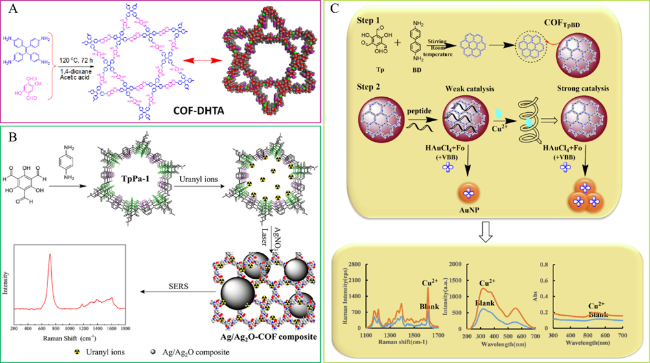
Through careful overall design, COFs materials can create multifunctional detection systems in conjunction with fluorescent monomers, meeting diverse detection needs. Chen et al.[42]utilized a pre-designed O, N, O′-chelating site as a COF-fluorescent sensor, enabling simultaneous detection and adsorption of Fe3+(with a detection limit of 3.07 μmol/L). It can also serve as a gas storage adsorbent and a volatile organic compound (VOCs) scavenger. Moreover, in practical applications, using COFs as fluorescent sensing materials does not require complex pretreatment steps or stringent experimental conditions, significantly enhancing the convenience and operability of detection[43]. Xiu et al.[44]combined tetraphenylethylene with COF materials featuring a unique pore structure to prepare a covalent organic framework (COF-DHTA), the synthesis scheme of which is shown in Figure 1A. This material exhibits high sensitivity and a good linear relationship in the detection of Al3+, with a detection limit as low as 0.93 μmol/L.
图1 A)COF-DHTA的合成和结构示意图[44];B) Ag/Ag2O-COF复合衬底对铀酰离子的SERS检测示意图[46];C) Cu2+偶联COFTpBD与PTRK催化扩增的SERS/RRS/Abs三模检测[47]

Fig.1 A)Illustration of the synthesis and structure of COF-DHTA[44]; B) Schematic of SERS detection of uranyl ions by the Ag/Ag2O-COF composite substrate[46]; C) SERS/RRS/Abs trimode detection of Cu2+ coupled COFTpBD catalysis amplification with PTRK[47]

2.1.4 COFs materials combined with SERS for the detection of heavy metal ions

Surface-enhanced Raman scattering (SERS) offers advantages such as high sensitivity, non-destructive and in-situ analysis, and ultra-trace analysis at the single-molecule level. Additionally, its rapid and convenient analysis makes SERS highly promising for the sensitive detection of metal ions[45]. The introduction of COFs further enhances detection efficiency, reduces analytical costs, and facilitates the detection of heavy metal ions that are difficult to detect using conventional methods. The porous structure of COFs can eliminate uneven molecular adsorption, block large molecules from entering, and minimize interference from non-target substances, thereby endowing the SERS substrate with high stability and strong anti-interference capability. Gai et al.[46]developed an Ag/Ag2O-COF (covalent organic framework) composite SERS substrate for detecting uranyl ions in environmental aqueous solutions. The schematic diagram of this detection method is shown in Figure 1B. This method achieves a limit of detection (LOD) of 8.9×10⁻¹⁰ mol/L for trace analysis of uranyl ions, which is lower than all previously reported direct detection methods. Shu et al.[47]utilized COF materials with high catalytic activity and stability, combined with a novel peptide-mediated nanocatalysis, to achieve ultra-trace SERS detection of Cu2+. The detection scheme is illustrated in Figure 1C, and an ideal linear range of 0.005~0.115 nmol/L was obtained.

2.1.5 Combining COF materials with colorimetric methods for detecting heavy metal ions

Colorimetry is a method based on the selective absorption of light by substances, causing solutions to exhibit specific colors. It determines the content of the component being measured by comparing or measuring the depth of color in colored solutions. This method offers advantages such as good selectivity, relatively high sensitivity, visual observation capability, and applicability to various matrices[48]. In analytical studies combining COFs materials, their roles in metal ion detection mainly include the following three aspects: (1) serving as color-developing reagents; (2) acting as enzyme-mimetic catalysts; and (3) functioning as supports for metal nanoparticle catalysts[6,49]. These three approaches fully leverage the advantageous characteristics of COFs materials. When used as color-developing reagents, they can enhance the color intensity or changes in absorbance of chromophores. As enzyme-mimetic catalysts, they can overcome the limitations of natural enzymes and improve detection sensitivity. Zhang et al.[50]designed a colorimetric strategy based on two-dimensional covalent organic frameworks, achieving excellent photocatalytic performance and nanozyme activity, thus providing a new approach for the sensitive detection of uranium ions. When used as catalyst supports, they can significantly enhance catalytic activity and stability, reduce detection costs, and ensure long-term stable operation of colorimetric assays. Additionally, through rational structural design and functional group modification, COFs materials can achieve selective binding to heavy metal ions. For instance, Xiu et al.[51]prepared a covalent organic framework (TPDQ-COF) modified with diaminanthraquinone, which, as a colorimetric sensor, achieved satisfactory results in the quantitative detection of Fe2+ and Fe3+, with detection limits of 6.91×10⁻⁷ mol/L and 7.14×10⁻⁷ mol/L, respectively, and demonstrated good recovery rates in real samples.

2.2 Organic pollutants

In today's critical fields of environmental protection and pollutant monitoring, the analysis and detection of organic pollutants have consistently been a research focus and challenge. Gas chromatography (GC), high-performance liquid chromatography (HPLC), fluorescence spectroscopy, enzyme-linked immunosorbent assay (ELISA), and other methods are commonly employed for analyzing and detecting organic pollutants; however, these traditional techniques have numerous limitations[52-53]. With the continuous advancement of materials science, COFs materials are gradually demonstrating their unique advantages in the treatment of organic pollutants. Compared to traditional materials such as activated carbon, COFs possess a high specific surface area, precisely tunable pore structures, and diverse functional groups, making them more targeted for the adsorption and treatment of organic pollutants. Additionally, COFs exhibit strong stability and are easy to separate and recover, unlike activated carbon, which can easily become deactivated under complex conditions due to adsorption saturation and competitive adsorption. COFs can maintain stable performance over long periods and are reusable, thereby reducing treatment costs[54-55]. In particular, COF materials play a crucial role in the treatment or detection of polycyclic aromatic hydrocarbons (PAHs), per- and polyfluoroalkyl substances and their derivatives, pesticide residues, antibiotics, and industrial waste[56]. Application examples of certain COFs in organic pollutant treatment are shown in Table 3. Notably, after using COFs materials, not only can organic pollutants be enriched and removed through adsorption, but also detection performance is significantly improved, greatly enhancing detection sensitivity, allowing even trace amounts of pollutants to be accurately detected.
表3 部分COFs材料用于有机污染物处理的应用

Table 3 Some COFs materials are used in organic pollutant treatment applications

COFs material Analyte Application ref
COF/NP-fibers Organic dyestuff Adsorption removal degradation 57
COF-TzDBd Organic dyestuff Adsorption 58
[OMe]100-COF Perfluorooctanoic acid (PFOA) and perfluorooctanesulfonic acid (PFOS) Adsorption removal 59
TPDGCl Perfluoroalkyl carboxylic acids (PFCAs) Adsorption removal 60
F-COF Polyfluoroalkyl substances (PFASs) Adsorption removal 61
COF-NH2 Polyfluoroalkyl substances (PFASs) SPME 62
COF-LZU1@PEI@Fe3O4 Polycyclic aromatic hydrocarbon(PAH) MSPE\HPLC 63
TpPa-1 Polycyclic aromatic hydrocarbon(PAH) MSPE 64
MCOF Polycyclic aromatic hydrocarbon(PAH) D-μ-SPE\GC-MS 65
TAPB-TMC-COF Polycyclic aromatic hydrocarbon(PAH) SPME\GC-MS 66
TpPa-1-1000 Polycyclic aromatic hydrocarbon(PAH) SPME\GC-MS 67
SCAU-1 Antibiotic SPE 68
Fe3O4@COFs Antibiotic MSPE\HPLC 69
Fe3O4@TpBD Antibiotic SPE 70
Fe3O4@COF-(NO22 Pesticide residue MSPE\HPLC 71
NH2@COF Pesticide residue SPE\HPLC 72
N0-COF Bisphenol A (BPA) OT-CEC 73
TFPB-BD Polychlorinated biphenyl SPME 74

2.2.1 COFs materials are used for the enrichment and treatment of organic pollutants.

Organic pollutants in the environment are often present at low concentrations. The designed COF materials possess outstanding adsorption and treatment capabilities, effectively enriching low-concentration organic pollutants in the environment and creating favorable conditions for subsequent precise detection using modern instruments, thereby enhancing detection sensitivity. Meanwhile, using COF materials for enrichment can concentrate target pollutants, achieving adsorption and removal of organic contaminants. The adsorption mechanism is similar to that for heavy metal ions, involving electrostatic interactions, hydrophobic interactions, and hydrogen bonding[56].For instance, Zhang et al.[59] utilized the synergistic effects of electrostatic and hydrophobic interactions of their designed COF material to achieve efficient removal of per- and polyfluoroalkyl substances (PFAAs), which are persistent and bioaccumulative. In terms of supporting instrumental detection, Zhang et al.[65] employed an in-situ method to prepare a novel paper-based material based on covalent organic frameworks (COFs). This material, characterized by its flexibility and stability, enabled effective detection and identification of polycyclic aromatic hydrocarbons in real corn oil samples using paper spray ionization mass spectrometry (PSI-MS), with a limit of detection (LOD) for phenanthrene of 0.50 ng/μL.
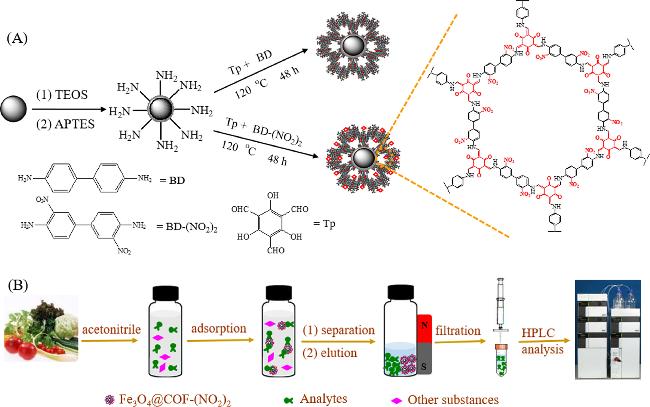
In addition, the selective enrichment capability of COFs materials can effectively reduce interference from various non-target substances that may be present in complex environmental samples, thereby enhancing the accuracy and reliability of detection. Yang et al.[66]also achieved satisfactory results in detecting polycyclic aromatic hydrocarbons using COFs materials. They synthesized a novel COFs material via amide coupling reaction, which was used as a coating for steel fibers in solid-phase microextraction of PAHs. The final detection results showed a wide linear range (0.2 ng/L~2 μg/L), low limits of detection (0.29~0.94 ng/L, S/N = 3), and high enrichment factors (EFs, 819~2420). Yan et al.[67]prepared porous carbon based on COFs materials, which enhanced the extraction capability for polycyclic aromatic hydrocarbons. Combined with gas chromatography-mass spectrometry (GC-MS) technology, the LOD was as low as 3.12~8.55 μg/kg, and excellent reliability was demonstrated in real samples. Wang et al.[69]A new type of triazine-based COFs material, named SCAU-1, was prepared by hydrothermal method, and SNW-1 was also synthesized as a comparative material. To investigate their adsorption properties, five sulfonamides (SAs) and four tetracyclines (TCs) antibiotics were selected for detection. Using UPLC-MS/MS analysis, the proposed method exhibited low LOD, a wide linear range, and good repeatability. Lu et al.[71]A functionalized magnetic covalent organic framework (nitro-Fe3O4@COF-(NO2)2) was employed for solid-phase extraction (MSPE) of six neonicotinoid pesticide residues in vegetable samples, achieving high enrichment factors of 170~250. Simultaneously, HPLC detection yielded a good linear range (0.02~0.05 ng/mL), with detection limits (S/N = 3) ranging from 0.02 to 0.05 ng/mL. The detection procedure is illustrated in Figure 2.
图2 A)合成的Fe3O4@COF-(NO22微球示意图; B)使用Fe3O4@COF-(NO22吸附剂的蔬菜样品MSPE程序[71]

Fig.2 A)Schematic illustration of the synthesized Fe3O4@COF-(NO22 microspheres; B)Procedure for MSPE of vegetable sample using Fe3O4@COF-(NO22 sorbent[71]

In this process, both the morphology and functional groups of COF materials play an indispensable and critical role. From a morphological perspective, structures such as high-surface-area nanosheets and porous spheres provide more adsorption sites; for instance, the two-dimensional structure of nanosheets increases the contact area with pollutants. An appropriate pore size distribution and well-organized pore channels create a molecular sieving effect, offering smooth diffusion pathways for pollutants and enhancing adsorption selectivity and kinetic performance. From the perspective of functional groups, their chemical properties determine the interactions with pollutants. For example, amino and carboxyl groups can achieve specific adsorption through hydrogen bonding, electrostatic interactions, and ion exchange; aromatic functional groups can engage in π-π stacking with pollutants possessing conjugated structures; and hydrophilic/hydrophobic groups regulate the adsorption capacity for pollutants of varying polarity. These factors synergistically influence the treatment and enrichment efficiency of COF materials for organic pollutants.

2.2.2 COFs materials combined with electrochemical sensors for detecting organic pollutants

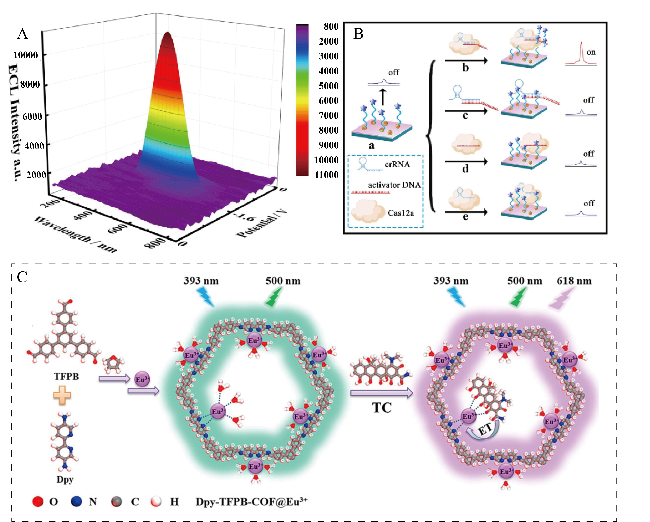
Electrochemical sensors face several challenges when detecting organic pollutants. Different organic pollutants exhibit varying electroactivity, and some may be difficult to detect directly via electrochemical methods, requiring complex pre-treatment or indirect detection approaches. In practical applications, certain natural organic substances can even interfere with detection. Moreover, for emerging organic pollutants with unique structures, existing electrode materials may not effectively facilitate their electrochemical oxidation or reduction. Therefore, combining COFs materials with electrochemical sensors is an ingenious approach to enhance their overall performance in detecting organic pollutants[76]. Wang et al.[77]employed an electroactive COF Tab-Dva nanofiber rich in vinyl groups, which enables accurate and reproducible detection of O, O-dimethyl-O-2,2-dichlorovinyl phosphate (DDVP). This pesticide sensor based on COFs not only operates at a low working potential but also effectively improves selectivity, avoiding the influence of large background currents, thus providing a new method for accurate pesticide detection with high accuracy, high reproducibility, and strong stability. To further enhance the stability of electrochemical sensors and fully leverage material advantages, Sun et al.[78]synthesized COFs materials using a "one-pot" method with 1,3,5-tris(4-aminophenyl)benzene (TAPB) and terephthalaldehyde (TPA) as monomers, followed by self-assembly of the COFs onto carbon nanotubes. The resulting COF@NH2-CNT hybrid material boasts a large surface area and excellent conductivity. Subsequently, 8 μL of COF@NH2-CNT dispersion was coated onto a polished glassy carbon electrode (GCE), dried at room temperature to obtain the COF@NH2-GCE, which demonstrated outstanding analytical performance in the detection of the antibiotic furazolidone, featuring a wide detection range and a low detection limit (approximately 77.5 nmol/L). Li et al.[79]first synthesized a stable covalent organic framework (COFs)-based material with strong electrochemiluminescence (ECL) through the condensation reaction between perylene-3,4,9,10-tetracarboxylic dianhydride (PTCDA) and melamine (MA), coupled with a CRISPR/Cas12a-mediated electrochemical-biosensor (PTCA-COF). Its 3D surface image is shown in Figure 3A, demonstrating satisfactory performance in detecting neonicotinoid insecticide dinotefuran. The detection schematic is illustrated in Figure 3B, with a LOD of 2.7 pmol/L (S/N = 3) and a linear correlation coefficient (R2) reaching 0.9994.
图3 A) PTCA-COF的3D表面图;B)所提出的啶虫脒生物传感器在各种条件下的示意图:a) Fc-DNA,b)Cas12a + crRNA+靶点,c) crRNA+靶点,d) Cas12a+靶点,e) Cas12a+crRNA[79] ; C)Dpy-TFPB-COF@Eu3+的合成和对TC的选择性和灵敏性监测的应用[81]

Fig.3 A) 3D surface view of PTCA-COF; B)Schematic diagrams of the proposed acetamiprid biosensor under various conditions: a) Fc-DNA, b) Cas12a+crRNA+target, c) crRNA+target, d)Cas12a+target, e)Cas12a+crRNA[79]; C) Synthesis of Dpy-TFPB-COF@Eu3+ and its application in monitoring the selectivity and sensitivity of TC [81]

2.2.3 COFs materials combined with fluorescent sensors for detecting organic pollutants

Some substances in the environment may alter fluorescence intensity through light absorption, energy transfer, and other mechanisms. Additionally, changes in environmental factors such as pH and temperature can affect the dissociation state or molecular structure of fluorescent materials, thereby altering their fluorescence properties and impacting the accurate detection of target organic pollutants. To overcome these limitations, researchers have continuously explored and improved the performance of fluorescent sensors. By combining with COF materials, the sensor's structure and design have been optimized to a certain extent, enhancing its sensitivity, stability, and applicability in detecting organic pollutants[80].Yu et al.[81]functionalized COFs containing bipyridine (Dpy-TFPB-COF) with lanthanide europium (III). When tetracycline (TC) is present, TC displaces water molecules and coordinates with Eu3+, generating a significant Eu3+ fluorescence signal, while the original fluorescence signal of Dpy-TFPB-COF remains. The schematic diagram of material synthesis and detection is shown in Figure 3C.Yang et al.[82]covalently linked hydrazone-linked fluorescent covalent organic framework (BATHz-COF) with N-acetyl-L-cysteine (NALC) via a "thiol-ene" click reaction and introduced carboxyl groups to enhance fluorescence intensity, thus fabricating a highly selective and reusable COF-NALC fluorescent sensor. This sensor achieved satisfactory results in the quantitative detection of p-nitrophenol (p-NP), with a linear range of 5–50 μmol/L and a detection limit of 1.46 μmol/L.

2.2.4 COFs materials combined with SERS for the detection of organic pollutants

The reproducibility of SERS signals may be affected by various factors. In particular, when analyzing organic pollutants, certain organic contaminants may exhibit weak interactions with the substrate or have small Raman scattering cross-sections, limiting detection sensitivity. Additionally, traditional SERS substrates may suffer from issues such as uneven nanoparticle distribution and aggregation during preparation, leading to significant variations in enhancement effects at different locations and thus affecting signal reproducibility. Although some novel substrates have improved stability to a certain extent, they can still be influenced by physicochemical factors in complex detection environments, resulting in reduced SERS activity. For instance, noble metal particles may detach from flexible substrates during the detection process, compromising the stability of the detection signal[83-84]. Therefore, introducing COF materials to address the shortcomings of SERS substrates has become one of the widely focused approaches among researchers. Xie et al.[85]employed a novel AuNPs/COFs composite material induced by photo-reduction deposition as a highly sensitive and reproducible SERS-active substrate, enabling clear SERS signals for low-concentration antibiotics that were previously difficult to detect. This substrate demonstrated excellent sensitivity and reproducibility in the analysis and detection of four macrolide antibiotics, with LODs of 3.30×10⁻¹¹, 3.43×10⁻¹⁰, 1.10×10⁻¹⁰, and 5.78×10⁻¹¹ mol/L, respectively, and exhibited a good linear relationship within the range of 10-10~10-3 mol/L.
COFs materials possess a regular structure and uniform pores, providing more homogeneous adsorption sites and environments. This allows for a more even distribution of organic pollutants to be measured on the substrate, increasing the number of molecules available for effective detection, thereby reducing signal fluctuations and enhancing the SERS signal, ultimately improving the reproducibility of SERS detection. Additionally, they can effectively prevent oxidation and corrosion of the substrate in complex environments, maintaining the structural and performance stability of the substrate[86].Niu et al.[87] coated the surface of silver nanowires (AgNW) with COFs materials to fabricate AgNW@COF hybrids. By utilizing the scouring effect induced by fluid flow and the regular pores of COFs, they eliminated interference from large molecules, achieving efficient purification of organic pollutants as well as real-time identification and detection of pollutant types and concentrations.

2.2.5 COFs materials combined with colorimetric methods for detecting organic pollutants

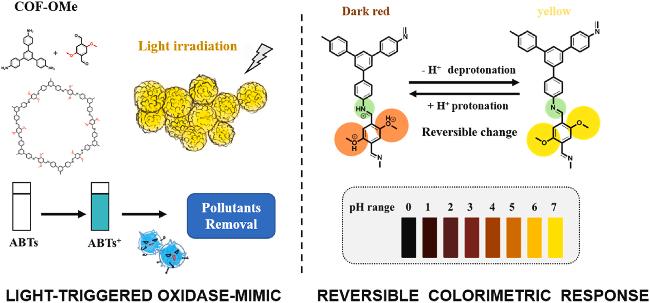
Colorimetric detection of organic pollutants struggles to meet the requirements for trace-level analysis, and environmental changes such as temperature and pH can affect color development, reducing the accuracy of results[88]. However, functionalized COFs materials used for colorimetric detection can effectively adsorb organic pollutants, producing distinct color changes that enhance accuracy and sensitivity. Their excellent chemical stability also ensures reliable detection results under various environmental conditions. Afshari et al.[89] synthesized a nitrogen-rich triazine-based COF material via hydrothermal method, which exhibits exceptionally strong adsorption capacity. By leveraging hydrogen bonding and π-π stacking interactions, this material has achieved remarkable success in adsorbing and removing the fast scarlet 4BS textile dye. Detection using a smartphone-based colorimetric analyzer yielded results consistent with those obtained from UV-Vis spectrophotometry, providing a new approach for on-site colorimetric analysis of textile wastewater and other samples. Zhou et al.[90] developed a dual-functional smart material based on a methoxy-containing covalent organic framework (COF-OMe), fully exploiting the advantages of COFs materials. On one hand, the light absorption capability of COFs materials enables excellent colorimetric performance; on the other hand, COF-OMe possesses a porous structure that mimics photocatalytic peroxidase activity, allowing it to remove organic pollutants through the synergistic effects of physical adsorption and photodegradation. The detection scheme is illustrated in Figure 4.
图4 COF-OMe的双重功能作用:污染物的光催化和可逆的pH响应[90]

Fig.4 The dual functional role of COF-OMe: photocatalysis of pollutants and reversible pH response[90]

2.3 gaseous pollutants

The environmental hazards caused by gaseous pollutants should not be underestimated either. They not only lead to deteriorating air quality and affect human respiratory health, but may also trigger acid rain, damage the ozone layer, and have profound impacts on ecological balance and climate change. Therefore, the detection and analysis of gaseous pollutants are of extremely significant importance. Currently, the main methods for treating and monitoring gaseous pollutants include adsorption removal and analytical detection. In terms of adsorption removal, common approaches involve using materials such as activated carbon and molecular sieves to adsorb pollutants. Common analytical detection methods include gas chromatography, chemiluminescence, and sensor-based techniques. However, these methods have certain limitations: gas chromatography requires expensive equipment and complex operation; chemiluminescence is prone to interference; and the stability and selectivity of sensor-based methods still need improvement[91-93]. For these reasons, COFs materials, with their unique structure and properties, can address the shortcomings of traditional adsorption materials or detection methods, thus demonstrating specific advantages in the adsorption of common gases and gas analysis detection methods. This provides new ideas and possibilities for the monitoring and treatment of gaseous pollutants (Table 4), particularly in the analytical detection of gases such as nitrogen oxides and volatile amines.
表4 部分COFs材料与气体传感相结合用于气体污染物处理的应用

Table 4 Some COFs materials are combined with gas sensing for applications dealing with gaseous pollutants

COFs material Analyte Response signal Ref
COF-DC-8 NH3\NO\NO2\H2S Conductivity 94
TAPB-BPDA COF NH3 Conductivity 95
COF-ETBA-DAB HCl Fluorescence 96
PBHP-TAPT COF HCl Chromism, conductivity 97
P-COFTPB-DMTP-COF O3 Change color 98
PNT-1 H2S Fluorescence 99
T-2DP NO2 Conductivity 100
CON-10 NO2 Conductivity 101
NiPc-CoTAA NO2 Conductivity 102
BTA-TAPT-COF Benzene Capacitance 103

2.3.1 COFs materials are used for adsorptive removal of gaseous pollutants

COFs materials exhibit significant advantages in the adsorption and removal of gaseous pollutants. With their high specific surface area and pore structures that are abundant and precisely tunable, COFs can achieve a specific surface area of 1000 to 5000 m²/g, providing numerous adsorption sites. By matching pore sizes to gas molecule dimensions, they can achieve high adsorption capacities and efficient adsorption of specific gases. Their chemical structures are designable and easily functionalizable; by introducing specific functional groups, they can selectively adsorb target gases and even undergo chemical reactions with certain gases for deep purification.
Meanwhile, COFs materials exhibit excellent chemical and thermal stability, with strong covalent bonds ensuring structural integrity across diverse chemical environments and high temperatures, allowing them to stably perform adsorption functions under complex and harsh conditions. Additionally, they possess good processability, enabling fabrication into various shapes to suit different scenarios, and can be easily regenerated and reused through physical or chemical methods once saturated, effectively reducing treatment costs[104]. In terms of adsorbing certain gases, COFs demonstrate high efficiency and selectivity. For instance, Li et al.[105]designed a porous framework NAT-COF, achieving highly efficient and specific adsorption of hydrocarbons and carbon dioxide. However, currently, in the field of adsorption and separation of gaseous pollutants, applications of COFs materials are relatively limited compared to research on heavy metal ions and organic pollutants. The adsorption mechanisms of COFs are primarily based on interactions between specific functional groups on their surfaces and gaseous analytes. Beyond this, there are several other notable characteristics. The high fluidity of gas molecules means that the pore structure and porosity of COFs significantly influence their diffusion rates and adsorption kinetics; three-dimensional interconnected pores and high porosity facilitate rapid gas diffusion and adsorption. Moreover, the selective adsorption of different gaseous pollutants relies on more complex mechanisms, involving not only conventional factors but also physical properties such as polarizability and dipole moment of gas molecules—COFs exhibit stronger adsorption capacity for VOCs with higher polarizability. When treating gases, COFs often require good reversible adsorption performance, allowing desorption and regeneration under mild conditions for repeated use. Furthermore, the charge distribution on the surface of COFs materials also affects the adsorption of gaseous pollutants and can be adjusted by modifying or altering synthesis conditions.

2.3.2 COFs materials combined with gas sensors for detecting gaseous pollutants

Gas sensors detect gas pollutants by inducing changes in their electrical, optical, or acoustic properties through physical or chemical interactions with the target gases, and then converting these changes into interpretable and analyzable signal outputs. Gas sensors offer numerous advantages, such as real-time, continuous monitoring of gas pollutant concentration changes and rapid responsiveness[106]. They typically exhibit high sensitivity, capable of detecting extremely low concentrations of gas pollutants, accurately capturing even minor concentration variations. Additionally, gas sensors are compact in size, making them easy to install and carry, suitable for various complex detection scenarios. Moreover, they have the advantages of relatively low cost, ease of maintenance, and simple operation. Due to these benefits, gas sensors are widely used by researchers for detecting gaseous pollutants in the environment. When combined with COFs materials, these advantages are further enhanced. Choi et al.[107] integrated COFs materials with graphene oxide to form a composite material, which demonstrated superior gas adsorption performance compared to pristine graphene oxide, with sensitivity improved by 2.7 times and response time significantly reduced from 234 s to 32 s. The high selectivity of COFs materials enables more accurate identification of specific gas pollutants, reducing false positives; their strong adsorption capacity also enhances sensor sensitivity, allowing detection of lower pollutant concentrations. Meanwhile, the excellent stability of COFs materials extends the sensor's service life and reduces usage costs.
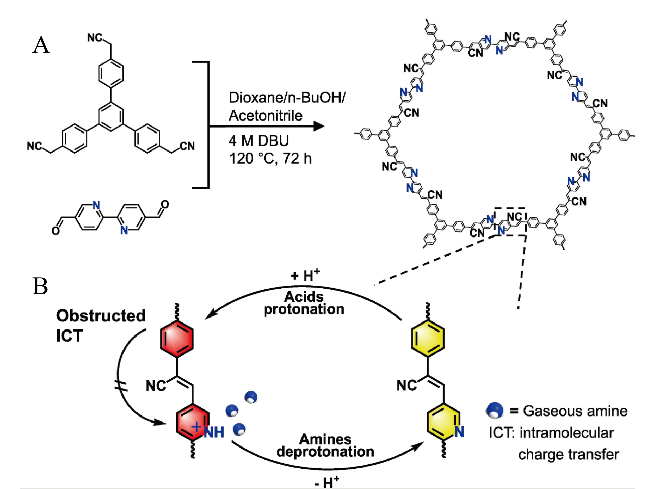
Li et al[108]have designed a fluorochromic COFs material, as shown in Figure 5A, where pyridine units are modified into larger pyridine frameworks, creating a visual fluorescence-colorimetric molecular "trigger" for the online and visual monitoring of volatile amines, while also enabling regeneration. As illustrated in Figure 5B, this effectively prevents porosity loss and achieves higher sensor-molecule recognition conversion efficiency, resulting in a millisecond response time (0.65 s).
图5 A)TPCH-mOBPy COF和传感单元的合成路线;B)TPCH-mOBPy COFs中传感和可再生机制示意[108]

Fig.5 A) Synthesis route of TPCH-mOBPy COF and sensing unit; B) Schematic diagram of sensing and reproducibility mechanisms in TPCH-mOBPy COFs[108]

3 Limitations of COFs Materials and Corresponding Strategies

COFs materials have attracted the attention of many researchers due to their numerous advantages and have achieved remarkable results, with widespread applications in environmental detection. However, we must also acknowledge certain limitations currently associated with COFs materials. (1) The complexity of the synthesis process and the diversity of available methods restrict large-scale production. Currently, the main synthesis methods for COFs materials include hydrothermal, ionothermal, mechanochemical, and microwave-assisted approaches, each with its own strengths and weaknesses. For instance, the hydrothermal method is simple to implement, but the reaction time is relatively long, and the resulting product is an unprocessable or insoluble powder. Although the ionothermal method reduces reaction time, it requires high temperatures. The mechanochemical method does not require solvents, making it environmentally friendly, but the resulting product has poor crystal orientation. While the microwave method effectively avoids the drawbacks of the aforementioned methods, it is more complex. (2) In practical environmental detection, the selectivity issue of COFs material types poses challenges to long-term monitoring stability and makes large-scale environmental detection difficult to achieve. Based on the functional groups involved, COFs materials can be classified into boron-based, imine-based, triazine-based, and imide-based COFs materials. Among these, boron-based COFs materials are more stable in organic solvents than in aqueous solutions. Compared to boron-based COFs materials, triazine-based COFs materials have lower crystallinity but exhibit excellent chemical and thermal stability. The surface area of triazine-based COFs materials is slightly lower than that of boron-based COFs materials, while COFs materials based on imide groups have a larger surface area and superior thermal stability[109].
Due to the diverse synthesis methods, varied types, and differing properties of COFs materials, selecting the appropriate synthesis method and material for targeted detection of specific pollutants in environmental testing becomes more complicated when dealing with certain complex environmental samples. To achieve large-scale environmental testing, choosing COFs materials requires considering both performance and cost, which complicates cost control and makes it challenging to find a detection solution that is both economical and efficient.
Regarding the complexity of synthesis processes and methods, future research should focus on developing simpler, more efficient, and cost-effective synthetic approaches. For example, in hydrothermal synthesis, new solvent systems or additives could be explored to increase reaction rates, shorten reaction times, and enhance product processability and solubility. In pyrolysis, efforts could be directed toward reducing reaction temperatures while maintaining high efficiency and product quality; by optimizing reaction conditions and selecting appropriate catalysts, it may be possible to achieve rapid reactions at lower temperatures. For mechanochemical methods, the focus should be on improving crystal orientation of the products—for instance, by refining the application of mechanical forces, adjusting reaction parameters, or introducing auxiliary techniques—to enhance crystal growth and orientation, thereby boosting material performance. As for microwave-assisted synthesis, further simplification of operational procedures, improvement of reproducibility and stability, and reduction of costs could facilitate wider adoption and application of this method.
Regarding the issue of diverse material selection types, when environmental conditions are easy to assess, appropriate COFs material types can be chosen based on the detection environment. For instance, when detecting organic pollutants (such as petroleum-based contaminants and volatile organic solvents), boron-based COFs materials can be used as adsorbents or sensitive materials for sensors, enabling them to function effectively in organic solvent environments and avoiding detection errors caused by material instability. When the primary detection environment is an aqueous solution, triazine-based or imide-based COFs materials have greater advantages. In situations where detection conditions become more complex, material modification and compositing can be employed to enhance stability and repeatability. For example, introducing additional functional groups into COFs materials can improve their stability, or combining COFs materials with other highly stable materials is also an effective approach.

4 Conclusion and Outlook

In summary, covalent organic frameworks (COFs) materials, with their outstanding advantages such as tunable structure, large specific surface area, high porosity, and excellent chemical stability, have demonstrated great application potential in the field of environmental monitoring. COFs materials have exhibited unique advantages in the adsorption treatment of heavy metal ions, organic pollutants, and gaseous pollutants. Moreover, their integration with various modern analytical detection technologies and tools has significantly enhanced the sensitivity, selectivity, and accuracy of detection, providing a more efficient and precise solution for environmental monitoring.
However, it cannot be overlooked that COFs materials still face numerous challenges in practical applications. For instance, although the diverse and complex synthesis methods provide more possibilities for the materials, they also limit large-scale production. Moreover, when dealing with complex environmental samples, the issue of material selectivity increases the complexity of detection and makes cost control more challenging.
Looking ahead, to further advance the development of COFs materials in the field of environmental detection, on one hand, efforts should be directed toward developing simpler, more efficient, and cost-effective synthesis methods, thereby enhancing the processability and scalability of these materials. On the other hand, it is essential to delve deeper into the interaction mechanisms between material properties and environmental pollutants, employing strategies such as material modification and compositing to improve stability and reproducibility in complex environments, and optimizing their applicability across various detection scenarios. With continued research progress, COFs materials are expected to play an increasingly significant role in environmental monitoring, making greater contributions to ecological protection and safeguarding human health.
[1]
Sengar M S, Kumari P, Sengar N, Singh S K. ACS Appl. Polym. Mater., 2024, 6(2): 1086.

[2]
Chu H Q, Liu Y, Xu N, Xu J C. Environ. Chem. Lett., 2023, 21(2): 1203.

[3]
İlyasoglu G, Kose-Mutlu B, Mutlu-Salmanli O, Koyuncu I. Chemosphere, 2022, 302: 134775.

[4]
Trevathan J, Johnstone R. Sensors, 2018, 18(7): 2248.

[5]
Mohanty B, Kumari S, Yadav P, Kanoo P, Chakraborty A. Coord. Chem. Rev., 2024, 519: 216102.

[6]
Meng Z, Mirica K A. Chem. Soc. Rev., 2021, 50(24): 13498.

[7]
Jiang M H, Yan X Y, Wang Y B, Pu F, Liu H L, Li Y M, Yang C F, Zhu J W, Liu X M, Ren J S, Qu X G. Adv. Funct. Mater., 2023, 33(24): 2300091.

[8]
Tadayyon G, Krukiewicz K, Britton J, Larrañaga A, Vallejo-Giraldo C, Fernandez-Yague M, Guo Y N, Orpella-Aceret G, Li L, Poudel A, Biggs M J P. Mater. Sci. Eng. C, 2021, 121: 111857.

[9]
Mohan B, Singh G, Gupta R K, Sharma P K, Solovev A A, Pombeiro A J L, Ren P. Trac Trends Anal. Chem., 2024, 170: 117436.

[10]
Singh A R, Mohan B, Raghav N, Sagar, Virender, Abhishek, Pombeiro A J L. J. Mol. Struct., 2025, 1321: 139945.

[11]
Mallakpour S, Azadi E, Hussain C M. New J. Chem., 2021, 45(30): 13247.

[12]
Akhzari S, Raissi H, Ghahari A. NPJ Clean Water, 2024, 7: 31.

[13]
Li Y Q, Wang Q, Ju Y H, Li Y R, Zhang Y B, Hu R G. Inorg. Chem. Front., 2022, 9(15): 3845.

[14]
Zhang S J, Liu D Q, Wang G T. Molecules, 2022, 27(8): 2586.

[15]
Dhiman S, Gupta B. J. Clean. Prod., 2019, 225: 820.

[16]
Da̧browski A, Hubicki Z, Podkościelny P, Robens E. Chemosphere, 2004, 56(2): 91.

[17]
Tuzen M, Soylak M. J. Hazard. Mater., 2009, 162(2/3): 724.

[18]
Shi L, Li Y Y, Rong X J, Wang Y, Ding S M. Anal. Chim. Acta, 2017, 968: 21.

[19]
Bozorgzadeh E, Pasdaran A, Ebrahimi-Najafabadi H. Food Chem., 2021, 346: 128916.

[20]
Zhang R, Liu H F, Jiang L H, Duan N, Xu F Y, Gao W J, Liu Y, Zhu G B, Wang J X. Anal. Methods, 2024, 16(11): 1674.

[21]
Gendy E A, Ifthikar J, Ali J, Oyekunle D T, Elkhlifia Z, Shahib I I, Khodair A I, Chen Z Q. J. Environ. Chem. Eng., 2021, 9(4): 105687.

[22]
Gatou M A, Bika P, Stergiopoulos T, Dallas P, Pavlatou E A. Energies, 2021, 14(11): 3197.

[23]
Li Y J, Chen M H, Han Y N, Feng Y Q, Zhang Z J, Zhang B. Chem. Mater., 2020, 32(6): 2532.

[24]
Zhao C R, Zhang L Y, Wang Q, Zhang L T, Zhu P H, Yu J H, Zhang Y. ACS Appl. Mater. Interfaces, 2021, 13(17): 20397.

[25]
Li Y Y, Zhou N, Yan J Y, Cui K X, Chu Q Q, Chen X, Luo X J, Deng X J. Food Chem., 2024, 456: 139998.

[26]
Dong Z Y, Yang Y X, Cai X T, Tang X H, Yan Y L, Zheng S R, Zhang W G, Cai S L, Fan J. J. Solid State Chem., 2022, 316: 123644.

[27]
Ali Ghazi Z, Khattak A M, Iqbal R, Ahmad R, Khan A A, Usman M, Nawaz F, Ali W, Felegari Z, Jan S U, Iqbal A, Ahmad A. New J. Chem., 2018, 42(12): 10234.

[28]
Wei D L, Zhang A R, Ai Y J, Wang X K. Chem., 2020, 15(7): 1140.

[29]
Merí-Bofí L, Royuela S, Zamora F, Ruiz-González M L, Segura J L, Muñoz-Olivas R, Mancheño M J. J. Mater. Chem. A, 2017, 5(34): 17973.

[30]
Ding S Y, Dong M, Wang Y W, Chen Y T, Wang H Z, Su C Y, Wang W. J. Am. Chem. Soc., 2016, 138(9): 3031.

[31]
Jiang Y Z, Liu C Y, Huang A S. ACS Appl. Mater. Interfaces, 2019, 11(35): 32186.

[32]
Li G L, Ye J R, Fang Q L, Liu F. Chem. Eng. J., 2019, 370: 822.

[33]
Zhang Y B, Wang Q, Li Y Q, Hu R G. Microporous Mesoporous Mater., 2022, 346: 112289.

[34]
Zu J H, Diao J J, Han G, Xue W J, Pan X H, Jin M J, Tang Q. Sep. Purif. Technol., 2024, 338: 126455.

[35]
Hussain M, Saddique A, Devarayapalli K C, Kim B, Cheong I W, Lee D S. Appl. Catal. B Environ., 2024, 344: 123672.

[36]
Li Y L, Jin X L, Ma Y T, Liu J R, Raziq F, Zhu P Y, Deng Z F, Zhou H W, Chen W X, Huang W H. Rare Met., 2024, 43(2): 758.

[37]
Chen X J, Zhang C R, Cai Y J, He H X, Niu C P, Qi J X, Liu J L, Xia Z, Liang R P, Qiu J D. Inorg. Chem., 2024, 63(24): 11459.

[38]
Wang H P, Ma Q, Wang Y X, Li R, Fu J H, Bai Q H. J. Polym. Sci., 2024, 62(19): 4527.

[39]
Liu J W, Zhong X, Zhang Q E, Deng L B, Hou L L, Zou J, Liu S W, Gao Y S, Wang L Y, Lu L M. Microchem. J., 2024, 201: 110603.

[40]
Mirzaei Karazan Z, Roushani M, Jafar Hoseini S. Food Chem., 2024, 442: 138500.

[41]
Wang R Y, Ji W H, Huang L Q, Guo L P, Wang X. Anal. Lett., 2019, 52(11): 1757.

[42]
Chen G, Lan H H, Cai S L, Sun B, Li X L, He Z H, Zheng S R, Fan J, Liu Y, Zhang W G. ACS Appl. Mater. Interfaces, 2019, 11(13): 12830.

[43]
Zhang N, Wei B X, Ma T T, Tian Y Y, Wang G. J. Mater. Sci., 2021, 56(20): 11789.

[44]
Xiu J, Zhang N, Li C, Salah A, Wang G. Microporous Mesoporous Mater., 2021, 316: 110979.

[45]
Wen G Q, Xiao Y, Chen S X, Zhang X H, Jiang Z L. Nanoscale Adv., 2021, 3(13): 3846.

[46]
Gai T, Jiang J L, Wang S F, Zhang L, Ren Y M, Qin Z, Wu Q, Zhang J, Liao J S. Talanta, 2024, 277: 126407.

[47]
Shu Y Y, Zhi S F, Li S, Liang A H, Jiang Z L. J. Ind. Eng. Chem., 2022, 113: 196.

[48]
Shi Y, Liu H L, Zhu X Q, Zhu J M, Zuo Y F, Yang Y, Jiang F H, Sun C J, Zhao W H, Han X T. Lab a Chip, 2018, 18(19): 2994.

[49]
Li C C, Yang J H, Xu R, Wang H, Zhang Y, Wei Q. Biosensors, 2022, 12(7): 508.

[50]
Zhang L, Yang G P, Xiao S J, Tan Q G, Zheng Q Q, Liang R P, Qiu J D. Small, 2021, 17(44): 2102944.

[51]
Xiu J, Li C, Wang G. J. Mol. Struct., 2023, 1276: 134779.

[52]
Soliven A, Pareja L, Shalliker R A, Heinzen H, Pérez-Parada A. Microchem. J., 2020, 159: 105444.

[53]
Girotti S, Ghini S, Maiolini E, Bolelli L, Ferri E N. Anal. Bioanal. Chem., 2013, 405(2/3): 555.

[54]
Ebrahimzadeh S, Wols B, Azzellino A, Kramer F, van der Hoek J P. J. Water Process. Eng., 2022, 47: 102792.

[55]
Streicher J, Ruhl A S, Gnirß R, Jekel M. Chemosphere, 2016, 156: 88.

[56]
Ali Aslam A, Irshad A, Nazir M S, Atif M. J. Clean. Prod., 2023, 400: 136737.

[57]
Talekar S, Tak Y, Joshi A, Ahn K, Yeon K M, Kim J. Environ. Res., 2024, 259: 119519.

[58]
Li Y, Yang C X, Qian H L, Zhao X, Yan X P. ACS Appl. Nano Mater., 2019, 2(11): 7290.

[59]
Zhang L Y, Chen T Q, Wang Y C, Wei X H, Yue Z Y, Bai D Y, Zhao W D, Zhang S S, Zhang W F. Sep. Purif. Technol., 2024, 338: 126476.

[60]
Zhang X X, Liu J C, Zhang H, Zhang Q M, Shen J W, Wei Y M, Wang C Z. Sep. Purif. Technol., 2025, 357: 130039.

[61]
He C, Yang Y Y, Hou Y J, Luan T G, Deng J W. Sep. Purif. Technol., 2022, 294: 121195.

[62]
Song X, Wang R Y, Wang X, Han H Y, Qiao Z Y, Sun X W, Ji W H. J. Hazard. Mater., 2022, 423: 127226.

[63]
Wang R, Chen Z L. Microchim. Acta, 2017, 184(10): 3867.

[64]
He S J, Zeng T, Wang S H, Niu H Y, Cai Y Q. ACS Appl. Mater. Interfaces, 2017, 9(3): 2959.

[65]
Fan J H, Yao X L, Yan Z H, Li Y, Liu J Y, Cai Y. Microchem. J., 2023, 195: 109444.

[66]
Yang X M, Wang J M, Wang W J, Zhang S H, Wang C, Zhou J H, Wang Z. Microchim. Acta, 2019, 186(3): 145.

[67]
Yan Q, Huang L J, Mao N Q, Shuai Q. Talanta Open, 2021, 4: 100060.

[68]
Wang G H, Zhou T, Lei Y Q. RSC Adv., 2020, 10(20): 11557.

[69]
Wang M, Gao M, Zhang K, Wang L, Wang W, Fu Q, Xia Z, Gao D. Microchim. Acta, 2019. 186(12): 827.

[70]
Liu J M, Lv S W, Yuan X Y, Liu H L, Wang S. RSC Adv., 2019, 9(25): 14247.

[71]
Lu J Y, Wang R, Luan J Y, Li Y J, He X W, Chen L X, Zhang Y K. J. Chromatogr. A, 2020, 1618: 460898.

[72]
Ji W H, Guo Y S, Wang X, Lu X F, Guo D S. J. Chromatogr. A, 2019, 1595: 11.

[73]
Zhao L Y, Lv W J, Niu X Y, Pan C J, Chen H L, Chen X G. J. Chromatogr. A, 2020, 1615: 460722.

[74]
Guo J X, Qian H L, Zhao X, Yang C, Yan X P. J. Mater. Chem. A, 2019, 7(21): 13249.

[75]
Zhang G L, Zhang M M, Shi Q, Jiang Z Y, Tong L L, Chen Z Z, Tang B. ACS Appl. Mater. Interfaces, 2021, 13(36): 43438.

[76]
Lu Z Y, Wang Y Y, Li G K. Biosensors, 2023, 13(2): 291.

[77]
Wang L Y, Wu N, Wang L, Song Y H, Ma G R. Sens. Actuat. B Chem., 2022, 372: 132608.

[78]
Sun Y F, Waterhouse G I N, Xu L H, Qiao X G, Xu Z X. Sens. Actuat. B Chem., 2020, 321: 128501.

[79]
Li Y, Yang F, Yuan R, Zhong X, Zhuo Y. Food Chem., 2022, 389: 133049.

[80]
Liu Q Y, Yang Y L, Zou Y M, Wang L C, Li Z, Wang M Y, Li L L, Tian M, Wang D D, Gao D. Anal. Methods, 2023, 15(44): 5919.

[81]
Yu Y X, Jin Q Q, Ren Y B, Wang Y S, Zhu D D, Wang J H. Chem. Eng. J., 2023, 465: 142819.

[82]
Yang S, Li X Y, Liao Y F, Ji Y B, Li R J. Chemosphere, 2024, 359: 142297.

[83]
Khabarov K, Filalova E, Nouraldeen M, Kameneva E, Musaev A, Tikhonov S, Ivanov V. Nanomaterials, 2023, 13(5): 812.

[84]
Lin D Y, Yu C Y, Ku C A, Chung C K. Micromachines, 2023, 14(7): 1343.

[85]
Xie Y L, Chen L P, Cui K X, Zeng Y, Luo X J, Deng X J. Talanta, 2024, 279: 126547.

[86]
Guan W N, Chen G Q, Yang Z C, Yang T Q, Ma C Q, Li L, Gao H, Zhu C, Cai Z C, Zhou Y, Zhang W, Li X. Vib. Spectrosc., 2024, 130: 103623.

[87]
Niu Q, Li W T, Yuan R L, Li Q Q, Tang H Z, Yang Z Y, Yang Y Q, Qiao X Z. Langmuir, 2024, 40(28): 14717.

[88]
Wongniramaikul W, Limsakul W, Choodum A. Food Chem., 2018, 249: 154.

[89]
Afshari M, Dinari M. J. Hazard. Mater., 2020, 385: 121514.

[90]
Zhou Z W, Wu Z N, Cai C X, Lin R D, Yu X Q, Li K, Wang N. Microporous Mesoporous Mater., 2023, 360: 112689.

[91]
Karu E, Li M Z, Ernle L, Brenninkmeijer C A M, Lelieveld J, Williams J. Atmos. Meas. Tech., 2021, 14(3): 1817.

[92]
Galimov D I, Yakupova S M, Vasilyuk K S, Bulgakov R G. J. Photochem. Photobiol. A Chem., 2021, 418: 113430.

[93]
Baharuddin A A, Ang B C, Haseeb A S M A, Wong Y C, Wong Y H. Mater. Sci. Semicond. Process., 2019, 103: 104616.

[94]
Meng Z, Stolz R M, Mirica K A. J. Am. Chem. Soc., 2019, 141(30): 11929.

[95]
Niu F, Shao Z W, Zhu J L, Tao L M, Ding Y. J. Mater. Chem. C, 2021, 9(27): 8562.

[96]
Cui F Z, Xie J J, Jiang S Y, Gan S X, Ma D L, Liang R R, Jiang G F, Zhao X. Chem. Commun., 2019, 55(31): 4550.

[97]
Kulkarni R, Noda Y, Kumar Barange D, Kochergin Y S, Lyu P B, Balcarova B, Nachtigall P, Bojdys M J. Nat. Commun., 2019, 10: 3228.

[98]
Yan D, Wang Z F, Cheng P, Chen Y, Zhang Z J. Angew. Chem., 2021, 133(11): 6120.

[99]
Guo L, Wang M, Zeng X F, Cao D P. Mater. Chem. Front., 2017, 1(12): 2643.

[100]
Yang K, Yuan W J, Hua Z Q, Tang Y T, Yin F X, Xia D. ACS Appl. Mater. Interfaces, 2020, 12(3): 3919.

[101]
Ko W C, Kim M S, Kwon Y J, Jeong J, Kim W R, Choi H, Park J K, Jeong Y K. J. Mater. Chem. A, 2020, 8(37): 19246.

[102]
Yue Y, Cai P Y, Xu X Y, Li H Y, Chen H Z, Zhou H C, Huang N. Angew. Chem., 2021, 133(19): 10901.

[103]
Yuan H Y, Li N X, Linghu J J, Dong J Q, Wang Y X, Karmakar A, Yuan J R, Li M S, Buenconsejo P J S, Liu G L, Cai H, Pennycook S J, Singh N, Zhao D. ACS Sens., 2020, 5(5): 1474.

[104]
Knebel A, Caro J. Nat. Nanotechnol., 2022, 17(9): 911.

[105]
Li J Y, He Y, Zou Y C, Yan Y, Song Z G, Shi X D. Chin. Chem. Lett., 2022, 33(6): 3017.

[106]
Jung H T. ACS Sens., 2022, 7(4): 912.

[107]
Choi J, Kim T, Li H, Jung H T, Zhao D. ACS Appl. Mater. Interfaces, 2023, 15(37): 44119.

[108]
Li J K, Wan Y Q, Jiang G Y, Ozaki Y, Pi F W. Chem. Eng. J., 2024, 479: 147746.

[109]
Zhou W B, Li X M, Luo M. Prog. Chem., 2024, 36(3): 430

(周文博, 李晓曼, 罗民. 化学进展, 2024, 36(3): 430).

Outlines

/