Home Journals Progress in Chemistry
Progress in Chemistry

Abbreviation (ISO4): Prog Chem      Editor in chief: Jincai ZHAO

About  /  Aim & scope  /  Editorial board  /  Indexed  /  Contact  / 
Review

Enhancement of Thermoelectric Performance by Compositing MXenes with Low-Dimensional Materials

  • Yuan Zhou 1, 2, 3 ,
  • Li Li 1, 2 ,
  • Yihao Hu 1 ,
  • Xirong Chen 1 ,
  • Qianlei Tian , 1, 2, 3, * ,
  • Huihui Huang , 3, *
Expand
  • 1 School of Microelectronics and Physics, Hunan University of Technology and Business, Changsha 410205, China
  • 2 Xiangjiang Laboratory, Changsha 410000, China
  • 3 School of Physics and Electronics, Hunan University, Changsha 410082, China
*(Huihui Huang);
(Qianlei Tian)

Received date: 2024-10-21

  Revised date: 2025-01-09

  Online published: 2025-06-18

Supported by

The Xiangjiang Laboratory Open Fund General Project(22XJ03023)

The Hunan Provincial Natural Science Foundation Youth Project(2024JJ6183)

The Hunan Provincial Department of Education Excellent Youth Project(23B0615)

The Hunan Provincial Department of Education Excellent Youth Project(24B0572)

The National Natural Science Foundation of China Youth Project(12304064)

Abstract

In recent years, novel 2D materials such as MXene have demonstrated considerable promise for thermoelectric applications, owing to their excellent conductivity, excellent mechanical flexibility, and good environmental stability. However, the metallic behaviour exhibited by the charge carrier transport of MXene hinders the Seebeck effect, thus limiting effect of the strong coupling between the Seebeck coefficient and the conductivity. Due to their special electrical, thermal, and structural properties at the micro/nano scale, low-dimensional materials are expected to be compounded with MXene and their thermoelectric properties can be regulated. In this review, we summarize the research progress of MXene and other low-dimensional materials to improve its thermoelectric properties, focusing on the combination of one-dimensional materials, two-dimensional materials and MXene. Then, a summary and analysis were conducted on the optimization and regulation of key thermoelectric performance indicators including electrical conductivity, thermal conductivity, and Seebeck coefficient. The subsequent research direction of the thermoelectric properties of MXene materials is proposed, and this is based on three aspects: application of flexible wearable electronic devices, material design combined with artificial intelligence, and optimization of material synthesis and integration technologies.

Contents

1 Introduction

2 MXene thermoelectric properties

3 MXene composites with one-dimensional materials

3.1 MXene-based composites with one-dimensional materials enhance electrical conductivity

3.2 MXene-based composites with one-dimensional materials reduce thermal conductivity

3.3 MXene-based composites with one-dimensional materials enhance the Seebeck coefficient

4 MXene composites with two-dimensional materials

4.1 MXene-based composites with two-dimensional materials enhance electrical conductivity

4.2 MXene-based composites with two-dimensional materials reduce thermal conductivity

4.3 MXene-based composites with two-dimensional materials enhance the Seebeck coefficient

5 Conclusion and outlook

Cite this article

Yuan Zhou , Li Li , Yihao Hu , Xirong Chen , Qianlei Tian , Huihui Huang . Enhancement of Thermoelectric Performance by Compositing MXenes with Low-Dimensional Materials[J]. Progress in Chemistry, 2025 , 37(7) : 1048 -1062 . DOI: 10.7536/PC241005

1 Introduction

With the continuous growth of global energy demand and the increasing depletion of fossil fuels, energy shortages and environmental pollution have become increasingly severe. Finding sustainable clean energy supply methods has thus become an important direction for global scientific research[1]. In this context, thermoelectric conversion technology has received widespread attention due to its ability to directly convert thermal energy into electrical energy. The underlying mechanism of thermoelectric conversion is the thermoelectric effect[1-2], which refers to the phenomenon where materials generate a potential difference under the influence of a temperature gradient. This effect can be divided into the Seebeck effect, Peltier effect, and Thomson effect. The key to the thermoelectric effect lies in the thermoelectric conversion efficiency of materials or devices, typically represented by the dimensionless thermoelectric figure of merit (ZT)[3-4]. The higher the ZTvalue, the better the material's thermoelectric performance. The ZTvalue is defined as ZT = S²σT/κ, where S is the Seebeck coefficient, σ is the electrical conductivity, T is the absolute temperature, and κ is the thermal conductivity. The Seebeck coefficient of a material can be derived based on the generation process of the thermoelectric effect. When a temperature difference is applied to a material, the presence of a temperature gradient causes electrons or holes generated in the material's charge carriers to diffuse due to energy differences. Under the influence of diffusion, an electric potential based on the temperature difference is established. In ideal conditions, the expression for the Seebeck coefficient S can be derived from the Boltzmann transport equation:
S = π 2 3   k B q k B T ( 1 n d n ( E ) d E + 1 μ d μ ( E ) d E ) E = E F
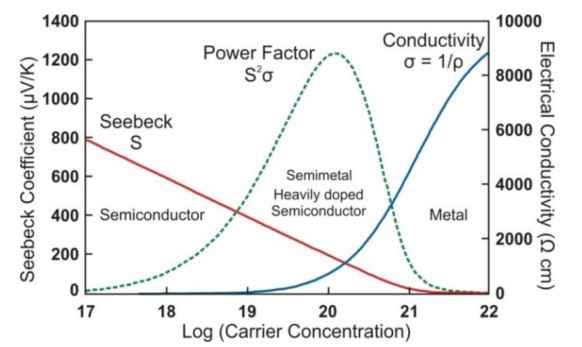
among them, k Bis the Boltzmann constant, qis the electron charge, Tis the temperature, nis the carrier concentration, Eis the carrier energy, μis the mobility, and EFis the Fermi level. As can be seen from the formula for the Seebeck coefficient, its magnitude is primarily influenced by the carrier concentration and mobility, and also exhibits a nonlinear relationship with temperature. For thermoelectric materials, the magnitude of the Seebeck coefficient determines the energy conversion efficiency of the material. Only materials with a high Seebeck coefficient can generate a higher thermoelectric potential at a given temperature, thereby improving thermoelectric conversion efficiency. The electrical conductivity of a material can be expressed by the formula $\sigma=q\left(\mu_{n} \cdot n_{n}+\mu_{p} \cdot n_{p}\right)$, where μnis the electron mobility, nnis the electron concentration, μpis the hole mobility, and npis the hole concentration. To improve the efficiency of converting thermal energy into electrical energy, it is necessary to reduce the Joule heat generated by the internal resistance of the thermoelectric material, which in turn requires the material to have a high electrical conductivity. The thermal conductivity of a material can be represented as κ = κ e + κ l, where κeis the electronic thermal conductivity and κlis the lattice thermal conductivity. Generally, at higher temperatures, the thermal conductivity of a material is mainly contributed by the electronic thermal conductivity, while at lower temperatures, it is primarily due to the lattice thermal conductivity. Thermal conductivity primarily reflects a material's ability to conduct heat. For thermoelectric materials, a lower thermal conductivity is usually required to create a larger temperature difference within the material, thus achieving a higher Seebeck voltage through a greater temperature gradient. As can be seen from the definition of the thermoelectric figure of merit, an ideal thermoelectric material should have a high Seebeck coefficient and electrical conductivity, while maintaining a low thermal conductivity, to ensure that more thermal energy is converted into electrical energy[5]. From the above definitions of the Seebeck coefficient and electrical conductivity, it is evident that increasing the carrier concentration and mobility can enhance the electrical conductivity of a material, but will lead to a decrease in the Seebeck coefficient[6]. Additionally, the Wiedemann-Franz law[7]indicates that free electrons in metals not only carry electric current but also transfer heat through their motion. As shown by its formula κ σ = L T(κis the thermal conductivity, σis the electrical conductivity, Lis the Lorenz number, and Tis the absolute temperature), electrical conductivity and thermal conductivity are directly proportional; an increase in carrier concentration leads to an increase in electrical conductivity, and consequently, thermal conductivity also rises. The variation of thermoelectric parameters with carrier concentration distribution is illustrated in Figure 1. Given the strong coupling among the three parameters—Seebeck coefficient, electrical conductivity, and thermal conductivity—optimizing one parameter often affects another, making it a significant challenge to find materials that simultaneously meet all these conditions. Therefore, balancing these parameters is a common compromise strategy; however, achieving decoupling of several core parameters remains essential and critical for breakthrough improvements in thermoelectric material performance[8].
图1 热电参数随载流子浓度分布图[5]

Fig.1 Thermoelectric parameters as a function of carrier concentration distribution ,Reprinted with permission from [5], Copyright 2023 Applied Materials Today

MXene is a class of two-dimensional materials composed of transition metal carbides, nitrides, or carbonitrides, characterized by a unique layered structure. Its surface termination groups (such as —OH, ═O, —F) can be adjusted through chemical modification. Due to its high electrical conductivity, tunable chemical surface properties, and mechanical flexibility, MXene has become a focal point for researchers[9].As a thermoelectric material, MXene possesses several key physicochemical characteristics: (1) A high Seebeck coefficient and electrical conductivity are essential, requiring the material to exhibit excellent electron transport performance; (2) Low thermal conductivity is necessary to maintain a temperature gradient and enhance thermoelectric conversion efficiency. The unique layered structure of MXene provides an inherent mechanism for suppressing thermal conductivity; (3) Excellent chemical stability and mechanical flexibility ensure long-term stability and durability under high-temperature and complex mechanical stress conditions; (4) The tunability of MXene's surface modification and functionalization allows precise control over its electronic structure and transport properties through simple doping and composite techniques, thereby achieving higher thermoelectric conversion efficiency. These characteristics make MXene an ideal candidate for thermoelectric applications. However, MXene also faces challenges in thermoelectric applications. MXene exhibits metallic-level electrical conductivity, with some MXenes reaching conductivities as high as 15,000 S·cm-1above[10]. Generally, high electrical conductivity contributes to improved thermoelectric performance. However, according to the Wiedemann-Franz law[7], electrical conductivity and electronic thermal conductivity are positively correlated. The metallic behavior of MXene makes it prone to increased thermal conductivity at high temperatures, which, in turn, leads to a reduction in thermoelectric performance within the non-equilibrium range between electrical and thermal conductivity, manifesting as a decrease in the ZT value or power factor.
To enhance the thermoelectric performance of MXene, researchers have recently proposed a strategy of combining MXene with low-dimensional materials. The introduction of low-dimensional materials generally serves the following purposes: (1) enhancing the Seebeck coefficient—low-dimensional materials such as one-dimensional nanowires and two-dimensional graphene, when combined with MXene, can significantly improve the overall Seebeck coefficient of the composite material. A higher Seebeck coefficient means that under a temperature gradient, the material can generate a larger potential difference, thereby increasing electrical power output; (2) improving electrical conductivity—low-dimensional materials typically possess high specific surface areas or large aspect ratios. When combined with MXene, they provide additional charge carrier transport channels, enabling an increase in the electrical conductivity of the composite material without significantly elevating thermal conductivity, which helps boost current output and enhances the power factor of the thermoelectric material; (3) reducing thermal conductivity—low-dimensional materials at the micro- and nanoscale exhibit stronger phonon scattering effects, effectively reducing heat generation through material conduction. Introducing low-dimensional materials into MXene creates numerous phonon scattering centers at the composite interface, significantly lowering its lattice thermal conductivity by enhancing phonon scattering, thus increasing the temperature gradient of the composite material and improving thermoelectric conversion efficiency; (4) optimizing electron and phonon transport—the introduction of low-dimensional materials can form heterogeneous interfaces with MXene nanosheets. These interfaces can regulate electron and phonon transport behaviors through band engineering, quantum confinement effects, and carrier filtering effects. By rationally designing the composite structure of MXene with low-dimensional materials, it is possible to optimize electron and phonon transport pathways, effectively separate high-energy and low-energy carriers, precisely control transport characteristics, and enhance interfacial properties to improve thermoelectric performance; (5) improving mechanical properties and stability—low-dimensional materials such as graphene and molybdenum disulfide, in addition to their excellent electrical and thermal properties, also exhibit superior mechanical flexibility and chemical stability. Incorporating these materials into MXene-based composites can enhance the mechanical performance and durability of the composite, ensuring stable performance under various application conditions.
Combining low-dimensional materials with MXene can leverage their respective advantages and significantly enhance the thermoelectric performance of the composites through synergistic effects. This strategy not only helps improve the material's Seebeck coefficient and electrical conductivity while reducing thermal conductivity, but also enhances its mechanical properties and stability, providing an effective pathway for developing high-performance thermoelectric materials. In the future, by conducting in-depth research and optimizing the composite systems of MXene with low-dimensional materials, it is expected to achieve more efficient thermoelectric conversion, offering viable solutions to address energy shortages and environmental challenges. This review will delve into how these composites overcome the limitations of traditional thermoelectric materials and ultimately enhance the thermoelectric conversion efficiency of MXene-based composites or devices, specifically from the perspectives of one-dimensional and two-dimensional typical low-dimensional materials. Based on a summary of the current research status, we will conclude by exploring future research directions, including new composite material systems, efficient preparation methods, and prospects for the practical application of these advanced materials in real-world thermoelectric devices.

2 Thermoelectric Properties of MXene

MXene, as a new class of two-dimensional materials, has demonstrated great potential in numerous application fields since its discovery in 2011[11], owing to its excellent conductivity and tunable surface functionalization properties[5,12]. The name MXene originates from its precursor material, the MAX phase, with a typical formula of M n +1AX n, where M represents early transition metals from groups III to VI (i.e., Sc, Ti, Zr, Hf, V, Nb, Ta, Cr, Mo, W), A stands for an element from group 13 or 14, and X denotes C, N, and O (nitrides, oxides, and carbides)[13-17]. By selectively etching the A layer from the MAX phase, a layered MXene structure can be obtained, represented by the general formula M n +1X nT x, where T xdenotes terminal groups (i.e., —O, —OH, —F, —Cl, ̿        S, etc.)[18], with n ranging from 1 to 4.
MXene exhibits excellent conductivity, which is attributed to its unique crystal structure, bonding characteristics, and electron transport mechanism. (1) Crystal Structure and Bonding Characteristics: MXene's conductivity is closely related to its two-dimensional layered structure. The chemical formula of MXene is M n +1X nT x, where M represents a transition metal, X represents carbon or nitrogen, and T represents surface termination groups (such as —OH, —O, —F, etc.). Each layer of MXene consists of transition metal atoms and carbon (or nitrogen) atoms bonded together by strong covalent bonds, forming a two-dimensional planar network. The strong covalent bonds between transition metal atoms and carbon (or nitrogen) atoms provide high electron density, facilitating free electron transport within the two-dimensional plane. Meanwhile, the layered structure of MXene features a high specific surface area and large interlayer spacing, enabling MXene to effectively adsorb and release ions, and achieve efficient charge transfer. (2) Electron Transport Mechanism: MXene's conductivity is closely linked to its electronic structure. Due to the abundance of unfilled d-orbitals in transition metals, these d-orbitals form strong covalent bonds with the p-orbitals of carbon (or nitrogen), allowing electrons to move freely between these orbitals. Additionally, MXene's layered structure enables charge carriers to efficiently transport within the two-dimensional plane, reducing scattering and resistance, thus giving MXene a high conductivity similar to that of metals. (3) Influence of Surface Termination Groups: During the preparation of MXene, chemical exfoliation introduces various termination groups on its surface. These termination groups not only stabilize the material's structure but also affect its electron transport properties. Although these groups may cause localization of certain electronic states, overall, they can enhance the material's conductivity by regulating the local electronic environment. For example, oxygen-containing groups can introduce more electron donors, thereby enhancing the material's electrical conductivity. Moreover, by selecting appropriate surface modifications, MXene's electronic structure and conductive performance can be further optimized. (4) Influence of Impurities and Defects: Impurities and defects present in MXene also impact its conductivity. Generally, defects in crystals cause electron scattering, reducing conductivity. However, in MXene, certain types of defects and impurities can actually enhance conductivity. For instance, a small amount of doping or surface defects can introduce additional free electrons or holes, increasing the material's carrier concentration and thus improving its conductivity.
MXene exhibits excellent electrical conductivity and relatively high thermal conductivity. Unlike electrons, phonons, as the primary carriers of heat conduction, have their propagation within the lattice strictly constrained by the crystal structure and chemical bonds. The high thermal conductivity of MXene, an important thermoelectric property, primarily stems from its unique layered structure and physicochemical characteristics[19].(1) Layered Structure and Phonon Scattering: MXene possesses a two-dimensional layered structure similar to graphene. The planar arrangement within layers not only enhances electron transport capability in the plane direction but also restricts phonon propagation within the material. Additionally, the interlayer void structure and interlayer interactions further limit the free movement of heat-conducting carriers, obstructing the thermal conduction pathways[20].(2) Influence of Surface Termination Groups: Transition metal atoms and functionalized carbon-nitrogen groups form complex chemical bonds and interactions. These bonds and interactions affect the vibrational frequencies and energy transfer paths of phonons in MXene. Moreover, the presence of surface termination groups increases interfacial roughness, thereby impacting its thermal conductivity[21].(3) Atomic Mass Differences and Chemical Bond Rigidity: The transition metal atoms and carbon (or nitrogen) atoms in MXene exhibit significant mass differences, leading to varying vibrational frequencies for atoms with large mass disparities. Furthermore, the rigidity of chemical bonds in MXene influences phonon conduction paths; less rigid chemical bonds can result in discontinuities in phonon conduction pathways.
As mentioned above, MXene possesses an inherent potential for highly efficient thermoelectric conversion, but it still needs to overcome the limitations imposed by coupling effects. Therefore, a universal regulation strategy involves reducing thermal conductivity while enhancing the power factor or maintaining high electrical conductivity[22]. This has been confirmed by both theoretical predictions and experimental studies. In 2012, Khazaei et al.[23]used first-principles calculations to predict a series of MXene materials, including Ti2CO2, Hf2CO2, Zr2CO2, Sc2CF, Sc2C(OH)2, and Sc2CO2. This series of MXene materials is considered to have semiconductor properties, with band gaps ranging from 0.24 to 1.8 eV. In 2014, subsequent computational studies showed that Mo2CF2(surface terminated with fluorine groups) exhibits an outstanding thermoelectric power factor among 35 different functionalized M2XT xMXene systems[11]. Over time, experimental evidence has continued to accumulate. In 2017, Kim et al.[24]measured the thermoelectric properties of three Mo-based MXene compounds (Mo2CT x, Mo2TiC2T x, and Mo2Ti2C3T x), demonstrating that Mo2TiC2T xhas an electrical conductivity of 1380 S·cm-1at 803 K and a Seebeck coefficient of -47.3 μV·K-1at 803 K, resulting in a thermoelectric power factor of 3.09×10⁻⁴ W·m-1·K-2at 803 K. In this study, the electrical conductivity of all MXenes showed a rapid increase above 500 K, which the researchers attributed to the removal of water and organic molecules, partial loss of functional groups, and consequent reduction in interlayer spacing.
At this point, researchers began attempting to introduce low-dimensional materials into MXene. Considering that two-dimensional MXene has a large specific surface area and is prone to oxidation in air, researchers adopted several low-temperature methods for doping or compounding experiments. As early as 2018, Guo et al.[25]reported a cold sintering process (CSP) that integrated MXene with ZnO quantum dots into a ceramic matrix, thereby avoiding high-temperature mutual diffusion and chemical reactions. The resulting two-dimensional MXene dispersed along the ZnO grain boundaries can enhance both the electrical conductivity and mechanical properties of the composite. At 750 ℃, the 99ZnO-1Ti3C2T xnanocomposite exhibited an electrical conductivity of 312 S·cm-1, a Seebeck coefficient of -120 µV·K-1, and a power factor of 4.5×10⁻⁴ W·m-1·K-2. In 2022, Yan et al.[26]developed an atomic layer deposition (ALD) technique for growing ZnO layers on MXene layers. By adjusting the number of ALD cycles, the thickness of ZnO can be precisely controlled. Due to the gaps between MXene layers, both the outer and inner surfaces are covered by ZnO. The Schottky barrier formed between ZnO and Ti3C2T xexhibits an energy filtering effect, significantly enhancing the Seebeck coefficient and more than doubling the power factor. Meanwhile, it was found that strong phonon interface scattering between ZnO and Ti3C2T xreduces the thermal conductivity of the composite film, further improving the overall thermoelectric performance of the ZnO@Ti3C2T xcomposite film.
Effective approaches such as elemental doping, construction of superlattice structures, and formation of Schottky barriers can enhance the thermoelectric performance of MXene. Additionally, introducing different scattering mechanisms enables the tuning of MXene's thermoelectric properties and allows for the decoupling of the three key physical quantities in thermoelectric applications: electrical conductivity, Seebeck coefficient, and thermal conductivity[27].
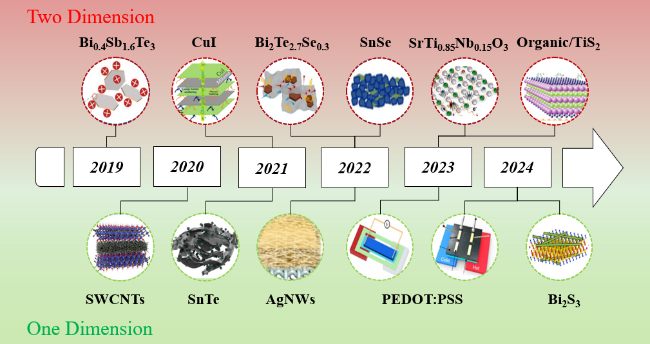
In low-dimensional materials, the quantum confinement effect reduces the coupling between thermoelectric factors, thereby enhancing the material's thermoelectric performance[28]. Combining MXene with low-dimensional materials is currently a hot topic in materials science research. Figure 2illustrates the research timeline of MXene combined with low-dimensional materials in the thermoelectric field. The combination not only fully leverages the advantages of each material and optimizes their overall performance but also expands the application scope and unlocks the potential functionalities of the materials. Therefore, researchers have proposed a strategy of combining MXene with low-dimensional materials to enhance its thermoelectric performance. This strategy aims to integrate the unique properties of low-dimensional materials with MXene's inherent superior characteristics, thereby improving MXene's thermoelectric performance and broadening its applications in the thermoelectric field. When combined with one-dimensional materials, emphasis is placed on utilizing their high carrier mobility[29]and quantum size effects[30]. When combined with two-dimensional materials, the focus is on optimizing carrier transport pathways[31]and regulating the band structure[32]. These two different combination approaches each have their own emphasis in enhancing thermoelectric performance, providing unique pathways for improving thermoelectric efficiency.
图2 MXene与一维、二维材料复合研究的时间进展线

Fig.2 Timeline of research progress on the combination of MXene with one-dimensional and two-dimensional materials

3 MXene Composites with One-Dimensional Materials

The combination of MXene with one-dimensional materials can achieve synergistic enhancement of multiple properties. By integrating MXene with one-dimensional materials, a novel composite structure can be realized, leveraging the low thermal conductivity of one-dimensional materials and the high electrical conductivity of MXene to reduce thermal conductivity while maintaining or enhancing electrical conductivity[33]. Meanwhile, the interfacial effects formed in the composite material may also introduce energy filtering effects or create special spatial structures, optimizing electron and phonon transport properties to regulate and improve thermoelectric performance. This section will analyze and summarize the enhancement of MXene's thermoelectric performance by introducing different types of one-dimensional materials (Table 1).
表1 MXene与一维材料复合的热电参数对比

Table 1 Comparison of thermoelectric parameters of MXene with one-dimensional materials

material σ(S·cm-1 S(μV·K-1 κ(W·m-1·K-1 PF(μW·m-1·K-2 ZT T(K) ref
MXene/Ag2Se 591.2 -129.5 0.88 933.4 0.27 400 37
MXene/SnTe 0.9×10³ 156 2.58 2000 0.63 823 39
SWCNT/MXene 1293.76 39.64 9.764 203.29 6.204×10⁻³ 300 42
PEDOT:PSS-MXene 736.4 57.3 0.35 155 0.12 300 47
Ti3C2Tx-SWCNTs-Ti3C2Tx 750.9 - 32.2 77.9 300 43
PEDOT:PSS/MXene 480.5 38.1 69.4 300 49

3.1 MXene combined with one-dimensional materials to enhance electrical conductivity

Combining MXene with one-dimensional materials such as nanowires/nanorods can enhance electrical conductivity. One approach is to provide additional electron and phonon transport channels or to create heterojunctions, enabling well-dispersed separation of photogenerated carriers and thus improving carrier mobility, which in turn boosts electrical conductivity and the power factor. Another method involves using a nano-composite strategy to optimize the lateral structure of layered MXene while forming a continuous electronic conduction network, thereby influencing electrical conductivity.
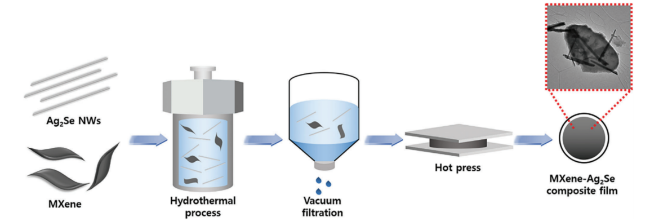
Silver nanowires (Ag NWs) exhibit excellent conductivity and can therefore be used as electrode materials[34]. In composites with MXene, the introduction of Ag NWs with a high specific surface area can increase carrier density by providing additional electron transport pathways, thereby enhancing the material's electrical conductivity. Meanwhile, the nanoscale effect also offers more electron conduction paths and phonon scattering centers, optimizing thermoelectric performance. Liu et al.[35] employed directional freezing and freeze-drying techniques to combine one-dimensional Ag NWs with two-dimensional MXene into a three-dimensional aerogel. The resulting three-dimensional MXene/Ag NWs aerogel serves as a conductive and heat-conducting framework for epoxy nanocomposites, providing channels for electron and phonon transport within the epoxy matrix (Figure 3). The resulting MXene/Ag NWs/epoxy resin nanocomposite demonstrates outstanding thermoelectric performance, with an electrical conductivity reaching as high as 1532 S·m-1. Qin et al.[36] investigated a strategy for combining an Ag2Se nanowire matrix with MXene nanosheets. The fabricated composite film features a transverse structure composed of Ag2Se grains and MXenes' unique layered arrangement, enabling rapid electron transfer. When the temperature rises to 400 K, the electrical conductivity increases to 2675 S·cm-1. Park et al.[37] proposed an innovative synthesis method that combines inorganic and organic components to produce high-performance flexible thermoelectric films. They prepared MXene-Ag2Se (MX-AS) composites through solution mixing, vacuum filtration, and hot pressing, systematically studying the thermoelectric properties of composites with different MXene concentrations. The results showed that the MX-AS composite film containing 1.5% by mass of MXene exhibited a maximum thermoelectric power factor of approximately 933.4 μW·m-1·K-2 at 400 K, representing a significant improvement of about 1.25 times. This enhancement is primarily attributed to the combination of Ag2Se's remarkable intrinsic Seebeck coefficient and MXene's high electrical conductivity.
图3 制备MX-AS复合材料的溶液混合方法示意图[37]

Fig.3 Schematic diagram of the solution mixing method for preparing MX-AS composite materials. Reprinted with permission from[37], Copyright 2024 Advanced Electronic Materials

The thermal properties of MXene can also be altered by compositing it with other one-dimensional materials. Ghosh et al.[38]used an in-situ hydrothermal method to anchor Ti3C2T xnanosheets directly onto 1D Bi2S3nanorods, thereby preparing a Bi2S3/Ti3C2T xcomposite material. The formation of Schottky junctions facilitates the separation of photogenerated carriers in the Bi2S3nanorods, resulting in excellent dispersion and a carrier mobility as high as 200 cm2·v-1·s-1.

3.2 MXene combined with one-dimensional materials reduces thermal conductivity

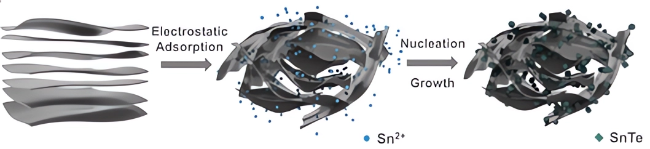
When MXene is combined with one-dimensional materials, the heterogeneous interface between them can effectively regulate electron and phonon transport behaviors through various mechanisms, thereby reducing thermal conductivity. By creating numerous interfacial structures (such as heterojunctions and mismatched lattice structures) between MXene and one-dimensional materials, phonon scattering can be enhanced. Jiang et al.[39]synthesized MXene/SnTe nanocomposites in situ via a simple thermal solvent method (Figure 4),exploring a new strategy for improving thermoelectric performance by combining two-dimensional MXene with SnTe-based materials. Due to enhanced phonon scattering, the thermal conductivity of the nanocomposite decreased from 3.21 W·m-1·K-1to 2.58 W·m-1·K-1, and the thermoelectric figure of merit reached 0.63.
图4 MXene/SnTe纳米复合材料的合成路线示意图[39]

Fig.4 Schematic diagram of the synthesis route for MXene/SnTe nanocomposites. Reprinted with permission from[39], Copyright 2021 Journal of Solid State Chemistry

3.3 MXene combined with one-dimensional materials enhances the Seebeck coefficient

Combining MXene with one-dimensional materials can introduce additional charge carriers or optimize the electronic structure through surface modification. Meanwhile, after combining MXene with one-dimensional materials, the interface region of the composite material may generate new band structures or novel charge transfer phenomena. These effects can increase the material's electron transport pathways, thereby enhancing the Seebeck coefficient.
Carbon Nanotubes (CNTs) are nano-scale one-dimensional materials formed by rolling up graphite layers. They possess extremely high mechanical strength and elastic modulus, as well as excellent electrical and thermal conductivity. Their electrical conductivity is comparable to that of copper, while their thermal conductivity surpasses that of any known material[40]. The electronic properties of CNTs depend on their structure (such as single-walled or multi-walled), and they can exhibit either conductive or semiconductive behavior. This characteristic gives them an extremely wide tunability in the Seebeck effect, making them one of the most promising flexible thermoelectric materials[9]. However, the current thermoelectric performance of CNTs is limited by their low Seebeck coefficient and high thermal conductivity. Combining CNTs with MXene is expected to create a synergistic effect that could lead to breakthroughs. The addition of CNTs can introduce vacancies into MXene[41], allowing CNTs to form heterostructures that provide efficient electron transport channels and phonon scattering centers. This can enhance electrical conductivity and reduce thermal conductivity, significantly improving the thermoelectric figure of merit of the composite material.
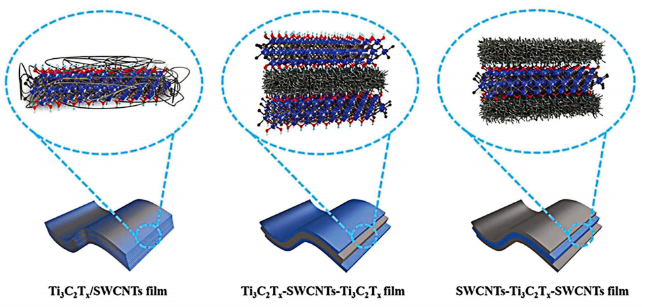
In recent years, many researchers have been dedicated to utilizing composite material structures and introducing energy filtering effects to enhance the thermoelectric performance of composites by increasing the Seebeck coefficient and reducing thermal conductivity without compromising electrical conductivity. For instance, Wei et al.[42]first prepared a series of three-dimensional hollow-structured SWCNTs/MXene films as p-type thermoelectric materials. The contact junction formed between SWCNTs and MXene in the composite facilitates electron transfer, and the three-dimensional hollow structure within the composite film significantly reduces thermal conductivity. Additionally, the decrease in hole concentration leads to an increase in the Seebeck coefficient. Due to these factors, the SWCNTs/MXene composite exhibits the highest Seebeck coefficient of 39.64 μV·K-1, with a corresponding PFof 203.29 μW·m-1·K-2. Ding et al.[43]optimized the thermoelectric performance of MXene-based materials by constructing heterogeneous interfaces to generate energy filtering effects that increase the Seebeck coefficient. They used a wet chemical assembly strategy to combine 2D MXene and 1D SWCNTs, forming a composite film with a vertical 2D-3D sandwich layered structure, as shown in Figure 5. The composite film consists of single-layer and few-layer structures, featuring a typical dense and well-aligned two-dimensional layered architecture. Phonon scattering at the interface contributes to higher electrical conductivity and lower thermal conductivity. Among the three different structured samples prepared in this work, the sandwich Ti3C2T x-SWCNTs-Ti3C2T xfilm exhibited a power factor higher than that of the interdigitated Ti3C2T x/SWCNTs film, being 25 times greater than that of the Ti3C2T xfilm, primarily due to its high electrical conductivity (750.9 S·cm-1) and elevated Seebeck coefficient (-32.2 µV·K-1). These results indicate that a rationally designed 2D-3D heterogeneous structure can initially achieve decoupling of carrier concentration and Seebeck coefficient, which holds positive significance for optimizing the thermoelectric performance of materials.
图5 Ti3C2Tx/SWCNTs(M/S)、Ti3C2Tx-SWCNTs-Ti3C2Tx (MSM)和SWCNTs-Ti3C2Tx-SWCNTs(SMS)薄膜结构示意图[43]

Fig.5 Schematic diagrams of Ti3C2Tx/SWCNTs(M/S), Ti3C2Tx- SWCNTs-Ti3C2Tx(MSM), and SWCNTs-Ti3C2Tx-SWCNTs (SMS) film structures. Reprinted with permission from [43], Copyright 2020 Advanced Materials Interfaces

Poly(3,4-ethylenedioxythiophene):polystyrene sulfonate (PEDOT:PSS) is a conductive polymer with remarkable properties and advantages, featuring excellent electrical conductivity that, with appropriate treatment, can rival certain metals[44], making it an important material for flexible electronic devices and conductive films, as well as one of the most widely studied organic thermoelectric materials currently[45]. PEDOT is an organic long-chain polymer and can be regarded as an organic one-dimensional material. At room temperature, the thermal conductivity of PEDOT:PSS is less than 0.2 W·m-1·K-1. Leveraging the low thermal conductivity of PEDOT:PSS and the high electrical conductivity of MXene, it holds promise for achieving a high ZT value[46]. Guan et al.[47]compounded n-type two-dimensional material MXene (Ti3C2T x) with PEDOT:PSS, achieving for the first time the enhancement of the Seebeck coefficient of p-type thermoelectric polymers through n-type doping. The internal electric field generated by electron transfer from MXene to PEDOT:PSS can filter low-energy carriers, increasing the Seebeck coefficient of the composite material from 23 to 57.3 μV·K-1 and the power factor from 44.1 to 155 μW·m-1·K-2.
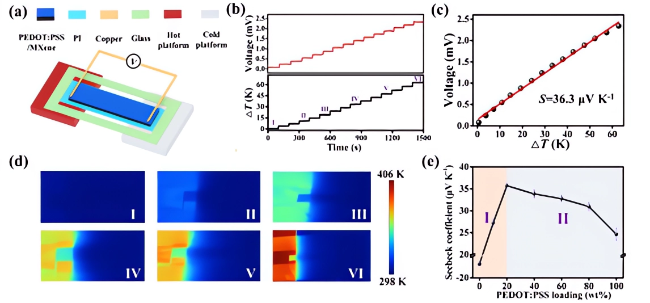
In addition to the advantages mentioned above, the MXene and PEDOT:PSS composite also offers new insights into the integration of thermoelectric devices. Qian et al.[48]reported a novel light-driven actuator with self-powered sensing capabilities. The functional design of this actuator integrates a photothermal generator into an actuator based on PEDOT:PSS/MXene composites and polyimide, enhancing thermoelectric performance (Figure 6). Due to the energy filtering effect at the PEDOT:PSS and MXene interface and the synergistic effect of their charge carriers, the Seebeck coefficient of the composite material reaches 35.7 μV·K-1.
图6 (a)基于PEDOT:PSS/MXene薄膜的热电性能测量装置示意图;(b)PEDOT:PSS/MXene薄膜在热平台加热过程中不同阶段的输出电压和△T;(c)PEDOT:PSS/MXene薄膜的输出电压随△T的变化;(d) PEDOT:PSS/MXene薄膜在热平台加热过程中不同阶段的红外图像;(e)PEDOT:PSS/MXene薄膜的塞贝克系数随PEDOT:PSS加载百分比的变化[48]

Fig.6 (a) Schematic diagram of the thermoelectric performance measurement device for PEDOT:PSS/MXene films; (b) Output voltage and △T at different stages of heating process of PEDOT:PSS/MXene films on a thermal platform; (c) Output voltage of PEDOT:PSS/MXene films as a function of △T; (d) Infrared images of PEDOT:PSS/MXene films at different stages of heating process on a thermal platform; (e) Seebeck coefficient of PEDOT:PSS/MXene films as a function of PEDOT:PSS loading percentage. Reprinted with permission from [48], Copyright 2023 RSC Advances

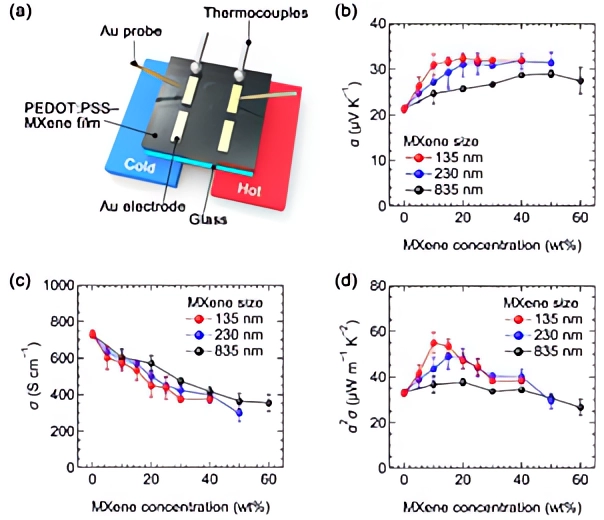
Unlike the aforementioned research approach that alters MXene content to study the thermoelectric properties of MXene composites, Park et al.[49]revealed the effects of interface area and energy barrier on thermoelectric performance by controlling the size of MXene and the oxidation level of PEDOT:PSS (Figure 7). The study found that increasing the interface area promotes the energy filtering effect, and smaller-sized MXene composite films exhibit a higher power factor. It was also demonstrated that an optimal energy barrier (0.14 eV) between PEDOT:PSS and MXene can accelerate the energy filtering effect, thereby maximizing the power factor of the composite film, reaching up to 69.4 μW·m-1·K-2.
图7 (a)PEDOT: PSS-MXene复合薄膜热电性能的测量装置示意图;(b)塞贝克系数;(c)电导率;(d)功率因子作为MXene浓度的函数[49]

Fig.7 (a) Schematic diagram of the measurement device for thermoelectric performance of PEDOT:PSS-MXene composite films; (b) Seebeck coefficient; (c) electrical conductivity; (d) power factor as a function of MXene concentration. Reprinted with permission from [49], Copyright 2023 IOP science

In summary, the strategy of combining MXene with one-dimensional materials such as carbon nanotubes, nanowires, and organic thermoelectric materials aims to fully leverage MXene's excellent thermoelectric properties while utilizing the characteristics of one-dimensional materials to address MXene's limitations in the thermoelectric field. Specifically, the flexibility and high conductivity of carbon nanotubes, when combined with MXene, can form a stable network structure, thereby enhancing the overall electrical conductivity of the material. Additionally, nanowires possess outstanding conductivity and flexibility, enabling them to create an efficient conductive network within the composite system. Furthermore, organic thermoelectric materials offer good processability and conductivity, serving as a supplement to the conductive network to further enhance the material's electrical conductivity and improve its thermoelectric performance.

4 MXene Composites with Two-Dimensional Materials

Two-dimensional materials, due to their atomically thin layered structure, exhibit higher electrical conductivity and electron mobility. In contrast, traditional materials often have higher thermal conductivity because of their three-dimensional structure, which is detrimental to optimizing thermoelectric performance. Additionally, the mechanical flexibility and processability of two-dimensional materials provide excellent tunability. By constructing new interfaces between MXene and two-dimensional materials (such as transition metal dichalcogenides (TMDs) and oxide nanosheets), it is possible to regulate the electronic properties of composite materials and influence carrier distribution and movement through band offset effects, potentially enabling precise control over the Seebeck coefficient and electrical conductivity[50-51]. Moreover, lattice mismatch and differences in phonon band structures between different materials, as well as material interfaces and defects serving as phonon scattering centers, can effectively reduce thermal conductivity. Furthermore, innovative heterostructure designs, such as vertically stacked van der Waals heterostructures and horizontally combined two-dimensional materials, hold promise for regulating nanoscale carrier transport phenomena and optimizing the thermoelectric performance of composite materials through material structure and interface design (Table 2). This section will analyze and summarize the different impacts of introducing two-dimensional materials on the thermoelectric performance of MXene.
表2 MXene与二维材料复合的热电参数对比

Table 2 Comparison of thermoelectric parameters of MXene combined with two-dimensional materials

material σ(S·cm-1 S(μV·K-1 κ(W·m-1·K-1 PF(μW·m-1·K-2 ZT T(K) ref
CoSb3/Ti3C2Tx 5.1 × 104 175 3 1200 0.29 623 27
SrTi0.85Nb0.15O3/MXene 1.35×10⁵ -152 2.9 2510 0.9 921 52
Bi2Te2.7Se0.3/MXene 7.2×10⁴ -158 0.65 1.85 1.2 425 53
(Bi,Sb)2Te3/MXene 5×10⁴ 206 0.61 21 1.3 375 22
Ti3C2Tx MXene-MP 2.5×10³ -13.9 0.19 0.48 1.7×10⁻³ 700 54
Sn0.98Cd0.02Se/Ti3C2 33.5 320 0.65 3.31 0.41 773 55
SnSe1.97Br0.03/Ti3C2Tx 120 -235 0.6 6.4 0.96 818 63
SnSe/Ti3C2Tx 5.5×103 310 0.41 0.55 0.93 773 64
Mg3.2Sb0.5Bi1.49Te0.01/MXene 500 -205 0.66 20 1.0 513 65
MXene/GeTe 1500 160 2.19 35 1.13 700 68
CuI/Ti3C2 40 224 0.18 225 0.48 550 59
Cu2Se/MXene 230 0.54 1000 1.77 923 66
Bi2Te2.7Se0.3/Ti3C2Tx -200 0.41 1.49 0.68 380 60
Sb2Te3/MXene 43.8 116 59 1.8×10⁻³ 300 56
MXene/Organic/TiS2 3.8×10⁴ -44.8 77.2 70

4.1 MXene combined with two-dimensional materials enhances electrical conductivity

The combination of MXene with two-dimensional materials can enhance electrical conductivity through various approaches. One method is to optimize electron transport by introducing new carrier channels. Two-dimensional materials typically exhibit high specific surface area, large aspect ratios, and unique electronic structural features, making them excellent electron transport media. They can provide additional carrier transport channels, enhancing current output and thus improving electrical conductivity and the power factor. Secondly, creating new interfaces between MXene and two-dimensional materials may influence carrier distribution and movement through band offset effects, thereby precisely regulating electrical conductivity. Another approach involves optimizing the electronic structure of MXene to improve its conductivity. By adjusting the electronic density of states and band structure at the interface, the electronic transport properties of MXene can be altered, leading to enhanced conductivity. Additionally, combining MXene with two-dimensional materials can also regulate the crystal or composite structure of MXene. New interlayer structures, interlayer distances, stacking modes, and stacking sequences can modulate electron transport behavior within the composite material, directly affecting electron mobility and band structure, and consequently influencing electrical conductivity.
Two-dimensional oxide flakes are outstanding candidates for high-temperature thermoelectric power generation. Among various available materials, SrTiO3(STO) has been proven to be one of the best candidates due to its excellent thermoelectric properties[9]. To further enhance the thermoelectric performance of STO in practical applications, constructing heterostructures or composites with other components has been shown to be an effective approach.
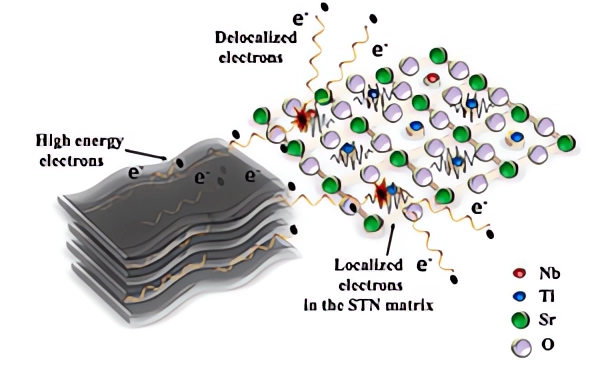
For example, Dixit et al.[52]first experimentally combined MXene with a rare-earth-free perovskite oxide and tested its thermoelectric properties (Figure 8). In doped SrTiO3 perovskite, charge localization dominates electron transport, which hinders the oxide from achieving a higher thermoelectric power factor. This work demonstrates that incorporating Ti3C2T x MXene into the SrTi0.85Nb0.15O3 (STN) matrix facilitates electron delocalization, resulting in an electron mobility superior to that of single-crystal samples in the polycrystalline composite material. The electrical conductivity increased by 1851%, the power factor was enhanced by 1000%, and the thermoelectric figure of merit achieved a remarkable enhancement of 700%.
图8 MXene通过传递应变和提供高能电子来促进STN矩阵中电子的离域示意图[52]

Fig.8 Schematic diagram of MXene facilitating the delocalization of electrons in the STN matrix by transferring strain and providing high-energy electrons. Reprinted with permission from [52], Copyright 2023 Small

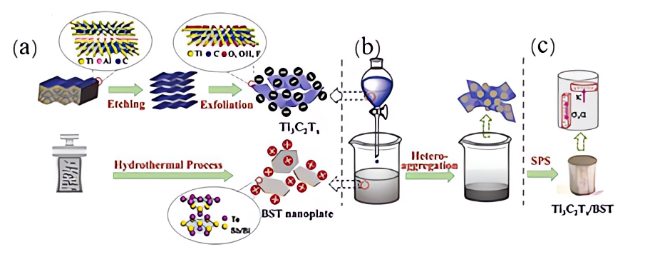
Some strategies for further enhancing the ZT value across the entire temperature range (or the average temperature range) have proven effective, particularly the incorporation of nanoscale second phases, which are expected to provide abundant heterogeneous interfaces and grain boundaries to modulate charge carrier and phonon transport behaviors in composites, thereby enhancing the ZT value over a wide temperature range[53]. Lu et al.[22] used p-type Bi0.4Sb1.6Te3 (BST) as the matrix and Ti3C2T xwith high conductivity as the second phase, preparing Ti3C2T x/BST composites with uniformly dispersed Ti3C2T xvia a self-assembly combined with spark plasma sintering method (Figure 9). The results showed that oxygen-terminated Ti3C2T xpossesses an appropriate work function, achieving higher electrical conductivity through hole injection while maintaining the Seebeck coefficient due to energy barrier scattering. Specifically, the composite achieved a thermoelectric figure of merit as high as 1.3, with an average thermoelectric figure of merit reaching 1.23 in the temperature range of 300–475 K.
图9 (a)Ti3C2Tx纳米片和BST纳米片制备示意图;(b)制备Ti3C2Tx/BST复合粉末的自组装工艺;(c)Ti3C2Tx/BST复合材料的致密化及不同性能的试样说明[22]

Fig.9 (a) Schematic diagram of the preparation of Ti3C2Tx nanosheets and BST nanosheets; (b) Self-assembly process for preparing Ti3C2Tx/BST composite powder; (c) Densification of Ti3C2Tx/BST composite materials and description of samples with different properties. Reprinted with permission from [22], Copyright 2020 Advanced Energy Materials

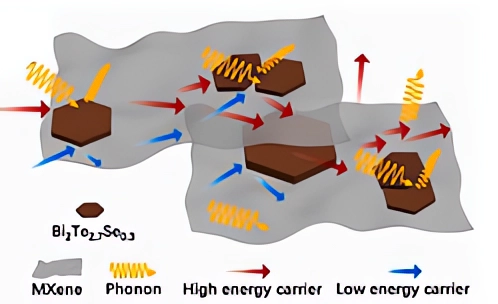
In addition to BST, BTS (a Bi-Te-Se compound) is currently also considered an efficient n-type room-temperature thermoelectric material[9]. Diao et al.[53]prepared a multifunctional BTS/MXene composite material by mixing Bi2Te2.7Se0.3with a MXene dispersion, followed by vacuum-assisted filtration and hot pressing (Figure 10). The results showed that the BTS/MXene composite material exhibited a maximum electrical conductivity of approximately 8.3×10⁴ S·m-1 at 313 K, and its maximum thermoelectric figure of merit reached 1.2 in the temperature range of 313–498 K.
图10 BTS/MXene系统中载流子和声子传输过程的示意图[53]

Fig.10 Schematic diagram of carrier and phonon transport processes in the BTS/MXene system. Reprinted with permission from [53], Copyright 2022 Carbon

In 2023, Li et al.[54]reported stretchable n-type thermoelectric fibers based on a mixture of Ti3C2T x MXene nanosheets and polyurethane (MP) via a wet-spinning process. The MP/Ti3C2T xcomposite exhibited a high electrical conductivity of 1.25×10³ S·m-1, an n-type Seebeck coefficient of -8.3 μV·K-1, and a thermal conductivity of 0.19 W·m-1·K-1. In practical applications, the temperature gradient between human skin and the surrounding environment highlights the great potential for harvesting low-grade human body heat energy. Shortly thereafter, Qin et al.[55]successfully prepared a Ti3C2/Sn0.98Cd0.02Se composite material using a thermal solvent method combined with electrostatic self-assembly and plasma sintering. The introduction of the phase interface between Ti3C2and Sn0.98Cd0.02Se effectively filters low-energy carriers due to the energy barrier it creates, thereby enhancing the Seebeck coefficient. Meanwhile, the Ti3C2/Sn0.98Cd0.02Se sample also achieved high electrical conductivity, and at 773 K, it obtained a high power factor of 3.31 μW·cm-1·K-2, with a maximum thermoelectric figure of merit of 0.41. Additionally, Xu et al.[56]prepared p-type Sb2Te3hexagonal nanosheets via a hydrothermal synthesis method and combined them with Ti3C2T xto form a composite film. Due to the excellent conductivity and high specific surface area of Ti3C2T x, the composite film demonstrated outstanding thermoelectric performance, with a power factor of approximately 59 µW·m-1·K-2.

4.2 MXene combined with two-dimensional materials reduces thermal conductivity

The thermal conductivity of MXene composites with two-dimensional materials can be reduced through various approaches, such as enhancing interfacial phonon scattering, designing stable two-dimensional materials, interface modulation, and introducing novel nano-sized second-phase materials. At the micro- and nanoscale, two-dimensional materials effectively suppress heat conduction by scattering phonons. Through interfacial scattering effects, additional scattering centers formed at the composite interface enhance the phonon scattering process, significantly reducing the phonon transmission rate in MXene composites and thereby markedly lowering their lattice thermal conductivity. Additionally, since the thermal conductivity of MXene is primarily influenced by its lattice structure, lattice mismatches between different materials, differences in phonon band structures, and various defects within the composite all play crucial roles in reducing thermal conductivity. Furthermore, combining MXene with two-dimensional materials can also lower thermal conductivity by optimizing grain boundaries; MXene typically has grain boundaries, and the introduction of composite materials can effectively reduce both the number and length of these boundaries, thus shortening the phonon transmission paths and decreasing thermal conductivity. This strategy for reducing thermal conductivity helps create a larger temperature gradient, enhancing thermoelectric conversion efficiency and further lowering thermal conductivity.
In terms of theoretical research on reducing thermal conductivity by combining MXene with two-dimensional materials to alter their thermoelectric properties, Rana et al.[57]used density functional theory and the Boltzmann transport equation to study the narrow-bandgap Janus monolayer MoWCO2.They calculated the scattering rates for electron-phonon, phonon-phonon, phonon-boundary, and electron-boundary interactions. At T=700 K, the power factor for p-type was 6.5×10³ W·m-1·K-2, and for n-type it was 1.5×10³ W·m-1·K-2. In a ribbon structure with a width of 1 m (L), the lattice thermal conductivity decreased from 308 W·m-1·K-1at T=300 K to 65 W·m-1·K-1. This reduction in thermal conductivity enhanced the Seebeck coefficient, resulting in an improvement of the thermoelectric figure of merit from 0.04 (p-type) and 0.01 (n-type) to 0.33 (p-type) and 0.08 (n-type) at T=700 K and L=10 nm. Based on the above theoretical research, Theja et al.[50]first fabricated a composite engineered thermoelectric generator device doped with bismuth and antimony telluride, as well as Ti3C2T x MXene nanosheets. The prepared composite material reduced thermal conductivity through interfacial phonon scattering, and the maximum power output of the composite thermoelectric generator device was 1.14 mW, with a power density of 6.1 mW·cm-2. The developed composite thermoelectric generator device represents a simple and efficient alternative for the next generation of telluride-based thermoelectric generator devices.
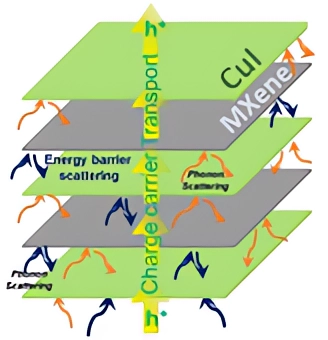
Nanocomposites or nano-interlayers can reduce the thermal conductivity of materials and improve their thermoelectric performance[58].Karthikeyan et al.[59]demonstrated the excellent thermoelectric behavior of novel two-dimensional CuI nanosheets by compounding with Ti3C2 MXene nano-inclusions (Figure 11). Through structural engineering, a remarkable power factor of 225 μW·m-1·K-2was achieved, and the thermoelectric figure of merit for the composite material with a CuI volume fraction of 5% and Ti3C2 was 0.48. The effect of the interlaced structure on energy barrier scattering between CuI and Ti3C2 is illustrated in Figure 11. This work establishes a method for directly regulating the thermoelectric properties of abundant, non-toxic materials found on Earth.
图11 交错结构对CuI和Ti3C2之间能量势垒散射的影响示意图[59]

Fig.11 Schematic diagram of the effect of interleaved structure on the energy barrier scattering between CuI and Ti3C2. Reprinted with permission from [59], Copyright 2022 Rapid Research Letters

Unlike the aforementioned study on enhancing the electrical conductivity of Bi2Te2.7Se0.3/MXene composites, Zhang et al.[60]prepared carbon nitrides by selectively etching the A layer of MAX phases and systematically investigated the thermoelectric properties of the Bi2Te2.7Se0.3/MXenes system. Due to the enhanced interfacial phonon scattering between Ti3C2T xnanosheets and the Bi2Te2.7Se0.3matrix, the lattice thermal conductivity of the composite decreased from 0.77 to 0.41 W·m-1·K-1at 380 K. Additionally, Dixit et al.[27]employed a four-phonon scattering mechanism and an improved Debye-Kalau model to demonstrate enhanced phonon-phonon scattering in the composite samples. The electrical conductivity of the Ti3C2T xMXene/CoSb3composite increased, while its lattice thermal conductivity decreased, resulting in a 137% increase in the figure of merit at 623 K. Under higher temperature conditions, the Seebeck coefficient data for both the pristine CoSb3and the CoSb3/Ti3C2T xMXene composite exhibited bipolar behavior.
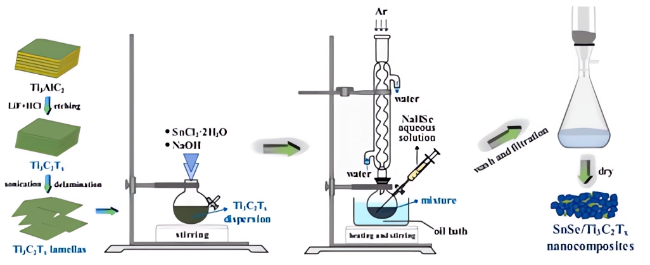
SnSe possesses stable chemical properties and a layered orthorhombic crystal structure[57-62], as well as strong anisotropy and anharmonicity, resulting in an extremely low thermal conductivity that is advantageous for thermoelectric applications. Wei et al.[63]successfully prepared Br-doped SnSe2/Ti3C2T xcomposites using a hydrothermal method combined with solid-phase synthesis. The carrier concentration of SnSe1.97Br0.03/Ti3C2T xincreased from 1017 cm2·v-1·s-1to 1020 cm2·v-1·s-1, an increase of three orders of magnitude. Combined with its inherently low lattice thermal conductivity, the SnSe1.97Br0.03/Ti3C2T xsample achieved a maximum thermoelectric figure of merit (ZT≈0.96) close to unity at 818 K. Zhang et al.[64]continued their research on SnSe materials as follows: using solution synthesis and rapid solidification, two-dimensional Ti3C2T xMXene was successfully compounded with the SnSe matrix, as shown in Figure 12. The SnSe/Ti3C2T xcomposite successfully reduced the lattice thermal conductivity, reaching a low value of 0.41 W·m-1·K-1at 773 K, and achieved a maximum thermoelectric figure of merit of 0.93.
图12 SnSe/Ti3C2Tx纳米复合材料溶液合成过程示意图[64]

Fig.12 Schematic diagram of the solution synthesis process for SnSe/Ti3C2Tx nanocomposites. Reprinted with permission from [64], Copyright 2022 Materials Today Energy

In addition to enhancing the thermoelectric performance of MXene by compositing it with SnSe, researchers have also employed other various methods to combine different materials with MXene. Tian et al.[65]used a combination of ball milling and rapid sintering to composite two-dimensional MXene with Mg3.2Sb0.5Bi1.49Te0.01, thereby modifying the composition and structure of the interface. The uniformly dispersed heterogeneous structure resulted in stronger phonon scattering, yielding a low lattice thermal conductivity of approximately 0.66 W·m-1·K-1for Mg3.2Sb0.5Bi1.49Te0.01/MXene, and achieving a thermoelectric figure of merit of about 1.0 at 513 K. Zhao et al.[66]introduced MXene as a novel nano-second-phase material into the fabricated Cu2Se alloy bulk via hydrothermal and vacuum hot-pressing methods, and investigated the microstructure and thermoelectric transport properties of the samples. The maximum thermoelectric figure of merit of the Cu2Se/MXene sample reached 1.77 at 923 K.
Since the in-plane thermal conductivity of the two-dimensional material MXene is significantly superior to its out-of-plane conductivity, the freeze-drying method can effectively enhance the thermal conductivity of composites by leveraging its anisotropy[67].Fan et al.[68]achieved uniform dispersion of the two-dimensional material MXene in GeTe through a simple freeze-drying process, successfully synchronizing the adjustment of electronic and thermal transport properties in the GeTe-based alloy. The formation of abundant interfaces between MXene and GeTe leads to increased phonon scattering, thereby reducing the material's thermal conductivity. At 700 K, the minimum thermal conductivity of the MXene/GeTe composite can reach 2.19 W·m-1·K-1. Influenced by the reduced carrier concentration and thermal conductivity, the composite achieves a maximum thermoelectric figure of merit of 1.13 at 700 K.

4.3 MXene combined with two-dimensional materials enhances the Seebeck coefficient

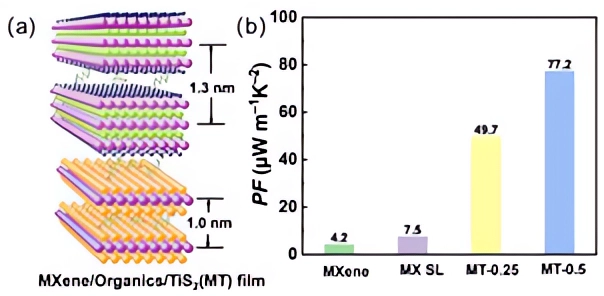
Gandi et al.[69]numerically solved the Boltzmann transport equations for phonons and electrons to investigate the thermoelectric response in heterostructures composed of M2CO2(M: Ti, Zr, Hf) MXenes and monolayers of transition metal sulfides. They found that low-frequency optical phonons, resulting from van der Waals bonding, significantly contribute to heat transport, and these low-frequency optical phonons compensate for the reduced phonon contribution (due to increased scattering cross-sections in the heterostructure), leading to a thermal conductivity similar to that of pure MXenes. The results suggest that when combined with intercalation, an important superlattice design approach for thermoelectric materials may be effective for two-dimensional van der Waals materials. Wang et al.[70]enhanced the Seebeck coefficient of MXenes by incorporating TiS2and constructing mismatched structures with organic molecules, thereby achieving the goal of improving the power factor. In this study, flexible MXene/Organic/TiS2mismatched films were synthesized using organic intercalation, exfoliation, and reassembly techniques, as shown in Figure 13a. The study revealed that the absolute value of the Seebeck coefficient of this mismatched film was significantly enhanced to 44.8 μV·K-1, primarily due to the energy filtering effect at the heterojunction interface. The power factor was also significantly improved to 77.2 μW·m-1·K-2, which is 18 times higher than that of the pristine MXene film. These results indicate that constructing MXene/organic/TiS2structures can significantly enhance the thermoelectric performance of materials, as illustrated in Figure 13b.
图13 (a)MXene/有机物/TiS2薄膜的结构示意图;(b)MXene、MX SL、MT-0.25、MT-0.5薄膜的功率因子[70]

Fig.13 (a) Schematic diagram of the structure of MXene/organic/TiS2 films;(b) Power factor of MXene, MX SL, MT-0.25, and MT-0.5 films. Reprinted with permission from[70], Copyright 2023 ACS Applied Materials & Interfaces

In summary, it has been found that combining MXene with two-dimensional materials and optimizing its thermoelectric performance by enhancing its electrical conductivity and Seebeck coefficient while reducing its thermal conductivity is an important strategy. The introduction of two-dimensional materials can alter the electronic density of states of MXene, adjust the position of its Fermi level, and thereby influence the carrier concentration and mobility of the material, ultimately affecting its thermoelectric performance. Additionally, the combination of MXene with two-dimensional materials can modify the crystal structure of MXene, regulating interfacial properties through lattice matching or mismatch. This lattice modulation can impact the electronic transport properties of MXene, further influencing its thermoelectric performance. Moreover, the composite interface formed between MXene and two-dimensional materials plays a crucial role in determining thermoelectric performance. Factors such as the energy level structure, defect distribution, and electron-phonon interactions at the interface all affect carrier transport and heat conduction. By controlling these interfacial characteristics, effective energy matching and carrier distribution can be achieved, thus enhancing the thermoelectric performance of the material.

5 Conclusion and Outlook

In the pursuit of new and sustainable energy forms, thermoelectric conversion technology can help recover energy from waste heat and convert thermal energy into electricity for power generation. There is good reason to believe that thermoelectric conversion technology will become one of the key energy technologies of the future. Therefore, it is necessary to design novel thermoelectric materials or structures with higher efficiency than existing materials. As a new type of two-dimensional thermoelectric material, MXene possesses unique advantages in mechanical, electrical, and thermal properties. However, due to its distinctive two-dimensional layered structure and physicochemical characteristics, MXene exhibits relatively high thermal conductivity. Phonons, which are the primary carriers of heat conduction, have their propagation within the crystal lattice strictly constrained by the lattice structure and chemical bonds. The interlayer coupling in MXene is weak, far less robust than the chemical bonds within a single layer. This unique layered structure limits the pathways available for phonon propagation. Additionally, surface-terminating groups form complex chemical bonds and interactions that affect phonon vibration frequencies and energy transport paths. Differences in atomic mass and the rigidity of chemical bonds also contribute to discontinuities in phonon conduction pathways.
To address the inherent limitations of MXene and further enhance its thermoelectric performance, a strategy of compositing with low-dimensional materials is proposed. Existing research has found that one-dimensional materials, due to their insufficient interfacial effects and scattering sources, perform worse than two-dimensional materials in reducing thermal conductivity. Moreover, when MXene is combined with one-dimensional materials, the interfacial scattering effect is relatively weak, lacking the thermal conduction-blocking effect provided by two-dimensional materials; thus, most studies focus on optimizing the Seebeck coefficient. In one-dimensional materials, electrons are confined to a smaller dimension, and their movement can only occur along a single direction within the material, often influenced by quantum effects in electron and heat conduction. In thermoelectric materials, one-dimensional materials can regulate carrier transport properties through quantum confinement effects, thereby enhancing the Seebeck coefficient. Two-dimensional materials, on the other hand, possess a broader band structure compared to one-dimensional materials, with higher degrees of freedom in electron energy and momentum distribution, resulting in weaker quantum effects. When two-dimensional materials are incorporated, carrier scattering effects easily occur at the interface, complicating carrier thermal excitation and transport, and consequently affecting the enhancement of thermoelectric performance.
The strategy of combining MXene with low-dimensional materials provides a new approach to addressing the inherent metallic properties of MXene, demonstrating the potential of low-dimensional materials in solving practical application challenges and promoting the cross-disciplinary integration and innovative development of materials science and thermoelectric conversion technologies. At the same time, it is also important to note that realizing the practical application of these composite thermoelectric materials still requires overcoming a series of challenges, including large-scale preparation of composites, interfacial stability, material compatibility, and cost-effectiveness issues.
Based on current research, this article proposes the following three directions for future development.
(1) Self-powered modules for flexible wearable electronic devices. The rapid development and high integration of miniaturized and self-powered electronic systems, along with the fast-growing popularity of flexible and wearable electronics, urgently necessitate the development of power supply device modules that meet safety, stability, flexibility, and miniaturization requirements, exemplified by thermoelectric conversion technology. Future thermoelectric materials need to possess good mechanical flexibility and stable thermoelectric performance[71-73], enabling them to adapt to various curved, twisted, and folded attachment surfaces, thus ensuring that thermoelectric devices maintain stable energy conversion efficiency even after repeated bending and stretching. The mechanical flexibility conferred by MXene's two-dimensional layered structure offers possibilities for realizing foldable electronic products. Considering that wearable electronic devices typically have low energy demands, while human-generated heat is characterized by a low temperature range, dispersed distribution, and frequent movement, thermoelectric conversion devices based on MXene must accordingly achieve higher power density and energy density. Additionally, in material selection, non-toxic and biocompatible materials should be used to ensure safety during prolonged wear.
(2) Thermoelectric Material Design in the Age of Artificial Intelligence. With the rapid advancement of artificial intelligence technologies, machine learning has already impacted various fields of materials science and engineering. Applying machine learning to the screening, design, and prediction of novel materials will lead to incredible discoveries and progress. MXene naturally allows for multi-elemental modifications and complex, diverse terminal groups. By combining MXene's unique characteristics with existing data, we can establish models to design structures and predict performance, conveniently adjusting and optimizing parameters to rapidly discover new MXene materials with outstanding thermoelectric properties. On the other hand, machine learning algorithms can also be used to conduct in-depth analysis and exploration of the structure-performance relationships in MXene and its composites, enabling the discovery and prediction of novel structures and enhancing thermoelectric performance[74-76].Relying on the powerful computational capabilities, algorithms, and databases of computers, we can predict material properties such as structure, free energy entropy, bandgap, lattice thermal conductivity, and electrical conductivity. By integrating materials genomics, big data, and AI-driven predictions, we can design material compositions, structures, sizes, and morphologies. Through precise material design solutions, we can specifically address the inherent drawbacks of traditional thermoelectric materials and intelligently design the structure and parameters of thermoelectric devices.
(3) Low cost, convenience, large-scale production, and integration. To achieve widespread application of thermoelectric conversion technology, the preparation process of thermoelectric materials and devices needs to be simple, low-cost, and suitable for large-scale production. Future research on MXene thermoelectric materials and related devices requires further optimization of synthesis and fabrication methods[77-79]to enable large-scale production. These technologies should also be compatible with existing electronic device manufacturing processes[61]to facilitate the integration of thermoelectric conversion technology with other electronic technologies. The composite technology of MXene with other materials also requires optimization of its preparation process to meet the demands of different application scenarios. In the future, advanced micro- and nano-fabrication techniques can be utilized to achieve rapid fabrication and customized design of MXene-based thermoelectric devices. Through systematic performance optimization and application exploration, the efficiency and stability of thermoelectric devices can be further improved, expanding their applications in energy conversion, thermal management, and other fields, thus providing new opportunities and challenges for the research and development of thermoelectric conversion technology.
[1]
Bu Z L, Zhang X Y, Hu Y X, Chen Z W, Lin S Q, Li W, Xiao C, Pei Y Z. Nat. Commun., 2022, 13: 237.

[2]
Wang D X, Ling X, Peng H, Liu L, Tao L L. Energy, 2013, 50: 343.

[3]
Chen Z G, Han G, Yang L, Cheng L N, Zou J. Prog. Nat. Sci. Mater. Int., 2012, 22(6): 535.

[4]
Zhu T J, Liu Y T, Fu C G, Heremans J P, Snyder J G, Zhao X B. Adv. Mater., 2017, 29(30): 1605884.

[5]
Bandaru S, Jastrzębska A M, Birowska M. Appl. Mater. Today, 2023, 34: 101902.

[6]
Ioffe A F, Stil'bans L S, Iordanishvili E K, Stavitskaya T S, Gelbtuch A, Vineyard G. Phys. Today, 1959, 12(5): 42.

[7]
Mahan G D, Bartkowiak M. Appl. Phys. Lett., 1999, 74(7): 953.

[8]
Biswas K, He J Q, Blum I D, Wu Chun-i, Hogan T P, Seidman D N, Dravid V P, Kanatzidis M G. Nature, 2012, 489(7416): 414.

[9]
Zhu M Y, Lu C C, Liu L R. iScience, 2023, 26(5): 106718.

[10]
Zhang J Z, Kong N, Uzun S, Levitt A, Seyedin S, Lynch P A, Qin S, Han M K, Yang W R, Liu J Q, Wang X G, Gogotsi Y, Razal J M. Adv. Mater., 2020, 32(23): 2001093.

[11]
Naguib M, Kurtoglu M, Presser V, Lu J, Niu J J, Heon M, Hultman L, Gogotsi Y, Barsoum M W. Adv. Mater., 2011, 23(37): 4248.

[12]
Khazaei M, Arai M, Sasaki T, Estili M, Sakka Y. Phys. Chem. Chem. Phys., 2014, 16(17): 7841.

[13]
Barsoum M W, Murugaiah A, Kalidindi S R, Zhen T. Physical Review Letters., 2004, 92: 255508.

[14]
Naguib M, Mochalin V N, Barsoum M W, Gogotsi Y. Adv. Mater., 2014, 26(7): 992.

[15]
Anasori B, Dahlqvist M, Halim J, Moon E J, Lu J, Hosler B C, Caspi E N, May S J, Hultman L, Eklund P, Rosén J, Barsoum M W. J. Appl. Phys., 2015, 118(9): 094304.

[16]
Eklund P, Beckers M, Jansson U, Högberg H, Hultman L. Thin Solid Films, 2010, 518(8): 1851.

[17]
Barsoum M W, Radovic M. Annu. Rev. Mater. Res., 2011, 41: 195.

[18]
Li Y, Chen J X, Cai P W, Wen Z H. J. Mater. Chem. A, 2018, 6(12): 4948.

[19]
Champagne A, Battaglia J L, Ouisse T, Ricci F, Kusiak A, Pradere C, Natu V, Dewandre A, Verstraete M J, Barsoum M W, Charlier J C. J. Phys. Chem. C, 2020, 124(43): 24017.

[20]
Sarikurt S, Çakır D, Keçeli M, Sevik C. Nanoscale, 2018, 10(18): 8859.

[21]
Magnuson M, Halim J, Näslund L Å. J. Electron Spectrosc. Relat. Phenom., 2018, 224: 27.

[22]
Lu X F, Zhang Q H, Liao J C, Chen H Y, Fan Y C, Xing J J, Gu S J, Huang J L, Ma J X, Wang J C, Wang L J, Jiang W. Adv. Energy Mater., 2020, 10(2): 1902986.

[23]
Khazaei M, Arai M, Sasaki T, Chung C Y, Venkataramanan N S, Estili M, Sakka Y, Kawazoe Y. Adv. Funct. Mater., 2013, 23(17): 2185.

[24]
Kim H, Anasori B, Gogotsi Y, Alshareef H N. Chem. Mater., 2017, 29(15): 6472.

[25]
Guo J, Legum B, Anasori B, Wang K, Lelyukh P, Gogotsi Y, Randall C A. Adv. Mater., 2018, 30(32): 1801846.

[26]
Yan L, Luo X, Yang R Z, Dai F, Zhu D D, Bai J N, Zhang L, Lei H L. ACS Appl. Mater. Interfaces, 2022, 14(30): 34562.

[27]
Dixit P, Ghosh S, Mallik R C, Maiti T. ACS Appl. Energy Mater., 2023, 6(23): 12105.

[28]
Wang L. Master's Thesis of Lanzhou Jiaotong University, 2022

(王丽. 兰州交通大学硕士论文, 2022).

[29]
Liu T J, Tang W D, Luong S, Fenwick O. Nanoscale, 2020, 12(17): 9688.

[30]
Mao J, Liu Z H, Ren Z F. NPJ Quantum Mater., 2016, 1: 16028.

[31]
Li S L, Tsukagoshi K, Orgiu E, Samorì P. Chem. Soc. Rev., 2016, 45(1): 118.

[32]
Pei Q, Wang X C, Zou J J, Mi W B. Nanotechnology, 2018, 29(21): 214001.

[33]
Hasan M M, Hossain M M, Chowdhury H K. J. Mater. Chem. A, 2021, 9(6): 3231.

[34]
He W W, Yan X H, Liang Y M, Long Y F, Pan C, Zhao J L, Chen L, Xiong W, Liu Q X. RSC Adv., 2018, 8(22): 12146.

[35]
Liu H B, Huang Z Y, Chen T, Su X Q, Liu Y N, Fu R L. Chem. Eng. J., 2022, 427: 131540.

[36]
Qin J, Lu Y, Liu W J, Du Z L, Li X, Ding T P, Feng J H, Du Y, Ke Q F, Wang X. J. Mater. Chem. A, 2024, 12(28): 17586.

[37]
Park D, Kim M, Kim J. Adv. Electron. Mater., 2024, 10(9): 2400018.

[38]
Ghosh K, Giri P K. Carbon, 2024, 216: 118515.

[39]
Jiang X P, Tian B Z, Sun Q, Li X L, Chen J, Tang J, Zhang P, Yang L, Chen Z G. J. Solid State Chem., 2021, 304: 122605.

[40]
Han Z D, Fina A. Prog. Polym. Sci., 2011, 36(7): 914.

[41]
Wang X X, You F F, Wu L S, Ji R, Wen X Y, Fan B X, Tong G X, Chen D B, Wu W H. J. Alloys Compd., 2022, 918: 165740.

[42]
Wei J C, Wu D L, Liu C F, Zhong F, Cao G B, Li B Z, Gao C M, Wang L. Chem. Eng. J., 2022, 439: 135706.

[43]
Ding W J, Liu P, Bai Z Z, Wang Y Y, Liu G Q, Jiang Q L, Jiang F X, Liu P P, Liu C C, Xu J K. Adv. Mater. Interfaces, 2020, 7(23): 2001340.

[44]
Shi H, Liu C C, Jiang Q L, Xu J K. Adv. Electron. Mater., 2015, 1(4): 1500017.

[45]
Fan Z, Ouyang J Y. Adv. Electron. Mater., 2019, 5(11): 1800769.

[46]
Zhang Y, Zhu C B, Chen Y L, Wang L, Huang X L, Zeng L H, Lv W Y. Surf. Interfaces, 2024, 50: 104526.

[47]
Guan X, Feng W, Wang X Z, Venkatesh R, Ouyang J. ACS Appl. Mater. Interfaces, 2020, 12(11): 13013.

[48]
Qian Y Q, Zhou P D, Wang Y, Zheng Y, Luo Z L, Chen L Z. RSC Adv., 2023, 13(46): 32722.

[49]
Park J, Ko Y, Jeong J, Song J H, Park J S, Kwak J. Mater. Res. Express, 2023, 10(5): 055504.

[50]
Theja V C S, Karthikeyan V, Assi D S, Huang H L, Kannan V, Chen Y, Shek C H, Roy V A L. Adv. Mater. Technol., 2024, 9(21): 2301722.

[51]
He S Y, Lehmann S, Bahrami A, Nielsch K. Adv. Energy Mater., 2021, 11(37): 2101877.

[52]
Dixit P, Jana S S, Maiti T. Small, 2023, 19(22): 2206710.

[53]
Diao J L, Yuan J, Cai Z H, Xia L, Cheng Z, Liu X Y, Ma W L, Wang S F, Huang Y. Carbon, 2022, 196: 243.

[54]
Li J H, Xia B L, Xiao X, Huang Z F, Yin J Y, Jiang Y W, Wang S L, Gao H Q, Shi Q W, Xie Y N, Chen J. ACS Nano, 2023, 17(19): 19232.

[55]
Qin Y, Wang M X, Li X H, Zhang Y J, Tang S L, Zhu J F, Zhao T. Int. J. Appl. Ceram. Technol., 2024, 21(2): 1220.

[56]
Xu Y H, Wu B, Hou C Y, Li Y G, Wang H Z, Zhang Q H. Glob. Chall., 2024, 8(2): 2300032.

[57]
Rana G, Gupta R, Bera C. Appl. Phys. Lett., 2023, 122(6): 063902.

[58]
Zhu Y, Aebersold R, Mann M, Guo T N. Cell, 2021, 184(18): 4840.

[59]
Karthikeyan V, Theja V C S, De Souza M M, Roy V A L. Phys. Status Solidi RRL, 2022, 16(1): 2100419.

[60]
Zhang D W, Cao Y, Hui Y T, Cai J Y, Ji J, Yin H N, Zhang M L, Xu J G, Zhang Q F. J. Eur. Ceram. Soc., 2022, 42(11): 4587.

[61]
Zhang L C, Qin G Z, Fang W Z, Cui H J, Zheng Q R, Yan Q B, Su G. Sci. Rep., 2016, 6: 19830.

[62]
Carrete J, Mingo N, Curtarolo S. Appl. Phys. Lett., 2014, 105(10): 101907.

[63]
Wei Y Q, Zhou Z Z, Liu J, Zhang B, Wang G W, Han G, Wang G Y, Zhou X Y, Lu X. Acta Mater., 2022, 241: 118369.

[64]
Zhang H, Chen Y, Liu X F, Wang H Y, Niu C Z, Zheng S K, Zhang B, Lu X, Wang G Y, Han G, Zhou X Y. Mater. Today Energy, 2022, 30: 101137.

[65]
Tian B Z, Liao Y Y, Xu F, Qiu X L, Zhang F J, Ang R. J. Mater. Chem. A, 2023, 11(43): 23319.

[66]
Zhao X K, Li M Y, Ma R, Zhang Y J, Song H Z. J. Alloys Compd., 2024, 971: 172787.

[67]
Cao S, Jiang T, Liu X, Wang Y, Li W G, Wu X F. China Plast., 2024, 38(6): 139

(曹帅, 姜涛, 刘雄, 王瑛, 李文戈, 吴新锋. 中国塑料, 2024, 38(6): 139).

[68]
Fan S J, Sun T T, Jiang M, Gu S J, Wang L J, Jiang W. J. Alloys Compd., 2023, 948: 169807.

[69]
Gandi A N, Alshareef H N, Schwingenschlögl U. J. Phys. Condens. Matter, 2017, 29(3): 035504.

[70]
Wang Z W, Zhang C R, Li Y, Liang J, Zhang J, Liu Z G, Wan C L, Zong P A. ACS Appl. Mater. Interfaces, 2023, 15(30): 36301.

[71]
Li X, Cai K F, Gao M Y, Du Y, Shen S. Nano Energy, 2021, 89: 106309.

[72]
Wang X Z, Suwardi A, Lim S L, Wei F X, Xu J W. NPJ Flex. Electron., 2020, 4: 19.

[73]
Jiang C, Wei P, Ding Y F, Cai K F, Tong L, Gao Q, Lu Y, Zhao W Y, Chen S. Nano Energy, 2021, 80: 105488.

[74]
Frey N C, Wang J, Vega Bellido G I, Anasori B, Gogotsi Y, Shenoy V B. ACS Nano, 2019, 13(3): 3031.

[75]
Li X W, Qiu J, Cui H P, Chen X P, Yu J B, Zheng K. ACS Appl. Mater. Interfaces, 2024, 16(10): 12731.

[76]
Park J, Kim M, Kim H, Lee J, Lee I, Park H, Lee A N, Min K, Lee S. Phys. Chem. Chem. Phys., 2024, 26(14): 10769.

[77]
Peng C, Wei P, Chen X, Zhang Y L, Zhu F, Cao Y H, Wang H J, Yu H, Peng F. Ceram. Int., 2018, 44(15): 18886.

[78]
Liu L Y, Orbay M, Luo S, Duluard S, Shao H, Harmel J, Rozier P, Taberna P L, Simon P. ACS Nano, 2022, 16(1): 111.

[79]
Ma G L, Shao H, Xu J, Liu Y, Huang Q, Taberna P L, Simon P, Lin Z F. Nat. Commun., 2021, 12: 5085.

Outlines

/