Home Journals Progress in Chemistry
Progress in Chemistry

Abbreviation (ISO4): Prog Chem      Editor in chief: Jincai ZHAO

About  /  Aim & scope  /  Editorial board  /  Indexed  /  Contact  / 
Review

Preparation and Application of Pore Gradient Unidirectional Moisture Conducting Materials

  • Hengtao Li 1 ,
  • Xiaoke Wang 2 ,
  • Guohe Wang 1 ,
  • Zhong Wang , 1, *
Expand
  • 1 College of Textile and Clothing Engineering, Soochow University, Suzhou 215123, China
  • 2 College of Fashion and Design, Donghua University, Shanghai 200051, China

Received date: 2024-09-04

  Revised date: 2025-01-09

  Online published: 2025-06-23

Supported by

the Young Elite Scientists Sponsorship Program by JSAST(JSTJ-2023-XH056)

Abstract

A unidirectional moisture transport material is a specialized type of material designed to transport moisture from one side to the other while simultaneously preventing moisture from moving in the opposite direction. Among these innovative materials, pore-gradient unidirectional moisture transport materials stand out as particularly significant. These advanced materials achieve unidirectional water transport through a carefully engineered gradient of pore sizes within the material, a process driven by the Laplace pressure. Such materials are not only eco-friendly and stable but also operate without requiring any external energy input, making them highly applicable and valuable in fields such as directional water collection, liquid transport, and oil-water separation. This paper first introduces a detailed classification of the various unidirectional moisture transport mechanisms and explains the underlying theoretical mechanisms from an energy perspective. It then reviews and analyzes the different types of pore-gradient materials. Finally, the paper discusses both the current and future applications of unidirectional moisture transport materials, along with a comprehensive analysis of their limitations and potential development directions.

Contents

1 Introduction

2 One-way moisture conduction mechanism of porous gradient materials

2.1 Classification of unidirectional moisture conduction mechanism

2.2 The mechanism of unidirectional moisture conduction explained from the perspective of energy

3 Classification of aperture gradient materials

3.1 One-component substrate aperture gradient material

3.2 Multi-component substrate composite aperture gradient materials

4 Applications of aperture gradient materials

4.1 Application of aperture gradient materials in directional water harvesting

4.2 Applications of aperture gradient materials in medical field

4.3 Applications of pore gradient materials in oil-water separation

5 Conclusion and outlook

Cite this article

Hengtao Li , Xiaoke Wang , Guohe Wang , Zhong Wang . Preparation and Application of Pore Gradient Unidirectional Moisture Conducting Materials[J]. Progress in Chemistry, 2025 , 37(7) : 1063 -1073 . DOI: 10.7536/PC240813

1 Introduction

Water is the source of life, and obtaining the water necessary for survival from nature is a challenge that all living organisms must address. Over 3.5 billion years of evolution, many organisms in nature have developed systems capable of efficiently collecting and transporting water. For example, the vascular system in plants and the network of blood vessels in animals provide essential water and nutrients for the proper functioning of living organisms[1-2]. With advances in materials science, researchers have begun to mimic these natural phenomena, designing and developing a series of materials with directional water transport capabilities. Studies have shown that surfaces capable of directional water transport in nature typically exhibit physical pore size gradients or wettability gradients. These structures create surface energy gradients and Laplace pressure differences on droplets, driving the directional transport of liquids. For instance, the needle-like spines of cacti feature a conical multi-level structure that can direct droplets from the tip of the spine to its base[3-5]; spider silk undergoes "wet reconstruction" upon absorbing water, with the radius gradually increasing from the silk's attachment point to the fusiform node, and the Laplace pressure difference created by the curvature gradient from the attachment point to the spinneret can drive droplets toward the fusiform node[6-9]; the bumps and grooves on the back of desert beetles allow water droplets condensed on their backs to roll into hydrophobic grooves once they reach a certain size, enabling the collection of moisture from the air[10].
Currently, constructing materials with an internal pore size gradient is a major research focus in developing unidirectional moisture-wicking functional materials. Researchers have employed methods such as structural design and laser etching to create materials with internal pore size gradients. These gradient materials can be categorized into single-substrate pore size gradient materials and multi-substrate composite pore size gradient materials. Pore size gradient materials exhibit high stability and good scalability, showing promising applications in water collection[11-13],oil-water separation[14-18],and medical applications[19-21],among others. This article first elaborates on the unidirectional moisture-wicking mechanism of pore size gradient materials and the mainstream methods for preparing such materials, then introduces their applications in various fields and future development directions.

2 Unidirectional moisture-wicking mechanism of pore-gradient materials

2.1 Categories of unidirectional moisture-wicking mechanisms

Currently, the unidirectional moisture-wicking mechanism of materials is typically attributed to three types: differential capillary effect, wettability gradient effect, and biomimetic transpiration effect. Pore-gradient materials primarily rely on the differential capillary effect to achieve unidirectional liquid transport, using Laplace pressure to move liquids unidirectionally from regions with larger pores to regions with smaller pores[22].

2.1.1 Differential capillary effect

The differential capillary effect is caused by the pore size gradient structure present in unidirectional moisture-wicking materials. The smaller the pores, the stronger the differential capillary effect and the greater the Laplace pressure (F c)[23]. When the structure of a unidirectional moisture-wicking material forms a pore size gradient in a specific direction, it guides the liquid to transport directionally from areas with larger pores to areas with smaller pores, which is the unidirectional moisture-wicking performance[24]. The Laplace pressure (F c) is shown in Equation (1).
$F_{\mathrm{c}}=\frac{2 \gamma_{\text {water }} \cos \theta}{r}$
in the above equation, γwaterrepresents the surface tension of water, θ is the water contact angle, and ris the average pore size of the material's surface. As can be seen from this formula, reducing the material's pore size rincreases F c, which facilitates the transport of water within the material. Constructing hierarchical micro- and nanostructures is an important method for achieving directional water transport in materials[25-26].

2.1.2 Moisture gradient effect

The wettability gradient refers to a multilayer structure composed of two or more parts, where each layer has distinctly different wettability, and the wettability of each layer gradually improves or deteriorates along the thickness direction. When a droplet first contacts the hydrophobic side of the material, due to the presence of a wettability gradient, the hydrophobic layer exerts resistance to droplet movement, while the hydrophilic layer exerts an attractive force on the droplet, enabling the liquid to be transported unidirectionally from the side with lower wettability to the side with higher wettability. Conversely, when the droplet first contacts the hydrophilic side of the material, it will wet the hydrophilic side, while the low wettability of the hydrophobic side hinders the transport of moisture toward that side, thus achieving unidirectional moisture conduction in the material.

2.1.3 Biomimetic Transpiration Effect

The biomimetic transpiration effect combines the humidity gradient effect and differential capillary effect, enabling rapid and efficient directional water transport within materials. It draws inspiration from the transpiration process in vascular plants found in nature. In vascular plants, transpiration facilitates gravity-defying water transport from soil to plant stems and leaves through passive capillary action. This process features multiple branching structures, with pores gradually narrowing from bottom to top, allowing water to be transported against gravity via capillary forces[27-29].

2.2 Explaining the unidirectional moisture-wicking mechanism from an energy perspective

Currently, the unidirectional moisture-wicking materials designed by various researchers all start with constructing an internal pore size gradient and a wettability gradient within the material. Liquid flows from the hydrophobic side to the hydrophilic side of the material, but not vice versa. This phenomenon can be explained from an energy perspective. When a droplet is placed statically on a surface, with one side exposed to air and the other in contact with the solid surface, the droplet converts surface energy into kinetic energy, providing the energy required for its movement[30].
To understand the mechanism of droplet motion, the energy conversion process in this motion can be represented as follows.
The surface energy of the material can be expressed as[31]:
$E=X \gamma_{\mathrm{lv}}+Y \gamma_{\mathrm{sv}}+Z \gamma_{\mathrm{sl}}$
among them, X, Y, and Z represent the contact areas between liquid/vapor, solid/vapor, and solid/liquid, respectively; γlv, γsv, and γsl denote the corresponding interfacial tensions between liquid/vapor, solid/vapor, and solid/liquid, respectively. When the water droplet is in its initial state, i.e., not in contact with the material surface, the surface energy of the water droplet is E0, Z0 = 0, and Y0 = 0. When the water droplet comes into contact with the material surface, Y1 = 0, and the surface energy of the water droplet in the above equation can be expressed as:
$E_{1}=X_{1} \gamma_{\mathrm{lv}}+Y_{1} \gamma_{\mathrm{sv}}+Z_{1} \gamma_{\mathrm{sl}}$
$\Delta E=E_{1}-E_{0}=\left(X_{1}-X_{0}\right) \gamma_{1 \mathrm{v}}+Z_{1} \gamma_{\mathrm{sl}}$
according to Young's equation[32],the interfacial tensions between liquid/vapor, solid/vapor, and solid/liquid are related as follows:
$\cos \theta=\frac{\gamma_{\mathrm{sv}}+\gamma_{\mathrm{sl}}}{\gamma_{\mathrm{lv}}}$
θ is the water contact angle on the material surface. Substituting equation (4) into equation (3) yields:
E = Z 1 γ s v - Z 1γlvcosθ+(X1-X0)γlv
simplifying, we get:
E = ( X 1 - X 0 - Z 1 c o s θ ) γ l v
considering that the contact area between the water droplet and air has changed relative to the contact area with the material, the relationship between the contact area of the water droplet with air and the water contact angle can be derived using the concepts of differentiation and integration.
Let the radius of the water droplet be R, and the relationship between the contact area between the water droplet and air (X 1) and the contact angle with water is:
X 1 = 2 π R 2 - 2 π R 2 c o s θ
$Z_{1}=\pi(R \sin \theta)^{2}$
X 0 = 4 π R 2
substituting equations (8, 9, and 10) into equation (7) and simplifying yields:
E = - π R 2 ( 2 c o s θ + ( s i n θ ) 2 c o s θ + 2 ) γ l v
as can be seen from the equation, E is related to the water contact angle θ. As the contact angle increases, E also gradually increases, and E is always less than 0, indicating that the surface energy decreases during the wetting process. The released energy disrupts the interface between water and the solid, providing kinetic energy for droplet movement and ultimately achieving wetting.

3 Classification of Pore-Gradient Materials

In recent years, with the advancement of science and technology, techniques such as laser etching and plasma treatment have become increasingly mature and are gradually being applied to material processing. As a result, pore-size gradient materials are no longer limited to composites of multiple materials; it has become possible to create pore-size gradients within a single substrate material. Therefore, pore-size gradient materials can be classified into those with a single substrate and those composed of multiple substrates. Table 1lists some of the technologies used in the preparation of directional liquid transport materials.
表1 液体定向运输材料部分制备技术

Table 1 The preparation technology of the directional transport material

Technology Principle Advantages Disadvantages
Laser Etching Utilize a high-energy laser beam to perform microfabrication on materials, forming microchannels or micropores on the material surface that can guide water flow in a specific direction. relatively high processing accuracy, meeting the requirements for microstructures on materials. High processing cost.
Plasma Treatment Introduce plasma on one side of the material, causing chemical or physical changes on that surface, thereby altering its wettability. Plasma treatment can modify material surfaces within a short time and can precisely control the treatment effect. Plasma treatment equipment is typically expensive and the treatment effect can be influenced by the material.
Chemical Vapor Deposition (CVD) Use gaseous substances to undergo chemical reactions on solid surfaces, thereby generating solid deposits. Can precisely control the structure and thickness of the deposit. The deposit usually has good adhesion and is not easy to fall off. Require certain thermal stability of the treated material. The process has a certain level of complexity and operational difficulty.
Electrospinning A technique that uses electric field forces to drive polymer solutions to form fibers. By adjusting parameters during the electrospinning process, the diameter, morphology, and alignment of fibers can be precisely controlled. The strength limitations of fiber membranes restrict their application in certain fields.

3.1 Single-base pore size gradient material

Single-base pore gradient materials refer to materials whose base consists solely of a single material with a pore gradient structure. To create such a pore gradient within the material, physical methods can be employed, such as laser etching techniques to fabricate directional water transport materials with graded micro- and nanostructures. Alternatively, one or more chemical substances can be introduced, with their concentrations gradually varying along the thickness direction, thereby forming a pore gradient within the material—for example, using chemical vapor deposition. Whether the approach involves physical processing or the introduction of new substances, the treatment process is always applied to a single material, without any composite of multiple materials. Typically, there is no significant difference in wettability between the two sides of the material.
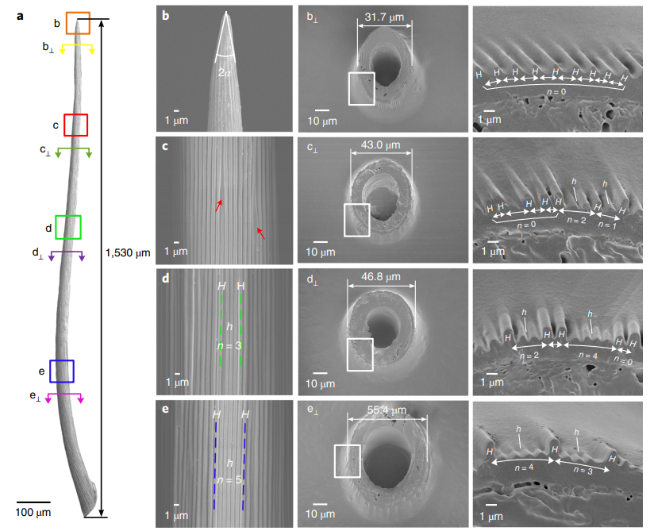
Chen et al[33]found that the high-speed transport of water on the surface of Sarracenia trichomes is caused by their unique hierarchical microchannel structure (Figure 1). Inspired by the water transport process on the surface of Sarracenia trichomes, Chen et al. used mathematical modeling and material testing methods to perform numerical simulations and experimental tests on these hierarchical microchannels, revealing a method for achieving highly directional water transport by incorporating secondary microchannels into the main microchannels through laser-etched high and low ribs. The study found that the water transport speed on the surface of Sarracenia trichomes is approximately three orders of magnitude faster than that of cactus spines and spider silk. When the trichomes are placed in a humid environment, a thin film of water forms within the hierarchical microchannels, automatically initiating an ultra-fast water collection and transport process. After a stable film is formed, even without the appearance of large droplets, the subsequent transport of collected water becomes even faster. This work strongly demonstrates the potential of pore gradient structures in directional water transport.
图1 Sarracenia毛状体的外观和表面结构。 a)针状毛体长约1530 μm。b~e,毛状体在纵向视图(b~e)和横截面视图(b-e)中沿长度不同部分的表面。b)毛状体尖端的顶角2α为~17°。c)红色箭头显示了两种不同类型的肋骨纵向延伸。d、e)两条相邻的虚线显示了沿毛状体连续的两条肋。b-e,毛状体的冷冻切片和部分放大的细节(右)[33]

Fig.1 Appearance and surface structure of the Sarracenia trichome. a) The needle-shaped trichome is about 1530  μm in length. b~e, The surface of the trichome at different parts along the length in longitudinal view (b~e) and cross-section (b-e). b) The apex angle 2α of the trichome tip is ~17°. c) The red arrows show two different types of longitudinal proliferation of the ribs. One is a rib that divides into two ribs, and the other is a new rib that grows out from two existing ribs. d, e) Two neighboring dotted lines show two successive ribs along the trichome. b-e, Frozen section of a trichome and partially enlarged details (right)[33]

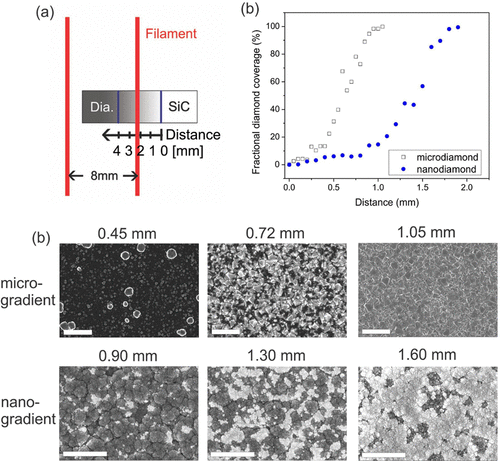
Wang et al. used hot-filament chemical vapor deposition (HFCVD) technology to deposit diamond powder onto β-SiC films, synthesizing micro- and nanocrystalline diamond/β-SiC composite gradient films. Using this method, they prepared a 0.9 mm gradient-length nano-diamond/SiC film capable of directional transport of acidic or alkaline solutions[34]. Furthermore, they investigated the effect of surface roughness on water contact angles and found that the micro-convexities on the micro- and nanodiamond surfaces were small enough to keep droplets in the Cassie-Baxter state. However, the nanocrystalline diamond surface had a higher coverage compared to the microcrystalline diamond surface, resulting in a higher water contact angle and lower surface energy (Figure 2).
图2 (a)灯丝/衬底结构的俯视图;(b)金刚石/SiC 梯度膜的覆盖率与距离的关系,蓝色圆圈表示纳米金刚石和黑色正方形微金刚石梯度表面;(c)沉积在Si上的纳米梯度(比例尺2 μm)和微梯度(比例尺5 μm)金刚石/SiC 薄膜的 SEM 显微照片[34]

Fig.2 (a) Top view of the filament/substrate configuration. (b) Fractional diamond coverage versus distance of the diamond/SiC gradient films, blue circles denote nanodiamond and black squares microdiamond gradient surface. (c) SEM micrographs of nano-gradient (scale bar 2 μm) and micro-gradient (scale bar 5 μm) diamond/SiC film deposited on Si along the gradient axis[34]

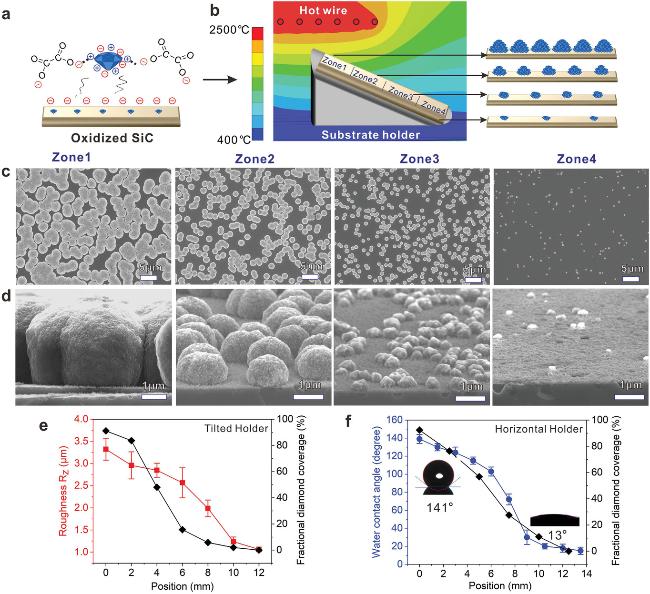
They continued their previous research approach, using a controlled chemical vapor deposition process to regulate the deposition temperature and gas-phase concentration, thereby designing and synthesizing multifunctional, robust diamond gradient films with gradually varying hierarchical structures and chemical compositions. The size and abundance of graded micro/nanoscale diamond crystals gradually increase along the length of the film, enabling the gradient surface to guide water droplets from the highly hydrophobic diamond-rich surface (contact angle 141°) to the hydrophilic SiC surface (contact angle 13°) (Figure 3).
图3 金刚石梯度薄膜的分级制备及润湿性:a)草酸稳定的纳米金刚石颗粒在氧化 SiC 表面自组装播种方案;b)利用倾斜的衬底保持器,采用 HFCVD 方法在 SiC 层上沉积层状金刚石梯度膜;c)扫描电镜图像,显示在(b)相应位置沉积的层状金刚石梯度膜的表面形貌;d)扫描电镜图像显示沉积后的梯度薄膜的横截面形貌;e)在沉积过程中在倾斜支架上合成的表面粗糙度和分数金刚石覆盖率与样本距离的关系,以及样本与样本位置的关系;f)在沉积过程中在水平支架上制备的水接触角和钻石覆盖率与样品的位置之间的关系[35]

Fig.3 Hierarchical diamond gradient film fabrication and wettability. a) Scheme of self‐assembly seeding of nanodiamond particles stabilized by oxalic acid on the oxidized SiC surface. b) Deposition of hierarchical diamond gradient film on SiC layer by HFCVD using a tilted substrate holder. c) SEM images showing surface morphology of as‐deposited hierarchical diamond gradient film at positions corresponding to (b). d) SEM images showing cross‐sectional morphology of as‐deposited gradient film. e) Surface roughness (Rz) and fractional diamond coverage versus distance along with the samples versus the samples' position, synthesized on a tilted holder during deposition. f) Water contact angle and fractional diamond coverage versus the position along with the samples, prepared on a horizontal holder during deposition[35]

3.2 Multi-base composite gradient material with aperture

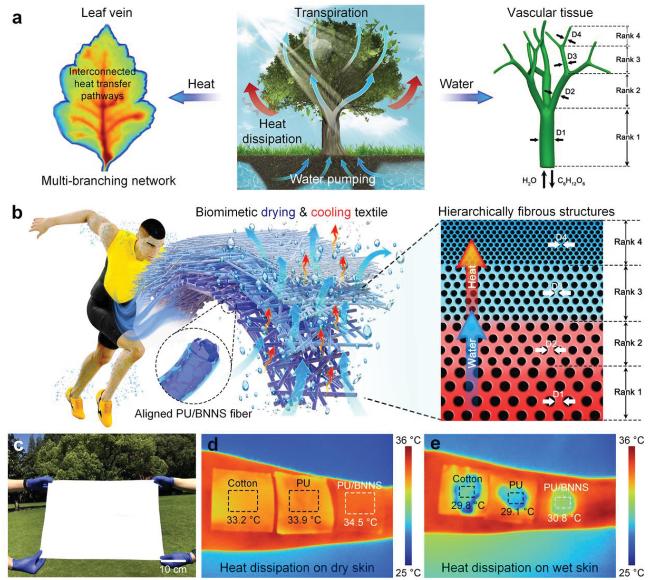
Currently, a major approach to fabricating materials with directional liquid transport capabilities is to combine multiple materials into multilayered structures using techniques such as electrospinning. Compared to single-substrate materials, multi-substrate composites allow for adjustments in pore size, wettability, and thickness for each layer, all of which are critical factors influencing the material's ability to direct water transport. Additionally, increasing the number of layers in the composite can create a greater pore size gradient, further enhancing the material's directional transport capacity. In nature, vascular plants possess a hierarchical porous structure that achieves greater capillary force and lower flow resistance by gradually reducing the diameter of capillaries (Figure 4a), minimizing fluid flow resistance within the capillaries and maximizing the capillary force driving vertical water transport[39-41]. Inspired by the transpiration process of vascular plants, Miao et al. used polyurethane (PU)/boron nitride nanofiber (BNNS) with a hierarchical porous structure whose capillary pore diameter (Dx) gradually decreases to mimic vascular tissue and mesophyll tissue[42]. By electrospinning PU/BNNS fibers with diameters gradually decreasing from 2500 nm to 300 nm, they prepared a hierarchical biomimetic multilayer fiber membrane with high directional transport capability (Figure 4b). Furthermore, they combined the Lucas-Washburn equation with the Poiseuille laminar flow equation to describe the vertical wicking and horizontal diffusion behaviors in the fiber membrane[43-45]. Theoretically, this confirmed that the anisotropic driving force between inter-fiber channels leads to enhanced vertical wicking and reduced horizontal spreading.
图4 a)植物蒸腾过程示意图。包括水分蒸发和通过其维管组织和叶脉的散热。b) 用于个人干燥和冷却的功能织物的仿生多层纤维膜的汗液释放和散热示意图[42]

Fig.4 a) Schematic of the transpiration process in plants. Water evaporation and heat dissipation through their vascular tissue and leaf veins are included. b) Schematic illustrating the sweat release and heat dissipation of the biomimetic multilayer fibrous membrane as a functional textile for personal drying and cooling[42]

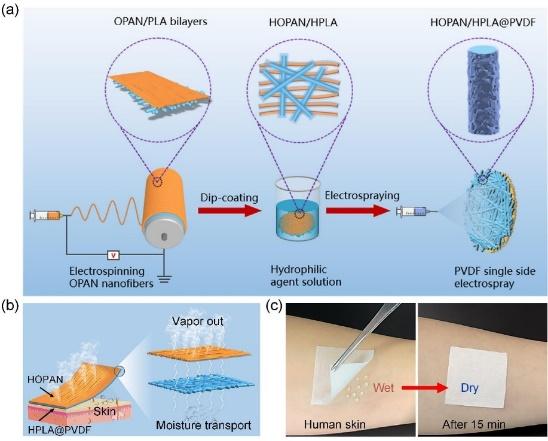
Based on the theory of constructing longitudinal channel differences in materials by utilizing a gradient of pore sizes across multiple layers to achieve unidirectional moisture transport, Chen et al. introduced innovations in water transport channels. They performed hydrophilic finishing on PLA nonwoven fabric surface electrospun with PAN (OPAN) nanofibers, obtaining an ultra-hydrophilic HOPAN layer with radial moisture transport channels, enabling water molecules to spontaneously diffuse and rapidly transfer radially along the fiber membrane[46]. They also compared the average pore sizes of PLA nonwoven fibers and HOPAN fibers. It was observed that the average pore size of the HPLA layer was 14.9 μm, one order of magnitude larger than that of the HOPAN layer (1.72 μm). Consequently, capillary pores with varying pore sizes were created between the HPLA and HOPAN layers, further enhancing the material's unidirectional moisture-wicking effect[47](Figure 5Figure 5).
图5 a)HOPAN/HPLA@PVDF纤维膜制备过程示意图;b)所制备的复合纤维膜的汗液运输过程示意图;c)复合纤维膜的快速干燥特性[46]

Fig.5 a) Schematic illustrating preparation procedures of HOPAN/HPLA@PVDF moisture-wicking membranes. b) Schematic demonstration of the sweat-release process of the prepared composite membranes. c) The digital images displaying quick-dry property of the prepared composite membranes[46]

4 Applications of Pore-Gradient Materials

Pore-gradient materials, with their unique morphology, offer advantages such as stability and no need for energy input. As multifunctional materials for directional liquid transport, they have extensive applications in directional water collection[48],liquid transport, oil-water separation[49],and other fields.

4.1 Application of Pore-Gradient Materials in Directional Water Collection

Currently, the shortage of freshwater resources is becoming increasingly severe. Fog in nature accounts for nearly 10% of all freshwater on Earth[50], and recovering water from fog can effectively alleviate the water resource crisis. Therefore, it is necessary to develop high-performance water-collecting materials to address freshwater scarcity. Researchers have achieved directional droplet aggregation and enhanced droplet capture capabilities by optimizing material structures and modifying wettability gradients[51]. Among these, fog collectors fabricated using fibers as material substrates exhibit superior water-collecting performance[52-54]. In regions facing water scarcity, many plants and animals have evolved unique abilities to collect fog water[55]. Early studies have shown that natural organisms such as spider silk, cacti, Namib desert beetles, and lizards can collect fog water from the atmosphere, relying on their unique asymmetric hydrophilic/hydrophobic surface wettability and surface topological structures, which enable directional droplet movement on their surfaces. Inspired by these principles, researchers have developed materials for directional liquid transport by constructing hydrophobic/hydrophilic surface morphologies and designing internal pore size gradients within the materials.
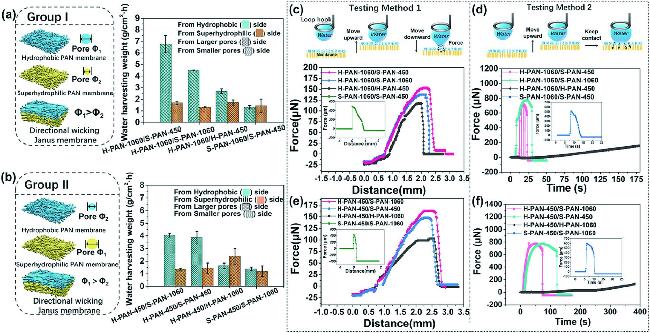
Wu et al. prepared hydrophobic/superhydrophilic directional moisture-wicking fiber membranes by electrospinning a double-layer PAN nanofiber membrane and subjecting it to differential heat treatment[56]. By controlling the pore sizes of the two fiber layers, they compared two types of fiber membranes with different pore size gradients: one with large pores in the hydrophobic layer and small pores in the hydrophilic layer, and the other with small pores in the hydrophobic layer and large pores in the hydrophilic layer. They found that the water collection capacity of the directional wicking membrane with larger pores in the hydrophobic layer and smaller pores in the hydrophilic layer was nearly 1.7 times that of the directional wicking membrane with smaller pores in the hydrophobic layer and larger pores in the hydrophilic layer. This demonstrates that an appropriate pore size gradient can significantly enhance the material's unidirectional liquid transport capability (Figure 6).
图6 (a)第I组及(b)第II组的纤维结构及集水能力示意图,测试方法1的说明及(c)第I组及(d)第II组的代表性测试结果,水滴(5 µL)被带到膜上接触,然后脱落,测试方法2及(e)第I组及(f)第II组具代表性的测试结果,将水滴(5 µL)附着在膜上而不脱落[56]

Fig.6 Schematic illustration of fibrous structure and water harvesting capacity for a) Group I and b) Group II. Illustration of testing Method 1 and the representative test results for c) Group I and d) Group II. Water droplet (5 µL) was brought to contact the membrane and then pulled off. Illustration of testing Method 2 and the representative test results for e) Group I and f) Group II. Water droplet (5 µL) was brought to attach the membrane without pulling off[56]

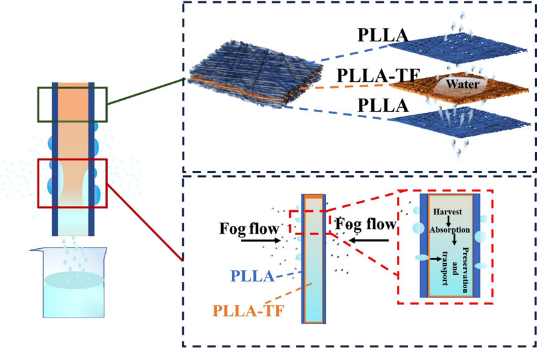
For materials with different hydrophobic and hydrophilic properties on either side, the water collection process typically begins at the hydrophobic side, as liquid cannot be directionally transported from the hydrophilic side to the hydrophobic side. Therefore, Bao et al. developed a three-layer membrane wicking structure with bidirectional water transport characteristics for continuous and efficient fog water collection[48]. They used multilayer electrospinning technology to fabricate a sandwich-structured composite nanofiber membrane, consisting of two outer layers of hydrophobic PLLA membranes and an inner layer of ultra-hydrophilic PLLA thin film modified in situ by a hydrophilic finishing agent (TF) through electrospinning. Due to the synergistic effect of the fiber structure and the anisotropic wettability from the external hydrophobic water transport layers to the intermediate ultra-hydrophilic water collection layer, the resulting membrane exhibits bidirectional water transport performance and excellent water collection capability. Water can spontaneously permeate from the two external hydrophobic layers into the central ultra-hydrophilic layer while being prevented from traveling in the opposite direction. In this sandwich structure, the pore size of the outer transport layers is larger, whereas the pore size of the middle layer is smaller, which further enhances the material's directional water collection ability (Figure 7).
图7 (a)三层纳米纤维膜的静电纺丝过程示意图;(b)通过静电纺丝14 wt% PLLA溶液获得的PLLA纳米纤维的SEM图像和纤维直径分布;(c)通过静电纺丝含有0.5 wt% TF的10 wt% PLLA溶液获得的PLLA-TF纳米纤维的SEM图像和纤维直径分布;(d)三明治结构纳米纤维膜中定向水分运输示意图;(e)实验室集水装置的示意图[48]

Fig.7 (a) Schematic illustration of the electrospinning process of trilayered nanofiber membranes. (b) SEM image and fiber diameter distribution of the PLLA nanofibers obtained by electrospinning a 14 wt% PLLA solution. (c) SEM image and fiber diameter distribution of PLLA-TF nanofibers obtained by electrospinning a 10 wt% PLLA solution containing 0.5 wt% TF. (d) Illustration of directional water transport in sandwich-structured nanofiber membranes. (e) Schematic illustration of the laboratory water-harvesting setup[48]

However, current directional water collection materials typically rely on electrospinning technology, and issues such as material durability and the stability of directional water collection performance remain unresolved. Additionally, aspects such as the desorption rate of water after directional collection and the extent to which adverse environmental factors affect water collection performance require further investigation[57]. Only after comprehensive experimental validation can these methods be applied to practical atmospheric water harvesting scenarios.

4.2 Applications of Pore-Gradient Materials in the Medical Field

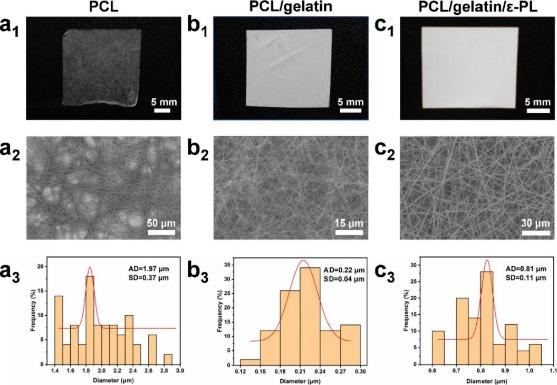
Pore-gradient materials' ability to direct liquid transport can help remove wound exudate while preventing external contaminants from entering the wound[58], thereby promoting wound healing[59]. Moreover, in air filtration devices such as masks, the directional transport properties of these materials can effectively discharge water vapor from the internal environment, enhancing the user's physiological comfort and reducing internal air pressure, which facilitates gas exchange with the external environment[60-61]. Lan et al. prepared a graded-structure air filtration membrane using electrospinning[62]. The inner layer is a hydrophobic thin PCL fiber membrane, with a PCL/gelatin layer serving as the intermediate layer, and an outer layer composed of PCL/gelatin/ε-PL. The pore size of the inner fiber membrane is significantly larger than that of the intermediate and outer layers. This filtration membrane can rapidly inactivate bacteria trapped on the surface of the fiber membrane[63], and more importantly, it can also prevent moisture from the external environment from entering, thus reducing discomfort caused by dampness. Meanwhile, the smaller pore size of the outer layer achieves a PM2.5 filtration efficiency of 98.82% (Figure 8).
图8 单个纤维层的形态和直径分布:(a1、a2和a3)PCL层;(b1、b2和b3)PCL/明胶层;(c1、c2和c3)PCL/明胶/ε-PL层[62]

Fig.8 Morphology and diameter distribution of the individual fibrous layer.(a1, a2 and a3) PCL layer;(b1, b2 and b3) PCL/gelatin layer; (c1, c2 and c3) PCL/gelatin/ε-PL layer[62]

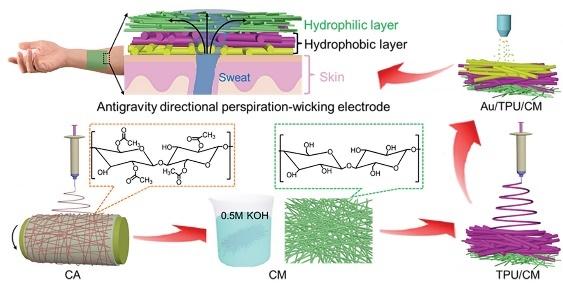
In recent years, sensors used for monitoring human health have become a major research focus; however, several issues still exist in practical applications. When wearing sensors closely to the body to monitor health conditions, sweat produced by the skin around the sensor can lead to signal degradation, sensor malfunction, and delamination between the device and the skin, severely affecting the accuracy of data collection[64]. To address these problems, Xu et al., inspired by liquid transport strategies found in living organisms, developed an electrode composed of a gold/thermoplastic polyurethane/cellulose membrane (Au/TPU/CM) with gradient pore size and surface energy. This electrode can unidirectionally remove sweat from the sensor/skin interface to the sensor surface, thereby preventing signal attenuation and discomfort caused by sweat accumulation[65]. By combining gradient porosity and surface energy gradients, this electronic skin can immediately "pump" sweat from the interface to the external environment. The resulting electrode exhibits excellent conductivity (2.68 Ω·sq-1), as well as outstanding water vapor permeability and water evaporation rates (2.2 times and 7.1 times that of cotton fabric, respectively). The ultra-fast sweat-wicking capability of this electronic skin not only enhances wearing comfort but also minimizes measurement errors caused by skin hydration and temperature changes due to sweating, eliminates the risk of short circuits in sensor arrays, reduces noise levels, and improves the accuracy and reliability of sensors (Figure 9).
图9 Au/TPU/CM电极的设计和制造示意图[65]

Fig.9 Schematic illustration of design and fabrication of Au/TPU/CM electrode[65]

The design of medical dressings needs to consider the integration of multiple functions, such as hemostasis[66],pain relief[67],and promoting wound healing[68],among others. Achieving synergistic effects of these multiple functions within limited dimensions and space presents another technical challenge. While enhancing the absorption of wound exudate, it is also crucial to improve the biocompatibility and safety of dressings, ensuring that they do not trigger immune responses after implantation in the body. However, due to the complexity and individual variability of living organisms, it is difficult to fully replicate real-world conditions in laboratory settings, necessitating large-scale clinical trials to evaluate the long-term effectiveness of medical dressings.

4.3 Applications of Pore-Gradient Materials in Oil-Water Separation

In recent years, the continuous increase in industrial oily wastewater discharge has caused widespread damage to ecological balance and public health[69-71]. Oily wastewater typically contains complex components, such as oil/water emulsions and oil/water multiphase mixtures. Membrane separation technology, with its advantages of low energy consumption, high separation efficiency, and convenient operation, has been widely applied in wastewater purification. In recent years, researchers have leveraged the pore size gradient effect to develop a new generation of specialized water-in-oil emulsion separation membranes that exhibit directional transport properties, excellent separation efficiency, and high permeation flux under lower driving pressures. These membranes can direct the transport of droplets upon contact with the surface, successfully enabling the directional collection of tiny droplets from oil-water mixtures. This holds significant importance for the remediation of oily wastewater.
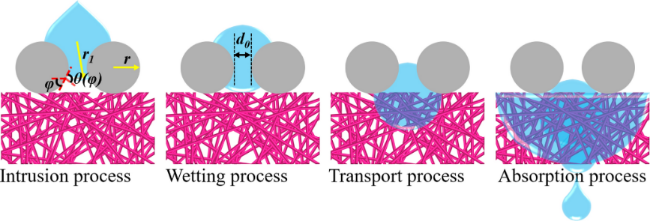
Zhang et al. developed a bilayer nanofiber membrane with directional moisture-wicking properties for oil-water separation by encapsulating TPU with CA, using TPU as the raw material[72]. The TPU serves as the hydrophobic layer, while the CA/TPU forms the hydrophilic layer. By adjusting the electrospinning parameters, a beaded structure was induced in the TPU fiber membrane, reducing the pore size of the TPU layer and creating a pore size gradient within the material. When an oil-water mixture comes into contact with the TPU layer, water molecules are transported directionally toward the CA/TPU layer due to differences in wettability and the pore size gradient. During this directional transport, the beaded structure of the TPU layer intercepts water droplets, exerting a repulsive effect on the liquid phase and preventing oil from entering the membrane, thereby imparting oil-repellent properties and achieving oil-water separation (Figure 10).
图10 水从 TPU 侧向 CA/TPU 侧输送的示意图[72]

Fig.10 Schematic illustration of water transport from TPU side to CA/TPU side[72]

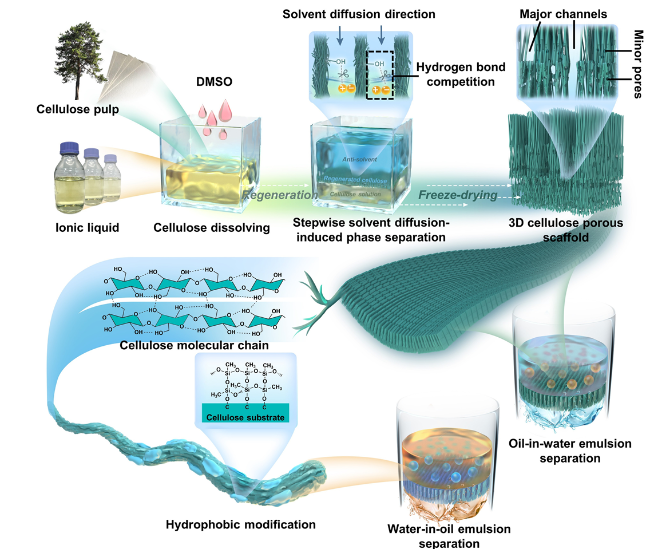
Not only fiber membranes are applied in the field of oil-water separation; three-dimensional gels with porous structures, high specific surface areas, and strong adsorption capacities are also widely used in the treatment of wastewater contaminated by petroleum pollutants. However, due to the limitations of traditional aerogels, the oil-water separation process is unsustainable, cumbersome, and costly, making it insufficient for practical applications. Inspired by the gradient porous structures observed in bamboo stems and glomerular filtration membranes, Zheng et al. prepared a 3D cellulose scaffold with a pore-size gradient structure (GPDS) from a homogeneous cellulose solution[73]. The pore-size gradient structure effectively reduced the density of GPDS (0.019 g/cm3), while significantly enhancing its specific surface area, porosity (98.82%), and compressive strength (up to 870 kPa at 70% strain). The oil/organic solvent absorption capacity of GPDS ranges from 13 to 25 g/g, achieving up to 99.8% separation efficiency for immiscible oil-water mixtures, with a flux exceeding 2000 L/m2·h, and stable surfactant-stabilized water-in-oil emulsions (with an efficiency of up to 97.7%). This 3D cellulose scaffold with a pore-size gradient, featuring excellent mechanical strength and separation performance, provides new insights for developing advanced oil-absorbing materials (Figure 11).
图11 梯度孔密度3D纤维素支架制备工艺示意图[73]

Fig.11 Schematic diagram of the preparation process of gradient pore-density 3D cellulose scaffold[73]

Currently, preparing fiber membranes with complex structures (hollow, porous, etc.) to achieve higher separation efficiency and longer service life is one of the hotspots in current research. There is still considerable room for improvement in the anti-fouling properties, mechanical strength, and thermal stability of oil-water separation materials. Further exploration of the structural design of oil-water separation materials and optimization of preparation processes are needed to produce materials with higher separation efficiency and longer service life at low cost and high production efficiency. Expanding their application scope in the field of oil-water separation, such as marine oil spill treatment[74],industrial wastewater treatment[75],and food processing wastewater treatment[76-78],can meet the demands of different industries for oil-water separation technology.

5 Conclusion and Outlook

The design of a pore size gradient structure causes the pore sizes within the material to vary gradually according to a specific gradient. This variation can generate a capillary pressure difference, thereby promoting the flow of liquids within the material along a particular direction. Compared to materials with uniform pore structures, pore size gradient structures can transport liquids more effectively and hold great application potential in scenarios where liquid flow direction needs to be controlled, such as drug delivery, water treatment, and air purification. By designing a pore size gradient structure within the material, it is possible to achieve directional liquid transport and enhance overall transport efficiency. This article summarizes the structural characteristics, functional principles, types, and potential application areas of pore size gradient materials capable of directional liquid transport. It also reviews the development and application of pore size gradient materials in related fields and proposes directions for future research.
(1) There is still room for improvement in the ability of pore gradient structures to regulate liquid flow. Currently, most pore gradient materials also feature a wettability gradient, leveraging differential capillary effects and variations in wetting properties within the material to achieve efficient directional transport of liquids. How to enhance the pore gradient's regulatory capacity for liquids is an issue that needs to be addressed. Biomimicry represents an important research direction. In nature, there are many sophisticated liquid transport systems (such as plant xylem vessels and animal blood vessels) capable of efficiently and stably directing liquid transport.
(2) Complexity of pore size gradient design. The pore structure of materials with a pore size gradient typically exhibits a gradual transition from large to small pores. This design requires precise control over the distribution of the gradient, and in different material systems, the design of the pore size gradient and its actual effect may vary, resulting in directional delivery performance that falls short of expectations.
(3) Difficulty in large-scale production. The process for manufacturing materials with gradient pore structures is relatively complex and costly. Achieving efficient, centralized production remains a challenge that needs to be addressed. Therefore, improving existing material preparation processes or adopting new technologies such as 3D printing is one approach to reducing production difficulties.
[1]
Liu M J, Wang S T, Jiang L. Nat. Rev. Mater., 2017, 2(7): 17036.

[2]
Zheng Y M, Gao X F, Jiang L. Soft Matter, 2007, 3(2): 178.

[3]
Xu T, Lin Y C, Zhang M X, Shi W W, Zheng Y M. ACS Nano, 2016, 10(12): 10681.

[4]
Luo C, Wang X. Scientific Reports., 2017,7:9717.

[5]
Jie J, Hao B, Zheng Y, Zhao T, Fang R, Lei J. Nature Communications, 2012, 3:6.

[6]
Zheng Y M, Bai H, Huang Z B, Tian X L, Nie F Q, Zhao Y, Zhai J, Jiang L. Nature, 2010, 463(7281): 640.

[7]
Luo C. Langmuir, 2015, 31(43): 11809.

[8]
Shang L R, Fu F F, Cheng Y, Yu Y R, Wang J, Gu Z Z, Zhao Y J. Small, 2017, 13(4): 1600286.

[9]
Carroll B J. J. Colloid Interface Sci., 1976, 57(3): 488.

[10]
Parker A R, Lawrence C R. Nature, 2001, 414(6859): 33.

[11]
Knapczyk-Korczak J, Stachewicz U. Nanoscale, 2021, 13(38): 16034.

[12]
Li A L, Xiong J, Liu Y, Wang L M, Qin X H, Yu J Y. Energy & Environmental Materials, 2023, 6:12254.

[13]
Başal G, Oral N. Tekstil Ve Konfeksiyon, 2022, 32(4): 384.

[14]
Zhou H, Wang H X, Niu H T, Lin T. Sci. Rep., 2013, 3: 2964.

[15]
Li X H, Zhang S L, Li J Z, Hu X Y, Zhang J J, Wei Q, Zhang C P, Zhang D D, Liu Y. J. Appl. Polym. Sci., 2024, 141(39): e56018.

[16]
Wang X, Wang H Y, Sun Y Y, Liu Z. Adv. Eng. Mater., 2023, 25(24): 2300806.

[17]
AL-Rajabi M M, Almanassra I W, Khalil A K A, Ali Atieh M, Laoui T, Khalil K A. Polymers, 2023, 15(23): 4594.

[18]
Yang H K, Wang T Y, Yan X J, Chen Y, Jia F, Gao Y Y, Gao G H. Sep. Purif. Technol., 2025, 354: 128835.

[19]
Zhang H, Chen C W, Zhang H, Chen G P, Wang Y T, Zhao Y J. Appl. Mater. Today, 2021, 23: 101068.

[20]
Mohamadinooripoor R, Kashanian S, Arkan E. Biotechnol. Bioprocess Eng., 2023, 28(1): 17.

[21]
Zhang S, Dong S, Dong D D, Ge X C, Chen Z Y, Wang R X, Sun Z B, Yang F. Cotton Textile Technology, 2024, 52(09):34

(张赛, 董硕, 董东东, 葛效成, 陈振远, 王蕊鑫, 孙召彬, 杨帆. 棉纺织技术, 2024, 52(09):34).

[22]
Mates J E, Schutzius T M, Qin J, Waldroup D E, Megaridis C M. ACS Appl. Mater. Interfaces, 2014, 6(15): 12837.

[23]
Yamada Y, Sakata E, Isobe K, Horibe A. ACS Appl. Mater. Interfaces, 2021, 13(29): 35079.

[24]
Yan L L, Yang X B, Long J, Cheng X Q, Pan D, Huang Y F, Shao L. Chem. Commun., 2020, 56(3): 478.

[25]
Ahmed Babar A, Zhao X L, Wang X F, Yu J Y, Ding B. J. Colloid Interface Sci., 2020, 577: 207.

[26]
Widodo M, Handayani A F, Sumaryadi G. J. Text. Inst., 2020, 111(7): 972.

[27]
Zhang P F, Zhang L W, Chen H W, Dong Z C, Zhang D Y. Adv. Mater., 2017, 29(45): 1702995.

[28]
Li D K, Fan Y F, Han G C, Guo Z G. Chem. Eng. J., 2021, 404: 126515.

[29]
Xie Z Y, Jiang P Q, Le P T, Zhang T, Li W B. Cotton Text. Technol., 2022, 50(1): 40

(谢治云, 蒋培清, 乐鹏涛, 张瞳, 李文斌. 棉纺织技术, 2022, 50(1): 40).

[30]
Yang J-T, Yang Z-H, Chen C Y, Yao D J. Langmuir, 2008, 24(17): 9889.

[31]
Long Z Y, Zhao Y Y, Zhang C H, Zhang Y H, Yu C M, Wu Y C, Ma J, Cao M Y, Jiang L. Adv. Mater., 2020, 32(17): 1908099.

[32]
Young T. Phil. Trans. R. Soc., 1805, 95: 65.

[33]
Chen H W, Ran T, Gan Y, Zhou J J, Zhang Y, Zhang L W, Zhang D Y, Jiang L. Nat. Mater., 2018, 17(10): 935.

[34]
Wang T, Handschuh-Wang S, Huang L, Zhang L, Jiang X, Kong T T, Zhang W J, Lee C S, Zhou X C, Tang Y B. Langmuir, 2018, 34(4): 1419.

[35]
Wang X Y, Handschuh-Wang S, Xu Y, Xiang L, Zhou Z Y, Wang T, Tang Y B. Adv. Mater. Interfaces, 2021, 8(12): 2100196.

[36]
Xue J J, Xie J W, Liu W Y, Xia Y N. Acc. Chem. Res., 2017, 50(8): 1976.

[37]
Wang X F, Yu J Y, Sun G, Ding B. Mater. Today, 2016, 19(7): 403.

[38]
Huang G, Liang Y C, Wang J H, Zeng X H, Li Z R, Zhang X Y. Mater. Lett., 2019, 246: 76.

[39]
Zheng X F, Shen G F, Wang C, Li Y, Dunphy D, Hasan T, Brinker C J, Su B-L. Nat. Commun., 2017, 8: 14921.

[40]
Sherman T F. J. Gen. Physiol., 1981, 78(4): 431.

[41]
Murray C D. Journal of General Physiology, 1926, 12:207.

[42]
Miao D Y, Wang X F, Yu J Y, Ding B. Adv. Funct. Mater., 2021, 31(14): 2008705.

[43]
Li C X, Dai H Y, Gao C, Wang T, Dong Z C, Jiang L. Proc. Natl. Acad. Sci. U. S. A., 2019, 116(26): 12704.

[44]
Szekely J, Neumann A W, Chuang Y K. J. Colloid Interface Sci., 1971, 35(2): 273.

[45]
Quéré D. Europhys. Lett., 1997, 39(5): 533.

[46]
Chen L X, Ahmed Babar A, Huang G, Zhao J, Yan W A, Yu H, Feng Q, Wang X F. J. Colloid Interface Sci., 2023, 645: 200.

[47]
Wang X F, Huang Z, Miao D Y, Zhao J, Yu J Y, Ding B. ACS Nano, 2019, 13(2): 1060.

[48]
Bao S W, Zhang X Y, Zhang L, Ning X, Niu H T, Zhou H. ACS Appl. Polym. Mater., 2024, 6(6): 3294.

[49]
Zhou S, Yu C L, Li C X, Dong Z C, Jiang L. J. Mater. Chem. A, 2019, 7(31): 18244.

[50]
Kim H, Yang S, Rao S R, Narayanan S, Kapustin E A, Furukawa H, Umans A S, Yaghi O M, Wang E N. Science, 2017, 356(6336): 430.

[51]
Luo H, Mei Y, Wei H, Zhou X Q, Qin B L, Wang X K. Surface Technology, 2024, 53(22):16

(罗鸿, 梅益, 韦函, 周学湫, 覃冰黎, 汪希奎. 表面技术, 2024, 53(22):16).

[52]
Li C, Liu Y F, Gao C L, Li X, Xing Y, Zheng Y M. ACS Appl. Mater. Interfaces, 2019, 11(4): 4507.

[53]
Yu Z H, Zhang H M, Huang J Y, Li S H, Zhang S N, Cheng Y, Mao J J, Dong X L, Gao S W, Wang S C, Chen Z, Jiang Y X, Lai Y K. J. Mater. Sci. Technol., 2021, 61: 85.

[54]
Tian Y, Zhu P G, Tang X, Zhou C M, Wang J M, Kong T T, Xu M, Wang L Q. Nat. Commun., 2017, 8: 1080.

[55]
Klemm O, Schemenauer R S, Lummerich A, Cereceda P, Marzol V, Corell D, van Heerden J, Reinhard D, Gherezghiher T, Olivier J, Osses P, Sarsour J, Frost E, Estrela M J, Valiente J A, Fessehaye G M. Ambio, 2012, 41(3): 221.

[56]
Wu J, Zhou H, Wang H X, Shao H, Yan G L, Lin T. Adv. Mater. Interfaces, 2019, 6(5): 1801529.

[57]
Uddin M N, Desai F J, Subeshan B, Rahman M M, Asmatulu E. Surf. Interfaces, 2021, 25: 101169.

[58]
Zhang Z C, Wang T, Chen S Y, Lv C, Zhuang X S, Wang S. Surf. Interfaces, 2022, 34: 102392.

[59]
Cao Y J, Xin B J, Wu X J, Du W P. Adv. Mater. Res., 2013, 850-851: 53.

[60]
Zhao X L, Li Y Y, Hua T, Jiang P, Yin X, Yu J Y, Ding B. Small, 2017, 13(11): 1603306.

[61]
Babar A A, Miao D Y, Ali N, Zhao J, Wang X F, Yu J Y, Ding B. ACS Appl. Mater. Interfaces, 2018, 10(26): 22866.

[62]
Lan X Z, Wang H, Liu Y R, Chen X Y, Xiong J J, Mai R B, Wang Y Q, Cai N, Chen X, Tang Y D. Chem. Eng. J., 2022, 447: 137518.

[63]
He P W, Wu F, Yang M, Jiao W L, Yin X, Si Y, Yu J Y, Ding B. Compos. Commun., 2021, 25: 100720.

[64]
Abdoli-Eramaki M, Damecour C, Christenson J, Stevenson J. J. Electromyogr. Kinesiol., 2012, 22(6): 908.

[65]
Xu Y T, Guo W, Zhou S Q, Yi H K, Yang G Q, Mei S X, Zhu K H, Wu H, Li Z. Adv. Funct. Mater., 2022, 32(23): 2200961.

[66]
Chen Z Q. Master's Thesis of Lanzhou Jiaotong University, 2022

(陈志强. 陆军军医大学博士论文, 2022).

[67]
Shao Z Y, Zhou Z Y, Leng X F. Journal of Qingdao University, (Medical Science), 2024, 60:467

(邵兆银, 周子艺, 冷向锋. 青岛大学学报(医学版), 2024, 60:467).

[68]
Xiang J Y. Doctoral Dissertation of Wuhan University, 2023.

(向婕妤. 武汉大学博士论文, 2023).

[69]
Pendergraft M A, Belda-Ferre P, Petras D, Morris C K, Mitts B A, Aron A T, Bryant M, Schwartz T, Ackermann G, Humphrey G, Kaandorp E, Dorrestein P C, Knight R, Prather K A. Environ. Sci. Technol., 2023, 57(10): 4071.

[70]
Feng H J, Yang W Y, Zhang Y F, Ding Y C, Chen L, Kang Y, Huang H, Chen R Y. Bioresour. Technol., 2023, 377: 128916.

[71]
Peng L, Deng X Z, Li Z H. J. Clean. Prod., 2023, 390: 136115.

[72]
Zhang Y, Zhang X M, Xu Y Q, Li Y, Chen X Y, Zeng Y C. Cellulose, 2024, 31(4): 2493.

[73]
Zheng W Q, Wang X Y, Che R M, Li D Q, Zeng X H, Kong F G, Shao L P, Li X, Xu F. Carbohydr. Polym., 2024, 344: 122544.

[74]
You Y Z. Master's Dissertation of Xi'an Shiyou University. 2023

(游琰真, 西安石油大学硕士论文, 2023).

[75]
Gao G H, Yu X H, Wang X Q. Wool Textile Journal, 2024, 52:128

(高国慧, 于小慧, 王雪琴. 毛纺科技, 2024, 52:128).

[76]
Cao M. Doctoral Dissertation of Tiangong University, 2023

(曹明, 天津工业大学博士论文, 2023).

[77]
Li X Y, Jin X, Wu Y J, Zhang D H, Sun F B, Ma H Z, Pugazhendhi A, Xia C L. Sci. Total Environ., 2023, 876: 162549.

[78]
Samuel O, Othman M H D, Kamaludin R, Kurniawan T A, Li T, Dzinun H, Imtiaz A. J. Environ. Chem. Eng., 2022, 10(6): 108539.

[79]
Sutrisna P D, Kurnia K A, Siagian U W R, Ismadji S, Wenten I G. J. Environ. Chem. Eng., 2022, 10(3): 107532.

Outlines

/