Home Journals Progress in Chemistry
Progress in Chemistry

Abbreviation (ISO4): Prog Chem      Editor in chief: Jincai ZHAO

About  /  Aim & scope  /  Editorial board  /  Indexed  /  Contact  / 
Review

Preparation and Applications of Covalent Organic Framework Colloids

  • Handan Cui ,
  • Wen Li ,
  • Shuai Gu , * ,
  • Juntao Tang ,
  • Guipeng Yu , *
Expand
  • College of Chemistry and Chemical Engineering, Central south University, Changsha 410083, China
*(Guipeng Yu);
(Shuai Gu)
†These authors contributed equally to this work.

Received date: 2024-07-29

  Revised date: 2024-09-24

  Online published: 2025-06-23

Supported by

The National Natural Science Foundation of China(52173212)

The National Natural Science Foundation of China(52103275)

The Science and Technology Program of Hunan Province(2021GK2014)

The Hunan Provincial Natural Science Foundation for Distinguished Young Scientists(2022JJ10080)

Abstract

The covalent organic framework colloid (COF Colloids) embodies not only the inherent traits of a controllable COF structure, adjustable pore size, and ordered crystalline structure, but also capitalizes on the versatility inherent in colloids for dispersion, molding, functionalization and assembly. In recent years, COF colloids have garnered substantial interest among researchers owing to their exceptional solution processability and stability. This paper delves into the formation mechanism of COF colloids, categorizing their preparation methods into two classifications: top-down and bottom-up. It also provides a comparative analysis of the advantages and limitations associated with these two synthesis strategies. Moreover, this review summarize the diverse applications of COF colloids in photocatalysis, devices, gas separation, and biomedicine, while also addressing the challenges by COF colloids and envisioning their future developmental trajectory.

Contents

1 Introduction

2 Synthesis strategy

2.1 Top-down synthesis

2.2 Bottom-up synthesis

3 Application

3.1 Photocatalysis

3.2 Device

3.3 Adsorption and separation

3.4 Biomedical science

4 Conclusion and outlook

Cite this article

Handan Cui , Wen Li , Shuai Gu , Juntao Tang , Guipeng Yu . Preparation and Applications of Covalent Organic Framework Colloids[J]. Progress in Chemistry, 2025 , 37(7) : 967 -977 . DOI: 10.7536/PC240721

1 Introduction

In 1861, Thomas Graham first introduced the term "colloid" to define a special form of matter aggregation. The dispersed particles in colloids are larger than those in true solutions but small enough to ensure that buoyancy and gravitational forces are balanced. Thus, colloids occupy an intermediate position between solutions and suspensions, making them highly suitable for specific applications. Over the past 163 years, scientists from various fields have conducted extensive theoretical research on colloidal particle dispersibility[1],colloidal stability[2],and the dynamic behavior of particles[3].Among these studies, the DLVO theory[4]and the Flory-Huggins theory[5]have been particularly influential in investigating colloidal stability and solvation behavior. The DLVO theory provides a theoretical model for describing interactions between colloidal particles, explaining how electrostatic repulsion and van der Waals forces affect colloidal stability. The Flory-Huggins theory, on the other hand, is used to describe the physicochemical behavior in polymer solutions, revealing the interaction mechanisms between solvents and polymers. Today, the concept of "colloid" has expanded to include polymers, proteins, and certain self-assembled materials[6].Covalent organic frameworks (COFs)[7-10],as a class of organic polymers characterized by highly ordered pore structures and tunable chemical functionalities, have attracted considerable attention from researchers. Most traditional COF synthesis methods (such as solvothermal and microwave-assisted techniques) typically yield insoluble microcrystalline powders, severely limiting the processability of COF materials. However, preparing COFs in colloidal form, resulting in materials with colloidal stability, effectively addresses these limitations and broadens their application scope.
Covalent organic framework colloids are uniform-shaped, colloidal-sized nanoporous crystals composed of conjugated structural units linked by covalent bonds. COF colloids not only inherit the inherent advantages of COFs, such as high specific surface area, high porosity, and tunable structure, but can also serve as self-assembling building blocks for fabricating functional materials. Compared to bulk COFs, the colloidal size of COFs facilitates further manipulation of COF particles in liquid media, whether they exist individually or in aggregates. The crystalline order achieved through self-assembly in terms of position and orientation can effectively enhance performance. Meanwhile, the small particle size and high specific surface area of COF colloids enable them to exhibit superior performance in applications such as catalysis and adsorption. The external surface of COF colloids determines the particle-solvent interactions[11], while their internal composition, including pore and framework structures, ensures the ability of solvents to interact with the internal voids of the colloids. Colloidal stability is enhanced by specific interactions between the solvent and the outer surface of the porous material, mediated by ordered solvation shells, ionic bonding, or steric hindrance coatings. The colloidal morphology significantly improves the solution processability of COFs and broadens their applications in fields such as catalysis, separation, and sensing. By controlling the particle size and morphology of COF colloids, their dispersibility and stability in different solvents can be further optimized, thus expanding their process applicability and application potential[12].
The synthesis technology of COFs has become relatively mature, and reviews on COF preparation and applications have comprehensively summarized their developmental history. However, COF colloids, which have only recently attracted attention from researchers, have fewer related reviews. This review summarizes the recent research progress on COF colloids. First, based on the formation mechanism of COF colloids, the preparation strategies are categorized into top-down and bottom-up approaches, with a further analysis and comparison of the advantages and limitations of each strategy. Subsequently, the applications of COF colloids in photocatalysis, gas separation, and biomedicine are summarized. Finally, future prospects for COF colloids in green synthesis, stability mechanisms, and application areas are discussed.

2 Synthetic strategy

Based on the formation mechanism of COF colloids, we classify their preparation methods into two categories. The first is the top-down approach, in which external energy is applied to disrupt the interlayer interactions within COF bulk materials, yielding COF nanoparticles. The second is the bottom-up approach, where the corresponding organic monomers are placed in solution to directly synthesize COF at the nanoscale.

2.1 Top-down synthesis strategy

The top-down strategy for synthesizing COF colloids mainly involves using a series of methods to exfoliate bulk COF materials into thin layers. Specific approaches include functionalizing COFs through post-modification to achieve exfoliation, electro-exfoliation, self-exfoliation, ultrasonic-assisted methods (UAM), acidic self-exfoliation (ASE) of imine-linked COFs, and the addition of ionic liquids to promote exfoliation (Table 1).
表1 自上而下合成方法

Table 1 Top-down synthesis method

Material Solvent Method Ref
COF-DIBO dioxane、trimethylbenzene、AcOH、H2O Functionalization promotes the spontaneous stratification of COF blocks to form colloidal particles 13
Alkyne0.17-COF NR0.17-COF THF/H2O Mechanical (ultrasonic) and chemical (acid-self-stripping) 14
TpHa-COF TbPa-COF TbBd-COF 1-methyl-3-octylimidazole bromide([C8mim][Br]) Ionic liquid assisted COF dispersion 15
PyVg-COF DMAc/mesitylene/AcOH=1/9/1 self-exfoliate 16
TPBDMTP-COF TRITER-1-COF Py-1P-COF DMF electrochemical exfoliation 17
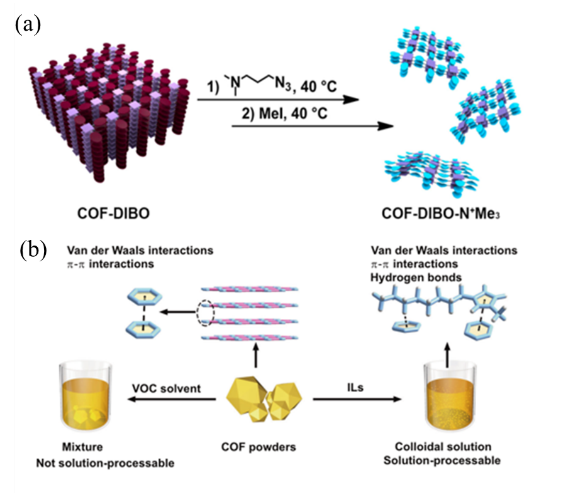
Dichtel et al.[13]used a post-synthetic modification (PSM) strategy to transform bulk COF materials into COF colloids. They condensed 2,7-dialdehyde dibenzocyclooctyne (DIBO-(CHO)2)with 1,3,6,8-tetra(4-aminophenyl)pyrene (TAPPy) to prepare a two-dimensional (2D) COF. Through the azide-alkyne strain-promoted cycloaddition (SPAAC) reaction, they successfully exfoliated COF-DIBO-N+Me3into dispersed flakes with an area of 0.6±0.2 μm2and a thickness of approximately 4 nm (Figure 1a). Subsequently, by utilizing conformational changes in the functionalized cyclooctyne units, COF-DIBO-N+Me3formed COF colloids in polar solvents such as DMF, dimethylacetamide (DMAc), N-methylpyrrolidone (NMP), and DMSO. Segura et al.[14]employed a conventional ultrasound-assisted method and an acid-induced self-exfoliation approach for imine-linked COFs, enabling the exfoliation of COF powders into COF colloids in water and water/organic media. The acid-induced self-exfoliation was achieved through electrostatic repulsion resulting from protonation of imino groups between COF layers in acidic media.
图1 (a)由COF-DIBO合成COF-DIBO- N+Me3[13];(b)制备溶液可加工COFs[15]

Fig.1 (a) Synthesis of COF-DIBO-N+Me3 from COF-DIBO[13]. Copyright 2021, American Chemical Society; (b) Preparation of solution-processable COFs[15]. Copyright 2019, American Chemical Society

He et al.[15]Using ionic liquids as solvents, they disrupted the van der Waals forces and π-π interactions in COFs to obtain COF colloids. They condensed 1,3,5-triformylresorcinol (Tp) with hydrazine (Ha) under hydrothermal conditions to produce COF powders, which were then subjected to heat treatment and subsequently uniformly dispersed in the optimized ionic liquid 1-methyl-3-octylimidazolium bromide (Figure 1b),forming COF colloids. The dispersion concentrations of imine-, azo-, and β-ketoenamine-linked COFs in the ionic liquid were 0.92, 0.95, and 0.80 mg·mL-1, respectively.
Gu et al.[16]reported the design and synthesis of a highly soluble crystalline COF colloid by modulating interlayer interactions. The linking monomer 4,4',4″,4‴-(pyrene-1,3,6,8-tetrayl) tetrakis(aniline) (Py) exhibits strong π-π interactions and tends to form crystalline stacks, whereas 1,1-bis(4-formylphenyl)-4,4'-bipyridinium dichloride (Vg2+·2Cl-) itself has a high charge density, which hinders the stacking of the COF. By integrating these two monomers into the COF framework, the COF prepared under solvothermal conditions exhibits distinct crystallinity and can dissolve in various organic solvents to form true solutions, spontaneously exfoliating into large-area single- or few-layer nanosheets.
Ma et al.[17]reported a strategy for converting imine-linked 2D COFs from unprocessable powders into nanosheets via electrolysis at room temperature. Three COFs—TPBDMTP-COF, TRITER-1-COF, and Py-1P-COF—were synthesized according to the literature. By cathodic reduction, the imine bonds were converted into protonated amine bonds, introducing a large number of positive charges into the COF framework. This process exfoliated the COFs into large-area nanosheets with high dispersibility in electrolyte solutions.

2.2 Bottom-up synthesis strategy

Although many methods have been developed for the top-down synthesis of COF colloids, the two-dimensional nanosheets obtained through these exfoliation techniques exhibit uneven sizes, which significantly limits the application of COF colloids. Therefore, it is crucial to develop effective bottom-up synthetic approaches for COF nanoparticles. Relevant synthetic methods are summarized in Table 2. The formation theory of COF colloids is relatively complex. Briefly, the synthesis of colloids in solution involves two key processes: nucleation and growth. In the early stage of the reaction, rapid polymerization occurs in the solution, generating polymer fragments with low solubility. As the reaction progresses, the polymer in the solution becomes supersaturated, exceeding the critical threshold required for nucleation. Subsequently, monomers in the solution polymerize on the surface of the pre-formed nuclei, causing the particles to continuously grow and increase in size. Due to the reversibility of the synthesis reaction, monomers tend to arrange periodically, forming COF colloids.
表2 自下而上合成方法

Table 2 bottom-up synthesis method

Colloid name Solvent Mechanism Ref
COF-5 CH3CN CH3CN interacts directly with the boronic acid bond, weakening the attraction between crystals and thus inhibiting crystal aggregation. 18
COF-5 CH3CN Inhibition of further nucleation by slow introduction of additional monomers 19
COF-5 CH3CN∶1,4 dioxane∶mesitylene =80∶16∶4 TCAT can react with phenylboronic acid as a competitor, thereby inhibiting COF-5 nucleation 20
TAPB -PDA 2D COF CH3CN Regulation of COF colloid size by varying the concentration of monomers 21
TAPB-BTCA dioxane/mesitylene Selective generation of spherical, fibrillar, and membranous COFs colloids with highly ordered structures by simultaneous introduction of two monofunctional competitors into a reaction system using reversible termination. 22
TAPB-PDA
2D COF
THF、H2O Synchronization of nanoparticle self-assembly and imine formation between them and organic substituents in confined media 23
TpPa-SO3H H2O caprylic acid The ionic repulsion between the charged COFs weakened the π-π interactions between the nanosheets, allowing the COF nanosheets to be well dispersed in the aqueous phase 24
TAPB-BTCA H2O A dense surfactant forms around the COF nanoparticles thereby preventing their further growth and flocculation. 25
TAPB-TFA CH3CN PEI forms a polymer network on the surface of the nuclei, limiting the adhesion between the nuclei of amino and aldehyde groups, resulting in a dispersed and stable colloidal solution 26
COF-300 CH3CN Functionalization of COF shells by reacting pendant amine groups with functionalized imidazole based salts 27
TAPB-PDA Aspartic acid aqueous solution The size control and surface functionalization of uniform spherical TAPB-PDA COF nanoparticles are realized by using Asp in one step 28
TAPP-TFP methanol and acetone A homogeneous and stabilized porphyrin-based COF colloid (COF-B) was prepared with the assistance of bovine serum albumin (BSA) 29
DABA-TFP
COF
DMSO The electrostatic repulsion between the charged polymers prevents the aggregation and precipitation of the colloid, causing it to grow anisotropic and orderly in the plane into large crystals 30
TAPB-MeOTP
COF
CH3CN By reasonable of building units and reaction conditions, the anisotropic growth of imine COF colloids was revealed. 31
M1-PDA H2O Substable COF colloidal dispersions were obtained by reducing the initial concentration of monomer and controlling the reaction kinetics 32
DPPN COF chloroform and methanol The COFs were prepared with good colloidal stability and uniform spherical morphology using chloroform and methanol as mixed solvents 45
TAPB-DVA
COF
CH3CN Uniform spherical COF with different sizes was obtained by changing the amount of acetic acid in catalyst 46
BTCA-TAPB
COF
CH3CN The shell thickness and particle size of microcapsules were adjusted by manipulating monomer concentration and emulsion drop size 47
COF-300 benzonitrile The carboxylic acid catalyst becomes colloidal stable counterion by surface protonation of amine. At the same time, imide protonation can provide similar colloidal stability. 48

2.2.1 Nitrile Solvent-Assisted Strategy

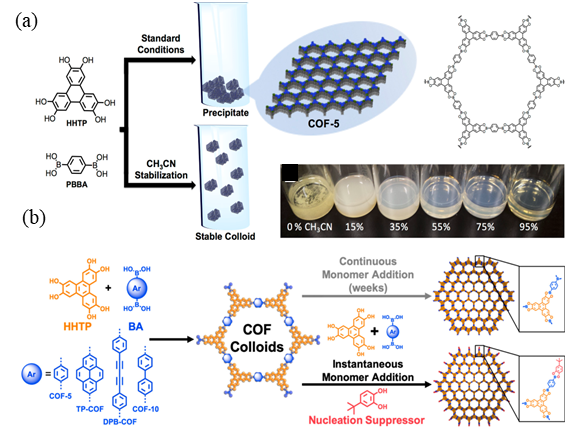
In 2017, Dichtel's research group[18]proposed that cosolvents containing nitriles could prevent the aggregation and precipitation of boronate-linked 2D COFs, thereby forming stable 2D COF colloids (Figure 2a). In their experiments, 2,3,6,7,10,11-hexahydroxytriphenyl (HHTP) and 1,4-bis(boronic acid)benzene (PBBA) were condensed under homogeneous conditions to form COF-5, with a volume fraction of 15% to 95% CH3CN added. The resulting translucent solution exhibited a distinct Tyndall effect, confirming that the system obtained was colloidal. The synthesis of four COFs proposed by Dichtel demonstrated that controlling the concentration of acetonitrile could regulate the colloidal particle size. Subsequently, Dichtel's research group[19]prepared 2D COF particles composed of single-crystal domains by separating the nucleation and growth processes. During the growth phase, monomers were slowly added to maintain a low monomer concentration in the reaction mixture, ensuring that growth dominated and allowing the particles to gradually increase in size without forming new particles.
图2 (a) 硼酸酯连接的2D COFs的典型生长条件提供了不溶的多晶粉末。相反,CH3CN共溶剂产生稳定的胶体纳米颗粒的结晶聚合物网络[18]; (b) 单体成核形成二维胶体种子示意图[20]

Fig.2 (a) Typical growth conditions of borate-linked 2D COFs provide an insoluble polycrystalline powder. In contrast, the CH3CN co-solvent produces a stable crystalline polymer network of colloidal nanoparticles[18] Copyright 2017, American Chemical Society; (b) Schematic of monomer nucleation to form two-dimensional colloidal seeds[20]. Copyright 2019, American Chemical Society

2.2.2 Regulator-induced method

To prepare colloidal nanoparticles with uniform size, the nucleation and growth processes should be separated as much as possible. However, blindly promoting nucleation while inhibiting growth may reduce the crystallinity of COFs. Therefore, it is particularly important to strike a reasonable balance between nucleation and growth. Adding a monofunctional regulator to the reaction system is an effective strategy to address this issue. Dichtel et al.[20]proposed a chemical control method that enables rapid growth of large-sized, highly crystalline 2D COF colloids under simple and scalable conditions (Figure 2b). By adding an excess of the monofunctional regulator 4-tert-butylcatechol (TCAT) to the polymerization reaction of HHTP and PBBA, the nucleation process of 2D COF colloids can be controlled. TCAT acts as a competitor in the reaction with phenylboronic acid, thereby inhibiting COF-5 nucleation in a concentration-dependent manner and inducing subsequent anisotropic growth.
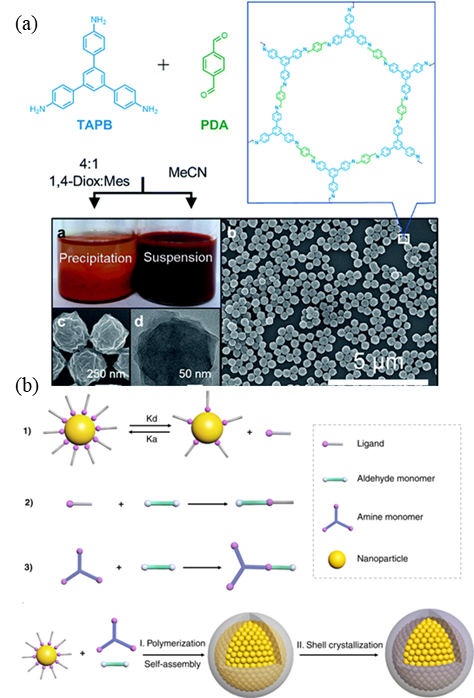
Subsequently, the research group[21]reported the successful synthesis of solution-stable imine-linked COF colloids without the need for templates or additives (as shown in Figure 3a). In the presence of the catalyst Sc(OTf)3, 1,3,5-tris(4-aminophenyl)benzene (TAPB) and paraphenylene diamine (PDA) were condensed in CH3CN to yield stable TAPB-PDA COF nanoparticles. The size of the COF colloids could be adjusted by varying the concentration of the monomers.
图3 (a) 用二氧六环与间二甲苯的典型混合溶剂合成亚胺连接的 COF 会产生不溶沉淀,用MeCN则会产生稳定的胶体悬浮液[21];(b) 纳米粒子与COF杂交示意图[23]

Fig. 3 (a) Synthesis of imine-linked COFs with a typical solvent mixture of 1,4-dioxane and mesitylene yields insoluble polycrystalline precipitates, whereas MeCN produces stable colloidal suspensions[21]. Copyright 2019, The Royal Society of Chemistry;(b) Schematic of hybridization between nanoparticles and COF[23]. Copyright 2019, Springer Nature

Wang et al.[22]introduced a reversible polymerization-termination (RPT) method, which involves introducing two monofunctional competitors. RPT can significantly enhance the reversibility of the reaction, avoid kinetic traps, and promote the system's shift toward a thermodynamically more stable state. This method can generate COF colloids composed of interwoven nanosheets with high crystallinity and various morphologies, including spheres, hollow fibers, and films. Monofunctional amines and aldehydes, used as competitors, are simultaneously added to the typical two-dimensional COF reaction system of BTCA and TAPB to enhance the reversible association during the Schiff base COF formation process.

2.2.3 Surface modification strategy

Surface modification strategies involve chemically or physically treating the surface of COF colloids using different methods to enhance their performance or impart new functionalities. For example, specific chemical functional groups can be introduced onto the surface of COF colloids, or COF colloids can be coated or surface-modified with polymers. Wei et al.[23]reported the synthesis of colloidal COFs within a closed space using O/W emulsion technology (Figure 3b). The self-assembly of nanoparticles within emulsion droplets is triggered by the evaporation of the carrier solvent, while polymerization (formation of imine bonds) occurs upon the addition of a Lewis acid to the aqueous phase. The surface of the nanoparticles is covered with oleylamine; due to dynamic ligand adsorption/desorption kinetics, imines form between oleylamine and aldehydes at nearby sites. The competition between self-assembly and polymerization allows for the spatial distribution of nanoparticles within COFs to be controlled by adjusting the reaction temperature. Pan et al.[24]also employed the same technique to synthesize colloidal TpPa-SO3H. The interface between octanoic acid and water was stabilized by adding the cationic surfactant cetyltrimethylammonium bromide (CTAC). The ionic repulsion between charged COFs weakened the π-π interactions between COF nanosheets, enabling the COF nanosheets to disperse well in the aqueous phase and thus forming a colloid.
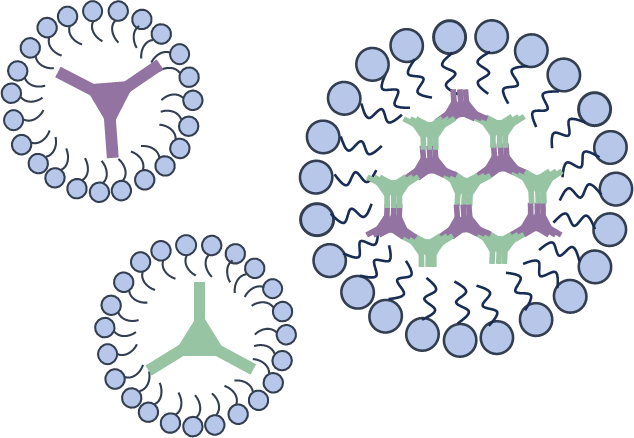
Surfactants can reduce surface energy by lowering the surface tension at the solid-liquid interface; therefore, surfactant-assisted synthesis (Figure 4) is one of the effective methods for preparing colloidal COFs. Puigmartí-Luis et al.[25] employed a one-pot method to produce stable imine-based COF particles in an aqueous colloidal solution under ambient temperature and pressure. A cationic micellar system formed by a mixture of cationic cetyltrimethylammonium bromide (CTAB) and anionic sodium dodecyl sulfate (SDS) surfactants (CTAB/SDS 97∶3) was used, with TAPB and 1,3,5-triformylbenzene (BTCA) as initial monomers, to synthesize stable crystalline TAPB-BTCA COF nanoparticles in water. The curvature reduction induced by SDS contributes to the colloidal stability of COF oligomers and the final TAPB-BTCA-COF nanoparticles. To optimize surfactant-assisted synthesis, Dong et al.[26] utilized a polyethyleneimine (PEI)-shielded covalent self-assembly strategy to prepare well-dispersed, uniformly shaped, amine-functionalized 2D imine-linked COF colloids. PEI was introduced into the initial condensation reaction system of TAPB with 2,3,5,6-tetrafluoroterephthalic acid (TFA), participating in the continuous growth and crystallization of COFs. PEI forms a polymer network on the rapidly formed crystal nuclei surfaces, restricting adhesion between nuclei bearing active amino and aldehyde groups, thereby forming a crystalline and well-dispersed colloidal solution.
图4 表面活性剂辅助合成胶体示意图

Fig. 4 Surfactant-assisted is synthetic colloid schematic

At room temperature, acetonitrile is the most common solvent used to obtain nanoscale COF colloids; however, nitrile solvents generally cannot be removed from the colloids without causing irreversible aggregation of the COF colloids. Braunecker et al.[27]developed a functionalized colloidal COF shell technology that allows them to be dried, purified, and redispersed in various non-nitrile solvents. In their experiments, PDA and tetra(4-aminophenyl)methane (TAPM) were used as precursors, with trifluoroacetic acid as the catalyst, yielding high-surface-area COF-300 colloids. To enhance the stability of the colloids, researchers designed an ionic liquid compound containing tetra(3,5-bis(trifluoromethyl)phenyl)borate anions (BArFanions), ensuring that reactions occur only on the surface. This work demonstrates a successful case of post-synthetic modification of COF colloids. However, methods for achieving water dispersibility and surface functionality while simultaneously controlling the optimal particle size below 100 nm remain underdeveloped, which hinders many biomedical applications. Wang et al.[28]utilized aspartic acid (D-/L-Asp), which plays a central role in acidic catalysis, hydrophilicity, size-controlled synthesis, and chiral enantiomers, to achieve one-step size control and surface functionalization of uniform spherical TAPB-PDA COF nanoparticles. Surface modification with Asp improves the dispersibility of COF NSs in aqueous solutions. Based on the dynamic reversibility of imine bonds and the higher reactivity of alkylamines, Asp can act as a nucleation inhibitor and a regulator competing with multifunctional amine building blocks.
Xie et al.[29]developed a homogeneous and stable porphyrin-based COF material (COF-B) using a protein-assisted synthesis strategy. Bovine serum albumin (BSA), a medical adjuvant with excellent biocompatibility and water solubility, was used as the model protein, while 5,10,15,20-tetra(4-aminophenyl)-21H,23H-porphyrin (TAPP) and 1,3,5-triisopropylchloroglucol (TFP) served as building blocks to prepare the porphyrin-based COF colloid (COF-B). The presence of protein in COF-B provides hydrophilic segments, which helps enhance stability. Meanwhile, the interaction between BSA and the COF material may involve both covalent and non-covalent interactions, resulting in size control and excellent stability.

2.2.4 Other synthetic strategies

Some researchers have also prepared COF colloids using a bottom-up strategy. Jiang et al.[30]reported the synthesis of COF-NS colloids containing abundant charged groups via a one-phase solution method. In their experiment, monomer solutions containing 2,5-diaminobenzenesulfonic acid (DABA) and 1,3,5-triformylresorcinol (TFP), respectively, were mixed to form a homogeneous solution. After standing at room temperature for a period of time, COF-NS colloids were obtained. Lotsch et al.[31]revealed the anisotropic growth of imine-based COF colloids by carefully selecting building blocks and reaction conditions. Using TAPB and 2,5-dimethoxyterephthalic acid (MeOTP) as precursors, they obtained COF nanosheets with a lateral size of approximately 200 nm and an average height of 35 nm. This colloid exhibited a unimodal particle size distribution and excellent colloidal stability after 10 months of storage, without any signs of aggregation. Yu et al.[32]reported a water-based sol-gel synthesis strategy for preparing COFs with specific task-oriented applications. Using (pyrrolidinylmethylene)cyclohexane-1,3,5-trione (M1) and p-phenylenediamine as initial compounds, with water as the solvent, they achieved metastable COF colloidal dispersions by reducing the initial monomer concentration and controlling the reaction kinetics. This approach facilitates mesoscopic assembly control and enables processing into objects of different dimensions in water ((1D) fibers, (2D) membranes, (3D) hydrogels or aerogels). Through this strategy, COF colloidal dispersions can be realized and formulated into processable films.
The development of COF bonding methods has consistently focused on enhancing the stability of COF colloids, characterized by dynamic and reversible covalent bonds. From the earliest borate ester-bonded COF colloids, which were prone to hydrolysis, to the more stable imine-bonded COFs, the diversification of bonding approaches has not only increased the diversity of COF colloids but also enhanced their stability to a certain extent, laying the foundation for the subsequent realization of multifaceted applications of COF colloids. Meanwhile, in organic synthetic chemistry, most chemical reactions are kinetically controlled and often accompanied by an increase in entropy, typically yielding products that react in different directions, many of which are not the desired target compounds. However, in dynamic covalent chemistry, reaction products are thermodynamically controlled and formed through reversible reactions; defects in the products can be effectively repaired via an "error-checking" process, ultimately leading to relatively perfect target products. On the other hand, the structural units of COF colloids usually feature rigid π-type frameworks with multiple reactive sites. Their solubility in solvents highly depends on the size of the π-system and the type of reactive units. Solvent, catalyst, reaction temperature, and reaction time are all key factors to consider in thermodynamic control of the reaction, as they determine the crystallinity and porosity of COF colloids.
In summary, the preparation and functional applications of COF colloids are closely related to organic building blocks, molecular structures, and the inherent properties of COF molecules themselves. Based on existing molecular topologies, targeted selection of functionalized organic building blocks and appropriate preparation methods can be employed to synthesize COF colloids with specific structures and functionalities.

3 Application

COF colloids have attracted widespread attention due to their rich porous ordered structure, tunable absorption spectra, and dispersion stability in solvents. They hold great application potential in areas such as photocatalytic conversion, materials for optoelectronic devices, gas adsorption and separation, and biomedicine (relevant applications are summarized in Table 3).
表3 COF胶体的应用

Table3 Application of COF colloid

Ingredients Material Application Ref
COF-5 COF-5/CoAl-LDH CO2 reduction 33
COF-5 LaNi-Phen/COF-5 CO2 reduction 34
TP-TTA COF Pdx/TP-TTA/SiO2/PAN Photocatalytic hydrogen evolution 49
Nano Tp-TTA COF colloids COF-COF heterojunction The selective oxidation of benzyl alcohol 35
COF-5 COF-10 DPB-COF TP-COF COF ink 3D printing 36
COF-5 COF-5@Cs2PdBr6 NO2 sensor 37
TAPB、BPDA TAPB-BPDA COF NH3 sensor 38
TAPPy、PDA TAPB、DMPDA TAPPy-PDA COF TAPB-DMPDA COF Separation of benzene and cyclohexane 39
L-/D-PDC BTA chiral COFs COF-based CPL Adsorption of various non-chiral organic dye objects 41
TpPa-SO3H、TpTGcl LBL-Type COF precise sieving of dye molecules 24
TAPB、BTCA TAPB-BTCA COF H2/CO2 separation 40
TII、TPA TPAT COF Cancer treatment 42
COF-5 COF-PLU/Dex Drug delivery 43
BTCA、TAPB BTCA-TAPB-COF ink 3D printing 50
Colloidal COF-301 Porous liquid H2 transport 44

3.1 Photocatalysis

The application of COF colloids in the field of photocatalysis mainly involves highly selective CO2reduction. The achievement of highly selective CO2reduction is attributed to the high specific surface area, porosity, and chemical stability of COF colloids.
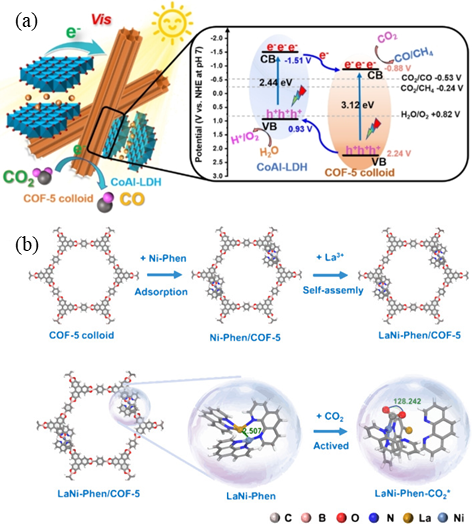
Liu et al.[33]leveraged the advantages of COF-5 colloids, such as their high specific surface area and porosity, in CO2 adsorption, and synthesized a heterojunction of COF-5 colloids in situ on the surface of CoAl-LDH. CoAl-LDH can extend the light absorption range of COF-5 colloids and enhance their photocatalytic efficiency in visible-light-driven CO2 reduction (Figure 5a). The COF-5/CoAl-LDH nanocomposite exhibited a CO production rate of 265.4 μmol g-1 within 5 hours, with a CH4 selectivity of 94.6%, which were 4.8 times and 2.3 times higher than those of COF-5 colloids and CoAl-LDH, respectively. Subsequently, Liu et al.[34]developed an electrostatically driven self-assembly strategy assisted by phenanthroline (Phen) ligands to incorporate atomically dispersed La-Ni sites into conjugated boronate-linked COF-5 colloids. As an electron transfer channel, COF-5 colloids enable photogenerated electrons to transfer from La-Phen to COF-5 colloids and then inject electrons into Ni-Phen for the CO2 RR process. Without the use of any additional photosensitizers, the COF-5 colloids with La-Ni sites showed a 15.2-fold increase in CO2 reduction rate compared to the benchmark COF colloids, along with improved CO2 selectivity (98.2%). This study proposed a potential strategy for integrating photoactive and catalytically active centers to enhance photocatalytic CO2 reduction capability (Figure 5b).
图5 (a)光催化CO2转化为CO (a) COF-5/CoAl-LDH的作用机理[33];(b) LaNi-Phen/COF-5的作用机理[34]

Fig.5 Photocatalytic conversion of CO2 to CO (a) Action mechanism of COF-5/CoAl-LDH[33]. Copyright 2022, Wiley-VCH GmbH; (b) Action mechanism of LaNi-Phen/COF-5[34]

In addition, to enhance the separation capability of COF-based photocatalysts, Yang et al.[35]deposited a nano-sized Tp-TTA COF colloid onto tetrahydroquinoline-linked QH-COF to fabricate a COF-COF heterojunction. In the selective oxidation of benzyl alcohol, the conversion rate of the Tp-TTA/QH heterojunction was 2.2 times that of QH-COF and 3.9 times that of Tp-TTA COF, outperforming most COFs reported in recent years.

3.2 device

The pore structure and chemical tunability of COF colloids give them great application potential in devices such as gas sensors and inks for 3D printing. Currently, COF colloids can be designed to detect and identify specific molecules like ammonia (NH3), nitrogen dioxide (NO2), and propylamine (C3H9N), exhibiting high sensitivity and selectivity. Meanwhile, 3D printing technology allows precise control over the shape and structure of COF materials, enabling tailored functionalities for various devices.
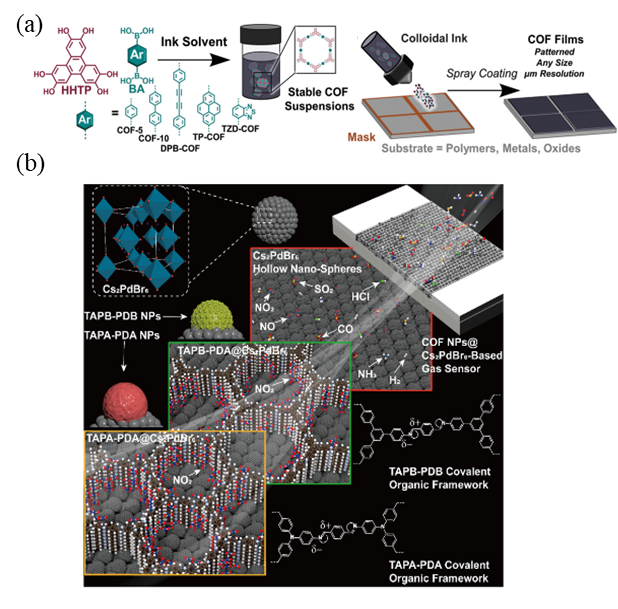
The Dichtel group[36]used borate-linked 2D COF colloids as sprayable inks to fabricate large-area 2D COF films. This method is synthetically versatile, enabling the preparation of colloidal inks from five different 2D COFs, which can then be sprayed onto various substrates (Figure 6a). By combining with template masks, the sprayed 2D COFs can be rapidly deposited into films larger than 200 cm2with relatively uniform coverage and a line resolution below 50 μm. In summary, this work establishes a scalable additive manufacturing technique that integrates 2D COF colloids into thin-film device architectures.
图6 COF胶体在器件上的应用:(a) 油墨制备及喷涂[36];(b) NO2传感器[37]

Fig.6 Application of COF colloid in devices: (a) Ink preparation and spraying[36]. Copyright 2020, Wiley-VCH GmbH; (b) NO2 sensor[37]. Copyright 2024, Research Square

To overcome the issues of low response and limited selectivity in halide peroxide sensors, Chen et al.[37]proposed an assembly-enhanced adsorption strategy for NO2sensors (Figure 6b). They designed two rapidly synthesizable COF colloids (TAPB-PDA and TAPA-PDA COF) and effectively assembled them with Cs2PdBr6using a nonsolvent-induced growth method. By utilizing the COF colloids to adsorb low concentrations of NO2from the environment, the intensity of the sensing signal was significantly enhanced, allowing for the direct detection of ultra-low concentrations (10 ppb) of NO2.
Ding et al.[38]In a mixed solvent of 1,4-dioxane/mesitylene, Sc(OTf)3catalyzed the construction of five imine-linked COF colloids, all of which exhibited NH3sensing capability at room temperature. Among them, COF 3 (TAPB-BPDA) showed a high response value, short response time, and excellent sensing selectivity, demonstrating superior NH3sensing performance. The hydrogen bonding between NH3and the imine bonds is the key reason for the outstanding NH3sensing performance of COF 3 colloid; this process is reversible, and the corresponding charge transfer disappears upon removal of NH3. Therefore, the COF 3 colloid sensor device can be reused for NH3detection.

3.3 Adsorption and Separation

COF colloids can also be applied in the field of adsorption and separation, and have already been used for the separation of benzene/cyclohexane mixtures and as a separation membrane for H2/CO2separation. The Dichtel group[39]prepared two imine-linked 2D COF colloids (TAPPy-PDA and TAPB-DMPDA) using TAPPy, TAPB, and 2,5-dimethoxyterephthalic acid (DMPDA), which were then employed for the separation of benzene and cyclohexane. Chromatographic columns containing TAPPy-PDA COF colloids exhibited excellent separation performance for benzene/cyclohexane mixtures, with cyclohexane showing superior adsorption compared to benzene.
Rapid implementation of decarbonization and hydrogen production technologies represents a promising approach to addressing modern environmental and energy supply challenges. Developing gas separation membranes with high selectivity and permeability is crucial for these processes. The Andreeva group[40]prepared COF colloids using TAPB and BTCA, and combined them with graphene oxide (GO) to create a COF-GO composite membrane featuring ideal nanosheet stacking, controllable thickness, and gas channels. Thanks to the excellent stability of the COF colloids, the COF-colloid-based composite membrane assembled at a pH of 4 has a thickness of 1.3 μm and exhibits favorable performance characteristics for an equimolar mixture of H2/CO2(ambient temperature and 1 Bar), with an H2permeance of 366 Barrer and a selectivity of 15.6, maintaining long-term stability for over 200 hours.
Liu et al.[41]used an aggregation-dispersion-filtration strategy to assemble COF colloids into thin films for adsorbing and loading various achiral organic dye guest molecules. Pan et al.[24]synthesized colloidal 2D COFs with customizable designs and preparations via water-in-oil emulsion interfacial polymerization. After layer-by-layer assembly into membranes, these COFs achieved precise sieving of dye molecules and high permeability (85 m-2·h-1·bar-1).

3.4 Biomedicine

To date, COFs are typically composed of small aromatic building blocks, which results in their absorption spectra being predominantly located in the high-energy portion of the visible light region. Xie et al.[42]developed a novel thiophene-isothianthrene-based 2D TPAT COF with a narrow bandgap by integrating electron-deficient thiophene isothianthrene with electron-rich triphenylamine. After optimizing the solvent, they obtained COF colloids with uniform particle size. Thanks to the broad light absorption range and remarkable photothermal conversion efficiency of these COF colloids, the photothermal conversion efficiency (PCE) of the COF colloids reached as high as 48.2% under 808 nm laser irradiation. This work provides a simple and practical method for obtaining a COF-colloid-based phototherapeutic agent, which can be applied in the biomedical field.
Gaharwar's research group[43]combined COF-5 colloids with amphoteric polymers for sustained drug delivery to guide stem cell fate. COF-5 colloids exhibit highly ordered porosity, biodegradability, and cytocompatibility, providing advantages in drug delivery. After functionalization with Pluronic F127 (PLU), COF-5 colloids can induce the osteogenic effects of dexamethasone (Dex) and facilitate its sustained release. This work offers a simple strategy for preparing physiologically stable 2D nanoparticles based on COF colloids for nanomedicine applications.

3.5 Other Applications

The application of COF colloids in various fields represents an expansion of COF material applications. Preparing COFs into colloidal form not only maintains the advantageous properties of COF materials but also effectively addresses issues that COF powders cannot or find difficult to resolve. For example, to address the weak interaction between COF powders and gases such as H2, which makes them unsuitable for H2 storage and transportation, Braunecker et al.[44] developed Cu(I)-loaded COF colloids. They used atom transfer radical polymerization (ATRP) technology to form a robust poly(dimethylsiloxane)-methyl methacrylate (PDMS-MA) coating around the COF colloids. Subsequently, the coated COF material was suspended in a liquid polymer matrix to create a porous liquid (PL), enabling H2 transport under mild or near-mild refrigeration temperatures.

4 Conclusion and Outlook

Covalent organic framework colloids, as a novel research direction in polymeric porous materials, have attracted widespread attention from researchers. COF colloids combine the advantages of covalent organic frameworks and colloids, and have been extensively studied in fields such as photocatalysis, devices, membrane separation, and biomedicine. Although some progress has been made in the study of COF colloids, several challenges still remain at present.
(1) As a cutting-edge material, COF colloids have demonstrated great potential in multiple fields; however, their synthesis still faces challenges such as complex conditions, long reaction cycles, low yields, and insufficient product purity. Optimizing reaction conditions and precursor design are key to addressing these issues.
(2) Although there is a certain theoretical basis for the study of COF colloids, the stability mechanism of COF colloids over long periods still requires more in-depth exploration, especially under different environmental conditions (such as changes in solvent, temperature, and pH). At the same time, when the solvent penetrates into the interior of the COF colloid, how does the presence of the inner surface affect traditional factors that control colloid stability, such as electrostatic forces, steric repulsion, and favorable enthalpic interactions?
(3) Currently, COF colloids have already found certain applications in fields such as photocatalysis, gas separation, dye adsorption, sensing, 3D printing, and biomedicine. However, their solution processability and stability give them a very promising future application potential, spanning multiple areas including energy, environment, and intelligent materials. With continuous advancements in science and technology and deeper research, COF colloids are expected to demonstrate more new application possibilities and practical value in the coming years.
(4) Based on the current COF colloidal preparation process, future research directions for COF colloids include developing COF colloids with specific functionalities tailored to particular applications (such as photo/electrocatalytic organic transformations, pollutant degradation, CO2 capture and adsorption, tumor phototherapy, etc.), and continuously expanding their scope of application. Potential hotspots include innovation in COF colloidal preparation processes and their versatility; enhancing the recyclability of COF colloids, including their stability during use and their ability to self-repair for multiple cycles of efficient reuse.
In summary, this article reviews the recent research progress on COF colloids from both synthesis and application perspectives. We hope this work can serve as a reference for researchers in related fields, and we look forward to COF colloids shining brightly in various domains.
[1]
Lin M Y, Lindsay H M, Weitz D A, Ball R C, Klein R, Meakin P. Nature, 1989, 339(6223): 360.

[2]
Lodge O. Nature, 1921, 107(2681): 73.

[3]
Wang Z R, Wang F, Peng Y, Han Y L. Nat. Commun., 2015, 6: 6942.

[4]
Silvera Batista C A, Larson R G, Kotov N A. Science, 2015, 350(6257): 1242477.

[5]
Carelli V, Liquori A M, Mele A. Nature, 1955, 176(4471): 70.

[6]
Schubert U S. Colloid Polym. Sci., 2020, 298(12): 1609.

[7]
Chen B H, Xie H L, Shen L G, Xu Y C, Zhang M J, Zhou M Z, Li B S, Li R J, Lin H J. Small, 2023, 19(17): 2207313.

[8]
She P F, Qin Y Y, Wang X, Zhang Q C. Adv. Mater., 2022, 34(22): 2101175.

[9]
Zhao Y J, Gu H, Zhou Y L, Wen C M, Liu X L, Wang S H, Chen Z S, Yang H, Wang X K. J. Environ. Sci., 2024, 141: 63.

[10]
Chen A Q, Jiang Z W, Tang J T, Yu G P. Prog. Chem., 2024, 36(3): 357

(陈安淇, 蒋智威, 唐俊涛, 喻桂朋. 化学进展, 2024, 36(3): 357).

[11]
Mapile A, Grape E S, Brozek C. Chem. Mater., 2024, 36(19): 9075

[12]
Zhang J, Cheng C, Guan L J, Jiang H L, Jin S B. J. Am. Chem. Soc., 2023, 145(40): 21974.

[13]
Li K, Wong N K, Strauss M J, Evans A M, Matsumoto M, Dichtel W R, Adronov A. J. Am. Chem. Soc., 2021, 143(2): 649.

[14]
Martínez-Fernández M, Gavara R, Royuela S, Fernández-Ecija L, Martínez J I, Zamora F, Segura J L. J. Mater. Chem. A, 2022, 10(9): 4634.

[15]
Zhang L, Zhu Q H, Zhou Y R, Wang S L, Fu J, Liu J Y, Zhang G H, Ma L J, Tao G H, Tao G H, He L. Nat. Commun., 2023, 14: 8181.

[16]
Wang L L, Zeng C, Xu H, Yin P C, Chen D C, Deng J, Li M, Zheng N, Gu C, Ma Y G. Chem. Sci., 2019, 10(4): 1023.

[17]
Wang L L, Xu C W, Zhang W Q, Zhang Q L, Zhao M L, Zeng C, Jiang Q L, Gu C, Ma Y G. J. Am. Chem. Soc., 2022, 144(20): 8961.

[18]
Smith B J, Parent L R, Overholts A C, Beaucage P A, Bisbey R P, Chavez A D, Hwang N, Park C, Evans A M, Gianneschi N C, Dichtel W R. ACS Cent. Sci., 2017, 3(1): 58.

[19]
Evans A M, Parent L R, Flanders N C, Bisbey R P, Vitaku E, Kirschner M S, Schaller R D, Chen L X, Gianneschi N C, Dichtel W R. Science, 2018, 361(6397): 52.

[20]
Castano I, Evans A M, Li H Y, Vitaku E, Strauss M J, Brédas J L, Gianneschi N C, Dichtel W R. ACS Cent. Sci., 2019, 5(11): 1892.

[21]
Li R L, Flanders N C, Evans A M, Ji W, Castano I, Chen L X, Gianneschi N C, Dichtel W R. Chem. Sci., 2019, 10(13): 3796.

[22]
Wang S, Zhang Z Y, Zhang H M, Rajan A G, Xu N, Yang Y H, Zeng Y W, Liu P W, Zhang X H, Mao Q Y, He Y, Zhao J J, Li B G, Strano M S, Wang W J. Matter, 2019, 1(6): 1592.

[23]
Zhang F H, Yang Z J, Hao J J, Zhao K X, Hua M M, Yang Y Z, Wei J J. Commun. Chem., 2019, 2: 123.

[24]
Zhao X T, Sun J S, Cheng X H, Qiu Q Q, Ma G M, Jiang C Y, Pan J F. ACS Appl. Mater. Interfaces, 2023, 15(46): 53924.

[25]
Franco C, Rodríguez-San-Miguel D, Sorrenti A, Sevim S, Pons R, Platero-Prats A E, Pavlovic M, Szilágyi I, Ruiz Gonzalez M L, González-Calbet J M, Bochicchio D, Pesce L, Pavan G M, Imaz I, Cano-Sarabia M, Maspoch D, Pané S, de Mello A J, Zamora F, Puigmartí-Luis J. J. Am. Chem. Soc., 2020, 142(7): 3540.

[26]
Chen L, Zhou C L, Yang T Y, Zhou W, Chen Y, Wang L H, Lu C Y, Dong L C. Small, 2023, 19(25): 2300456.

[27]
Mow R E, Lipton A S, Shulda S, Gaulding E A, Gennett T, Braunecker W A. J. Mater. Chem. A, 2020, 8(44): 23455.

[28]
Gao K X, Zhou Z, Yao L L, Wang S X, Zhang Y X, Zou Q C, Ma L X, Wang H X. ACS Appl. Bio Mater., 2022, 5(3): 1210.

[29]
Sun T T, Xia R, Zhou J L, Zheng X H, Liu S, Xie Z G. Mater. Chem. Front., 2020, 4(8): 2346.

[30]
Huang T, Jiang H F, Douglin J C, Chen Y, Yin S Y, Zhang J F, Deng X J, Wu H, Yin Y, Dekel D R, Guiver M D, Jiang Z Y. Angew. Chem. Int. Ed., 2023, 62(4): e202209306.

[31]
Yao L, Rodríguez-Camargo A, Xia M, Mücke D, Guntermann R, Liu Y P, Grunenberg L, Jiménez-Solano A, Emmerling S T, Duppel V, Sivula K, Bein T, Qi H Y, Kaiser U, Grätzel M, Lotsch B V. J. Am. Chem. Soc., 2022, 144(23): 10291.

[32]
Hu F, Hu Z Y, Liu Y F, Tam K C, Liang R R, Xie Q J, Fan Z W, Pan C Y, Tang J T, Yu G P, Zhang W. J. Am. Chem. Soc., 2023, 145(50): 27718.

[33]
Ou S Y, Zhou M, Chen W, Zhang Y Y, Liu Y L. ChemSusChem, 2022, 15(7): e202200184.

[34]
Zhou M, Wang Z Q, Mei A H, Yang Z F, Chen W, Ou S Y, Wang S Y, Chen K Q, Reiss P, Qi K, Ma J Y, Liu Y L. Nat. Commun., 2023, 14: 2473.

[35]
Dai H C, Li H, Yang Q H. Microporous Mesoporous Mater., 2022, 342: 112121.

[36]
Evans A M, Bradshaw N P, Litchfield B, Strauss M J, Seckman B, Ryder M R, Castano I, Gilmore C, Gianneschi N C, Mulzer C R, Hersam M C, Dichtel W R. Adv. Mater., 2020, 32(42): 2004205.

[37]
Ye W, Li M, Li G X, Jiang L H, Tian S, Dong S H, Xu Q F, Chen D Y. Adv. Funct. Mater., 2025, 35(14): 2418897.

[38]
Niu F, Shao Z W, Zhu J L, Tao L M, Ding Y. J. Mater. Chem. C, 2021, 9(27): 8562.

[39]
Natraj A, Ji W, Xin J J, Castano I, Burke D W, Evans A M, Strauss M J, Ateia M, Hamachi L S, Gianneschi N C, Alothman Z A, Sun J L, Yusuf K, Dichtel W R. J. Am. Chem. Soc., 2022, 144(43): 19813.

[40]
Chen M S, Trubyanov M, Zhang P X, Rodríguez-San-Miguel D, Zamora F, Novoselov K S, Andreeva D V. Carbon, 2024, 219: 118855.

[41]
Tang X H, Zhang K, Xue R X, Zheng Y X, Chen S M, Zheng S R, Fan J, Zhang Y W, Ye W P, Zhang W G, Cai S L, Liu Y. Angew. Chem. Int. Ed., 2024, 63(50): e202413171.

[42]
Xia R, Li C N, Yuan X D, Wu Q H, Jiang B W, Xie Z G. ACS Appl. Mater. Interfaces, 2022, 14(17): 19129.

[43]
Bhunia S, Jaiswal M K, Singh K A, Deo K A, Gaharwar A K. Adv. Healthc. Mater., 2022, 11(10): 2101737.

[44]
Mow R E, Russell-Parks G A, Redwine G E B, Petel B E, Gennett T, Braunecker W A. Chem. Mater., 2024, 36(3): 1579.

[45]
Xia R, Zheng X H, Li C N, Yuan X D, Wang J, Xie Z G, Jing X B. ACS Nano, 2021, 15(4): 7638.

[46]
Ma W D, Zheng Q, He Y T, Li G R, Guo W J, Lin Z A, Zhang L. J. Am. Chem. Soc., 2019, 141(45): 18271.

[47]
Zhang Z Y, Wang S, Yang Y H, Li W, Liu P W, Wang W J. ACS Macro Lett., 2021, 10(7): 933.

[48]
Ji W, Kim D M, Posson B M, Carlson K J, Chew A C, Chew A J, Hossain M, Mojica A F, Ottoes S M, Tran D V, Greenberg M W, Hamachi L S. RSC Adv., 2023, 13(21): 14484.

[49]
Ren X M, Li C Z, Liu J L, Li H, Bing L J, Bai S Y, Xue G Y, Shen Y B, Yang Q H. ACS Appl. Mater. Interfaces, 2022, 14(5): 6885.

[50]
Royuela S, Sevim S, Hernanz G, Rodríguez-San-Miguel D, Fischer P, Franco C, Pané S, Puigmartí-Luis J, Zamora F. Adv. Funct. Mater., 2024, 34(17): 2314634.

Outlines

/