Home Journals Progress in Chemistry
Progress in Chemistry

Abbreviation (ISO4): Prog Chem      Editor in chief: Jincai ZHAO

About  /  Aim & scope  /  Editorial board  /  Indexed  /  Contact  / 
Review

Preparation of Fully Conjugated Metal Phthalocyanine Complex Catalysts and to Enhance the Catalytic Oxygen Reaction Bifunctional Performance

  • Zhuang Yanqiong ,
  • Sun Yinggang ,
  • Sun Peng ,
  • Li Zhongfang , *
Expand
  • School of Chemistry and Chemical Engineering, Shandong University of Technology, Zibo 255086, China

Received date: 2025-02-08

  Revised date: 2025-05-26

  Online published: 2025-09-05

Supported by

The National Natural Science Foundation of China(22172093)

The National Natural Science Foundation of China(21776167)

The Natural Science Foundation of Shandong Province(ZR2023MB061)

Abstract

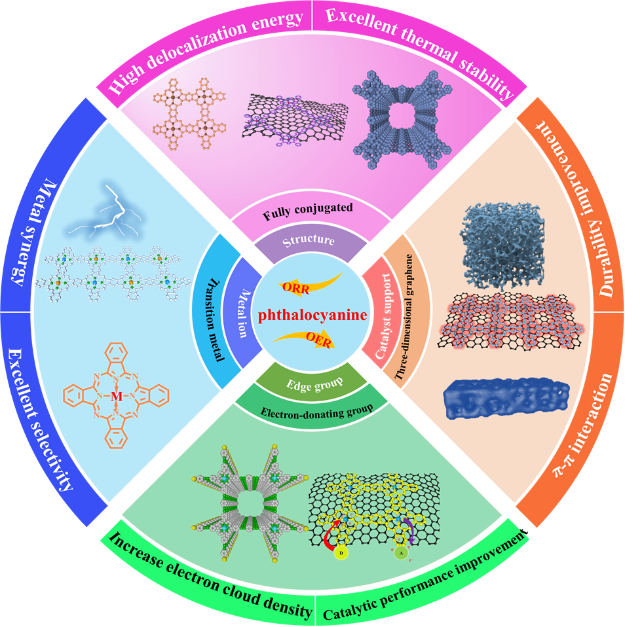
Phthalocyanine transition metal macrocyclic complexes have been widely applied in electrochemical reaction processes related to energy conversion and storage, including catalytic oxygen reduction reaction (ORR) and oxygen evolution reactions (OER), etc. Their excellent bifunctional performance in catalytic oxygen reactions has attracted extensive attention. This article mainly reviews the preparation methods and current research progress of metal phthalocyanine-based catalysts, as well as the factors influencing the performance of metal phthalocyanine-based catalysts, such as the structure of metal phthalocyanine, the support, the synergistic effect of central metal ions and bimetallic ions, and the influence of edge modification groups, etc. The influence of the fully conjugated structure on its thermal stability and the improvement of catalytic performance was analyzed; The π-π interaction between polymeric metal phthalocyanine complexes and three-dimensional graphene is conducive to improving catalytic activity and durability. The synergistic effect between the two metals and the edge-modified electron-donating groups can enhance catalytic performance.

Contents

1 Introduction

2 Preparation of metal phthalocyanine complexes and their catalysts

3 Influencing factors of catalytic performance of metal phthalocyanine complex catalysts

3.1 The influence of the structure of metal phthalocyanine complexes on the catalytic performance of catalysts

3.2 The influence of the carrier on the catalytic performance of metal phthalocyanine complex catalysts

3.3 The influence of central metal ions on the catalytic performance of polymeric metal phthalocyanine-based catalysts

3.4 The influence of edge group modification on the catalytic performance of metal phthalocyanine complex catalysts

4 Conclusion
Cite this article

Zhuang Yanqiong , Sun Yinggang , Sun Peng , Li Zhongfang . Preparation of Fully Conjugated Metal Phthalocyanine Complex Catalysts and to Enhance the Catalytic Oxygen Reaction Bifunctional Performance[J]. Progress in Chemistry, 2025 , 37(9) : 1290 -1300 . DOI: 10.7536/PC20250203

1 Introduction

The energy crisis and environmental pollution issues have attracted widespread attention, and fuel cells, as a new energy technology to alleviate the energy crisis, have become a research hotspot[1]. Water electrolysis for hydrogen production is a technology for generating green hydrogen, which can effectively contribute to achieving the "dual carbon" goals[2]. The slow reaction kinetics of the oxygen reduction reaction at the fuel cell cathode and the oxygen evolution reaction at the water electrolysis anode severely hinder their development[3,4]. Therefore, the development of highly efficient bifunctional catalysts for oxygen reactions has become urgent[5,6]. Currently, cathode catalysts for fuel cells are mainly based on noble metal platinum-group catalysts, while anode catalysts for water electrolysis mostly use oxides or alloy materials of ruthenium (Ru) and iridium (Ir)[7]. Due to resource scarcity and high costs, these noble metal catalysts are limited in large-scale applications. Therefore, cost-effective and stable non-noble metal catalysts have become a research focus. Metal phthalocyanine catalysts, with their well-defined active sites and low cost, have been widely applied in the field of electrocatalysis[8,9].
Metal phthalocyanines consist of four isoindole units, characterized by a large π-bond containing 18 π-electrons within the molecule. Their structure is similar to that of natural porphyrin derivatives (such as chlorophyll, hemoglobin, cytochrome c, vitamin B12, etc.)[10-12]. Metal phthalocyanine complexes have advantages such as widely available synthetic raw materials, low cost, and excellent catalytic performance. Therefore, research on metal phthalocyanine complex catalysts has become an important research direction in the field of electrocatalysts[13,14].

2 Preparation of Metal Phthalocyanine Complexes and Their Catalysts

The preparation methods for metal phthalocyanine complex catalysts are also diverse. The main methods for synthesizing mononuclear metal phthalocyanine complexes include the phthalonitrile method, the phthalic anhydride-urea method, and the diiminoisoindole method[15-17]. The phthalonitrile method uses phthalonitrile and its derivatives as raw materials, with 1,8-diazabicyclo[5.4.0]undec-7-ene (DBU) as a catalyst, and nitrobenzene or N, N-dimethylformamide (DMF) as solvents to synthesize metal phthalocyanines. A drawback of this method is that the cyano group is prone to hydrolysis, necessitating anhydrous conditions. In contrast, the phthalic anhydride-urea synthesis method employs ammonium molybdate as a catalyst, using phthalic anhydride and its derivatives, urea, and metal salts as raw materials, reacting under high-temperature molten conditions or in high-boiling-point solvents. However, this method yields relatively low productivity, and the main challenge lies in the separation and purification of the crude product. Additionally, attention must be paid to the amount of ammonium molybdate used; too little may result in a slow reaction rate and reduced yield, while too much may introduce impurities and affect product purity. The diiminoisoindoline method utilizes diiminoisoindoline or an intermediate prepared from phthalonitrile, diiminoisoindoline, as the starting material for synthesizing metal phthalocyanine complexes[18,19]. This reaction must be carried out under inert gas protection, with strict control over reaction temperature and time, and its high cost limits its large-scale application.
The synthesis of polymerized metal phthalocyanine complexes varies depending on their connectivity: (1) Non-full-conjugated polymerized metal phthalocyanine covalent organic frameworks (COFs), which are formed by reacting single-ring metal phthalocyanine complexes with different substituents and various structural units, resulting in COF structures with non-sp2 hybridization (structural formula shown in Figure 1a, where X represents a non-conjugated unit). Common reaction types include boronate ester formation and imination reactions[20,21]. (2) In fully conjugated polymerized metal phthalocyanine molecules, single-ring metal phthalocyanines are connected by single bonds to form polymerized metal phthalocyanine complexes (structural formula shown in Figure 1b). These complexes are synthesized by reacting trimellitic anhydride, urea, and transition metal salts under ammonium molybdate catalysis, yielding polymerized metal phthalocyanine complexes linked by C—C single bonds between phthalocyanine rings[22-24]. (3) In fully conjugated polymerized metal phthalocyanine molecules, polymerized metal phthalocyanine complexes connected via shared benzene rings are primarily prepared using 1,2,4,5-tetrakisbenzonitrile or pyromellitic dianhydride and their derivatives as starting materials (structural formula shown in Figure 1c). Two synthetic methods are available: the liquid-phase method, typically conducted in high-boiling-point organic solvents (such as high-boiling-point kerosene, nitrobenzene, diphenyl ether, etc.), which yields relatively higher product yields; and the solid-phase method, where pyromellitic dianhydride, urea, and transition metal ion salts are mixed under ammonium molybdate catalysis, heated in a sealed container at 180 ℃ for a melt reaction, followed by extraction of the intermediate product, thorough grinding, and subsequent reaction at 270 ℃ in a sealed container to obtain the crude product, which is then purified to yield the final product[25,26]. (4) Other fully conjugated polymerized metal phthalocyanine covalent organic framework (COF) complexes are formed by coupling single-ring metal phthalocyanine complexes with different substituents and various structural units, creating two-dimensional ordered porous frameworks with full sp2 hybridization (structural formula shown in Figure 1d, where Y represents a fully sp2-hybridized group or molecular fragment). Common linking methods include imine bonds, azo groups, or aromatic (hetero)cyclic linkages[27,28].
图1 (a)非全共轭的金属酞菁COF;(b)单键连接的聚合金属酞菁配合物;(c)共用苯环连接的聚合金属酞菁配合物;(d)全共轭的金属酞菁COF

Fig.1 (a) Non-fully conjugated metal phthalocyanine COF; (b) Single-bond-linked polymeric metal phthalocyanine complexes; (c) Polymeric metal phthalocyanine complexes connected by shared benzene rings; (d) Fully conjugated metal phthalocyanine COF

Due to the tendency of metal phthalocyanine complexes to form face-to-face stacking structures between molecules, this not only masks the catalytic active centers but also degrades their electrical conductivity, making it difficult to use them directly as efficient catalysts. To address this issue, carbon materials can be employed as supports to immobilize metal phthalocyanine complexes onto their surfaces. Common carbon materials include carbon black, carbon nanotubes, reduced graphene oxide, and three-dimensional graphene. Immobilizing metal phthalocyanine complexes onto carbon materials with good electrical conductivity, porosity, and large specific surface areas can not only compensate for the poor electrical conductivity of metal phthalocyanine complexes but also allow the complexes to lie flat on the carbon material surface, fully exposing their catalytic active sites and thereby enhancing the catalytic performance of the catalyst. Currently, the main preparation methods for these catalysts include impregnation, ball milling, and in-situ synthesis. The impregnation method involves dissolving a certain amount of metal phthalocyanine complex and then adding it to a quantified amount of carbon material, followed by impregnation, aging, activation, and other processes to obtain the catalyst[29]. The ball milling method involves mixing metal phthalocyanine complexes with different carbon materials used as supports and milling them together. Through mechanical ball milling, metal phthalocyanine complexes are loaded onto the surface and within the pores of the carbon material, resulting in a catalyst where the metal phthalocyanine complexes are immobilized on the carbon material surface. The in-situ synthesis method involves preparing metal phthalocyanine complexes directly on the surface of various carbon materials to produce the catalyst. Considering the above three preparation methods, from the perspective of the degree and effectiveness of immobilization of metal phthalocyanine complexes onto the support, the impregnation method appears to be the best approach. However, if the polymerized metal phthalocyanine complexes cannot be dissolved, only the ball milling or in-situ synthesis methods can be used for preparation.
Bifunctional performance refers to the enhanced catalytic activity of a catalyst that efficiently promotes both ORR and OER simultaneously. This study investigates the main factors influencing the catalytic activity of metal phthalocyanine complexes for oxygen reactions, including the structure of metal phthalocyanine complexes, polymerization degree, support materials, metal ions, and the effects of edge-modifying groups[30,31].

3 Factors Affecting the Catalytic Performance of Metal Phthalocyanine Complex Catalysts

3.1 The effect of the structure of metal phthalocyanine complexes on the catalytic performance of catalysts

Among the factors influencing the catalytic performance of metal phthalocyanine complexes, the structure of the metal phthalocyanine complex plays a crucial role. The structures of metal phthalocyanine complexes include mononuclear metal phthalocyanine complexes, dimeric (or polymeric) metal phthalocyanine complexes, covalently bonded polymeric metal phthalocyanine COFs, and fully conjugated polymeric metal phthalocyanine COFs[32,33]. Mononuclear metal phthalocyanine catalysts have relatively poor thermal stability due to their smaller macrocyclic π-bonds, causing them to decompose into metal-nitrogen-carbon (M-N-C) atomic clusters under high-temperature activation (HT) conditions during catalyst preparation, resulting in reduced catalytic activity and stability, as well as unclear catalytic active sites. Dimeric (or polymeric) metal phthalocyanine catalysts, with larger macrocyclic π-bonds, exhibit better thermal stability and do not decompose at 400 ℃ HT; therefore, the catalytic performance of catalysts prepared from these complexes is significantly enhanced[34,35].
Different structured polymeric metal phthalocyanine COFs have varying effects on the catalytic performance of catalysts. Covalently bonded polymeric metal phthalocyanine COFs containing non-sp²-hybridized structures exhibit conjugation only in the phthalocyanine ring portion, resulting in an overall non-complete conjugated system. Under high-temperature conditions (HT), this type of COF, similar to single-ring metal phthalocyanines, tends to thermally decompose into M-N-C atomic clusters, leading to reduced catalytic performance and unclear catalytic active sites. In contrast, fully conjugated polymeric metal phthalocyanine COFs connected via covalent bonds with sp²hybridization maintain a fully conjugated molecular structure, forming a large π-bond system with excellent thermal stability and preventing decomposition under high-temperature conditions (HT). Compared to monomeric metal phthalocyanine complexes, fully conjugated polymeric metal phthalocyanine COFs possess greater delocalization energy and a lower HOMO-LUMO bandgap, making them more readily able to gain or lose electrons and thus exhibiting enhanced catalytic redox performance.
Therefore, the influence of metal phthalocyanine complex structures on the catalytic performance of catalysts is manifested in the effect of polymerization degree on fully conjugated polymeric metal phthalocyanine complexes. It is worth noting that a higher polymerization degree does not necessarily lead to better performance. During the preparation of catalysts, in order to ensure that the polymeric metal phthalocyanine complexes can fully interact with the support, they need to be dissolved in a solvent. Thus, the polymerization degree should not be excessively high; otherwise, it will result in solubility issues, thereby affecting their effective interaction with the support and ultimately reducing the catalytic performance of the catalyst.
Sun et al.[36]loaded cobalt phthalocyanine (CoPc) onto self-made three-dimensional graphene (3D-G) to prepare a CoPc/3D-G catalyst for the oxygen reduction reaction (ORR) (Figure 2a). The 3D-G was prepared using coal tar pitch as the raw material, magnesium oxide nanoparticles as the template, and KOH as the activating agent. In a saturated oxygen solution of 0.1 mol/L KOH, the half-wave potential (E 1/2) of CoPc/3D-G for catalytic ORR was 0.85 V vs RHE, which was 50 mV higher than that of 6% Pt/C by mass fraction (Figure 2b). At 0.65 V vs RHE, the number of electron transfers for CoPc/3D-G was 3.99, indicating that oxygen reduction was primarily catalyzed through a four-electron process. In durability tests, the current density of CoPc/3D-G decreased by only 10% after 40,000 seconds, whereas that of CoPc/C decreased by 17.5% over the same period, suggesting strong π-π interactions between 3D-G and CoPc, thus giving CoPc/3D-G superior durability.
图2 (a)3D-G的制备示意图[36];(b)催化ORR的LSV曲线

Fig.2 (a) Schematic diagram of 3D-G preparation[36]; (b) LSV curve of catalytic ORR

Xu et al.[37]successfully prepared planar polymeric phthalocyanine cobalt (PPcCo) through self-polymerization of 4,4′,4″,4‴-tetracarboxyphthalocyanine cobalt (TcPcCo) at 400℃. The TG test results indicated that the obtained PPcCo was stable below 600 ℃ (Figure 3a). PPcCo was then supported on Vulcan XC-72 and activated at 400℃ to yield PPcCo/C. Tests such as XRD, HRTEM, and XPS demonstrated that PPcCo was uniformly distributed on the surface of Vulcan XC-72, and the PPcCo on the catalyst surface did not decompose. Its catalytic active sites were Co-N4groups within the phthalocyanine rings. PPcCo/C exhibited excellent electrocatalytic performance and electrochemical stability in 0.5 mol/L H2SO4. In O2-saturated H2SO4, the catalytic ORR E 1/2was 0.75 V vs RHE, with a number of transferred electrons close to 4e-(n=3.7) (Figure 3b). During methanol tolerance testing, PPcCo/C was almost unaffected by 1 mol/L methanol in the electrolyte, whereas Pt/C experienced a 0.2 V decay in the presence of 1 mol/L methanol, demonstrating that PPcCo/C possessed remarkable anti-poisoning performance.
图3 (a)热重分析和PPcCo的结构[37];(b)在PPcCo/C上记录固定转速为1500 r/min时的极化曲线Pt/C电极在1.0 mol/L饱和甲醇存在和不存在的情况下

Fig. 3 (a) TG curve and structure of PPcCo[37]; (b) The polarization curve at a fixed speed of 1500 r/min was recorded on the PPcCo/C electrode in the presence and absence of 1.0 mol/L saturated methanol

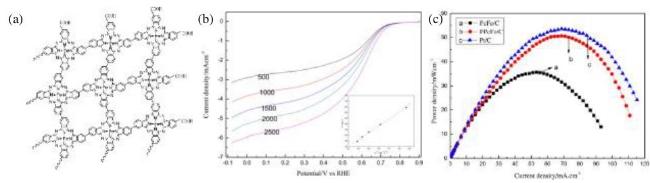
Li et al[38]prepared polymerized phthalocyanine iron (Fig. 4a) by high-temperature self-polymerization of 4,4',4'',4'''-tetracarboxyphthalocyanine iron (TcPcFe) at 400 ℃,and then loaded the resulting polymerized phthalocyanine iron onto carbon black and activated it at 400 ℃ to obtain the PPcFe/C catalyst. The ORR catalytic performance of PPcFe/C was tested, and in 0.5 mol/L H2SO4, the E 1/2for ORR catalyzed by PPcFe/C was 0.77 V vs RHE (Fig. 4b). In durability tests, during a 60-hour chronoamperometric test, the current density of PPcFe/C decreased by only 14%, outperforming the single-ring phthalocyanine iron catalyst (PcFe/C) (31%), indicating that PPcFe/C has superior durability. After the durability test, the infrared spectrum of the dissolved and purified PPcFe product showed no change in its characteristic absorption peaks compared to the initial compound, demonstrating that the structure of the PPcFe precursor remained unchanged during catalyst preparation and throughout the catalyst's durability. When used as a cathode catalyst in magnesium-air fuel cells (MAFCs), the MAFC single-cell with PPcFe/C catalyst achieved a peak power density of 50.5 mW/cm2at 20 ℃ (Fig. 4c). During continuous discharge at 20 mA/cm2for over 11 hours, the battery voltage dropped by less than 0.01 V, exhibiting excellent durability. These results indicate that PPcFe/C possesses outstanding catalytic activity.
图4 (a)PPcFe的结构;(b)PPcFe/C不同转速ORR LSV;(c)MAFC电池峰功率[38]

Fig.4 (a) The Structure of PPcFe; (b) ORR LSV curves of PPcFe/C at different speeds; (c) Peak power of MAFC battery[38]

Sun et al.[39]prepared amide polymerized phthalocyanine iron (CPMPcFe) via a solid-phase method (Figure 5a). Thermogravimetric analysis results indicated that CPMPcFe did not lose weight at 400 ℃, demonstrating its excellent thermal stability (Figure 5b). Subsequently, CPMPcFe was supported on Vulcan XC-72 and activated under argon protection at 400 ℃, yielding the CPMPcFe/C catalyst. In 0.1 mol/L KOH, the E 1/2for ORR catalyzed by CPMPcFe/C was 0.87 V vs RHE, higher than that of iron phthalocyanine catalyst (FePc/C, 0.71 V vs RHE) and 6% Pt/C by mass fraction (0.83 V vs RHE) (Figure 5c). After 5000 cycles of cyclic voltammetry, the current density decay of CPMPcFe/C was 0.05 mA/cm2, whereas that of FePc/C was 0.35 mA/cm2. Chronoamperometric tests showed that under the same operating conditions, the current density decay of FePc/C was approximately 28.2%, while that of CPMPcFe/C was about 16.9%, indicating that CPMPcFe/C exhibits superior catalytic durability.
图5 (a)CPMPcFe的结构;(b)CPMPcFe 的TG曲线;(c)催化剂在在1500 r/min转速下的LSV曲线[39]

Fig.5 (a) Structure of CPMPcFe; (b) TG curve of CPMPcFe; (c) LSV curve of the catalyst at 1500 r/min[39]

Mi et al[40]used a non-pyrolytic method to synthesize several metal-coordinated phthalocyanine-based conjugated two-dimensional covalent organic polymers (COPBTC-M) (Figure 6a). Their catalytic ORR E 1/2(0.921 V vs RHE) was superior to that of COPBTC-Co (E 1/2= 0.864 V vs RHE) (Figure 6b). COPBTC-Co exhibited higher OER performance ( E η 10= 397 mV), outperforming COPBTC-Fe ( E η 10= 460 mV). The ΔEof COPBTC-Co was 0.76 V, indicating that COPBTC-Co possesses excellent bifunctional oxygen reaction performance.
图6 (a)COPBTC-M结构框图[40];(b)在1 mol/L KOH条件下,用LSV评价COPBTC-Fe和COPBTC-Co的ORR和OER活性

Fig.6 (a) COPBTC-M structure block diagram[40]; (b) The ORR and OER activities of COPBTC-Fe and COPBTC-Co were evaluated by LSV at 1 mol/L KOH

Kumar et al.[41]prepared polymeric iron phthalocyanine (Poly-FePc) sharing a common benzene ring using the microwave method with 1,2,4,5-tetracyanobenzene as the starting material (Figure 7a). Poly-FePc exhibits structural features similar to those of monomeric FePc. In alkaline media, compared to conventional 20 wt% Pt/C and monomeric FePc/CB catalysts, Poly-FePc/CB achieves an E 1/2of up to 0.91 V vs RHE, demonstrating superior ORR performance (Figure 7c). The enhanced ORR catalytic activity of Poly-FePc is attributed to the extended conjugation, which increases the electron density around the Fe atoms. Theoretical studies have shown that the conjugation in Poly-FePc lowers the energy of the iron dz orbital, bringing it closer to the π orbital, thus enabling ideal coupling between the two orbitals and resulting in a low overpotential.
图7 (a)Poly-FePc的合成示意图[41];(b)ORR LSV曲线;(c)ORR E1/2和电流密度;(d)不同转速下ORR LSV

Fig.7 (a) Schematic diagram of Poly-FePc synthesis[41]; (b) ORR LSV curve; (c) ORR E1/2 and current density; (d) ORR LSV at different rotational speeds

Therefore, based on the structural analysis of metal phthalocyanine complexes, we can draw the following conclusions: monocyclic metal phthalocyanine complexes and non-fully conjugated polymerized metal phthalocyanine COFs have relatively small molecular π-bonds and poor thermal stability. Under high-temperature activation conditions, they decompose into metal-nitrogen-carbon (M-N-C) atomic clusters, resulting in reduced catalytic activity and stability. In contrast, fully conjugated polymerized metal phthalocyanines possess larger π-electron delocalization energy due to their extensive π-bonds, giving them superior thermal and chemical stability, and preventing decomposition during high-temperature treatment (HT) in catalyst preparation. Additionally, compared to monocyclic metal phthalocyanine complexes, fully conjugated polymerized metal phthalocyanine COFs exhibit a lower HOMO-LUMO bandgap, making it easier for them to gain or lose electrons and thus providing enhanced bifunctional catalytic performance in oxygen reduction reactions.

3.2 The Influence of Supports on the Catalytic Performance of Metal Phthalocyanine Complex Catalysts

The influence of the support on the catalytic performance of metal phthalocyanine complex catalysts is also crucial. This is because the phthalocyanine complex molecules possess a large π-bond structure, are planar in shape, and tend to easily stack layer upon layer, thereby masking their catalytic active centers and degrading their electronic conductivity. The support can disperse the metal phthalocyanine complexes, preventing their aggregation and fully exposing their active sites. Additionally, the presence of a highly conductive support can enhance the electrical conductivity of catalysts prepared from metal phthalocyanine complexes. Through strong interactions between the metal phthalocyanine complexes and the support, the catalytic activity and durability of the metal phthalocyanine complex catalysts can be further improved.
Currently, the main carriers studied domestically and internationally include carbon black, carbon nanotubes, graphene, reduced graphene oxide, and three-dimensional graphene. Moreover, different immobilization methods used in catalyst preparation yield varying results, necessitating selection based on the type of carrier and the properties of the phthalocyanine complexes[42].
Mei et al.[10]developed a method for preparing an FePc-based electrocatalyst supported on multi-walled carbon nanotubes (FePcP//MWCNTs). By activating and pre-treating the MWCNTs loaded with FePc molecules, they achieved excellent ORR activity (Figure 8a). The resulting catalyst exhibited an E 1/2of 0.902 V vs RHE in alkaline media (Figure 8b). The zinc-air battery fabricated using this catalyst demonstrated a discharge voltage of 1.296 V, a power density of 102 mW/cm2, and stability over 500 cycles. Theoretical calculations indicated that the addition of MWCNTs led to an accumulation of electron clouds around the Fe-N4site, enhancing oxygen adsorption and accelerating the ORR rate.
图8 (a)碳纳米管固载的聚合金属酞菁配合物催化剂模型图[10];(b)催化ORR的 LSV曲线

Fig.8 (a)Model diagram of polymeric metal phthalocyanine complex catalyst supported by carbon nanotubes [10]; (b) LSV curve of catalytic ORR

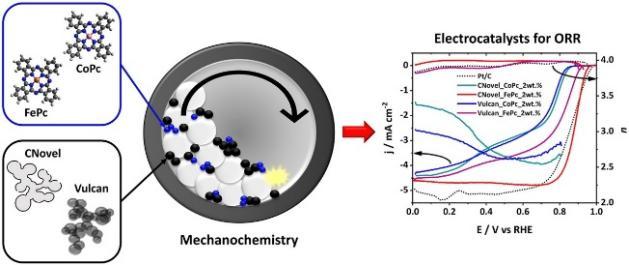
Trigueros-Sancho et al.[43]adopted a simple and direct solvent-free ball-milling method to prepare CoPc- and FePc-supported electrocatalysts using either porous carbon (CNovel) or carbon black as carriers (Figure 9). Compared to carbon black, CNovel possesses superior nanostructure and surface chemical properties, allowing for better dispersion of metal phthalocyanine complexes (MPc) on its surface. The CNovel-supported FePc exhibits excellent oxygen reduction reaction performance in alkaline media, with an E 1/2of up to 0.86 V vs RHE, outperforming the FePc catalyst supported on carbon black (0.83 V vs RHE). The electron transfer number of the CNovel-supported FePc catalyst is 3.99, demonstrating good selectivity.
图9 CNovel和炭黑球磨的金属酞菁配合物催化剂制备示意图及其催化ORR LSV和转移电子数[43]

Fig.9 Schematic diagram of the preparation of metal phthalocyanine complex catalysts by CNovel and carbon black ball grinding, as well as the number of ORR LSV catalyzed and transferred electrons [43]

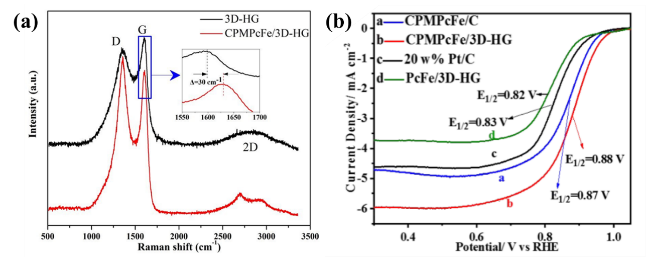
Liu et al[44]prepared two-dimensional densely packed amide phthalocyanine iron (CPMPcFe) loaded on three-dimensional hierarchical graphene (3D-HG). CPMPcFe/3D-HG exhibits a microporous and mesoporous graphene structure, with CPMPcFe uniformly distributed on both the internal and external surfaces of 3D-HG. Due to the strong π-π interactions between CPMPcFe and 3D-HG (Figure 10a),this enhances catalytic activity and durability. Under alkaline conditions, CPMPcFe/3D-HG catalyzes ORR with an E 1/2of 0.88 (V vs RHE) (Figure 10b), and the number of electron transfers for CPMPcFe/3D-HG is 3.99 at 0.6 (V vs RHE). The 3D-HG structure contributes to the excellent durability of CPMPcFe/3D-HG, and aberration-corrected electron microscopy confirms that this catalyst is a single-atom catalyst.
图10 (a)载体与催化剂的拉曼光谱;(b)催化剂的 LSV 曲线[44]

Fig.10 (a) Raman spectra of the carrier and catalyst; (b) LSV curve of catalyst[44]

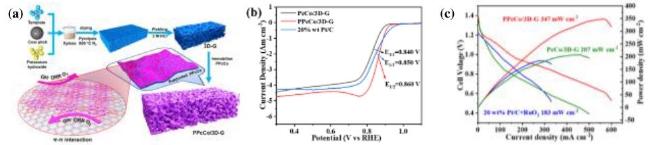
Wang et al[45]prepared polymerized cobalt phthalocyanine by solid-phase method, adjusted the polymerization degree by varying the reaction time, and immobilized it onto the surface of three-dimensional graphene via impregnation, yielding a bifunctional oxygen catalyst PPcCo/3D-G (Figure 11(a)). The PPcCo/3D-G catalyst exhibits excellent oxygen reduction reaction performance (E 1/2=0.86 V vs RHE) (Figure 11b). They used Gaussian16 (G16 A.01) to simulate the HOMO-LUMO bandgap of monocycle-PcCo (m-PcCo) and double-PcCo (d-PcCo), respectively. The energy gap between the HOMO and LUMO of m-PcCo was 2.227 eV, while that of d-PcCo was 1.794 eV. The lower energy required for electron transitions in d-PPcCo compared to m-PcCo indicates that d-PPcCo has a smaller bandgap, making it easier to lose or gain electrons, thus effectively catalyzing ORR and OER. The zinc-air battery (ZAB) using PPcCo/3D-G as the cathode catalyst demonstrates a high power density (347 mW/cm2), specific capacity (776 mAh/g), reduced charge-discharge polarization, and remarkable long-term stability (Figure 11c).
图11 (a)三维石墨烯(3D-G)以及聚合酞菁钴催化剂(PPcCo/3D-G)的制备示意图;(b)ORR LSV 曲线;(c)ZABs的峰功率[45]

Fig.11 (a) Schematic diagram of the preparation of three-dimensional graphene (3D-G) and polymerized cobalt phthalocyanine catalyst (PPcCo/3D-G); (b) ORR LSV curve; (c) Peak power of ZABs[45]

In summary, three-dimensional graphene, with its intrinsic graphene properties and hierarchical pore structure, is the optimal choice as a support for planar polymerized metal phthalocyanine complexes. This is particularly beneficial for enhancing the catalytic oxygen reaction performance of phthalocyanine-based catalysts, primarily due to the following reasons: (1) The abundant porous structure and high specific surface area of three-dimensional graphene enable better dispersion and immobilization of phthalocyanine complexes on its surface, increasing the number of active sites and enhancing the contact opportunities between the catalyst and reactants, thereby improving the efficiency of the catalytic oxygen reaction; (2) The porous structure of three-dimensional graphene can enhance mass transfer efficiency; (3) Graphene itself possesses excellent electronic conductivity, and when combined with phthalocyanine complexes, it allows for rapid electron transfer through graphene's electronic network, facilitating the electron transfer process in catalytic oxygen reactions and thus improving catalytic performance; (4) The face-to-face contact between 3D-G and polymerized metal phthalocyanine complexes results in strong π-π interactions between molecules, further enhancing the catalyst's bifunctional catalytic performance and durability.

3.3 The Influence of Central Metal Ions on the Catalytic Performance of Polymeric Metal Phthalocyanine Catalysts

Among all transition metal ions, more than 70 types of transition metal ions can coordinate with the phthalocyanine ring[46,47]. The center of metal-free phthalocyanine contains two hydrogen atoms, which can be replaced by metal and metalloid cations. Many divalent metal cations can coordinate at the center of the phthalocyanine macrocycle to form complexes, as illustrated in Figure 12. Some larger divalent ions, such as Pb2+, cannot fully fit within the cavity and are located out of the plane, while metal ions like Lu3+, Eu3+, and Ho3+form sandwich structures.
图12 无配位金属与配位金属的模型图

Fig.12 Model diagram of uncoordinated metal and coordinated metal

The most commonly studied metal ions in electrocatalytic centers are transition metal ions such as Fe2+, Co2+, Mn2+, and Ni2+, which can coordinate well within the phthalocyanine ring and exhibit excellent catalytic activity for ORR[48,49].
Singh et al.[26]immobilized metal phthalocyanine complexes with different coordination (MPc, where M = Mn, Fe, Co, Ni, Cu, and Zn) onto porous carbon nitride materials (MCN). The electrocatalytic oxygen reduction reaction of MPc@MCN catalysts with different metal coordinations was tested in 0.1 mol/L KOH and 0.5 mol/L H2SO4. The results showed that in 0.1 mol/L KOH, the ORR activity of FePc@MCN and CoPc@MCN catalysts was higher than that of other metal-coordinated MPc@MCN catalysts. The number of transferred electrons for ORR catalyzed by FePc@MCN was close to 4e-, and it was higher than that of several MPc composites with carbon supports tested under similar conditions.
Duan et al.[50]prepared a planar polymerized phthalocyanine manganese (PPcMn). Thermogravimetric analysis confirmed that PPcMn remains stable without decomposition at 400 ℃, demonstrating excellent thermal stability. The prepared PPcMn was immobilized onto 3D-G and subjected to high-temperature treatment at 400 ℃, yielding PPcMn/3D-G. Solid-state UV and Raman spectroscopy revealed a red shift in the absorption peaks, indicating π-π interactions between PPcMn and 3D-G. Under 0.1 mol/L KOH conditions, the catalytic ORR E 1/2of PPcMn/3D-G was 0.863 V vs RHE. The total overpotential of PPcMn/3D-G (ΔE=Ej =10-E 1/2) was 0.77 V. DFT results indicated that PPcMn has a lower HOMO-LUMO bandgap, thus possessing strong electron-donating and -accepting capabilities. Furthermore, calculations on the catalytic ORR reaction intermediates of PPcMn demonstrated a low reaction energy barrier, suggesting superior ORR catalytic performance. Antioxidant tests showed that PPcMn/3D-G does not undergo metal leaching under acidic conditions. PPcMn/3D-G catalyzes the direct conversion of H2O2into H2O without generating hydroxyl radicals. Therefore, PPcMn/3D-G is an excellent catalyst that does not induce Fenton reactions.
By comparison, the Fe-coordinated CPMPcFe/3D-HG exhibits superior catalytic ORR activity (E 1/2=0.880 V vs RHE). This is primarily due to the presence of Fe, which endows the M-N4center with favorable adsorption energy, thereby further enhancing its catalytic performance.
How does the catalytic performance of polymer phthalocyanine complexes change when two different transition metal ions are present simultaneously? Is there a synergistic effect? To address this question, our research group prepared a polymerized bimetallic iron-cobalt phthalocyanine complex with Fe and Co co-coordinated (Fe∶Co=1∶1) (PPcFeCo) (Figure 13a), and investigated the synergistic effect between Fe and Co[51]. First, density functional theory (DFT) calculations were used to confirm the bimetallic synergistic effect of Fe-N4 and Co-N4 in PPcFeCo (Figure 13b, Figure 13c). This synergistic interaction alters the original d-orbital energy levels of Fe and Co atoms, thereby influencing their adsorption energies toward substrates and endowing PPcFeCo/3D-G with superior catalytic activity.
图13 (a)聚合酞菁Fe/Co催化剂示意图;(b)中间体的吸附能;(c)中间体吸附能与动力学活性的关系;(d)ORR LSV[51]

Fig.13 (a) Schematic diagram of bimetallic polymerized phthalocyanine Fe/Co catalyst; (b) The adsorption energy of the intermediate; (c) The relationship between adsorption energy of intermediate and kinetic activity; (d) ORR LSV[51]

The changes in the d-orbital energy levels of Fe and Co enable PPcFeCo to exhibit an appropriate adsorption strength for substrates and intermediates in the oxygen reduction reaction, thereby enhancing the catalytic performance of PPcFeCo/3D-G. Through catalytic ORR performance tests on PPcFeCo/3D-G, it was found that under alkaline conditions, the E 1/2of PPcFeCo/3D-G for catalyzing ORR is 0.890 V vs RHE, which is higher than that of PcFe/3D-G and PcCo/3D-G (Figure 13d). Therefore, it can be demonstrated that the synergistic effect between Fe and Co in PPcFeCo/3D-G can further enhance its catalytic performance.
The bifunctional catalytic performance of polymerized phthalocyanine complexes with different metal ions in oxygen reduction reactions was compared, as shown in Table 1. As clearly demonstrated in Table 1, the bifunctional catalytic performance for oxygen reduction reactions of most bimetallic coordinated polymerized metal phthalocyanine catalysts is superior to that of monometallic coordinated polymerized metal phthalocyanine catalysts. This indicates that synergistic effects exist in polymerized bimetallic phthalocyanine catalysts, which can further enhance their catalytic performance in oxygen reduction reactions.
表1 不同金属离子的聚合酞菁配合物类催化氧反应双功能性能对比[45,50,51,56-60]

Table 1 Comparison of bifunctional catalytic oxygen performance of polymerized phthalocyanine complexes of different metal ions[45,50,51,56-60]

Catalyst ORR E1/2
(V vs RHE)
OER Ej=10
(V vs RHE)
ΔE (V)
PPcCo/3D-G 0.86 1.64 0.78
PPcMn/3D-G 0.86 1.63 0.77
PPcFeCo/3D-G 0.89 1.59 0.70
CoPc-SO3H/CNT 0.88 1.62 0.74
FePPc@CB 0.90 1.588 0.68
CNT@Co2-Fe1/FePc 0.86 1.57 0.71
Co/Fe-TPDA-CP 0.87 1.57 0.69
FeCo-LDH||FePc/rGO 0.92 1.56 0.64
The central metal ion is the catalytic active center of the catalyst, and its type significantly influences the performance of polymerized metal phthalocyanine complex catalysts.
The catalytic mechanism of aggregated metal phthalocyanine catalysts involves the interaction between the d-orbitals of central metal ions (such as Fe2+and Co2+) and the π* orbitals of oxygen molecules, which lowers the energy barrier for O―O bond cleavage and promotes the direct conversion of O2into H2O, thereby avoiding the formation of byproducts such as H2O2. Additionally, the energy levels of the d-orbitals of the central metal ions determine the adsorption strength of reaction intermediates. In metal phthalocyanines, the coupling of the d-orbitals of the metal ions with the 2p orbitals of oxygen places the adsorption energy within an optimal range, reducing overpotential[52-55].
When two different transition metal ions coexist in a metal phthalocyanine complex, a synergistic effect is produced. The synergy between the two metals can alter the original d-orbital energy levels of the metal atoms, thereby optimizing the adsorption energy of the substrate. An appropriate adsorption energy enables the catalyst to more effectively bind with and separate from the reactants during catalytic reactions, significantly enhancing its catalytic oxygen reaction performance.

3.4 The Effect of Edge Group Modification on the Catalytic Performance of Metal Phthalocyanine Complex Catalysts

The catalytic performance of metal phthalocyanine complex catalysts can also be regulated by the electron-donating and electron-withdrawing properties of groups at the edges of the phthalocyanine ring. These substituents include alkyl, aryl, heteroaryl, halogen, thiol, amine, ether, or other groups.
However, for single-ring metal phthalocyanine complexes, although adding appropriate groups to the edges of the metal phthalocyanine ring can significantly enhance their solubility in organic solvents, these complexes decompose during catalyst preparation (HT activation), causing the edge-modifying groups to thermally degrade and be lost. Therefore, studying the effects of edge-modifying groups on single-ring metal phthalocyanine complexes is meaningless.
Xie et al.[61]prepared polymerized phthalocyanine COFs modified with ―CH2NH2, ―COOH, and ―CN using piperazine and NiPc[NH2]8. The structure is shown in Figure 14a. The results indicate that the introduction of the strong electron-donating group ―CH2NH2 significantly enhances its catalytic activity and selectivity for CO2 RR (Figure 14b).
图14 (a)—CH2NH2修饰的聚合酞菁结构式;(b) CO2RR的法拉第效率图;(c)自由能图[61]

Fig.14 (a) —CH2NH2 modified polymer phthalocyanine structure formula; (b) Faraday efficiency diagram of CO2RR; (c) Free energy diagram[61]

A comparison was made between COFs with strongly electron-donating groups —CH2NH2and electron-withdrawing groups (—CN, —COOH). DFT results indicated that the electron-donating group (—CH2NH2) not only reduced the surface work function of the COF but also enhanced the adsorption energy of reaction intermediates. The introduction of the electron-donating group further increased the electron cloud density of the Ni-N4center, thereby reducing catalytic performance (Figure 14c). Thus, it is evident that strongly electron-donating groups at the edges can enhance the catalytic performance of metal phthalocyanine complex catalysts.
Due to the similar structures of porphyrins and phthalocyanines, our research group prepared a poly(1,4-azobenzene porphyrin cobalt) COF with different electron-donating/electron-withdrawing groups modified at the edges (Fig. 15a)[62]. Studies have shown that A-PpazoPorCo with strong electron-donating -ph-NH2 groups at the edges exhibits the best catalytic oxygen reaction performance (E1/2 = 0.88 V vs RHE, catalytic OER Ej=10 = 1.467 V vs RHE, △E = 0.617 V) (Fig. 15b, Fig. 15c). Density functional theory (DFT) calculations indicate that the strong electron-donating -ph-NH2 groups further enhance the electron cloud density of the catalytic active center Co-N4 in A-PpazoPorCo, thereby improving its catalytic performance[63,64]. The highly efficient oxygen catalytic performance suggests that A-PpazoPorCo/3D-G has potential applications in fuel cell cathodes and overall water splitting anodes.
图15 (a)A-PpazoPorCo的结构式[62];(b)ORR LSV曲线;(c)OER LSV曲线

Fig.15 (a) Structural formula of A-PpazoPorco[62]; (b) ORR LSV curve; (c) OER LSV curve

In addition, fully conjugated porphyrin-based COFs linked via Schiff base groups[63]and benzimidazole groups[64]exhibit excellent bifunctional catalytic performance for oxygen reactions. Furthermore, COF catalysts of polymerized porphyrin-manganese prepared using nitrogen-doped three-dimensional graphene as a support can significantly enhance catalytic performance due to the formation of Mn-N5catalytic centers[65].
The edge-group substituents of polymeric metal phthalocyanine rings play a role in regulating the electron cloud density of the polymeric metal phthalocyanine complex. In fully conjugated polymeric metal phthalocyanine complexes, the presence of large π-bonds within the molecule enhances thermal stability, allowing the molecular structure to remain intact during the HT process without decomposition. Therefore, the edge-modifying groups can regulate the electron cloud density at the catalytic active center. Studies have found that strong electron-donating groups can significantly increase the electron cloud density at the catalytic active center of polymeric metal phthalocyanine complexes, while electron-withdrawing groups reduce it. For example, polymeric metal phthalocyanines modified with ―CH2NH2and ―ph―NH2exhibit significantly enhanced catalytic performance. This finding provides a feasible approach for optimizing catalyst performance through chemical modification. Certain groups, such as N ̿        N, can further enhance the adsorption capacity of polymeric metal phthalocyanine complexes toward oxygen reaction intermediates, thereby further improving their bifunctional catalytic performance in oxygen reactions.
Currently, the hotspots in catalyst research include new in-situ characterization methods, the application of modern instrumental techniques, and precise quantitative calculations. The use of synchrotron radiation technology and aberration-corrected electron microscopy, commonly employed in single-atom catalyst research, is highly significant. Synchrotron radiation is widely applicable for confirming the local structural environment of metal atoms in single-atom catalysts, playing a crucial role in identifying catalytic active sites, especially for catalysts with unclear active centers such as metal clusters. It should be noted that, when studying metal-nitrogen-carbon cluster catalysts, synchrotron radiation typically uses metal phthalocyanine as a standard reference material for comparative studies; this is a well-known compound characterized by the M-N4structure. However, for fully conjugated polymer metal phthalocyanine COF catalysts, since their molecular structure remains intact during the preparation and activation processes, their catalytic active centers have a very clear structure, specifically the M-N4configuration present in the original polymerized metal phthalocyanine molecules. Therefore, synchrotron radiation is not particularly important in studying these catalysts as single-atom catalysts. The same principle applies to the use of aberration-corrected electron microscopy, as these catalysts can already be confirmed as single-atom catalysts, making further electron microscopy analysis less meaningful.

4 Conclusion

This article primarily reviews the preparation methods of metal phthalocyanine complexes and their catalysts, several structural forms of polymerized metal phthalocyanine complexes, and the influence of their structures on catalytic performance. Fully conjugated metal phthalocyanine covalent organic frameworks (COFs) possess a larger π-bond structure, resulting in greater delocalization energy of π electrons, thereby enhancing their thermal stability and bifunctional oxygen reaction performance. To address the issue of poor electrical conductivity in metal phthalocyanine complexes, they can be immobilized onto carbon materials to fabricate catalysts. Results indicate that catalysts supported by three-dimensional graphene exhibit superior catalytic performance, mainly because the unique three-dimensional graphene structure not only facilitates strong π-π interactions between its large graphene π bonds and the large π bonds of polymerized phthalocyanine, thus improving bifunctional oxygen reaction performance and durability, but also provides more pores and surface area through its three-dimensional architecture, enhancing mass transfer efficiency. Regarding the influence of central metal ions, catalysts with Fe2+, Co2+, Mn2+, and other central metal ions demonstrate excellent catalytic performance. Additionally, catalysts containing two types of transition metal ions can produce a synergistic effect, further enhancing their bifunctional oxygen reaction performance. For fully conjugated polymerized metal phthalocyanine rings, electron-donating or electron-withdrawing groups at the ring edges can regulate electrocatalytic performance; electron-donating groups increase the electron cloud density around the M-N4center, thereby improving bifunctional oxygen reaction performance.
In summary, through the study of preparation methods and influencing factors, theoretical basis and guidance have been provided for developing highly efficient all-conjugated metal phthalocyanine complex catalysts, which will help promote their application in catalytic oxygenation reactions.
[1]
Duan W J, Wang C, Sun P, Sun Y G, Zhuang Y Q, Wang J G, Li Z F. ACS Appl. Nano Mater., 2023, 6(18): 16662.

[2]
Liu Y P, Duan W J, Pei H C, Sun P, Sun Y G, Zhuang Y Q, Li Z F. ACS Appl. Energy Mater., 2023, 6(13): 7194.

[3]
Wu Q, Xie R K, Mao M J, Chai G L, Yi J D, Zhao S S, Huang Y B, Cao R. ACS Energy Lett., 2020, 5(3): 1005.

[4]
Chen Y Q, Xia M Q, Zhou C, Zhang Y, Zhou C K, Xu F F, Feng B, Wang X Z, Yang L J, Hu Z, Wu Q. ACS Nano, 2023, 17(21): 22095.

[5]
Li C, Homberg J, Weismann A, Berndt R. ACS Nano, 2022, 16(10): 16987.

[6]
Li R S, Fan W J, Rao P, Luo J M, Li J, Deng P L, Wu D X, Huang W, Jia C M, Liu Z X, Miao Z P, Tian X L. ACS Nano, 2023, 17(18): 18128.

[7]
Zhang M, Liao J P, Li R H, Sun S N, Lu M, Dong L Z, Huang P, Li S L, Cai Y P, Lan Y Q. Natl. Sci. Rev., 2023, 10(11): 226.

[8]
Sheng J, Sun S D, Jia G D, Zhu S, Li Y. ACS Nano, 2022, 16(10): 15994.

[9]
Ding L G, Wang S, Yao B J, Li F, Li Y A, Zhao G Y, Dong Y B. Adv. Healthc. Mater., 2021, 10(8): 2001821.

[10]
Mei Z Y, Cai S, Zhao G F, Zou X X, Fu Y, Jiang J W, An Q, Li M, Liu T T, Guo H. Chem. Eng. J., 2022, 430: 132691.

[11]
Zhang Z, Wang W W, Wang X N, Zhang L, Cheng C, Liu X K. Chem. Eng. J., 2022, 435: 133872.

[12]
Kumar A, Sun K, Duan X X, Tian S B, Sun X M. Chem. Mater., 2022, 34(12): 5598.

[13]
Oliveira R C P, Milikić J, Daş E, Yurtcan A B, Santos D M F, Šljukić B. Appl. Catal. B Environ., 2018, 238: 454.

[14]
Chen H, Li Q H, Yan W S, Gu Z G, Zhang J. Chem. Eng. J., 2020, 401: 126149.

[15]
Miao Q Y, Lu C B, Xu Q, Yang S, Liu M H, Liu S J, Yu C B, Zhuang X D, Jiang Z, Zeng G F. Chem. Eng. J., 2022, 450: 138427.

[16]
Sharma M, Jalalah M, Alsareii S A, Harraz F A, Xue W, Thakur N, Salama E S, Li X K. Chem. Eng. J., 2024, 479: 147431.

[17]
Ranjeesh K C, Illathvalappil R, Veer S D, Peter J, Wakchaure V C, Goudappagouda, Raj K V, Kurungot S, Babu S S. J. Am. Chem. Soc., 2019, 141(38): 14950.

[18]
Wang Y, Wang M Y, Zhang Z S, Wang Q, Jiang Z, Lucero M, Zhang X, Li X X, Gu M, Feng Z X, Liang Y Y. ACS Catal., 2019, 9(7): 6252.

[19]
Li M Z, Hu Q K, Shan H Q, Yu W J, Xu Z X. Chemosphere, 2021, 263: 128250.

[20]
Wang S Y, Yang H Y, Liang X, Ren Y X, Ma H Z, Zhu Z, Wang J Y, Zeng S Q, Song S Q, Wang X R, Han Y, He G W, Jiang Z Y. Adv. Funct. Mater., 2023, 33(24): 2300386.

[21]
Altundal O F, Altintas C, Keskin S. J. Mater. Chem. A, 2020, 8(29): 14609.

[22]
Zhou Y Z, Lu R H, Tao X F, Qiu Z J, Chen G B, Yang J, Zhao Y, Feng X L, Müllen K. J. Am. Chem. Soc., 2023, 145(6): 3647.

[23]
Sun H X, Zhou P L, Ye X Y, Wang J J, Tian Z Y, Zhu Z Q, Ma C H, Liang W D, Li A. J. Colloid Interface Sci., 2022, 617: 11.

[24]
Yang S X, Yu Y H, Gao X J, Zhang Z P, Wang F. Chem. Soc. Rev., 2021, 50(23): 12985.

[25]
Huang S S, Chen K, Li T T. Coord. Chem. Rev., 2022, 464: 214563.

[26]
Singh D K, Ganesan V, Yadav D K, Yadav M. Langmuir, 2020, 36(41): 12202.

[27]
Sun Y G, Zhang T W, Sun P, Wang J G, Duan W J, Zhuang Y Q, Wang L K, Li Z F. J. Energy Chem., 2024, 94: 778.

[28]
Fan H W, Xie Y F, Li J C, Zhang L, Zheng Q Y, Zhang G J. J. Mater. Chem. A, 2018, 6(36): 17602.

[29]
Wang Y H, Zhao J Y, Zhang S, Zhang Z M, Zhu Z T, Wang M D, Lyu B H, He G W, Pan F S, Jiang Z Y. Mater. Horiz., 2023, 10(11): 5016.

[30]
Wang Q Q, Ma X Y, You W, Ma P C, Bi R, Song S Y, Chen F, Qu F J, Wang X L, Liu P F. Chem. Eng. J., 2024, 482: 148712.

[31]
Yang C, Hou L X, Zhao J J, Yao Z K, Li G, Zhang L, Hou L A. Chem. Eng. J., 2022, 428: 131124.

[32]
Zhu L Y, Ye P, Zhang L M, Ren Y T, Liu J, Lei J D, Wang L Y. Small, 2024, 20(3): 2304575.

[33]
Zhang C L, Xiao T L, He J W, Lu B X, Li X J, Zhai J, Fan X. Small, 2023, 19(37): 2301512.

[34]
Li Z F, Yao F S, Wang S W, Yu R J, Wang J. CN1276918C, 2006

( 李忠芳, 姚福生, 王素文, 于如军, 王捷. CN1276918C, 2006 )

[35]
Li Z F, Wang S W, Wang X T, Zhang Y, Yu X J. CN101327451, 2012

( 李忠芳, 王素文, 王旭涛, 张燕, 于先进. CN101327451, 2012 )

[36]
Sun C, Li Z, Zhong X, Wang S, Yin X, Wang L. J. Electrochem. Soc., 2018, 165(2): F24.

[37]
Xu G F, Li Z F, Wang S W, Yu X J. J. Power Sources, 2010, 195(15): 4731.

[38]
Li Z F, Yang J W, Xu G F, Wang S W. J. Power Sources, 2013, 242: 157.

[39]
Sun C Y, Li Z F, Yang J W, Wang S W, Zhong X Z, Wang L K. Catal. Today, 2020, 353: 279.

[40]
Mi C X Yu, H F Han, L K, Zhang L, Zhai, L L Li, X L Liu, Y J, Xiang, Z H. Adv. Funct. Mater., 2023, 33(36): 2303235.

[41]
Kumar A, Yasin G, Tabish M, Kumar Das D, Ajmal S, Kumar Nadda A, Zhang G X, Maiyalagan T, Saad A, Gupta R K, Makhlouf M M, Ibraheem S. Chem. Eng. J., 2022, 445: 136784.

[42]
Chen Y H, Xu J J, He P, Qiao Y, Guo S H, Yang H J, Zhou H S. Sci. Bull., 2022, 67(23): 2449.

[43]
Trigueros-Sancho A, Martínez-Sánchez B, Cazorla-Amorós D, Morallón E. Carbon, 2023, 211: 118100.

[44]
Liu Y P, Li Z F, Sun C Y, Wang S F, Wang L K, Niu X L, Sun P, Zhang S Z. Sustain. Energy Fuels, 2021, 5(20): 5216.

[45]
Wang S F, Sun P, Li N, Wang J G, Zhang L, Duan W J, Li Z F. J. Power Sources, 2023, 556: 232471.

[46]
Yang X H, Lan X W, Zhang Y Z, Li H S, Bai G Y. Appl. Catal. B Environ., 2023, 325: 122393.

[47]
Li Z H, Liu Y Y, Zou S Y, Lu C B, Bai H, Mu H B, Duan J Y. Chem. Eng. J., 2020, 382: 123008.

[48]
Wang S C, Zhang M Y, Mu X Q, Liu S L, Wang D S, Dai Z H. Energy Environ. Sci., 2024, 17(14): 4847.

[49]
Wang R Y, Liu Q Q, Peng Q, Yang X Y, Zhao H W, Fan H, Liu H, Cao X X. Eur. Polym. J., 2022, 175: 111359.

[50]
Duan W J, Sun Y G, Li Z F, Sun P, Zhuang Y Q, Zhi X L. ACS Appl. Nano Mater., 2024, 7(21): 24833.

[51]
Wang S F, Li Z F, Duan W J, Sun P, Wang J G, Liu Q, Zhang L, Zhuang Y Q. J. Energy Chem., 2023, 86: 41.

[52]
Rong J X, Xu Q, Han J W, Ren K, Zhang J, Zhao X, She P, Qin J S, Rao H. Chem. Eng. J., 2025, 507: 160814.

[53]
Wang Y Q, Feng Y, Wang X, Wang D. J. Energy Chem., 2024, 98: 144.

[54]
Acuña-Saavedra L, Méndez-Torres A M, Cárdenas-Jirón G, Oñate R, Sánchez-Allende B, Venegas R, Bernal R, Melo F, Imbarack E, Zagal J H, Ponce I. ACS Catal., 2025, 15(2): 719.

[55]
Qian Z X, Zeng J S, Zhao S, Zheng Q N, Tian J H, Xu Q C, Zhang H, Li J F. Nano Mater. Sci., 2024, DOI:10.1016/j.nanoms.2024.03.006.

[56]
Xie P F, Hu H, Fang L Z, Yu X H, Rong J, Qiu X Y, Wu F, Li T, Shao M H, Li J C. Chem. Eng. J., 2024, 494: 152909.

[57]
Li W J, Ye Q M, Chen W M, Ouyang Y G, Liu R Y, Yu J S, Zhuo H Y, Zhang Y X, Chen Y L. Mol. Catal., 2024, 568: 114509.

[58]
Zhao Y X, Liu J X, Zhang T, Liu F X, Zheng M, Shi K, Liu J P, Zhang Y F, Wang H. Colloids Surf. A Physicochem. Eng. Aspects, 2024, 684: 133093.

[59]
Cheng W Z, Liang J L, Yin H B, Wang Y J, Yan W F, Zhang J N. Rare Met., 2020, 39(7): 815.

[60]
Li C, Huang T X, Huang Z D, Sun J P, Zong C, Yang J G, Deng W A, Dai F N. Dalton Trans., 2019, 48(46): 17258.

[61]
Xie T, Chen S, Yue Y, Sheng T, Huang N, Xiong Y J. Angew. Chem. Int. Ed., 2024: e202411188.

[62]
Zhuang Y Q, Sun Y G, Wang L K, Sun P, Wang J G, Zhang P H, Li Z F. J. Energy Chem., 2025, 104: 214.

[63]
Sun Y G, Sun P, Wang J G, Zhuang Y Q, Wang L K, Li A, Li Z F. Nano research, 2025, 18: 94907789.

[64]
Sun Y G, Duan W J, Wang J G, Sun P, Zhuang Y Q, Li Z F. Chem. Sci., 2025, 16(22): 9951.

[65]
Sun Y G, Sun P, Wang J G, Zhuang Y Q, Wu Y N, Li Z F. J. Colloid Interface Sci., 2025, 686: 711.

Outlines

/