Home Journals Progress in Chemistry
Progress in Chemistry

Abbreviation (ISO4): Prog Chem      Editor in chief: Jincai ZHAO

About  /  Aim & scope  /  Editorial board  /  Indexed  /  Contact  / 
Review

The Application of Metal Organic Frameworks in Battery Electrodes

  • Chen Jiayao ,
  • Xiao Pengcheng ,
  • Nie Saiqun ,
  • Luo Fuli ,
  • Zhao Tian , * ,
  • Chen Yi , *
Expand
  • School of Materials Science and Engineering,Hunan University of Technology,Zhuzhou 412007,China
*(Tian Zhao);
(Yi Chen)

Received date: 2025-03-03

  Revised date: 2025-04-28

  Online published: 2025-09-01

Supported by

The National Natural Science Foundation of China(51802094)

The Natural Science Foundation of Hunan Province(2024JJ7164)

Abstract

As environmental challenges continue to escalate, the importance of energy storage development has never been greater. The design and advancement of high-performance batteries are now essential to meet the demands of modern society. However, existing battery substrates are inadequate for the production of next-generation batteries. Metal-Organic Frameworks (MOFs) have emerged as a novel class of multifunctional materials that offer significant advantages as battery substrates, including high specific surface area, exceptional porosity, and customizable properties. This review comprehensively examines the applications of various MOF substrates in the field of battery electrodes, and delves into innovative application strategies, challenges and outlines future development prospects for MOF electrode substrates, emphasizing their transformative potential in enhancing electrode performance, paving the way for their integration into sustainable energy solutions.

Contents

1 Introduction

2 Pure MOFs electrode material

3 MOFs composite electrode materials

4 MOFs derivatives and their composite electrode materials

5 Conclusion and outlook

Cite this article

Chen Jiayao , Xiao Pengcheng , Nie Saiqun , Luo Fuli , Zhao Tian , Chen Yi . The Application of Metal Organic Frameworks in Battery Electrodes[J]. Progress in Chemistry, 2025 , 37(9) : 1301 -1320 . DOI: 10.7536/PC20250301

1 Introduction

In recent years, with the continuous growth of the economy and people's demands, coupled with the increasingly severe issues of resource scarcity and environmental degradation, the development and upgrading of renewable energy storage systems and conversion technologies have gained sustained momentum. How to effectively enhance the performance of existing energy storage devices to achieve environmental sustainability has become a key area of focus for society and relevant researchers at this stage[1-2].
Currently, among sustainable energy storage systems, rechargeable batteries have attracted significant attention due to their wide range of applications and outstanding environmental and economic benefits, becoming an indispensable part of the energy storage field. Rechargeable lithium-ion batteries (LIBs) have rapidly developed because of their high specific energy, operational potential, long cycle life, fast charge-discharge rates, and environmental friendliness, making them one of the most widely used energy storage devices in portable electronic equipment[3-4]. Although LIBs have achieved remarkable results in performance and application, their sustainable development is challenged by the scarcity and high cost of lithium resources. In contrast, alkali metals sodium (Na) and potassium (K), with chemical properties similar to lithium and advantages such as abundant resources and lower costs, make sodium-ion batteries (SIBs) and potassium-ion batteries (KIBs) promising alternatives to LIBs[5-6]. Zinc-ion batteries (ZIBs), owing to their high theoretical capacity, excellent safety, high environmental sustainability, low cost, and simple assembly process, have recently gained widespread attention and become a hot topic in the energy storage field[7-8]. Meanwhile, elemental sulfur, with its abundant sources, low production costs, and environmental friendliness, makes lithium-sulfur batteries (LSBs) a promising candidate for next-generation energy storage devices[9-10]. Despite the significant advantages of rechargeable batteries and their widespread use in many applications, they still face numerous challenges, including insufficient energy density, low charge-discharge rates, limited cycle life, safety concerns, environmental pollution, and cost issues[11]. As an important component of batteries, the quality of electrode materials largely determines the electrochemical performance of batteries. Exploring new electrode materials and innovative technologies will be key to the future development of battery energy storage[12].
Most battery (LIB, SIB, KIB, ZIB, LSB) electrode materials primarily operate through the insertion/extraction of ions, or by alloying and multiple redox conversion reactions of the electrode materials to store and release energy. Due to the fixed compositional structure of most existing electrode materials, their mechanisms of action are relatively simple, which to some extent limits the improvement of their performance[13-14]. In contrast, the highly tunable pore structure of metal-organic framework materials (MOFs) can effectively alleviate the volume expansion of electrode materials caused by the insertion/extraction of conductive ions. Moreover, their multivalent metal centers, high specific surface area, rich chemical composition, and versatile modification strategies enable MOF-based materials to achieve theoretical capacities equal to or even exceeding those of existing high-capacity electrode materials (such as silicon). Additionally, after high-temperature pyrolysis or modified composite treatment, MOFs can combine the flexibility of soft carbon materials with the high redox-active sites of nanoparticles. This unique and abundant chemical composition allows them to synergistically integrate multiple electrode mechanisms, significantly enhancing battery performance[15-17]. Considering the larger ionic radii and varying electrochemical potentials of Na+, K+, and Zn2+[18-22], the highly tunable porous structure, designable framework, and diverse modification strategies of MOFs meet the requirements of SIB, KIB, and ZIB electrode materials for ion insertion/extraction capability, mechanical stability, and adaptability to large volume changes. Furthermore, traditional LSB electrode materials commonly suffer from low electrical conductivity, frequent polysulfide shuttle effects, and irreversible destructive volume changes[23-24]. The adjustable "smart" pore structure of MOFs and their Lewis acid-base interactions with polar polysulfide components can effectively address these issues, increasing the sulfur loading capacity and volume change adaptability of electrode materials, thereby significantly mitigating the polysulfide shuttle effect.
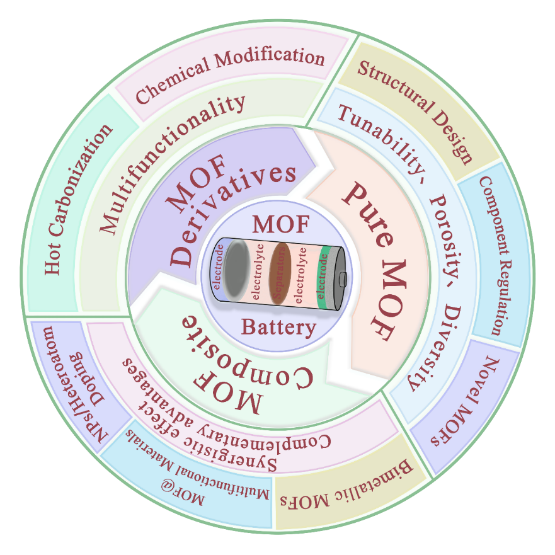
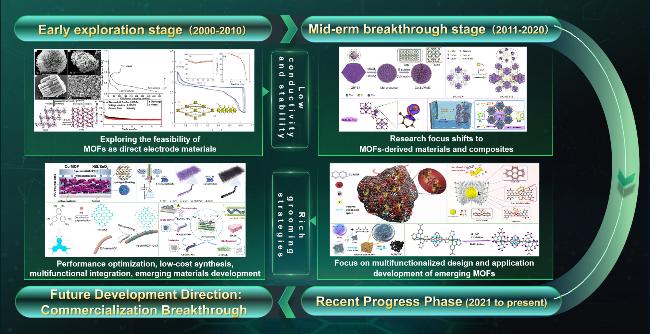
Although MOFs have demonstrated great potential in the field of batteries, their inherent defects still limit the application of pristine MOFs. To address this limitation, various innovative strategies for designing and applying MOFs have been proposed in recent years[25-30](Scheme 1). For example, MOFs can be combined with other multifunctional materials to form MOF composites; or they can be modified and subjected to thermal treatment to serve as self-sacrificing templates, selectively preserving relevant metal sites and generating diversified functional MOF derivatives and their composites. These strategies effectively circumvent the defects of MOFs while preserving their original morphology and properties, allowing for the selective adjustment and optimization of their structure and function, thus enabling the preparation of high-performance MOF-based electrode materials (Figure 1illustrates the development history of MOF-based electrode materials).
图式1 MOF 基电池电极材料应用策略的示意图

Scheme 1 Schematic application strategy for MOF materials for batteries

图1 MOF 基电池电极材料的发展历程图

Fig.1 Development history of MOF-based battery electrode materials

Currently, although numerous large-scale reviews have emerged on the applications of MOFs in various fields such as batteries, supercapacitors, adsorption, and electrocatalysis, these reviews generally suffer from a broad scope and insufficient depth of discussion for each specific area, easily leading readers to experience knowledge confusion after reading[31-34].This article summarizes and discusses the latest research progress of MOF-based materials (pure MOFs, MOF composites, MOF derivatives, and their composites) in various battery electrode fields, with a particular focus on the advantages, disadvantages, and modification strategies of MOFs in each battery electrode application. Finally, this article also highlights the challenges, solutions, and future development directions of MOF-based materials in the electrode field, aiming to provide valuable references for researchers in this area.

2 Pure MOFs electrode materials

In recent years, pure MOFs have garnered widespread attention in the field of battery electrodes due to their outstanding structural advantages and functional characteristics, emerging as a novel material directly applicable to battery electrode applications. The use of pure MOFs as LIB electrode materials originated in 2006, when Li et al.[35]synthesized MOF-177, a Zn-based MOF, via a solvothermal method and employed it as a LIB anode material. It exhibited a high irreversible capacity during the initial discharge cycle, but its subsequent electrochemical cycling performance significantly declined. Subsequently, Shin and his team[36]reported an Fe-based MOF, and test results indicated that this material also suffered from a similar issue of low capacity retention. These phenomena can be attributed to the inherently low stability and conductivity of MOFs, as well as their lack of permanent porosity and irreversible structural degradation upon lithium storage.
The primary reason why most MOFs have poor conductivity lies in the fact that their ligand components are predominantly carboxylic acid and imidazole-based materials, which are inherently insulating or exhibit low electrical conductivity. As integral parts of the MOF crystal framework, these materials significantly restrict the free movement of electrons within the MOF and hinder charge transfer and transitions between ligands and metal ions. Similarly, under certain conditions, the poor stability of MOFs is largely attributed to the sensitivity of the coordination bonds between metals and ligands in the MOF components. Under specific environmental conditions, these coordination bonds are prone to breaking, leading to the collapse of the crystal structure and consequently reducing stability.
At its root, the insufficient conductivity and stability stem from inherent limitations, yet benefiting from the diversity of MOF components and the tunability of their structure, recent studies have found that adjusting MOF compositions and selecting specific functional ligands or metal salts can significantly address these shortcomings. For instance, the chemical composition and structure of organic ligands (such as ligand length and substituent groups) substantially influence the pore structure, electronic properties, and coordination effects of MOFs, playing a crucial role in enhancing the theoretical capacity of MOF-based electrode materials[29,37-38]. HITP (Hexaiminotriphenylene) is an important organic ligand widely used in the synthesis of MOFs, catalyst supports, and organic semiconductors. The six amino groups in the HITP molecule can form strong coordination bonds with metal ions, and this robust coordination capability makes it highly suitable for constructing MOF materials with specific porosity and functionality[39]. Additionally, the amino groups and benzene rings within can participate in redox reactions, providing extra transport pathways and charge storage capacity for batteries. For example, Zhang et al.[40]prepared a two-dimensional conductive MOF—Ni3(HITP)2by reacting 2,3,6,7,10,11-hexamino triphenyl (HITP) with Ni2+. As a LIB negative electrode material, this MOF demonstrated good reversible capacity with almost no capacity decay after multiple cycles. Furthermore, Wei et al.[41]successfully developed a SIB negative electrode material Co-HITP with multiple advantages through in-situ electrochemical reconstruction. In this study, an amorphous pure MOF precursor Co-HITP-P was first synthesized via coordination self-assembly and used as the negative electrode material. Subsequently, during the electrochemical charge-discharge process, the insertion and extraction of Na2+induced crystallization and structural rearrangement of Co-HITP-P, reconstructing it in situ into a 2D nanoribbon structure with a single-crystal framework. Due to its stable single-crystal structure, expanded interlayer spacing, d-π conjugated system, π-π stacking effect, abundant active sites, and excellent conductivity, Co-HITP was found to be an excellent choice for negative electrode materials, exhibiting outstanding electrochemical performance and ultra-long cycle stability. At a high current density of 8 A·g-1, the capacity decay rate after 15,000 cycles was only 0.001%. These results fully demonstrate the potential of Co-HITP as a high-performance negative electrode material for SIBs. Metal porphyrins are compounds formed by the coordination of porphyrins or porphyrins with metal ions, characterized by high stability and ease of modification. Electrode materials synthesized from MOFs using metal porphyrins as ligands exhibit excellent electrochemical performance similar to that of bimetallic MOFs[42]. Dai et al.[43]combined organic synthesis and solvothermal methods to synthesize three types of iron-based porphyrin MOFs, including Fe TCPP, TCPP(Fe)-Fe, and TCPP(Co)-Fe. The TCPP ligand serves as a conductive material for electron and Li+transport, helping to improve rate performance. The introduction of Fe3+or Co2+not only enhances the overall electrical conductivity but also establishes a synergistic effect with TCPP to boost lithium storage capacity. Studies have shown that TCPP(Co)-Fe is the best choice among the three electrodes as a LIB negative electrode material, exhibiting the lowest charge transfer resistance and the highest electron conductivity. In the field of lithium-sulfur batteries, MOFs with metal porphyrins as ligands are often used as sulfur host materials for LSB positive electrodes due to their multiple active centers and superior electrochemical performance. Wang et al.[44]combined a Cu-containing metal porphyrin ligand with a zirconium metal source, self-assembling a hybrid metal MOF-525(Cu) with a unique structure and porosity. This metal was used as a sulfur host material in LSB positive electrodes, demonstrating excellent cycling and rate performance. At a current density of 0.5 C, the reversible capacity remained at 704 mAh·g-1after 200 cycles; at a high current density of 5 C, the capacity reached above 400 mAh·g-1.
MOFs are nanoscale materials with highly tunable structures. By adjusting and optimizing preparation conditions such as synthesis time, temperature, and solvent dosage, it is possible to efficiently achieve MOF designs with different morphologies, particle sizes, and structures. The number of active sites provided by MOFs with different morphologies varies, directly affecting their electrochemical properties. The particle size of MOFs also significantly influences battery performance. Slightly larger particles offer better polysulfide confinement effects, while smaller particles, when combined with conductive additives, exhibit a higher active surface area and faster ion transport kinetics[45]. Zhou et al.[46]synthesized five groups of ZIF-8 samples with varying particle sizes as LSB cathode materials to investigate the effect of particle size on electrochemical performance. The results indicated that ZIF-8 with a medium particle size performed best. Liu et al.[47]controlled the growth morphology, pore structure, and stacking pattern of MOFs (M-DBH, M = Ni, Co, Mn) by adjusting ammonia concentration, thereby forming novel 2D conductive MOFs with specific morphologies (such as flower-like) and 3D extended structures, which exhibited excellent electrochemical performance as LIB and LSB electrodes. Ma et al.[48]successfully prepared hollow FeS2 spheres with a core-shell structure during the synthesis of MIL-88B(Fe) by regulating the amount of citric acid. The size and morphology of the MOF were significantly influenced by the amount of citric acid added. At lower concentrations, citric acid exhibited better dispersibility, leading to the formation of smaller MOFs; whereas at higher concentrations, enhanced interactions between citric acid molecules resulted in an increase in the size of the MOF precursors.
The development of novel conductive MOFs signifies an effective boost to the advancement of battery electrode materials, particularly in emerging battery fields, playing a crucial role in enhancing energy storage efficiency, reducing storage costs, and aligning with green development trends. Most conductive MOFs are prepared by increasing the number of active centers and improving the energy efficiency of components involved in redox reactions. In the field of KIBs, bismuth has gradually emerged as a highly regarded anode material due to its high theoretical capacity, low cost, and non-toxicity. Bismuth can alloy with potassium, providing excellent potassium storage performance. Meanwhile, as an anode material, bismuth offers a suitable potential window, significantly enhancing the safety of KIBs[49]. Li et al.[50]used a simple wet chemical synthesis method to prepare a new type of conductive bismuth-based porous MOF embedded with bismuth nanoparticles, which significantly enhanced their electrochemical performance in KIBs. The Bi-MOF combines a 3D porous matrix structure with dual active centers, where bismuth elements store K+via alloying reactions, while carboxylate groups in the organic ligands participate in K+storage through deintercalation/intercalation reactions, effectively boosting capacity. As a KIB anode material, it exhibits a high reversible capacity (419 mAh·g-1at 0.1 A·g-1) and cycling stability (315 mAh·g-1after 1200 cycles at 0.5 A·g-1), as well as outstanding full-cell performance (a high energy density of 183 Wh·kg-1). Sang et al.[51]reported a highly crystalline one-dimensional π-d conjugated conductive metal-organic framework Cu-BTA-H, which was employed as a high-capacity and durable cathode material for ZIBs. This material's dual redox mechanism, involving the single-electron redox reaction of Cu2+and the two-electron redox reaction of the organic ligand (C ̿        N/C—N), significantly improved the transfer efficiency of Zn2+and electrons, as well as the electrode's reversible capacity. At a current density of 0.2 A·g-1, the initial reversible capacity of Cu-BTA-H was 330 mAh·g-1. After 500 cycles at a high current density of 2 A·g-1, its capacity retained 106.1 mAh·g-1, with a Coulombic efficiency approaching 100%.
Due to its low conductivity, the application of pure MOFs in LSB batteries is limited. However, relevant studies have shown that, in the field of LSB electrodes, MOFs serve as a host matrix for sulfur cathodes, and their practical value in confining polysulfides and guiding and encapsulating sulfur far outweighs the intrinsic conductivity of the MOF itself. The melt-diffusion method is the most commonly used approach for embedding sulfur into porous hosts, allowing the molten state of sulfur to fully permeate and fill the micropores and nanopores of the host material, thereby enhancing the sulfur loading capacity. Rezan et al.[52]successfully employed the melt-diffusion strategy, using pure MOF MIL-100(Cr) as the host material for the S cathode. Although MIL-100(Cr) has poor conductivity, the electrochemical reaction of S within the pores can still proceed smoothly due to the electron tunneling effect. Moreover, the pore structure of the MOF effectively immobilizes sulfur, reversibly trapping and releasing polysulfides, and reducing their dissolution and diffusion during battery operation.
Vanadium-based MOFs (V-MOFs) and manganese-based MOFs (Mn-MOFs) have attracted significant attention in the field of ZIB cathode electrodes due to their advantages such as multivalence, high stability, multi-channel structure, and abundant ion-active sites[53]. Compared with MOF composites and their derivatives, the pristine V-MOF and Mn-MOF electrode materials not only effectively avoid the framework collapse often observed after carbonization heat treatment, but also circumvent the issue of difficult template removal inherent in traditionally templated preparation of vanadium and manganese compounds[54-55]. Based on these advantages, the design and development of novel pristine V-MOF and Mn-MOF electrode materials have become a new direction in the field of ZIBs. Mondal et al.[56]evaluated the potential of porous V-MOF (MIL-100) as a ZIB cathode material. Tests revealed that, thanks to MIL-100's robust molecular sieve framework, high porosity, multivalence, and strong V—O bonds, the electrode material facilitates efficient insertion and extraction of Zn2+ions, demonstrating high specific capacity and Coulombic efficiency. The assembled ZIB battery exhibits excellent recyclability, with no significant performance degradation observed after 3500 cycles of galvanostatic charge-discharge (GCD). Cao et al.[57]developed a novel two-dimensional Mn-MOF with ion tunnels, which serves as a ZIB anode material showing a low energy barrier for Zn2+insertion while maintaining a high energy barrier for other impurity elements, thus exhibiting efficient channel selectivity. This anode material facilitates the shuttle of Zn2+ions through highly ordered MOF channels, ensuring uniform distribution of electric fields and Zn2+flux, and achieving outstanding zinc deposition. When assembled into a symmetric battery, the electrode material can stably cycle for over 2000 hours at a current density of 4 mA·cm-2and a surface capacity of 4 mAh·cm-2, demonstrating exceptional electrochemical stability.
Although pure MOFs occupy an important position in the field of battery electrodes due to their unique advantages, they still face several challenges because of their inherent limitations. First, pure MOFs have poor conductivity and environmental stability, which restricts their application in high-performance, high-power-density batteries. Second, the preparation cost of pure MOFs is relatively high, and the structure and performance of some MOFs are susceptible to environmental influences, making the production process complex for large-scale manufacturing and hindering widespread adoption. Therefore, developing novel MOFs through component optimization has become a key research direction for electrode material scientists.Table 1provides a detailed summary of the advantages, disadvantages, and strategies for applying pure MOF electrode materials.
表1 纯MOFs电极材料的相关总结

Table 1 Relevant summaries of pure MOFs electrode materials

Summary of pure MOFs electrode materials
Materials Advantages Disadvantages
pure MOFs electrode materials (1) Complete skeleton structure, clear and stable pore structure;
(2) Functional groups are intact, and can effectively circumvent losses during optimization;
(3) Relatively simple preparation and application process, which is conducive to cost savings.
(1) Pure MOFs electrode materials generally have poor electrical conductivity and insufficient mechanical strength;
(2) Although some of the pure MOFs are chemically stable, most of the MOFs have poor environmental stability;
(3) Mass production remains a challenge due to performance and cost constraints.
Optimization strategy of pure MOFs electrode materials and their characteristics
Optimization strategy Advantages Disadvantages
Adjustment component (functional ligand or metal ion) Selection of functional components to improve the insulating properties of MOFs, as well as optimization of their electron-leaping modes and enhancement of charge carrier concentration Most functional ligands are expensive and the commissioning phase is cumbersome and time-consuming
Adjustment of synthesis conditions (time, temperature, amount of solvent, etc.) Adjust the preparation conditions to achieve MOF design with different shapes, particle sizes, and structures, in order to selectively adjust the active sites and mechanism of action of MOF electrode materials Difficult to achieve precise control of morphology, requiring extensive system experiments and characterization tests
Preparation of novel conductive MOFs The research and development of new high-performance MOFs can effectively circumvent the shortcomings of traditional MOFs and realize the upgrading of the application of MOFs in the field of battery electrodes. The development process is difficult and time-consuming and requires a very solid experimental foundation

3 MOF-based composite electrode materials

By combining MOFs with specific multifunctional materials, their electrochemical performance can be enhanced while maintaining the original structure of the MOF. Table 2A detailed summary of the advantages, disadvantages, and strategies for the application of MOF-based composite electrode materials is provided.
表2 MOFs复合电极材料的相关总结

Table 2 Relevant summaries of MOFs composite electrode materials

Summary of MOFs composite electrode materials
Materials Advantages Disadvantages
MOFs composite electrode materials (1) Maximization of advantages: Components can form complementary performance, structural advantages, to achieve the optimization of specific functions;
(2) Performance optimization: on the basis of maintaining the original structure of MOFs, realize the simultaneous improvement of conductivity and stability of MOFs-based electrode materials.
(1) Complex synthesis process: the preparation process of MOFs composite electrode materials involves the combination and interaction of multiple materials, high requirements for equipment and operation, so it increases the cost and difficulty of production;
(2) Interfacial contact problem: Due to the differences in electronegativity and potential between materials, the homogeneity of the contact interface is more difficult to control, so it may lead to an increase in interfacial resistance, which affects the efficiency of charge and ion transmission.
(3) Complexity of performance prediction: Due to the complexity of the composition and structure of the composite electrode material, its electrochemical performance is difficult to accurately predict, and the performance of the same product may vary from batch to batch, which hinders its large-scale application to a certain extent.
Optimization strategy of MOFs composite electrode materials and their characteristics
Optimization strategy Advantages Disadvantages
Composite with conductive polymers Can effectively provide abundant functional atoms and mitigate the volume expansion of MOFs-based electrode materials The interaction mechanism between components needs to be explored; the control of polymer loading level and loading uniformity in composites still needs to be further explored
Composite with 2D inorganic conducting materials (RGO, CNT, MXene) Due to the excellent toughness and conductivity, the composite with MOFs can significantly improve the electrochemical performance of composite electrode materials; the formation of a compact conductive network structure can effectively improve the brittleness, self-stacking and volume expansion phenomena of MOFs. Due to the differences in the chemical properties of the components, the composite process is prone to agglomeration and sedimentation phenomena; due to the higher cost of conductive materials, the cost of composite materials will be synchronized with the increase in costs.
Preparation of bimetallic MOFs by introducing additional metal ions The synergistic effect of multi-metal can effectively increase the number of active sites in the electrode materials, and at the same time change the electronic structure of MOFs to increase their electron delocalization and charge transfer ability; construct new conductive pathways to enhance the conductivity of the materials. Prone to structural reorganization and changes, resulting in pore collapse, ligand deletion and misalignment of MOFs.
Doped NPs or metal compounds NPs and metal compounds are rich in active sites, which can provide additional paths for electron transport; they can form new chemical bonds with the metal nodes and ligands of MOFs, which in turn significantly improves the stability of MOFs-based composites. Most NPs and metal chemistries are expensive.
Conductive polymers are a class of compounds characterized by conjugated π-electron systems, regular polymer chains, and a certain degree of crystallinity. Combining MOFs with conductive polymers can effectively address, to some extent, the issues of poor volume expansion, conductivity, and stability in MOF electrode materials, while also providing abundant functional atoms to promote the anchoring of polysulfides. Polypyrrole (PPy) is a heterocyclic polymer with high conductivity and excellent stability, widely used in electrochemical applications. It offers advantages such as simple synthesis processes, good chemical stability, and non-toxicity[58].Inspired by "regional chains," Ma et al.[59] successfully synthesized a PPy-filled HKUST-1 composite material. The nitrogen-rich PPy synergistically interacts with the MOF, achieving efficient lithium storage. By modifying the Cu current collector with this composite material and applying it in both half-cells and symmetric LIB cells, significant improvements in Coulombic efficiency and cycling stability were achieved, demonstrating clear dendrite-free lithium plating/stripping behavior and opening up new avenues for constructing LIB anodes. Chen et al.[60] synthesized a Ce-MOF-808 composite material coated with a polypyrrole (PPy) layer. This composite boasts a high specific surface area and a unique microporous structure. The outer PPy coating facilitates the adsorption of polysulfides. When used as a cathode material in LSBs, it exhibited an initial discharge specific capacity of 1612.5 mAh·g-1 at 0.1 C, retaining 771.9 mAh·g-1 after 100 cycles, and maintaining 40% of its capacity at a rate of 2 C, demonstrating outstanding electrochemical performance.
The application of MOFs and conductive polymers in the electrode field has been well established, and their composite materials have attracted increasing attention due to their outstanding functional advantages. Nevertheless, certain challenges remain in this field[61]: the mechanistic features of interactions between MOFs and polymers still require further investigation; the control of polymer loading levels and uniformity in composite materials needs additional exploration; and the chemical and mechanical stability of the composites needs to be improved.
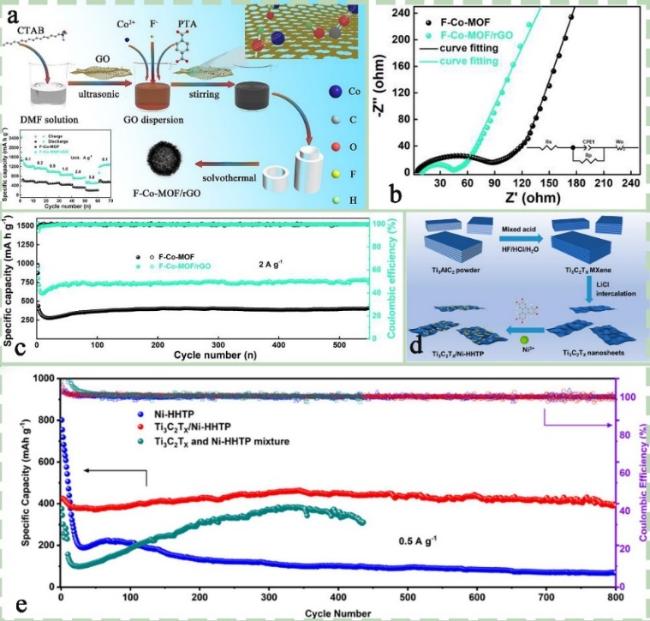
Reduced graphene oxide (RGO), carbon nanotubes (CNTs), and the two-dimensional layered material MXene are all two-dimensional inorganic conductive materials composed of carbon elements. They all exhibit high electron mobility, mechanical strength, and toughness, and can react with various chemical substances, demonstrating significant application potential in the field of energy storage[62-64]. By combining these materials with MOFs to create a close conductive network structure between them, it is possible to effectively address the brittleness, self-aggregation, and volume expansion issues of MOFs, significantly enhancing the electrochemical performance of electrode materials. Yin et al.[19]incorporated graphene oxide (GO) into the synthesis process of MOF-Cu-HHTP, forming a Cu-HHTP/G composite material through in-situ growth. The addition of graphene effectively reduced the aggregation of Cu-HHTP, increased the material's oxidative active sites and specific surface area, and established a continuous two-dimensional conductive network, resulting in outstanding electrochemical performance in LIBs and KIBs. After 300 cycles at a current density of 0.1 C, the specific capacities of the LIB and KIB were 1086/226 mAh·g-1, respectively; after 500 cycles at 1 C, the LIB and KIB still retained specific capacities of 621/165 mAh·g-1, respectively. Wei et al.[65]employed a similar composite strategy to assemble fluorine (F)-doped hollow sea urchin Co-MOF directly on reduced graphene oxide (RGO) (Figure 2a). Due to the unique F-containing sea urchin structure and hollow morphology of the MOF, combined with RGO's highly conductive network and mechanical support, the F-Co-MOF anode material offers abundant Li+ and Na+ storage sites, as well as a high specific surface area and pseudocapacitive performance, demonstrating excellent electrochemical properties when used as an anode for LIBs and SIBs (Figures 2b, c). Zhang et al.[66]prepared a dense-packed MOF@CNT hybrid material with a customized hierarchical pore structure through in-situ growth and room-temperature drying/shrinkage methods. By controlling the MOF content, they optimized the packing density and porosity, achieving a high specific surface area and volumetric capacity for this hybrid electrode material, providing a reference for further development of superior electrode materials for high-energy-density and compact energy storage devices.
图2 (a) F-Co-MOF/rGO的制备示意图;(a)中的插图是F-Co-MOF/rGO和F-Co-MOF电极的倍率能力;(b) F-Co-MOF/rGO和F-Co-MOF电极在2 A·g-1下的循环稳定性图;(c) F-Co-MOF/rGO和F-Co-MOF电极的奈奎斯特图[65];(d) Ti3C2TX/Ni-HHTP复合材料的制备示意图;(e) 电池在0.5 A·g-1下使用三种不同负极材料的长期循环性能图[68]

Fig.2 (a) is a schematic diagram of the preparation of F-Co-MOF/rGO, and the insets in (a) shows the rate capability of F-Co-MOF/rGO and F-Co-MOF electrodes. (b) The cycling stability of F-Co MOF/rGO and F-Co MOF electrodes at 2 A·g-1. (c) Nyquist plots of F-Co-MOF/rGO and F-Co-MOF electrodes[65]. Copyright 2020 Elsevier. (d) Schematic diagram of preparation of Ti3C2TX/Ni HHTP composite material. (e) Long term cycling performance of batteries using three different negative electrode materials at 0.5 A·g-1[68]. Copyright 2024 Elsevier

Combining MOFs with the flexible conductive material MXene can effectively address the inherent limitations of MOFs, enhancing conductivity and accelerating ion transport, while also effectively preventing the aggregation and stacking of MOF particles. Lu et al.[67]developed a novel microfluidic-assisted 3D printing strategy (M3DP), successfully fabricating an anti-corrosion ZIB anode material with a Cu-MOF/MXene heterostructure. The functionalized conductive network of this hybrid material exhibits strong adsorption for Zn2+,effectively homogenizing the flux and current distribution of Zn2+,while suppressing side reactions and achieving stable zinc cycling. A symmetric battery based on this anode material demonstrates high reversible cycling stability of 1800 hours. Similarly, Wu et al.[68]prepared a MOF/MXene hetero-composite material Ti3C2T X/Ni-HHTP (Figure 2d)via an in-situ growth method, which was used as a LIB anode material and also showed satisfactory rate performance and cycling stability. The initial discharge capacity was 424.4 mAh·g-1,with a capacity of 390.2 mAh·g-1 at 0.5 A·g-1,and a capacity retention rate of 92.0% after 800 cycles (Figure 2e). This composite material combines the advantages of both MOFs and MXene, featuring regular pores, excellent conductivity, and outstanding stability.
The strategies for combining two-dimensional inorganic conductive carbon materials with MOFs are highly diverse, including embedding, coating, surface deposition, and in-situ mixing. Different composite modes have specific advantages, and the interfacial interaction mechanisms and composite uniformity between components also vary. For instance, compared to the simple, widely applicable physical-mechanical mixing method, the in-situ growth strategy primarily involves chemical bonding and chemical reconstruction. This allows the MOF to fully penetrate from the inside into functional inorganic carbon materials with a high aspect ratio, more effectively enhancing the synergistic effects of the composite material and facilitating the preparation of high-performance layered MOF composites with high specific surface areas and multiple active sites[69]. For example, as shown in Figure 2e, the Ti3C2T X/Ni-HHTP composite prepared via the in-situ method maintains a specific capacity of around 400 mAh·g-1after 800 cycles at a current density of 0.5 A·g-1, demonstrating significantly superior electrochemical stability compared to the physically mixed Ti3C2T Xand Ni-HHTP mixture (whose capacity decayed after only 400 cycles). Although the combination of two-dimensional inorganic conductive carbon materials with MOFs shows great development potential, it still faces several challenges[70-71]: (1) CNTs and MXenes typically have a large aspect ratio, and due to differences in electronegativity and potential, they tend to aggregate and settle during the composite process (especially during physical-mechanical mixing), leading to poor uniformity in the resulting composite materials; (2) these two-dimensional conductive carbon materials generally suffer from high costs and relatively low theoretical capacities, and their use in LIB electrode applications has yet to effectively address the frequent formation of Li+dendrites. Developing a hybrid method that combines physical-mechanical and chemical bonding mechanisms may achieve dual optimization of both processing procedures and performance. Additionally, identifying suitable multifunctional materials to complement the above-mentioned carbon materials functionally and then combining them with MOFs will also become one of the promising research directions in the future energy field.
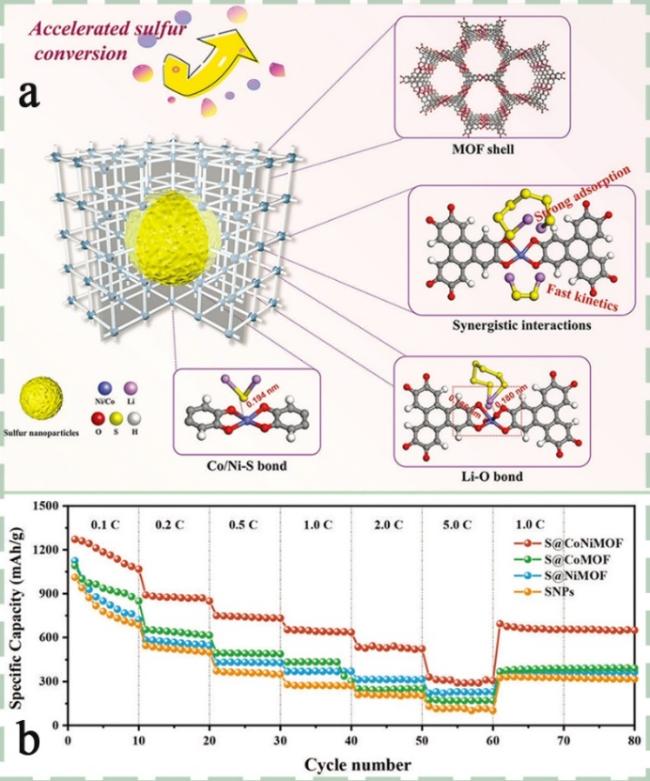
Different metal centers have varying redox capabilities and exhibit different adsorption effects on specific ions. They also differ in the number of electrons provided during electrochemical reactions. Bimetallic MOFs with multiple metal centers working synergistically serve as battery electrode substrates with outstanding electrochemical performance, and this high-performance material is most widely used in the field of LSB batteries[72-73].Ren et al.[74]prepared a core-shell structured Co/Ni bimetallic MOF around pre-synthesized sulfur nanoparticles (S NPs) using a chemical immobilization method. When used as the cathode material for LSBs, it demonstrated stable high reversible capacity and a low capacity decay rate (only 0.075% per cycle), maintaining good stability over 200 cycles even at a high sulfur loading of 3.8 mAh·cm-2. The excellent performance of this composite material benefits from the physical confinement and chemical bonding (covalent and coordination bonds) between the MOF shell and S NPs, effectively restricting the migration of polysulfides and S NPs, enhancing sulfur utilization, and successfully alleviating the shuttle effect and slow sulfur conversion kinetics in LSBs (Figure 3).
图3 (a) 示意图展示了硫纳米颗粒的“网中鱼”封装效果以及所获得的纳米复合材料中多种相互作用的效果,包括物理限制、共价键和配位键;(b) 展示了具有各种电极的Li-S电池的倍率能力[74]

Fig. 3 (a) Illustrates the "fish in the net" encapsulation effect of sulfur nanoparticles and the effects of various interactions in the obtained nanocomposites, including physical confinement, covalent bonds, and coordination bonds. (b) The rate capability of Li-S batteries with various electrodes was demonstrated[74]. Copyright 2023 Wiley VCH GmbH

Constructing bimetallic MOFs can effectively address the issues of insufficient conductivity and stability in pure MOFs, and in recent years, they have also been widely applied in LIB, ZIB, and SIB battery fields[75-77]. Yan et al.[76]used an iridium-based metal-organic ligand containing 3-(pyridin-2-yl)benzoic acid as a bridging unit to connect Co-based metal clusters, thereby preparing a novel bimetallic MOF with high conductivity and excellent porosity. Thanks to the layered stacking structure and ordered porous framework of the Co4-Ir MOF, when used as a LIB anode material, it exhibits a high specific capacity (1202 mAh·g-1), outstanding rate performance (515 mAh·g-1at 3000 mA·g-1), and good cycling stability (an average capacity decay rate of 0.041% per cycle after 1000 cycles). Liu et al.[78]synthesized a bimetallic CoFe-ZIF with an open nanoflower structure using a simple room-temperature stirring strategy. Compared to the closed dodecahedral rhombic structure of single Co-ZIF, the bimetallic structure provides more coordination active sites and greater structural stability. When used as an SIB anode material, it demonstrates a high capacity of 424.78 mAh·g-1at a current density of 0.10 A·g-1, retaining a capacity of around 410.32 mAh·g-1after 500 cycles, showing excellent electrochemical activity and stability.
Zeolitic imidazolate frameworks (ZIFs) are a class of MOFs characterized by hierarchical porous structures and abundant active sites, often used as substrates for battery electrodes. Due to their unique elemental composition and outstanding stability, most related studies have focused on ZIF-derived materials after thermal treatment. However, ZIF-derived materials also have certain limitations, such as excessively large specific surface areas and the potential loss of functional groups after pyrolysis. Therefore, the "non-carbonization" application strategy for ZIF-based materials holds promising development prospects. Combining ZIFs with other metals or doping them with specific metal clusters to form bimetallic MOFs can significantly optimize the chemical structure and electrochemical performance of ZIFs. In recent years, this strategy has been widely explored for the production of high-performance electrode materials. Liu et al.[78]introduced Fe3+into Co-ZIF, creating a bimetallic MOF electrode material with multiple active sites. This transformation changed the original rhombic dodecahedral structure into a highly open nanoflower structure, significantly enhancing its performance in sodium-ion batteries (SIBs). This study provides valuable insights for the development of composite electrode materials based on ZIFs. Zhou et al.[79]prepared amorphous CoNi bimetallic ZIF materials with hierarchical pores using a chemical oxidation reaction. When used as anode materials for lithium-ion batteries (LIBs), these electrodes exhibited outstanding electrochemical performance. However, research has revealed that the exceptional electrochemical performance of this material is not only attributable to the synergistic effects of the bimetallic components but also to its amorphous characteristics. This is because different systems and reaction mechanisms have varying requirements for the crystallinity of electrode materials. Highly crystalline MOF-based electrode materials offer a more regular and uniform distribution of active sites, enabling capacities closer to theoretical values. Conversely, MOF substrates with lower crystallinity or those that are amorphous can effectively enhance phase transitions and reaction kinetics in specific battery applications due to their unique defect structures, disorder, and isotropy, thereby optimizing electrochemical reactions.
Preparing bimetallic MOFs to enhance the electrochemical performance of pure MOFs is an important direction for the future development of MOF applications in energy storage. Based on recent developments, common approaches include: (1) heteroatom doping, a widely used method that effectively induces the formation of two-dimensional bimetallic MOF materials with multiple active sites; (2) preparing two-dimensional bimetallic frameworks through continuous exchange reactions between metal cations and ligands, which is also a novel approach[73]; (3) novel MOFs such as two-dimensional π-conjugated bimetallic (dithiophene) complexes (MCS) and two-dimensional hexaaminobenzene coordination polymers (HAB-CPs), due to the unique properties of their multi-metal components, possess outstanding active sites and electrochemical advantages[80-82], effectively immobilizing soluble polysulfides and promoting rapid Li+transport, making them highly promising cathode materials for LSBs; (4) cluster-bridged coordination strategies are also a type of bimetallic MOF synthesis approach, effectively improving the conductivity of single MOFs, though the synthesis mechanism still requires further investigation[76].
Although bimetallic MOFs exhibit excellent performance as electrode materials in the energy storage field, their development still faces certain bottlenecks and challenges. For instance, under electrochemical conditions, bimetallic MOFs inevitably undergo structural reorganization and transformation, leading to structural and compositional defects within the material. Although these defects can, to some extent, induce the formation of additional active sites, thereby enhancing electrochemical performance, they may also cause issues such as pore collapse, ligand loss, and coordination errors, ultimately limiting their practical applications and performance optimization. Therefore, based on a thorough understanding of the synthesis mechanisms of bimetallic MOFs, exploring more advanced experimental equipment and theoretical research methods, adopting more rational compounding and modulation strategies, and elucidating the relationships among defect structures, types, and properties are all crucial for optimizing the performance of bimetallic and polymetallic MOFs. Additionally, combining various strategies to integrate polymetallic MOFs with other functional materials holds promise for further optimizing and tailoring their performance.
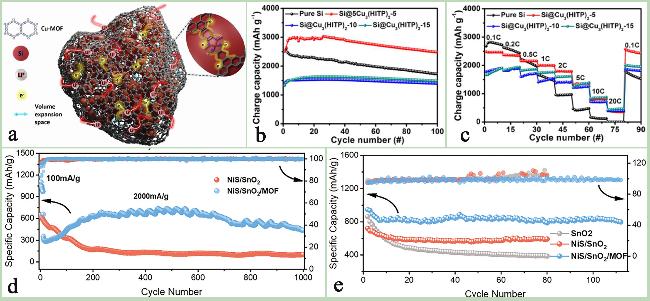
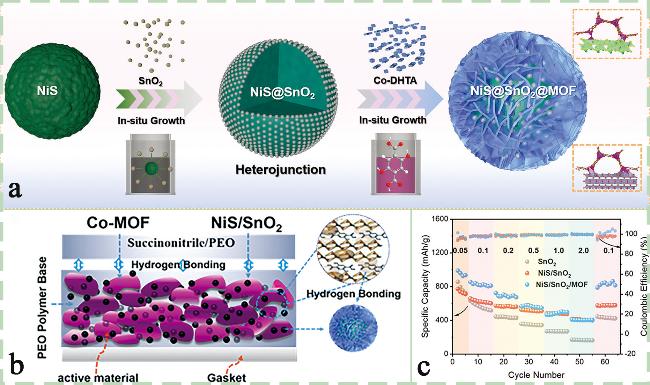
In addition to the above-mentioned composite strategies, embedding and encapsulating specific metal nanoparticles (NPs) or metal compounds within the MOF framework can also significantly enhance the storage performance and conductivity of MOFs as electrode materials[83-84]. Nazir et al.[85]successfully prepared a novel LIB anode material by encapsulating silicon nanoparticles (Si NPs) within a two-dimensional conductive Cu-MOF. This electrode material exhibited excellent structural stability and electrochemical performance during lithiation and delithiation cycling, achieving an initial reversible capacity as high as 2511 mAh·g-1at a rate of 0.1 C (Figure 4c), and maintaining a capacity of 2483 mAh·g-1after 100 cycles (Figure 4b). Furthermore, even at a high rate of 1 C, the capacity remained at 1039 mAh·g-1after 1000 cycles. The superior electrochemical performance is primarily attributed to the synergistic effect between the Cu-MOF and Si NPs. Si can form Li-Si alloys through alloying with Li+, while the porous framework of the MOF effectively mitigates the volume expansion of Si during cycling and provides efficient ion transport channels, facilitating the rapid insertion/extraction of Li+(Figure 4a). Together, these factors synergistically enhance both the cycling stability and conductivity of the material. In the following year, Nazir et al.[86]employed a similar strategy, uniformly encapsulating Sb nanoparticles within Ni-MOF, resulting in a composite electrode material that significantly improved the performance of rechargeable potassium-ion battery (PIB) anodes and became one of the best PIB anodes reported to date. Zhang et al.[87]proposed a multi-template synthesis strategy, combining Co-MOF with a heterostructure formed by two metal compounds (NiS/SnO2) (Figure 5a), to prepare a LIB anode material (NSM) with a unique structure and outstanding electrochemical performance. Benefiting from the porous framework of the MOF and the high theoretical capacity of the heterostructure (NiS/SnO2), this composite electrode material demonstrated superior specific capacity and stable cycling efficiency (Figures 4d, eand Figure 5c), effectively improving the interfacial effects between traditional composite heterostructures, alleviating volume changes caused by Li+deintercalation and metal compounds during cycling, and significantly enhancing the interfacial compatibility between the electrode material and polyethylene oxide (PEO) electrolyte (Figure 5b). The strategy proposed in this work for constructing heterostructures and optimizing microstructures represents one of the most attractive approaches for designing high-performance composite electrode materials.
图4 (a) Si@Cu3(HITP)2复合电极材料的工作机理图;(b)纯Si、Si@Cu3(HITP)2-5、Si@Cu3(HITP)2-10和Si@Cu3(HITP)2-15电极的循环性能图:在0.1 C倍率下进行100次充放电循环;(c) 纯Si、Si@Cu3(HITP)2-5、Si@Cu3(HITP)2-10和Si@Cu3(HITP)2-15电极的倍率性能[85];(d) NiS/SnO2、NiS/SnO2/MOF电极在2 A·g-1下的长期循环性能图;(e) SnO2、NiS/SnO2、NiS/SnO2/MOF电极在0.2 A·g-1下的循环性能图[87]

Fig. 4 (a) Si@Cu3(HITP)2 working model effect diagram. (b) Cyclability of the pure Si, Si@Cu3(HITP)2-5, Si@Cu3(HITP)2-10, and Si@Cu3(HITP)2-15 electrodes: at a rate of 0.1 C during 100 discharge/charge cycles. (c) Rate capability of the pure Si, Si@Cu3(HITP)2-5, Si@Cu3(HITP)2-10, and Si@Cu3(HITP)2-15 electrodes[85]. Reproduced with permission. (d) Long term cycling performance of NiS/SnO2 and NiS/SnO2/MOF electrodes at 2 A·g-1. (e) The cycling performance of SnO2, NiS/SnO2, and NiS/SnO2/MOF electrodes at 0.2 A·g-1[87]. Copyright 2023 Wiley VCH GmbH

图5 (a)NSM复合材料合成路线示意图;(b) 柔性电极内部结构示意图;(c) SnO2、NiS/SnO2、NiS/SnO2/MOF 电极的倍率性能图[87]

Fig.5 (a) Schematic diagram of the synthesis route of NSM composite materials. (b) Schematic diagram of the internal structure of flexible electrodes. (c) Rate performance graphs of SnO2, NiS/SnO2, and NiS/SnO2/MOF electrodes[87]. Copyright 2023 Wiley VCH GmbH

MOF-encapsulated composites of metal nanoparticles (NPs) and metal compounds, owing to their remarkable performance complementarity, have significant potential in electrode materials for energy storage. However, due to the high cost of most NPs and metal compounds, in recent years, the application of derived metal NPs, metal compounds, and their composites obtained through high-temperature carbonization or modification of MOFs has steadily increased. It is anticipated that these materials will continue to develop further and may even replace MOF composites synthesized from externally introduced metal NPs or metal compounds in the future[88-90].

4 MOF Derivatives and Their Composite Electrode Materials

MOFs derivatives applied in the electrode field are mainly categorized into derived carbon materials, derived metal-based substances, and derived composite materials. High-temperature pyrolysis-derived carbon materials from MOFs not only inherit the high specific surface area and high porosity characteristics of the original MOFs but also effectively enhance the material's conductivity and stability. Derived metal-based substances (MDs), such as metal nanoparticles, metal oxides, nitrides, etc., can achieve size and shape control through processing and are uniformly dispersed within the MOF framework during the derivation process, increasing the number of active sites and significantly improving the material's conductivity and stability[91]. Additionally, hybridizing MOFs derivatives with other functional materials or performing specific chemical modification treatments can both facilitate the preparation of electrode materials with tailored functionalities[92]. Table 3provides a detailed summary of the advantages, disadvantages, and strategies for applying MOFs derivatives and their composite electrode materials.
表3 MOFs衍生物及其复合电极材料的相关总结

Table 3 Relevant summaries of MOFs derivatives and their composite electrode materials

Summary of MOFs derivatives and their composite electrode materials
Materials Advantages Disadvantages
MOFs derivatives and their composite electrode materials (1)Significant improvement of electrical conductivity: Changing the properties of MOFs by physical carbonization or chemical modification can significantly improve their electrical conductivity on the basis of inheriting the high specific surface area and high porosity of pure MOFs;
(2)Functional diversification: the diverse classification of MOFs derivatives and rich modification strategies make MOFs-based electrode materials have significant advantages in functional orientation.
(1)Complex synthesis process: The preparation process involves the combination and interaction of multiple materials, requiring precise control of the synthesis conditions, which increases the difficulty and cost of production;
(2)Difficult to control the performance of derived materials: After high-temperature pyrolysis or chemical modification, there will inevitably be loss or destruction of the skeleton and functional groups of MOFs, and the effect of such loss on the performance is difficult to control.;
(3) Complicated material mechanism: Due to the multi-component and multi-mechanism synergistic effect of MOFs derivatives electrode materials, their mechanism of action is relatively complicated, and it is time-consuming and laborious to analyze and explore the materials with a large number of characterizations.
Optimization strategy of MOFs derivatives and their composite electrode materials and their characteristics
Optimization strategy Advantages Disadvantages
Physical carbonization Formation of metal nanoparticles active sites and carbonized skeleton to improve the conductivity and flexibility of MOFs electrode materials; Carbonization products are rich and adjustable in function and structure, and the high-temperature derivatives obtained under different carbonization conditions have different structures and functions. High-temperature pyrolysis may lead to the collapse of the structure of MOFs, resulting in a decrease in their porosity and specific surface area; energy consumption is also high due to higher equipment requirements
Co-pyrolysis after introduction of functional materials or active elements (S, P, N, etc.) The carbon skeleton network formed with abundant active components can effectively enhance the surface polarity and electrical conductivity of MOFs-based electrode materials; the diverse tunability of this strategy provides more possibilities for the optimization of the performance of MOFs-based electrode materials Significantly higher production costs due to the synergy of multiple strategies; relatively more difficult to explore the main mechanism of action of hybridized materials
Chemical modification (functionalization, ion exchange, etc.) Functional groups or ions can be introduced in a targeted manner to regulate the force between MOFs and specific conductive ions, improve the concentration of specific ions in the material, and thus enhance the electrochemical performance of MOFs-based electrode materials The introduction of specific functional groups may require expensive precursors and catalysts, which may increase the preparation cost of MOF-based electrode materials; how to control the influence of the lifetime of functional groups on the long-term stability of electrode materials is a difficult point to realize industrialization; Chemical modification is relatively harmful to the environment
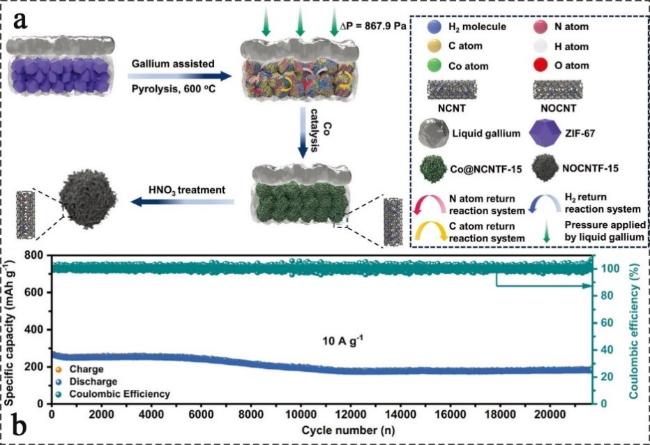
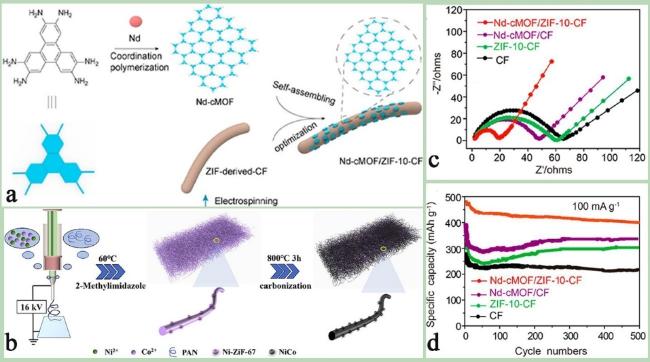
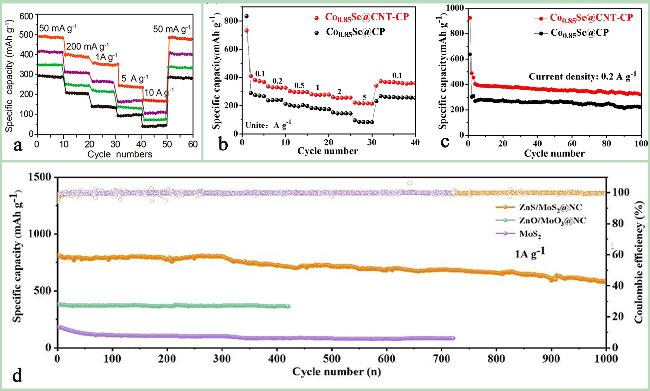
Carbonization of MOFs can not only effectively enhance their electrical conductivity and flexibility, but also form new active sites and coordination bonds through chemical reconstruction among components, thereby significantly improving their performance as electrode materials. Jiang et al.[93]combined the phosphorus source from organic ligands with Sn via high-temperature pyrolysis of tin (Sn)-based MOFs, forming a phosphorus (P)-doped Sn3(PO4)2@PC derivative. In this material, Sn3(PO4)2nanocrystals are uniformly dispersed within the carbon matrix, creating a novel long-range self-assembled layered structure. P-doped carbon effectively enhances the material's conductivity, and when used as anode materials for KIBs and SIBs, they exhibit excellent reversible deintercalation/intercalation capabilities and long-term cycling stability. Through clever strategy adjustments, the applications of MOF-derived pyrolysis products are no longer limited to their inherent natural porous carbon framework; derivatives such as CNTs, nanofibers, and nanobox particles derived from MOFs are also gradually becoming more widespread[94]. Han et al.[95]prepared a novel MOF-derived carbon material—a nitrogen-doped non-hollow carbon nanotube framework—using liquid gallium-assisted pyrolysis. Thanks to the protection provided by liquid gallium, CNTs originating from organic ligands achieved high-yield growth both inside and outside the MOF framework at lower pyrolysis temperatures, forming a non-hollow structure. Meanwhile, Co2+was reduced by H2to form Co nanoparticles (Co NPs), encapsulated at the ends of the CNTs, which were subsequently chemically processed to create a non-hollow carbon nanotube material enriched with N and O elements and C ̿        O groups (Figure 6a). These materials were used as SIB anode materials, demonstrating outstanding high specific capacity (185 mAh·g-1at a current density of 10 A·g-1) and cycling stability (stable operation for 20,000 cycles at 10 A·g-1and 50 ℃) under high current density and elevated temperature conditions (Figure 6b). Dai et al.[96]used zeolite imidazole metal-organic framework (ZIF)-derived carbon fiber materials (ZIF-CFs) as an in-situ growth platform for conductive MOF materials, synthesizing Nd-cMOF/ZIF-CFs, a MOF-derived composite material with a dense hierarchical pore structure (Figure 7a). In this novel material, MZIF-CFs provide conductivity, flexible porous structure, and mechanical stability, while Nd-cMOF offers interfacial kinetic activity, conductivity, and sufficient volumetric buffering space. SIB cells assembled with this material as the anode exhibit excellent electrochemical performance, achieving a specific capacity of 480.5 mAh·g-1at a current density of 0.05 A·g-1, and maintaining 84% capacity retention after 500 cycles at a current density of 100 mA·g-1(Figures 7c and dand Figure 8a). All these studies provide innovative design approaches for the preparation of MOF carbonization derivatives.
图6 (a) ZIF-67液镓辅助合成NOCNTF-15的示意图;(b) NOCNTF-15电极在10 A·g-1下的长循环性能[95]

Fig.6 (a) Schematic diagram of ZIF-67 liquid gallium assisted synthesis of NOCNTF-15. (b) Long cycle performance of NOCNTF-15 electrode at 10 A·g-1[95]. Copyright 2024 Wiley VCH GmbH

图7 (a) Nd-Cmof在ZIF-10 CF表面上的自组装示意图[96];(b) NiCo-PCNF的制备过程示意图[105];(c) 各电极材料的阻抗图和(d) 循环稳定性图像,Nd-cMOF/ZIF-10-CF(红色)、Nd-cMOF/CF(紫色)、ZIF-10-CF(绿色)和 CF(黑色)[96]

Fig.7 (a) Schematic diagram of self-assembly of Nd CMOF on ZIF-10 CF surface[96]. (b) Schematic diagram of the preparation process of NiCo PCNF[105]. Copyright 2024 Elsevier B.V. (c) Impedance maps and (d) cycling stability images of each electrode material, including Nd cMOF/ZIF-10-CF (red), Nd cMOF/CF (purple), ZIF-10-CF (green), and CF (black)[96]. Copyright 2023 American Chemical Society

图8 (a) Nd-cMOF/ZIF-10-CF(红色)、Nd-cMOF/CF(紫色)、ZIF-10-CF(绿色)和CF(黑色)的倍率能力比较图[96];(b) Co0.85Se@CNT-CP和Co0.85Se@CP的倍率性能对比图;(c) Co0.85Se@CNT-CP和Co0.85Se@CP在0.2 A·g-1下的循环性能对比图[106];(d) ZnS/MoS2@NC、ZnO/MoO3@NC和MoS2在1 A·g-1下的循环性能[112]

Fig.8 (a) Rate capabilities of Nd-cMOF/ZIF-10-CF (red), Nd-cMOF/CF (purple), ZIF-10-CF (green), and CF (black)[96]. Copyright 2023 American Chemical Society. (b) Rate capability of Co0.85Se@CNT-CP and Co0.85Se@CP under different current densities. (c) Comparison of cycle performances of Co0.85Se@CNT-CP and Co0.85Se@CP at 0.2 A·g-1[106]. Copyright 2022 Elsevier Ltd. (d) The cycling performance at 1 A·g-1 of ZnS/MoS2@NC、ZnO/ MoO3@NC and MoS2[112]. Copyright 2024 Wiley VCH GmbH

Combining MOF derivatives with various multifunctional materials, or jointly pyrolyzing them after compositing, is also an important approach for preparing high-performance MOF-based electrode materials. Functional non-polar carbon sources (RGO, MXene, CNT, carbon nanofibers CNF) exhibit excellent conductivity and flexibility, but have limited application value as single electrode materials[97-99]. Due to their outstanding aspect ratio, when combined with MOF-derived porous carbon materials, they facilitate the preparation of electrode materials with high specific surface area, uniform particle size, favorable morphology, and high conductivity. Deng et al.[100] combined a calcium-based metal-organic framework (Ca-MOF) with reduced graphene oxide (rGO), followed by high-temperature heat treatment, yielding a highly stable KIB anode material. Thanks to the clever in-situ formation of a thin carbon coating on the material's surface during heat treatment, which synergistically interacts with the highly stable crystalline structure of Ca-MOF and the enhanced conductivity of rGO, the resulting CaC8H4O4/rGO-450 composite still maintains a high reversible capacity of 110 mAh·g-1 after 700 cycles at a current density of 100 mA·g-1. Carbon nanofibers (CNF) are among the most abundant and sustainable organic biomass materials on Earth, characterized by low cost, rich functional groups, high conductivity, good flexibility, thermal stability, and mechanical strength, making them an excellent substrate suitable for large-scale preparation. CNF is typically prepared using electrospinning, where MOFs grow in-situ on the PAN precursor of CNF, followed by co-pyrolysis, forming an electron transport network rich in active sites and tightly connected, with good chemical stability. As an electrode material, it can significantly enhance the overall electrochemical performance[101-102]. Zhu et al.[103] employed electrospinning combined with high-temperature pyrolysis to embed Sn-based MOF into cross-linked one-dimensional carbon nanofibers (CNF), forming a hierarchical porous structure of the carbon substrate after pyrolysis. The Sn-based MOF, acting as a sacrificial template, provides Sn metal nanoparticles (Sn NPs) on the CNF, while the interwoven carbon nanofibers effectively alleviate the volume expansion of Sn NPs during cycling, creating a layered structure with abundant hollow micropores on the surface. This structure promotes electrolyte diffusion and charge transfer, effectively enhancing the electrochemical performance of LIB and SIB anode materials. This strategy is also applicable to the preparation of high-performance LSB sulfur cathode materials[104], where a dense porous carbon conductive network loaded with multiple nanoactive sites can effectively reduce the shuttle effect of soluble polysulfides, improve the redox kinetics of sulfur, and promote the conversion of polysulfides to lithium sulfide. Wang et al.[105] adopted a generalized in-situ growth strategy of MOF/PAN, combining electrospinning and high-temperature calcination to prepare MOF-derived CNF/MOF composite electrode materials (Figure 7b), in which nitrogen-doped CNF supported MOF-derived bimetallic nanoparticles as a sulfur-free LSB cathode material, significantly improving the electrode material's anchoring ability toward polysulfides and the kinetics of their conversion, mitigating volume changes during lithiation/delithiation, and achieving high specific activity and long-term stability of the electrode material. This research holds significant importance in guiding the design of high-performance independent LSB cathode materials and is expected to accelerate the rapid development of LSBs.
Carbon nanotubes (CNTs) are nano-scale tubular structures composed of carbon atoms, featuring a unique one-dimensional nanostructure. Carbon nanotubes exhibit exceptional elasticity and ductility, making them one of the materials with the highest specific strength found in nature today. Additionally, their electrical conductivity significantly outperforms materials such as graphene and carbon black; moreover, the thinner the tube diameter and the longer the length, the better the electrical conductivity. Carbon nanotubes also possess excellent chemical stability, as well as resistance to heat, acids, and bases. The hollow cavities, gaps between tubes, interlayer spaces within the tube walls, and various defects in the tube structure can provide ample storage space and transport channels for conductive particles, making carbon nanotubes one of the most promising electrode material candidates. Huang et al.[106]prepared a composite material derived from Co@CNT-CP by combining Co-MOF with a CNT precursor and subsequently subjecting it to high-temperature calcination, followed by introducing selenium powder for selenization, successfully synthesizing a porous Co0.85Se@CNT-CP hybrid SIB electrode material with a large specific surface area. Benefiting from the buffering and protective effects of the 3D hierarchical fluffy structure of CNTs, as well as the highly active selenium and cobalt nanoclusters, compared to the Co0.85Se@CP material without added CNTs, the Co0.85Se@CNT-CP anode demonstrates superior cycling stability and rate performance (Figure 8b, c). The results indicate that the outstanding electrochemical performance of this material not only relies on mechanical confinement but also involves chemical adsorption and catalytic effects, suggesting that this hybrid strategy may have certain application potential in other battery fields, such as lithium-sulfur batteries (LSB).
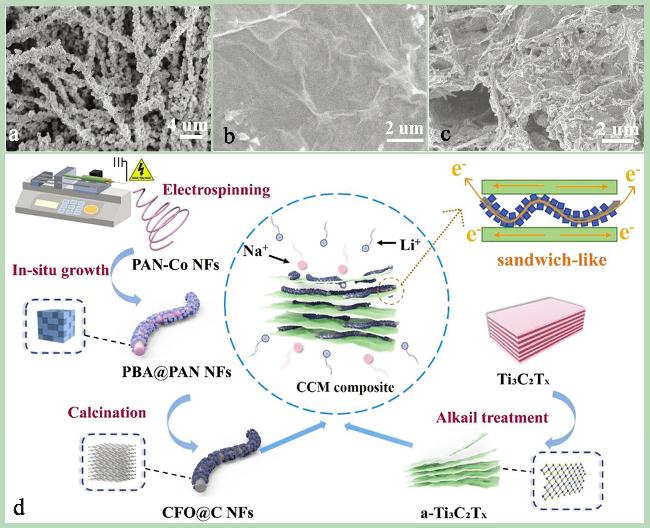
MXene is a two-dimensional material with excellent conductivity, and its complexation with MOF derivatives can significantly enhance the overall conductivity of the composite material. The layered structure of MXene facilitates the uniform distribution of active metal nanoparticles or MOF-derived metal compounds, while the carbon and nitrogen framework of MOFs effectively alleviates the tight stacking phenomenon between MXene sheets. The heterogeneous interface formed by their interaction promotes accelerated charge transfer and enhances the electrochemical activity of the electrode. In recent years, to improve the binding force between MOF-derived active materials and MXene and reduce their dispersion, a strategy involving in-situ growth of MOFs on CNF precursors followed by pyrolysis and subsequent compounding with MXene has been widely adopted. Shi et al.[107]combined electrospinning, in-situ growth, and high-temperature pyrolysis strategies to create a MOF-derived bimetallic CoFe2O4@CNF@MXene composite material (Figure 9d). This composite material features tightly interconnected components, forming a conductive network structure with synergistic effects from multiple active sites (Figures 9a~c), effectively preventing volume expansion of nanoparticles and facilitating the insertion and extraction of conductive ions. When used to enhance the performance of LIB and SIB anodes, this material demonstrates superior ion diffusion kinetics, high capacitance, and outstanding rate capability. Additionally, Liu et al.[108]prepared a 3D cross-linked composite ZIBs cathode material by using two-dimensional MXene to modulate the space group and electronic properties of MOF-derived vanadium oxides. The strong interfacial interaction between MOF-derived vanadium-based oxides and MXene significantly enhances the storage performance of Zn2+, as well as its electrochemical activity and kinetic characteristics. Furthermore, in this composite strategy, MXene effectively controls the directional chemical transformation of vanadium-based oxides, providing a new reference for achieving efficient synergy between metal oxide and MXene composite structures.
图9 (a) CFO@C NFs的SEM图像;(b) Ti3C2TX的SEM图像;(c) CCM2的SEM照片;(d) MXene (CCM)复合材料CoFe2O4@CNF@MXene多褶夹层状结构的制备示意图[107]

Fig. 9 (a) SEM images of CFO@C NFs. (b) SEM image of Ti3C2TX. (c) SEM image of CCM2. (d) Schematic diagram of the preparation of MXene (CCM) composite material CoFe2O4@CNF@MXene with pleated sandwich structure[107]. Copyright 2023 Wiley VCH GmbH

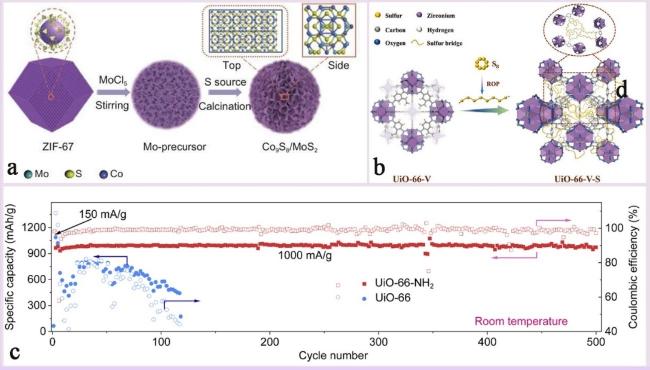
By employing certain methods and strategies to embed specific metal and non-metal nanoparticles or elements (such as S, P, N, etc.) into MOFs, followed by pyrolysis, a carbon framework network rich in active substances can be generated. This effectively enhances the active components, surface polarity, and conductivity of MOF-based electrode materials, as well as optimizes ion diffusion channels. This strategy can provide more possibilities for performance optimization of MOF-based electrode materials[109-111]. Wang et al.[112]successfully prepared a sulfur-containing bimetallic MOF-derived composite material ZnS/MoS2@NC by in-situ introducing Mo2+into Zn-MOF to form bimetallic MOFs, followed by high-temperature sulfidation. Compared with the unsulfidized ZnO/MoO3@NC and MoS2, the ZnS/MoS2@NC composite material exhibited significantly improved lithium storage performance as a LIB anode, retaining a specific capacity of 580.8 mAh·g-1after 1000 cycles at a current density of 1 A·g-1(Figure 8d). Its superior performance is attributed to the heterogeneous structure composed of two sulfides, ZnS and MoS2, as well as the carbon-nitrogen framework derived from imidazole ligands, which effectively alleviates volume changes. Chen et al.[113]adopted a similar approach of simultaneous sulfidation and calcination to prepare a heterogeneous structure consisting of cobalt-molybdenum bimetallic sulfides, Co9S8/MoS2/C, used as an SIB anode material, demonstrating excellent electrochemical performance (Figure 10a), with a discharge specific capacity of 394.4 mAh·g-1after 1000 cycles at a current density of 2000 mA·g-1.
图10 (a) 花状Co9S8/MoS2/C异质球的示意图[113];(b) UiO-66-V-S合成路线示意图[124];(c) 使用Li-Cl2@MOF电极的电池在1000 mA·g-1电流密度下的循环性能[123]

Fig.10 (a) Schematic diagram of flower-shaped Co9S8/MoS2/C heterospheres[113]. Copyright 2023 Institute of Coal Chemistry, Chinese Academy of Sciences. (b) Schematic diagram of UiO-66-V-S synthesis route[124]. Copyright 2022 Wiley VCH GmbH. (c) Cycle performance graph of the Li-Cl2@MOF electrods battery at a current density of 1000 mA·g-1[123]. Copyright 2023 Elsevier Inc

For nitrogen elements, in addition to direct introduction, the zeolitic imidazolate framework (ZIFs)-based MOFs can also derive nitrogen-doped three-dimensional porous carbon materials rich in metal active sites after pyrolysis, benefiting from the nitrogen and carbon atoms in their ligands[114-116]. This type of derivative is widely used in the field of LSB batteries, effectively enhancing the anchoring of polysulfides, suppressing their shuttle effect, and accelerating the conversion kinetics of sulfur species. Wang et al.[117]prepared a three-dimensional Zn, Co, and N co-doped carbon nano-architecture derived from MOFs by simply calcining a modified zeolite imidazole framework precursor under a nitrogen atmosphere. The abundant pore structure effectively accommodates the volume expansion of sulfur, while nitrogen vacancies and metal active sites significantly enhance the polysulfide conversion kinetics and Li+transport diffusion rate. As a cathode material for LSB batteries, it exhibits excellent electrochemical performance, featuring outstanding high reversible capacity and superior rate capability. However, the specific surface area of such ZIFs-derived carbon frameworks is typically difficult to regulate, and their structural and morphological orderliness is largely lost, limiting their stability and conductivity. Therefore, combining them with well-ordered carbon materials that possess inherent excellent conductivity and large specific surface areas (such as MXene, CNT, CNF, etc.) can further optimize their electrochemical performance. Luo et al.[118]embedded ZIFs-derived composite nanoparticles into hollow carbon polyhedra, where the carbon matrix formed a conductive network capable of rapidly transporting ions and electrons, enabling uniform distribution of the active sites of the ZIFs-derived nickel-cobalt composite nanoparticles and effectively improving the polysulfide conversion kinetics. After using this derived composite material as an LSB cathode, its electrochemical performance was significantly enhanced.
In addition to applications in the LSB battery field, the ZIF series also holds great potential in other battery areas[119-121]. Wang et al.[119]recycled micron-sized silicon powder waste generated by the photovoltaic industry and grew ZIF-67 in situ on its surface. After pyrolysis, silicon was uniformly embedded into the amorphous carbon-nitrogen structure derived from ZIF-67. The hollow skeletal structure of the MOF alleviated the volume expansion of Si, while the porous nitrogen-doped carbon layer provided rapid transport channels for Li+and electrons. The resulting LIB composite anode material exhibited a high specific capacity as well as excellent rate and cycling performance. This strategy offers an innovative approach for the sustainable development of high-performance LIB anode materials. Guo et al.[122]also used the ZIF series (ZIF-8) as a precursor, preparing Fe-doped porous carbon materials (Fe-N-C) via self-assembly/carbonization. This material features atomically dispersed Fe and N elements with coordination effects, forming Fe-N4sites that enhance adsorption of iodine species. Moreover, the material's superior specific surface area and porous structure enable it to serve as a cathode host material for zinc-iodine batteries (AZIBs), demonstrating outstanding cycling stability and high specific capacity. At a high current density (2 A·g-1), the discharge capacity remained around 161.9 mAh·g-1after 10,000 cycles.
Chemically modified MOF-derived materials can impart specific functionalities to MOFs, adjusting their pore structure, surface properties, and ability to interact with particular molecules. Functional group modification strategies involve introducing specific functional groups onto the organic linkers or metal nodes of MOFs to effectively regulate the material's chemical and physical properties. This strategy is also increasingly being applied in the field of electrodes. The amino group (—NH2) is a polar functional group with Lewis basicity. Amino-functionalized MOFs can form strong coordination effects with various cations or substances possessing Lewis acidity, thereby specifically enhancing the ion-exchange capacity of electrodes. Xu et al.[123] used an amino-functionalized MOF (UiO-66-NH2) as the cathode material for a rechargeable lithium-chlorine (Li-Cl2) battery. The nano-scale pore structure and Lewis basicity of the —NH2 group in the modified MOF enable strong chemisorption interactions with chlorine gas (Cl2) and lithium chloride (LiCl) at the cathode side, achieving high storage capacity and stable ion transport in the battery. Compared to unfunctionalized UiO-66, the amino-functionalized UiO-66-NH2 exhibits superior charge-discharge efficiency and cycling stability (Figure 10c), providing a solid foundation for developing high-performance MOF-based electrode materials. Zeng et al.[124] employed a chemical co-polymerization approach to co-composite sulfur chains, vinyl-functionalized MOFs (UiO-66-V), and CNTs, preparing a hybrid LSB cathode material with a polymer-sulfur network (CNT@UiO-66-V). This copolymer design strategy significantly enhances the conversion rate of polysulfides and alleviates polarization during battery charge-discharge cycles. The vinyl groups in UiO-66-V can co-polymerize with sulfur to form sulfur-vinyl polymers, fixing S within the MOF pores and markedly improving the structural stability of the material. Additionally, the introduction of double-bonded vinyl groups enhances the electronic conductivity of UiO-66 and promotes the redox reactions of S (Figure 10b). Meanwhile, carbon nanotubes, acting as anchoring points, can form strong interactions with sulfur, effectively limiting sulfur dissolution and improving the material's structural stability and battery cycle life. Tests demonstrate that this cathode material exhibits excellent discharge capacity and a low capacity decay rate, maintaining stable cycling performance even under a high sulfur loading (5.6 mg·cm-2).
Chemical modification can significantly enhance the functionality of MOFs and is a highly promising strategy for preparing MOF-based electrode materials with superior performance. However, chemical modification of MOFs still faces certain drawbacks and challenges. (1) The chemical modification process may increase synthetic complexity, making it crucial to precisely control reaction conditions to ensure successful introduction and uniform distribution of functional groups; (2) introducing specific functional groups may require expensive precursors and catalysts, potentially raising the cost of preparing MOF-based electrode materials; (3) determining the lifespan of functional groups during electrochemical reactions to ensure they do not compromise the long-term stability of the electrode material is an issue that requires further research in this field; (4) some processes involved in the chemical modification of MOFs may involve toxic or hazardous substances, which is inconsistent with current sustainable development principles.
In conclusion, existing scoring systems have limited predictive capabilities for bleeding events, and their results are inconsistent[25,30,33].
表4 近年来MOF基电池电极材料的电化学性能总结

Table 4 Summary of electrochemical properties of MOF-based battery electrode materials in recent years

Strategy Material Application Storage capacity
CDa)/SCb)
(mA·g-1/mAh·g-1
Cyclic stability
CDc)/CNd)/CR e)
(mA·g-1/*/mAh·g-1
Ref
Pure MOF Ni3(HITP)2 LIB - 1000/200/128 40
Ni-DBH LIB 0.1 C/676.19 0.2 C/500/70% 47
TCPP(Co)-Fe LIB 200/2180.4 2000/150/220.73 43
Co-MOF-BA0.1 Li-O2 100/14,011 1000/215/- 29
MIL-100(V) ZIB 200/362 200/3500/95.45% 56
Cu-BTA-H ZIB 200/330 2000/500/106.1 51
2D Mn-MOF ZIB 3000/104.7 4000/1000/119.5% 57
S@MOF-525(Cu) LSB 5 C/400 1 C/200/742 44
MIL-88A@S LSB 0.1 C/600 0.5 C/1000/200 125
S@Mn-CCs LSB 0.2 C/1420 0.2 C/200/990 126
Co-HITP SIB 200/2019.1 8000/15000/192 41
Ca-BDC SIB 200/235.2 200/100/144 127
Bi-MOF KIB 100/419 500/1200/315 50
HAN-Cu-MOF KIB 2000/161 1000/1600/96.7% 128
MOF composite Si@Cu3(HITP)2 LIB 0.1 C/2511 1 C/1000/1039 85
MOF-Fe2O3@carbon@MXene LIB 10000/202 2000/2000/401 129
Co4-Ir MOF LIB 1000/1202 500/200/623 76
Co-MOF-CNT LIB 100/2486 100/100/1451 69
Amorphous CoNi MOF(ACNZ) LIB 100/1649.6 1000/600/1086.2 79
Ti3C2TX/Ni-HHTP LIB 500/424.4 500/800/390.2 68
Cu-HHTP/G LIB 100/1055 1 C/500/621 19
F-Co-MOF LIB 100/1202 2000/550/771.5 65
MXene@Sn-MOF LIB 100/1002 2000/500/540 130
Co1.5Ni1.5(HHTP)2@MXene LIB - 4000/5000/70.2 131
Al/Cu-MOF-S LSB 0.1C/974.2 0.5 C/400/324.4 72
ZnCo-MOF/S LSB 0.1 C/1076 0.5 C/300/688 73
S@CoNiMOF LSB 0.1 C/1258 0.2 C/400/690 74
CNTs@ZIF-8 LSB 1 C/550 1 C/300/85% 66
Ce-MOF-808@S/PPy LSB 0.1 C/1612.5 2 C/200/470 60
Cu-HHTP/MX ZIB 4000/173.1 4000/1000/166.9 132
Sb@Ni3(HHTP)2 KIB 100/590 1000/300/431 86
Cu-HHTP/G KIB 100/218 1C/500/165 19
F-Co-MOF SIB 100/428.6 100/100/181.6 65
CoFe-ZIF SIB 1000/270.6 100/500/410.32 78
MOF derivatives ZnO-C@SiOC LIB 100/1364.6 800/1000/472 133
Ni-NiO-MoO2/rGO LIB 500/1233 500/220/910 89
Si@NC-ZIF LIB 200/2858.32 500/200/1034.19 119
NiCo2S4 @HPCS/CNTs e LIB 40000/584.9 1000/800/782.4 88
SnS2/C/CNT LIB 200/1689.7 200/100/954.2 92
KL-Si@C-ZIF/N/Co LIB 100/2755.9 2000/350/981 90
Ni-NiO-MoO2/rGO LIB 3000/534 1000/400/386 89
Si/pCNF@C LIB 1000/1114 1000/400/740 102
3DZCN-C LSB 0.5 C/975.6 2 C/1000/627.1 117
ZIF-8(C)@CMK-3@S LSB 0.1 C/1597.2 2 C/300/596 134
S@NiCoP4O12 LSB 5 C/518.7 1 C/1500/808.26 118
NiCo-PCNF LSB 0.2 C/1431.7 0.2 C/500/628.5 105
Cu-Mo@NPCN/6.5S LSB 2 C/702 0.2 C/100/935 104
NixSy-C/CNT@S LSB 0.2 C/1468 0.5 C/500/76.20% 135
α-Mn2O3(Mn-MOF) ZIB 50/225 20000/1700/92.7 136
T-HVO ZIB 30000/217.7 30000/3000/215.4 99
VO2(B)@Ta4C3 ZIB 500/221.8 500/1200/199 108
M9/I2(Zn-MOF) AZIB 20000/161.9 2000/10000//161.9 122
CaC8H4O4/rGO-450 KIB 20/202 100/700/110 100
Sn3(PO42@PC-48 KIB 100/325 5000/10000/144 93
CHS-FeS2 SIB 20000/224 500/100/546.5 47
NOCNTF-15(ZIF-67) SIB 10000/185 10000/20000/39 95
Nd-cMOF/ZIF-10CF SIB 50/480.5 100/500/409 96
NOCNTF-15(ZIF-67) SIB 10000/185 10000/20000/39 95
Fe2O3@C@N-Ti3C2Tx SIB 5000/135 2000/3000/209 137

a) current density; b) specific capacity; c) current density; d) cycle number; e) capacity retention.

5 Conclusion and Outlook

In this review, we introduce the application advantages and strategies of pristine MOFs, MOF composites, and MOF derivatives in various types of battery electrodes, summarizing the latest research progress of MOF-based materials in electrode applications. Due to their unique and controllable chemical composition and structure, MOFs have increasingly significant application value in the electrode field. However, because of differences in MOF compositions, their performance and structures vary, and thus not all MOFs are suitable for every battery electrode system. Selecting appropriate MOFs and adopting proper synthesis strategies are essential to maximize their advantages as electrode energy storage materials. For instance, compared to MOF composites, MOF derivatives exhibit superior electrochemical performance in the electrode field after pyrolysis, with exposed open metal sites (OMSs) and carbon frameworks demonstrating enhanced activity. Particularly in lithium-sulfur batteries (LSBs), the abundant surface metal active sites (OMSs) exhibit outstanding adsorption capacity for polysulfides, while the large specific surface area and porous structure can significantly alleviate volume expansion. Additionally, ZIF-derived materials, due to their nitrogen-doping effect, have remarkable application value in the electrode field; however, their poor acid resistance limits their effectiveness in acidic media. In contrast, UiO-66 is a MOF with excellent chemical stability. Although its electrochemical activity is not high, it can still form highly stable active substrates with diverse morphologies and functionalities through composite regulation or modification. Furthermore, for aqueous zinc-ion batteries (ZIBs), the key to improving their performance lies in effectively mitigating interfacial side reactions and corrosion phenomena. Given that their electrolyte is an aqueous solution, water-stable MOFs are more suitable as electrode substrates for optimizing battery performance. V-based and Mn-based MOFs, owing to their excellent multivalence and water stability, are widely used in the ZIB field.
Although MOFs have significant application value in battery electrodes, there are still many issues and challenges. (1) Due to the insulating nature of their organic ligands and their inherently low carrier concentration, most untreated MOFs exhibit poor conductivity, severely affecting their electron transport efficiency and reaction kinetics during application. (2) Most MOFs have poor structural stability and are highly sensitive to temperature and moisture, making them prone to irreversible structural changes during electrochemical processes. This not only limits their widespread application but also hinders in-depth research into their reaction mechanisms. (3) Although the highly ordered porous structure of MOFs provides numerous channels and cavities inside, endowing them with advantages such as high specific surface area and alleviation of volume changes, it also increases their contact area with the electrolyte as electrode materials, potentially complicating electron transport pathways and leading to lower Coulombic efficiency. (4) While MOF derivatives expose multiple metal active sites, they suffer from the loss of functional groups on the MOF surface; thus, achieving efficient coordination between these two aspects represents a potential direction for future research. (5) During the composite process of MOFs with other materials, particle aggregation may occur. Effectively improving dispersion and uniformity is crucial for enhancing the electrochemical performance of electrode materials. (6) The synthesis and optimization of MOFs may impose a certain burden on ecosystems. Some MOFs, such as MIL-101(Cr), contain chromium (Cr) as a metal source, which, in specific oxidation states and exposure environments, may exhibit toxicity and potential carcinogenicity. Additionally, commonly used additives in their synthesis, such as hydrofluoric acid (HF), nitric acid (HNO3), and hydrochloric acid (HCl), not only pollute the environment but also increase the cost of large-scale production. Furthermore, the extensive use of organic solvents during MOF synthesis will inevitably harm both the environment and human health. (7) The synthesis and structural regulation of MOFs are cumbersome, time-consuming, and relatively cost-inefficient, which are the main factors restricting their large-scale application.
The greatest advantage of MOFs lies in their diverse components and abundant synthetic modification strategies, enabling functional utilization even when faced with various limitations. This advantage also implies that MOFs hold unlimited development potential in multiple fields in the future. To achieve efficient preparation of MOF-based battery electrode materials and maximize their unique advantages, efforts can be made from the following three aspects: (1) Developing more advanced testing methods, using extensive experimental characterization to distinguish the extent of influence of each modification strategy on composite performance, accurately understanding the specific structural changes of MOFs during electrochemical processes, and deeply exploring their working mechanisms. This is of great significance for the future development and application of MOF-based electrode materials; (2) Focusing on exploring the modulation of MOF components and the synergistic effects between different components, achieving precise control over structure and composition to optimize their electrochemical performance, which remains a highly promising direction; (3) Exploring natural materials or recycling industrially reusable waste materials as components for MOF synthesis, preparation, and performance optimization (e.g., chitosan, natural amino acids, and waste PET bottles can serve as ligand components, while discarded electronic components, industrial waste salts, and spent metal catalysts can be used as sources for extracting metal salts, and cellulose and lignin can be employed as modifying substrates). This approach represents a key strategy for developing low-cost, environmentally friendly MOFs and will be crucial for promoting large-scale industrial production and commercialization of MOF-based electrode materials.
[1]
Zhao R, Liang Z B, Zou R Q, Xu Q. Joule, 2018, 2(11): 2235.

[2]
Zhao T, Xiao P C, Nie S Q, Luo M L, Zou M M, Chen Y. Coord. Chem. Rev., 2024, 502: 215592.

[3]
Xu J J, Cai X Y, Cai S M, Shao Y X, Hu C, Lu S R, Ding S J. Energy Environ. Mater., 2023, 6(5): e12450.

[4]
Du H, Wang Y D, Kang Y Q, Zhao Y, Tian Y, Wang X S, Tan Y H, Liang Z, Wozny J, Li T, Ren D S, Wang L, He X M, Xiao P T, Mao E Y, Tavajohi N, Kang F Y, Li B H. Adv. Mater., 2024, 36(29): 2401482.

[5]
Sada K, Darga J, Manthiram A. Adv. Energy Mater., 2023, 13(39): 2302321.

[6]
Zhao L N, Zhang T, Li W, Li T, Zhang L, Zhang X G, Wang Z Y. Engineering, 2023, 24: 172.

[7]
Zhang Q, Jiang S, Lv T T, Peng Y, Pang H. Adv. Mater., 2023, 35(48): 2305532.

[8]
Ming J, Guo J, Xia C, Wang W X, Alshareef H N. Mater. Sci. Eng. R Rep., 2019, 135: 58.

[9]
Chen J, Yang Y J, Yu S, Zhang Y, Hou J W, Yu N F, Fang B Z. Nanomaterials, 2023, 13(17): 2416.

[10]
Zhao F L, Xue J H, Shao W, Yu H, Huang W, Xiao J. J. Energy Chem., 2023, 80: 625.

[11]
Du M, Li Q, Zhao Y, Liu C S, Pang H. Coord. Chem. Rev., 2020, 416: 213341.

[12]
Li Y, Wang Z H, Cai Y, Pam M E, Yang Y K, Zhang D H, Wang Y, Huang S Z. Energy Environ. Mater., 2022, 5(3): 823.

[13]
Zhu B J, Wen D S, Liang Z B, Zou R Q. Coord. Chem. Rev., 2021, 446: 214119.

[14]
Quilty C D, Wu D R, Li W Z, Bock D C, Wang L, Housel L M, Abraham A, Takeuchi K J, Marschilok A C, Takeuchi E S. Chem. Rev., 2023, 123(4): 1327.

[15]
Bajwa R A, Farooq U, Ullah S, Salman M, Haider S, Hussain R. J. Energy Storage, 2023, 72: 108708.

[16]
Li Q M, Han N, Chai J L, Zhang W, Du J K, Tian H, Liu H, Wang G X, Tang B. Energy, 2023, 282: 128378.

[17]
Maniyazagan M, Naveenkumar P, Zuhaib H, Yang H W, Kang W S, Kim S J. Solid State Sci., 2023, 136: 107091.

[18]
Li R R, Long Z W, Wu C Q, Dai H, Li W, Bai L, Qiao H, Wang K L. J. Alloys Compd., 2023, 936: 168359.

[19]
Yin X J, Li Y M, Cai W S, Fan C, Liu W Q, Wang N N, Qin G X, Xie Z, Chen X D, Han Y. Appl. Surf. Sci., 2023, 624:157124.

[20]
Guo Z Y, Xu Z, Xie F, Jiang J L, Zheng K T, Alabidun S, Crespo-Ribadeneyra M, Hu Y S, Au H, Titirici M M. Adv. Mater., 2023, 35(42): 2304091.

[21]
Yu J X, Jiang M C, Zhang W, Li G, Ali Soomro R, Sun N, Xu B. Small Meth., 2023, 7(11): 2300708.

[22]
Xu H, Yang W Y, Li M, Liu H B, Gong S Q, Zhao F, Li C L, Qi J J, Wang H H, Peng W C, Liu J P. Small, 2024, 20(27):2310972.

[23]
Li J Y, Gao L, Pan F Y, Gong C, Sun L M, Gao H, Zhang J Q, Zhao Y F, Wang G X, Liu H. Nano-Micro Lett., 2024, 16: 12.

[24]
Zhou L, Danilov D L, Qiao F, Wang J F, Li H T, Eichel R A, Notten P H L. Adv. Energy Mater., 2022, 12(44): 2202094.

[25]
Peng Y, Xu J, Xu J M, Ma J, Bai Y, Cao S, Zhang S T, Pang H. Adv. Colloid Interface Sci., 2022, 307: 102732.

[26]
Yan J J, Gao C W, Qi S B, Jiang Z J, Jensen L R, Zhan H B, Zhang Y F, Yue Y Z. Nano Energy, 2022, 103: 107779.

[27]
Song K X, Feng Y, Zhou X Y, Qin T T, Zou X, Qi Y G, Chen Z J, Rao J C, Wang Z Z, Yue N L, Ge X, Zhang W, Zheng W T. Appl. Catal. B Environ., 2022, 316: 121591.

[28]
Zhang D J, Wang W J, Li S M, Shen X J, Xu H. Energy Storage Mater., 2024, 69: 103436.

[29]
Wang X X, Du D Y, Yan Y, Ren L F, Xu H Y, Wen X J, Zeng T, Tian G L, Liu S, Fan F X, Shu C Z. Energy Storage Mater., 2023, 63: 103033.

[30]
Lv A J, Lu S L, Wang M Y, Shi H T, Yan W J, Jiao S Q. J. Energy Chem., 2022, 69: 35-43.

[31]
Liu C S, Li J J, Pang H. Coord. Chem. Rev., 2020, 410: 213222.

[32]
Pettinari C, Tombesi A. Inorganics, 2023, 11(2): 65.

[33]
Wang H, Zhang N, Li S M, Ke Q F, Li Z Q, Zhou M. J. Semicond., 2020, 41(9): 091707.

[34]
Sun R M, Dou M Y, Chen Z L, Wang R R, Zheng X Y, Zhang Y X, Zhou C G, Menezes P W. Battery Energy, 2023, 2(3): 20220064.

[35]
Li X X, Cheng F Y, Zhang S N, Chen J. J. Power Sources, 2006, 160(1): 542-7.

[36]
Shin J, Kim M, Cirera J, Chen S, Halder G J, Yersak T A, Paesani F, Cohen S M, Meng Y S. J. Mater. Chem. A, 2015, 3(8): 4738-44.

[37]
Li T, Bai Y L, Wang Y, Xu H, Jin H. Coord. Chem. Rev., 2020, 410: 213221.

[38]
Yang M, Zhu N N, Huang Y F, Xiao J M, Fang Y, Yi Z J, Bin D S, Liu L, Li D. Sci. China Mater., 2025, 68(3): 724.

[39]
Cai Y J, Wang W K, Cao X X, Wei L F, Ye C C, Meng C F, Yuan A H, Pang H, Yu C. Adv. Funct. Mater., 2022, 32(14): 2109927.

[40]
Zhang Y, Qiu T P, Jiang F, Amzil S, Wang Y J, Fu H, Yang C F, Fang Z B, Huang J J, Dai G L. Appl. Surf. Sci., 2021, 556: 149818.

[41]
Shuang W, Wang Y, Wu Y J, Ma N N, Chen F Y, Wang X, Yan W, Bai Z Y, Yang L, Zhang J J. Adv. Funct. Mater., 2024, 34(49): 2408962.

[42]
De S, Mouchaham G, Liu F B, Affram M, Abeykoon B, Guillou N, Jeanneau E, Grenèche J M, Khrouz L, Martineau-Corcos C, Boudjema L, Salles F, Salcedo-Abraira P, Valente G, Souto M, Fateeva A, Devic T. J. Mater. Chem. A, 2023, 11(46): 25465.

[43]
Dai L H, Xie M F, Liu J Y, Peng H J. J. Electroanal. Chem., 2023, 949: 117843.

[44]
Wang Z Q, Wang B X, Yang Y, Cui Y J, Wang Z Y, Chen B L, Qian G D. ACS Appl. Mater. Interfaces, 2015, 7(37):20999.

[45]
Zhou J W, Li R, Fan X X, Chen Y F, Han R D, Li W, Zheng J, Wang B, Li X G. Energy Environ. Sci., 2014, 7(8): 2715.

[46]
Zhou J W, Yu X S, Fan X X, Wang X J, Li H W,( Zhang Y Y, Li W, Zheng J, Wang B, Li X G. J. Mater. Chem. A, 2015, 3(16): 8272.).

[47]
Liu X, Yu M X, Liu J Q, Wu S G, Gong J B. Small, 2024, 20(8): 2306159.

[48]
Ma L L, Hou B X, Zhang H, Yuan S T, Zhao B, Liu Y, Qi X R, Liu H Y, Zhang S H, Song J J, Zhao X X. Chem. Eng. J., 2023, 453: 139735.

[49]
Zhou X Z, Chen X M, Kuang W X, Zhang X S, Wu X Q, Chen X, Zhang C F, Li L, Chou S L. Chem. Sci., 2024, 15(31): 12189.

[50]
Li S Y, Zhang Q S, Deng H L, Chen S, Shen X H, Yuan Y Z, Cheng Y L, Zhu J, Lu B G. Small Meth., 2023, 7(6): 2201554.

[51]
Sang Z Y, Liu J X, Zhang X Q, Yin L C, Hou F, Liang J. ACS Nano, 2023, 17(3): 3077.

[52]
Demir-Cakan R, Morcrette M, Nouar F, Davoisne C, Devic T, Gonbeau D, Dominko R, Serre C, Férey G, Tarascon J M. J. Am. Chem. Soc., 2011, 133(40): 16154.

[53]
Chen X D, Liu J H, Jiang H X, Zhan C C, Gao Y, Li J Y, Zhang H, Cao X H, Dou S X, Xiao Y. Energy Storage Mater., 2024, 65: 103168.

[54]
Xu H T, Li M, Guo P, Yang W Y, Li C L, Wang H H, Peng W C, Liu J P. Carbon, 2024, 228: 119403.

[55]
Wen J X, Hu Z P, Song R, Huang R, Liu Q T, Zhang R, Hu S F, Fu X D. J. Alloys Compd., 2024, 976: 173209.

[56]
Mondal S, Samanta P, Sahoo R, Kuila T, Das M C. Chem. Eng. J., 2023, 470: 144340.

[57]
Cao Z W, Zhang H, Song B, Xiong D Y, Tao S S, Deng W T, Hu J G, Hou H S, Zou G Q, Ji X B. Adv. Funct. Mater., 2023, 33(28): 2300339.

[58]
Zhang H R, Wang X S, Ma H, Xue M Q. Adv. Energy Sustain. Res., 2021, 2(11): 2100088.

[59]
Ma Y, Wei L, He Y, Yuan X Z, Su Y H, Gu Y T, Li X J, Zhao X H, Qin Y Z, Mu Q Q, Peng Y, Sun, Deng Z. Angew. Chem. Int. Ed., 2022, 61(12): e202116291.

[60]
Chen X H, Zhang M, Zhu J, Wang J, Jiao Z B, Li Y. J. Alloys Compd., 2022, 901: 163649.

[61]
Bindra A K, Wang D D, Zhao Y L. Adv. Mater., 2023, 35(40): 2300700.

[62]
Li X L, Huang Z D, Shuck C E, Liang G J, Gogotsi Y, Zhi C Y. Nat. Rev. Chem., 2022, 6(6): 389.

[63]
Wu X, Mu F W, Zhao H Y. J. Mater. Sci. Technol., 2020, 55: 16.

[64]
Zhang H, Zhao W Q, Zou M C, Wang Y S, Chen Y J, Xu L, Wu H S, Cao A Y. Adv. Energy Mater., 2018, 8(19): 1800013.

[65]
Wei R P, Dong Y T, Zhang Y Y, Zhang R, Al-Tahan M A, Zhang J M. J. Colloid Interface Sci., 2021, 582: 236.

[66]
Zhang H, Zhao W Q, Wu Y Z, Wang Y S, Zou M C, Cao A Y. J. Mater. Chem. A, 2019, 7(15): 9195.

[67]
Lu H Y, Hu J S, Zhang K Q, Zhao J X, Deng S Z, Li Y J, Xu B G, Pang H. Adv. Mater., 2024, 36(6): 2309753.

[68]
Wu L Q, Li W J, Yin Y T, Liu Z, Zheng B, Zhang Q Y, Hao Z D. Mater. Today Commun., 2024, 38: 108160.

[69]
Tang X X, Wang H, Fan J, Lv L P, Sun W W, Wang Y. Chem. Eng. J., 2022, 430: 133023.

[70]
Wang J J, Sun J L, Gao H Y, Wang C. Res. Explor. in Lab., 2019, 38(07): 12.

[71]
Xu T J, Wang Y H, Xue Y H, Li J X, Wang Y T. Chem. Eng. J., 2023, 470: 144247.

[72]
Geng P B, Du M, Guo X T, Pang H, Tian Z Q, Braunstein P, Xu Q. Energy Environ. Mater., 2022, 5(2): 599.

[73]
Zhu Z, Zeng Y X, Pei Z H, Luan D Y, Wang X, Lou X W D. Angew. Chem. Int. Ed., 2023, 62(31): e202305828.

[74]
Ren X Y, Wang Q, Pu Y L, Sun Q, Sun W B, Lu L H. Adv. Mater., 2023, 35(44): 2304120.

[75]
Li M T, Kong N, Lan Y Q, Su Z M. Dalton Trans., 2018, 47(14): 4827.

[76]
Yan W, Fan K, Zheng L M, Jin Z. Small Struct., 2021, 2(12): 2100122.

[77]
Wan J, Li J F, Xiao Z H, Tang D D, Wang B, Xiao Y J, Xu W L. Front. Mater., 2020, 7: 194.

[78]
Liu J J, Shi Y, Xu J H, Yang Y J, Yang W Y. Dalton Trans., 2025, 54(3): 1127.

[79]
Zhou L W, Li S, Yin S Y, Cui Q Q, Wen Z S, Sun J C. J. Energy Storage, 2024, 98: 113048.

[80]
Cui W J, Yu S S, Zhao J X. Comput. Mater. Sci., 2020, 171: 109228.

[81]
Bhauriyal P, Heine T. J. Mater. Chem. A, 2022, 10(23): 12400.

[82]
Li T T, He C, Zhang W X. Energy Storage Mater., 2020, 25: 866.

[83]
Hsiao Y S, Huang J H, Cheng T H, Hu C W, Wu N J, Yen C Y, Hsu S C, Weng H C, Chen C P. J. Energy Storage, 2023, 68: 107686.

[84]
Li Y L, Xu Z H, Zhang X Y, Wu Z Y, Zhou J E, Zhang J J, Lin X M. J. Energy Chem., 2023, 85: 239.

[85]
Nazir A, Le H T T, Kasbe A, Park C J. Chem. Eng. J., 2021, 405: 126963.

[86]
Nazir A, Le H T T, Nguyen A G, Kim J, Park C J. Chem. Eng. J., 2022, 450: 138408.

[87]
Zhang N, Meng Q Q, Wu H Y, Hu X, Zhang M M, Zhou A B, Li Y T, Huang Y X, Li L, Wu F, Chen R J. Adv. Energy Mater., 2023, 13(25): 2300413.

[88]
Jia Z Q, Lyu H J, Wang W R, Wu Y L, Guo S Y. Colloids Surf. A Physicochem. Eng. Aspects, 2023, 669: 131500.

[89]
Chen Y, Chen H Y, Du F H, Shen X P, Ji Z Y, Zhou H B, Yuan A H. J. Alloys Compd., 2022, 926: 166847.

[90]
Yuan Y H, Wan J L, Zhao Z Q, Chen X, Gao S B, Xie H W, Yin H Y. J. Alloys Compd., 2024, 970: 172429.

[91]
Cheng H, Xu G Y, Zhu C Y, Alhalili Z, Du X, Gao G. Chem. Eng. J., 2023, 454: 140454.

[92]
Xu Z X, Lv W H, Zhang T, Ye Z R, Li Q T, Jin D, Qiu H L. Energy Technol., 2024, 12(1): 2300890.

[93]
Jiang H, Zhang S, Yan L, Xing Y L, Zhang Z C, Zheng Q J, Shen J X, Zhao X B, Wang L. Adv. Sci., 2023, 10(17): 2206587.

[94]
Li Z A, Wang S G, Chen P P, Lei J T, Hou Y L, Chen J Z, Zhao D L. ACS Appl. Mater. Interfaces, 2024, 16(15): 19730.

[95]
Han X, Cao Y Y, Liu Y Y, Li C, Geng H B, Gu H W, Braunstein P, Lang J P. Adv. Mater., 2024, 36(36): 2407274.

[96]
Dai H M, Xu Y, Han Y C, Sun S X, Zhang X L, Xiong F Y, Huang C, Fang C, Han J T, Chu P K. ACS Appl. Mater. Interfaces, 2023, 15(24): 29170.

[97]
Choudhary M, Sharma A, Aravind Raj S, Sultan M T H, Hui D, Shah A U M. Nanotechnol. Rev., 2022, 11(1): 2632.

[98]
Mathew E E, Manoj B. Carbon Lett., 2022, 32(2): 431.

[99]
Chen J, Liu Y P, Xiao B Q, Huang J J, Chen H W, Zhu K, Zhang J K, Cao G Z, He G J, Ma J, Peng S L. Angew. Chem. Int. Ed. 2024, 63(35): e202408667.

[100]
Deng Q J, Luo Z B, Liu H X, Wang Y M, Zhou Y Y, Yang R. Appl. Surf. Sci., 2022, 571: 151387.

[101]
Lu Y, Liu C Z, Mei C T, Sun J S, Lee J, Wu Q L, Hubbe M A, Li M C. Coord. Chem. Rev., 2022, 461: 214496.

[102]
Li Y R, Liu X Y, Zhang J W, Yu H T, Zhang J W. J. Alloys Compd., 2022, 902: 163635.

[103]
Zhu S Q, Huang A M, Wang Q, Xu Y. Nanotechnology, 2021, 32(16): 165401.

[104]
Cheng Z B, Pan H, Wu Z Y, Wübbenhorst M, Zhang Z J. ACS Appl. Mater. Interfaces, 2022, 14(40): 45688.

[105]
Wang Z P, Liu C X, Wang Y Y, Zhang S Q, Huang M, Bai J B, Wang H, Liu X J. J. Electroanal. Chem., 2024, 959: 118185.

[106]
Huang Y N, Wang M J, Huang M Z, Xiong Y P, Yang X, Miao Z R, Yang Z Y, Yu J. Electrochim. Acta, 2022, 414: 140167.

[107]
Shi C, Long Z W, Wu C Q, Dai H, Li Z C, Qiao H, Liu K, Fan Q H, Wang K L. Small, 2023, 19(48): 2303802.

[108]
Liu W C, Zong H, Li M S, Zeng Z Q, Gong S J, Ke Y, Zhu Z Q. ACS Appl. Mater. Interfaces, 2023, 15(10): 13554.

[109]
Zhou J E, Chen J H, Peng Y H, Zheng Y Q, Zeb A, Lin X M. Coord. Chem. Rev., 2022, 472: 214781.

[110]
Lin J, Sun Y H, Lin X M. Nano Energy, 2022, 91: 106655.

[111]
Reddy R C K, Lin J, Chen Y Y, Zeng C H, Lin X M, Cai Y P, Su C Y. Coord. Chem. Rev., 2020, 420: 213434.

[112]
Wang J, Zhang B X, Kang K, Li P H, Zhang W G, Liu Y M. Chem.-Eur. J., 2024, 30(69): e202402940.

[113]
Chen H, Mu J J, Bian Y H, Gao X W, Wang D, Liu Z M, Luo W B. New Carbon Mater., 2023, 38(3): 510.

[114]
Qiu S S, Zhang J W, Liang X Q, Li Y, Cui J Y, Chen M H. Chem. Eng. J., 2022, 450: 138287.

[115]
Zhang M J, Mao H S, Liang Y R, Yu X Y. J. Mater. Chem. A, 2023, 11(34): 17892.

[116]
Wang H Y, He Q Q, Liang S F, Li Y, Zhao X, Mao L, Zhan F Y, Chen L Y. Energy Storage Mater., 2021, 43: 531.

[117]
Wang R, Tang W, Tang M Q, Wu Q, Li J. ACS Appl. Mater. Interfaces, 2021, 13(18): 21544.

[118]
Luo J H, Liu Y, Xiao H, Wang Y, Mao Y J, Zhang Y, Su Y, Xia Y T, Chen S X, Deng Q, Zeng Z L, Deng S G, Wang J. Chem. Eng. J., 2023, 451: 138677.

[119]
Wang M Y, Xi F S, Li S Y, Ma W H, Wan X H, Tong Z Q, Luo B. J. Electroanal. Chem., 2023, 931: 117210.

[120]
Zhang W G, Kang K, Duan J Z, Li P H, Zhang R X, Wang J, Liu Y M. J. Alloys Compd., 2024, 992: 174591.

[121]
Liang A J, Hou T Y, Peng H, Xie X, Li W J, Cui S Z, Li W B, Ma G F. J. Energy Storage, 2024, 84: 110989.

[122]
Guo X T, Xu H Y, Tang Y J, Yang Z B, Dou F, Li W T, Li Q, Pang H. Adv. Mater., 2024, 36(38): 2408317.

[123]
Xu Y, Jiao L, Ma J L, Zhang P, Tang Y F, Liu L M, Liu Y, Ding H H, Sun J F, Wang M M, Li Z Y, Jiang H L, Chen W. Joule, 2023, 7(3): 515.

[124]
Zeng Q H, Li X, Gong W, Guo S J, Ouyang Y, Li D X, Xiao Y B, Tan C, Xie L, Lu H B, Zhang Q, Huang S M. Adv. Energy Mater., 2022, 12(21): 2104074.

[125]
Benítez A, Amaro-Gahete J, Esquivel D, Romero-Salguero F J, Morales J, Caballero Á. Nanomaterials, 2020, 10(3): 424.

[126]
Liu X F, Guo X Q, Wang R, Liu Q C, Li Z J, Zang S Q, Mak T C W. J. Mater. Chem. A, 2019, 7(6): 2838.

[127]
Xiao F Y, Gao W, Wang H, Wang Q, Bao S J, Xu M W. Mater. Lett., 2021, 286: 129264.

[128]
Yang M, Zeng X, Xie M, Wang Y, Xiao J M, Chen R H, Yi Z J, Huang Y F, Bin D S, Li D. J. Am. Chem. Soc., 2024, 146(10): 6753.

[129]
Li Z C, Long Z W, Dai H, Yan Z L, Liu K, Qiao H, Wang K L, Li W. J. Power Sources, 2024, 606: 234586.

[130]
Yang Z H, Weng C C, Gao X Y, Meng F Y, Ji Y Y, Li J B, Lu T, Li J L, Wang J C, Pan L K. Chem. Eng. J., 2024, 486: 150299.

[131]
Xiong J B, Li Q, Li K H, Guo X, Zhong M, Wang R Y, Chen Y, Tan X J, Na B, Tong X L. J. Colloid Interface Sci., 2025, 681: 182.

[132]
Wang Y, Song J, Wong W Y. Angew. Chem. Int. Ed., 2023, 62(8): e202218343.

[133]
Idrees M, Batool S, Javed M S, Ud Din M A, Imran M, Chen Z W. Mater. Chem. Front., 2022, 6(12): 1690.

[134]
Liu Q Q, Wang X M, Wei Y H, Liu J J, Cheng M, Wang L, Li Y B, Wu J F, Wei T, Hu J, Ling Y, Liu B, Li W F. J. Alloys Compd., 2023, 934: 167861.

[135]
Cui H G, Sun Y J, Yan X Y, Zhang X H, Zhao X X, Liu B S. J. Phys. Chem. Solids, 2025, 197: 112419.

[136]
Mao M, Wu X X, Hu Y, Yuan Q H, He Y B, Kang F Y. J. Energy Chem., 2021, 52: 277.

[137]
Li Z C, Long Z W, Dai H, Yan Z L, Wang Q Q, Wang K L, Wei Q F, Qiao H. Chem. Eng. J., 2024, 498: 155814.

Outlines

/