Spintronic Optoelectronic Effects and Material Developments of Organic Semiconductors
Received date: 2025-04-21
Revised date: 2025-06-13
Online published: 2025-10-15
Supported by
National Natural Science Foundation of China(62374093)
National Natural Science Foundation of China(22275097)
National Natural Science Foundation of China(62288102)
Organic semiconductors have exhibited not only excellent optoelectronic properties, but also many unique advantages such as lightweight, flexibility, easy processability, and low cost. In recent years, the introduction of the 'spin' as a new degree of freedom into organic semiconductors expands the research of organic optoelectronic effects and material studies into new dimensions, providing novel approaches for developing new materials, regulating new functionalities, and designing innovative devices. This article systematically reviews recent progress in spin-related research of organic semiconductors, thoroughly exploring the injection, transport, and relaxation mechanisms of spin-polarized electrons. It introduces various organic spintronic devices and their underlying physical principles, comprehensively summarizes different types of organic spin-semiconductor materials including small molecules, polymers, exciplexes, and organic/inorganic hybrids, along with their applications in devices such as spin valves, spin light-emitting diodes, spin photovoltaic devices, and spin field-effect transistors. Finally, we provide perspectives on future development directions in organic spintronics, aiming to offer valuable references for subsequent in-depth research in this perspective investigation field.
1 Introduction
2 Organic spin photoelectron effect and spin devices
2.1 Spin photoelectronic effect
2.2 Organic spintronic devices
3 Organic spintronic materials
3.1 Magnetic/non-magnetic organic spin materials
3.2 Small organic molecules
3.3 Polymers
3.4 Exciplexes
3.5 Organic-inorganic hybrid materials
4 Conclusions and outlook
Chao Zheng , Qi Zhou , Dongyue Cui , Jingyu Zhang , Shuwei Zhang , Chenxi Zhu , Runfeng Chen . Spintronic Optoelectronic Effects and Material Developments of Organic Semiconductors[J]. Progress in Chemistry, 2025 , 37(10) : 1410 -1427 . DOI: 10.7536/PC20250411
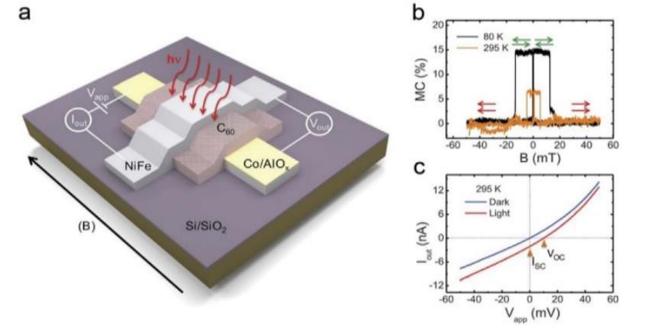
图4 (a) C60基分子自旋光伏器件示意图; (b) 暗场条件下的磁电流(10 mV偏压); (c) 室温下有/无白光辐照(7.5 mW/cm2)下的电流-电压曲线[45]Fig.4 (a) Schematic representation of the C60-based molecular spin-photovoltaic device. (b) Magnetocurrent at a bias of 10 mV in dark conditions. (c) Current-voltage curves with and without white-light irradiation (7.5 mW/cm2) at room temperature |
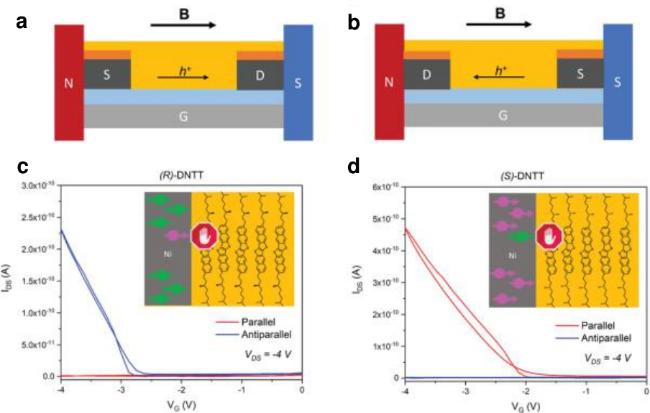
图5 (a)平行和(b)反平行磁场B条件下的铁磁电极的底栅底部接触(BGBC)OFET器件结构;c)平行(红色)和反平行(蓝色)磁场中(R)-DNPTT和(d)(S)-DTNTT在饱和状态(Vd = -4 V)下的迁移曲线[47]Fig.5 Geometry of a BGBC (bottom-gate bottom-contact) OFET device with ferromagnetic electrodes (a) in a parallel and (b) in an antiparallel magnetic field (B). (c) Transfer curves in saturation regime (Vd = -4 V) of (R)-DNTT and (d) (S)-DNTT in a parallel (red) and antiparallel (blue) magnetic field |
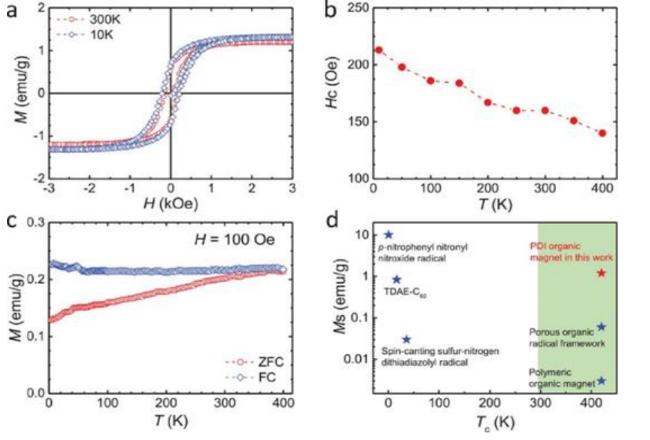
图9 PDI在(a)10和300 K温度下PDI粉末的M-H磁滞回线;(b)矫顽磁场的温度依赖性;(c)外加磁场下随温度变化的磁化曲线;(d)不同温度下纯有机磁体的饱和磁化性质[80]Fig.9 Magnetic properties of PDI powder. (a) M-H hysteresis loops taken at 10 and 300 K. (b) Temperature dependence of the coercive field. (c) Magnetization measured at an applied magnetic field of 100 Oe at different temperatures. (d) Saturated magnetization versus Tc of the purely organic magnets |
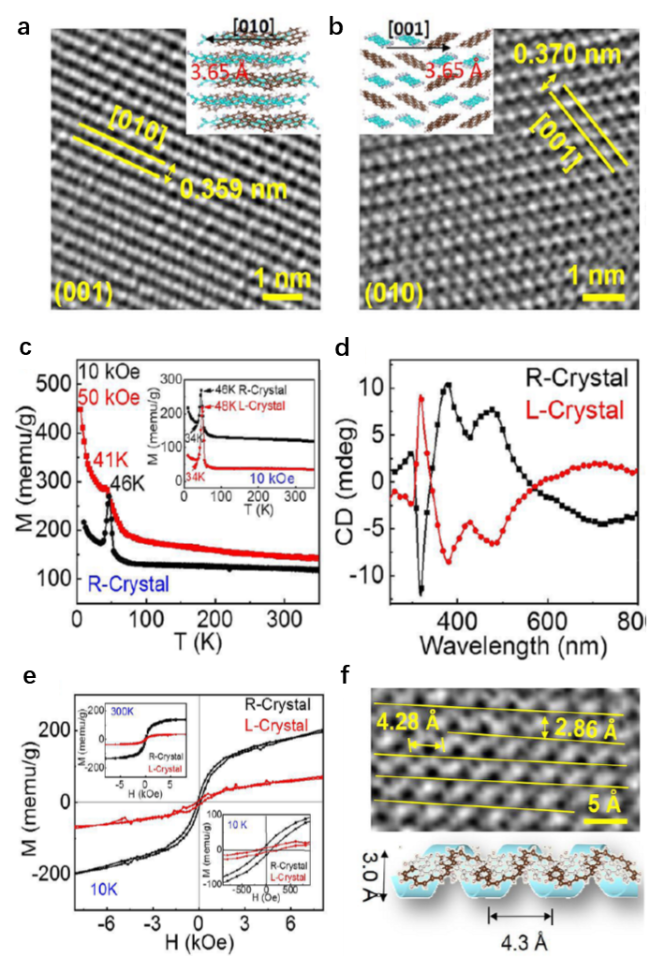
图10 (a, b) 高分辨电镜和单晶衍射; (c) 不同外加磁场下磁化强度的温度依赖性曲线; (d) 圆二色性; (e)10 K温度下磁滞曲线和(f)共晶螺旋分子排布的高分辨电镜[84]Fig.10 (a, b) HRTEM of Bper-FTCNQ crystals and single-crystal X-ray diffraction; (c) temperature dependence of magnetization with different applied magnetic fields; (d) opposite circular dichroism signals and (e) M-H loops of R-Crystal and L-Crystal at 10 K; (f) spiral molecular arrangement of HRTEM inside the cocrystal |
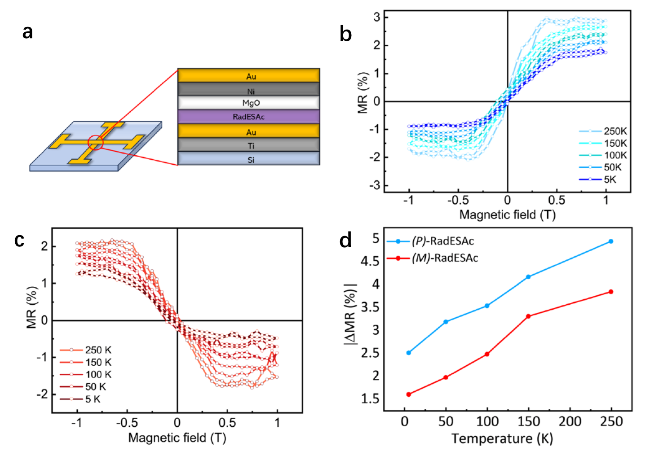
图11 (a) 磁阻器件的结构示意图; (b, c) (P)-RadESAc@Au和(M)-RadESAc@Au单分子层的磁阻百分比;(d) 两种对映体的磁阻差异值温度依赖关系[97]Fig.11 (a) Scheme of the magnetoresistance device with magnification on the cross junction. Magnetoresistance percentage of (b) (P)-RadESAc@Au and of (c) (M)-RadESAc@Au monolayers. (d) |ΔMR (%)| values as a function of the temperature for both the enantiomers |
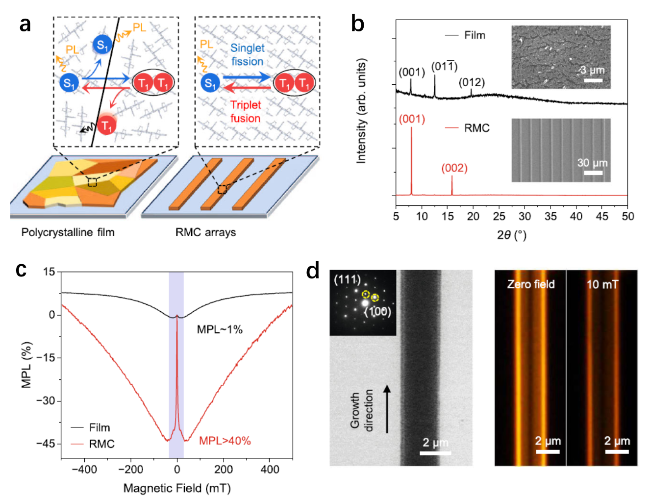
图12 红荧烯的巨磁阻发光性质(MPL): (a) 红荧烯薄膜和微晶的自旋反转; (b) 红荧烯薄膜的X射线衍射和(c) MPL;(d) 单个微晶的透射电子显微镜和光学成像[102]Fig.12 Observation of giant MPL in RMCs. (a) Illustration for the spin conversion and (b) X-ray diffraction patterns and (c) typical MPL(B) curves of rubrene film. (d) Transmission electron microscopy image and optical images of a single RMC |
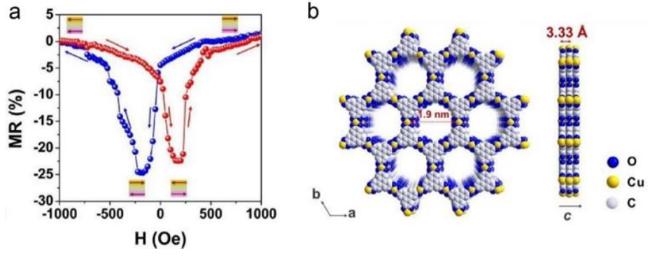
图14 (a) LSMO/Cu3(HHTP)2/Co 有机自旋阀在10 K下的MR循环;(b) Cu3(HHTP)2的俯视图和侧视图[124]Fig.14 (a) The MR loop for the LSMO/Cu3(HHTP)2 (100 nm)/Co organic spin valves at 10 K; (b) the top and side view of Cu3(HHTP)2 (proposed space filling drawings in slipped-parallel stacking mode, Hydrogen atoms are omitted for clarity) |
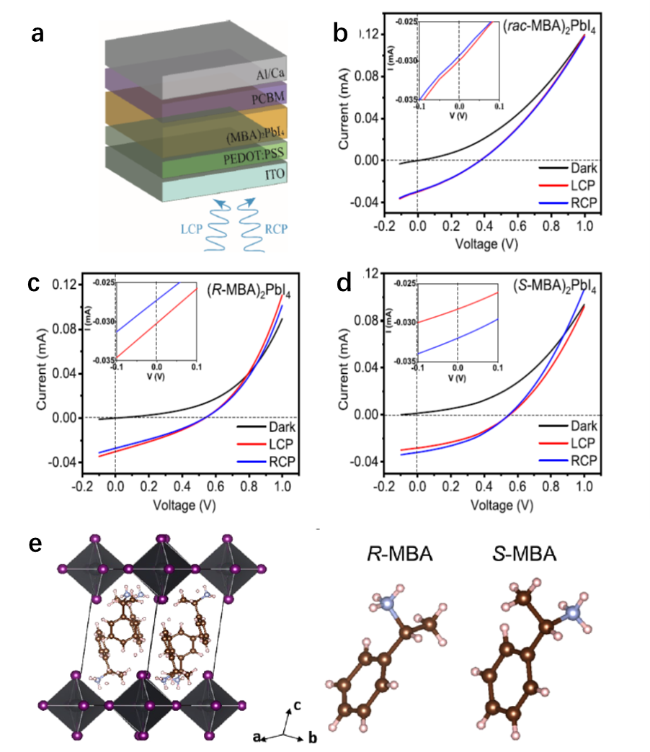
图16 (a) 自旋光伏器件示意图;(b) (rac-MBA)2PbI4, (c) (R-MBA)2PbI4和(d) 7 K条件下(S-MBA)2PbI4的I-V响应;(e) 手性2D杂化钙钛矿(R/S-MBA)2PbI4的晶体结构[147]Fig.16 (a) Schematic view of the spin photovoltaic device, the I-V response of the photovoltaic devices based on (b) (rac-MBA)2PbI4, (c) (R-MBA)2PbI4, and (d) (S-MBA)2PbI4 measured at 7 K. (e) Crystalline structure of (R/S-MBA)2PbI4[147] |
| [1] |
|
| [2] |
|
| [3] |
|
| [4] |
|
| [5] |
|
| [6] |
|
| [7] |
|
| [8] |
|
| [9] |
|
| [10] |
|
| [11] |
|
| [12] |
|
| [13] |
|
| [14] |
|
| [15] |
|
| [16] |
|
| [17] |
|
| [18] |
|
| [19] |
|
| [20] |
|
| [21] |
|
| [22] |
|
| [23] |
|
| [24] |
|
| [25] |
|
| [26] |
|
| [27] |
|
| [28] |
|
| [29] |
|
| [30] |
|
| [31] |
|
| [32] |
|
| [33] |
|
| [34] |
|
| [35] |
|
| [36] |
|
| [37] |
|
| [38] |
|
| [39] |
|
| [40] |
|
| [41] |
|
| [42] |
|
| [43] |
|
| [44] |
|
| [45] |
|
| [46] |
|
| [47] |
|
| [48] |
|
| [49] |
|
| [50] |
|
| [51] |
|
| [52] |
|
| [53] |
|
| [54] |
|
| [55] |
|
| [56] |
|
| [57] |
|
| [58] |
|
| [59] |
|
| [60] |
|
| [61] |
|
| [62] |
|
| [63] |
|
| [64] |
|
| [65] |
|
| [66] |
|
| [67] |
|
| [68] |
|
| [69] |
|
| [70] |
|
| [71] |
|
| [72] |
|
| [73] |
|
| [74] |
|
| [75] |
|
| [76] |
|
| [77] |
|
| [78] |
|
| [79] |
|
| [80] |
|
| [81] |
|
| [82] |
|
| [83] |
|
| [84] |
|
| [85] |
|
| [86] |
|
| [87] |
|
| [88] |
|
| [89] |
|
| [90] |
|
| [91] |
|
| [92] |
|
| [93] |
|
| [94] |
|
| [95] |
|
| [96] |
|
| [97] |
|
| [98] |
|
| [99] |
|
| [100] |
|
| [101] |
|
| [102] |
|
| [103] |
|
| [104] |
|
| [105] |
|
| [106] |
|
| [107] |
|
| [108] |
|
| [109] |
|
| [110] |
|
| [111] |
|
| [112] |
|
| [113] |
|
| [114] |
|
| [115] |
|
| [116] |
|
| [117] |
|
| [118] |
|
| [119] |
|
| [120] |
|
| [121] |
|
| [122] |
|
| [123] |
|
| [124] |
|
| [125] |
|
| [126] |
|
| [127] |
|
| [128] |
|
| [129] |
|
| [130] |
|
| [131] |
|
| [132] |
|
| [133] |
|
| [134] |
|
| [135] |
|
| [136] |
|
| [137] |
|
| [138] |
|
| [139] |
|
| [140] |
|
| [141] |
|
| [142] |
|
| [143] |
|
| [144] |
|
| [145] |
|
| [146] |
|
| [147] |
|
| [148] |
|
| [149] |
|
/
| 〈 |
|
〉 |